Applying argan oil to your face: the right way
Properly applying argan oil to the face makes all the difference. It's not the quantity that matters, but the technique: the right dosage, the right time of day, and the right place in your routine. Nicknamed "liquid gold" from Morocco, this plant-based active ingredient concentrates remarkable richness – essential fatty acids, tocopherols, phytosterols – in just a few drops, provided you know how to use it. At Nopal Life, we've chosen natural ingredients from day one, focusing on our signature ingredient, prickly pear seed oil (Opuntia ficus-indica), for which argan is the ideal companion.
This guide gets straight to the point: how many drops, when, in what order, and for what skin type. You'll also find a detailed composition of argan, morning and evening protocols, mistakes to avoid, and answers to the most frequently asked questions. By the end of your reading, the technique will hold no secrets for you.
The essentials of the technique at a glance
Before going into detail, here's a condensed user guide for applying this active ingredient to your face flawlessly.
| The question | Key takeaway |
|---|---|
| How much? | 2 to 3 drops for the entire face and neck |
| What technique? | Warm between palms, then press—never rub |
| When? | In the morning under cream, in the evening as the very last step |
| Before or after SPF? | Always before sunscreen, never on top of it |
| For whom? | Primarily dry and mature skin; combination and oily skin in micro-doses |
| How long until results? | Comfort from the 1st week; visible radiance between 4 and 8 weeks |
The right technique, step-by-step
Applying argan is not just about putting it on your fingers. A precise technique conditions absorption, a satin finish, and felt comfort. Here's the method we teach at Nopal Life.
- Measure just right — Place 2 to 3 drops in the palm of your hand. For the eye contour or a targeted touch-up, a single drop is enough.
- Warm it up — Gently rub your palms together for a few seconds. When warmed, the texture becomes more fluid and spreads better.
- Press, don't rub — Place your palms on your face and gently press, from the center outwards. This pressing motion avoids stretching the skin and promotes even penetration.
- Finish with dry areas — Dab the remainder on your cheekbones, around your lips, and along your jawline, which often need it most.
- Be patient — Allow 2 to 3 minutes before the next step (sunscreen in the morning, nothing in the evening).
On slightly damp skin — just after a mist or toner — application is even more comfortable: the thin film of water helps the active ingredient spread and seal in surface hydration.
Understanding Argan: Origin and Composition
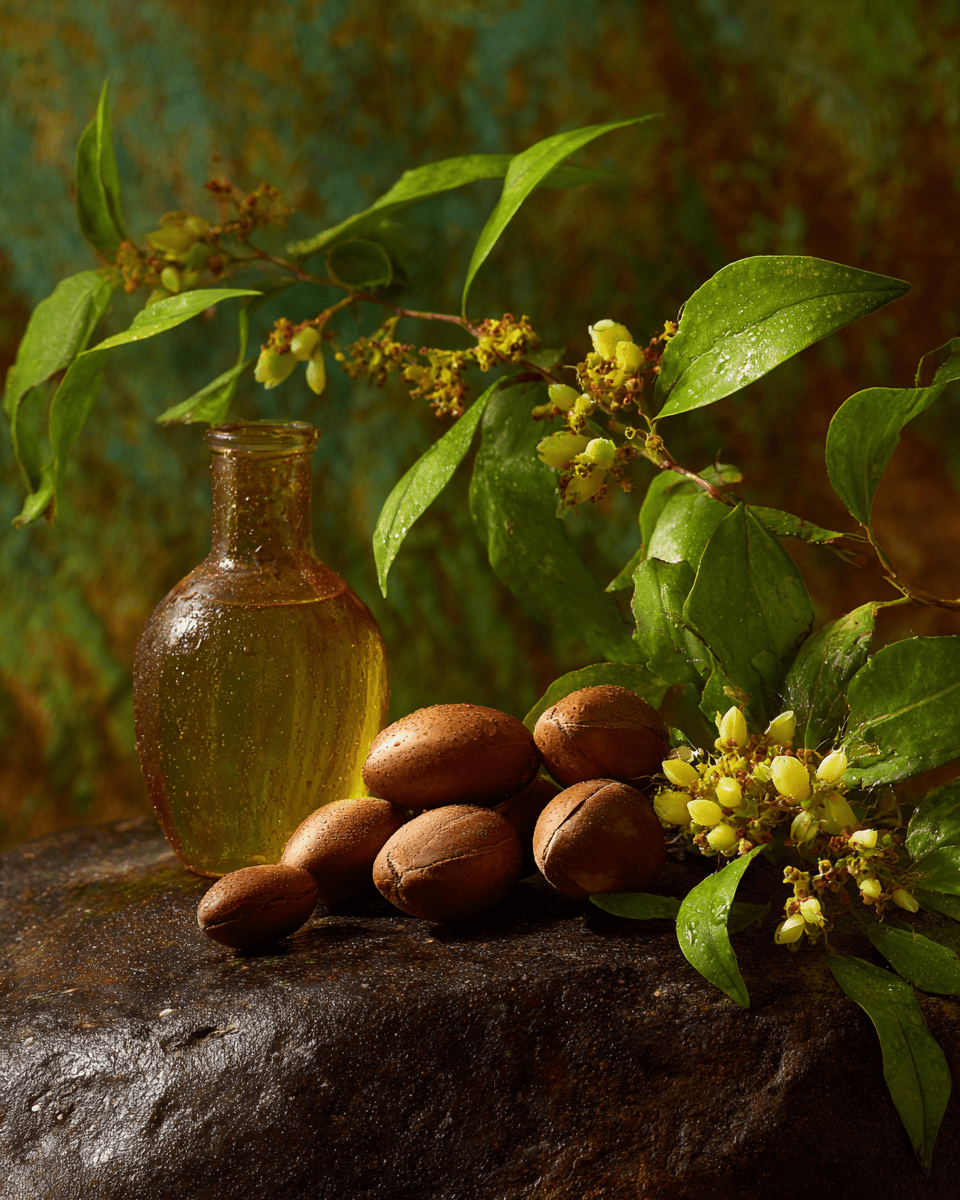
Argan oil is extracted from the nuts of the argan tree (Argania spinosa L.), a tree endemic to the Souss-Massa region of Morocco, a UNESCO World Heritage site. Over 80 million years old, this rare species grows only in this geographical corridor, subjected to intense sunlight and structural drought. These extreme conditions have resulted in a seed with exceptional nutritional concentration, which Berber women have been exploiting for centuries.
For cosmetics, extraction is done by first cold pressing from unroasted kernels. This process preserves all compounds, without solvent residue or thermal alteration. Women's cooperatives in Morocco play a central role in this artisanal production, transmitting ancient know-how while ensuring a positive economic and social impact.
Its signature is due to four families of molecules:
| Component | Content | What it contributes to appearance |
|---|---|---|
| Oleic acid (omega-9) | 42 to 49% | Suppleness and comfort; helps diffuse active ingredients on the surface |
| Linoleic acid (omega-6) | 29 to 36% | Comfort of the surface film; helps mattify the appearance of shiny areas |
| Tocopherols (vitamin E) | 600 to 900 mg/kg | Antioxidants; help preserve radiance against external aggressions |
| Phytosterols | ≈ 220 mg/100 g | Comfortable appearance; soothing sensation on sensitive skin |
In addition, it contains squalene and polyphenols, secondary antioxidants that complete the profile. Specifically, argan helps maintain the comfort of the skin barrier by providing surface lipids, supports hydration by helping to limit evaporation, and contributes to reducing dullness. Its dry texture upon application – lighter than coconut oil – and its non-comedogenic rating (0) make it compatible with a wide range of skin profiles, without leaving a film.
For which skin type, and at what dose
Versatility is one of the great strengths of this active ingredient: it adapts to almost all profiles, provided the quantity and application time are adjusted.
Dry to very dry skin
This is argan's preferred domain. Its richness in oleic acid quickly penetrates the surface layers and provides immediate comfort. Here, morning and evening application, in pure or formulated form, is fully justified. Our dedicated guide to the benefits of argan for dry skin explores this profile in depth.
Combination skin
Shiny T-zone, more delicate cheeks: this is one of the most common profiles in France. Linoleic acid helps mattify the appearance of the central zone by providing missing lipids without excessive occlusion. The golden rule: a maximum of two to three drops, as a night treatment or mixed with day cream. Avoid a thick layer on the T-zone. Our protocol for dull and combination skin guides you step-by-step.
Oily skin prone to imperfections
Counterintuitively, this profile can also benefit from it, thanks to its non-comedogenic index and its linoleic acid content—often deficient in skin prone to imperfections. Prioritize microdosing: 1 to 2 drops mixed with your usual cream, as a night treatment. If in doubt, start two to three times a week.
Mature or sun-exposed skin
This is where this active ingredient unleashes its full potential for visible radiance and firmness. Its tocopherols help preserve the skin's luminosity against exposure and pollution; its fatty acids compensate for surface lipids that become scarce with age. Daily application, morning and evening, in a complete routine, helps maintain apparent radiance and firmness.
Still unsure which profile you belong to? The Nopal Life Skin Intelligence™ diagnostic analyzes your epidermis in minutes and recommends a personalized routine with the most suitable active ingredients.
Apply a few drops — two for the face, three if you extend to the neck. Using too much argan oil won't make it penetrate better: the excess remains on the surface and stains the pillow.
An organic, virgin, and undessicated argan oil retains its characteristic scent. This is a sign that it has not been refined, meaning it retains the tocopherols to which its benefits against skin aging are attributed.
Where to place argan in your routine
The order of application, the texture of associated products, and the time of day determine the actual result. Here's the recommended protocol at Nopal Life.
The texture rule
In natural cosmetics, you always apply from the lightest to the richest texture: aqueous serum → gel → emulsion → oil. Each layer then diffuses without being blocked by a preceding lipid film. Anhydrous by nature, argan therefore comes last, to seal in the hydration provided earlier.
Morning — radiance and protection
- Gentle cleansing — Thermal water or gel adapted to your profile.
- Toner or floral water — To prepare the skin for active ingredients.
- Hydrating serum or booster — Optional, depending on needs.
- Formulated Argan — 2 to 3 drops of our Glow Comfort Multi-Use Facial Oil, warmed then pressed onto the entire face and eye contour.
- SPF day cream — Always last in the morning, to protect the entire routine.
Evening — nourishment and comfort
- Double cleansing — Oil cleanser then gentle cleanser if wearing makeup.
- Gentle exfoliant — 1 to 2 times a week, to support nighttime renewal.
- Active serum or concentrate — Retinol, niacinamide, or vitamin C according to your protocol.
- Nourishing night cream — Our Anti-Aging Firming Wrinkle Night Cream combines a synergy of smoothing active ingredients for the night.
- Argan for light occlusion — 1 to 2 drops on the driest areas (eye contour, cheekbones, lips) to seal it in for the night.
Frequency and adjustments
Dry to mature skin: morning and evening. Combination skin: in the evening, or mixed with morning cream. Oily skin: 3 to 4 evenings a week, in microdoses. Listen to your skin: if it shines more than usual upon waking, reduce the quantity rather than the frequency.
Always apply last in the skincare phase, before sunscreen in the morning. Using argan oil under a serum would be like applying a film that the aqueous active ingredient would not penetrate.
For very dry skin, a few drops of argan oil mixed with cream in the palm of the hand create an intermediate texture that is easier to spread than layering.
Active ingredients that enhance argan
Alone, argan is already remarkable; combined with complementary natural active ingredients, it becomes exceptional. This is the entire formulation philosophy of Nopal Life: to create synergies that highlight every benefit.
Prickly pear seed oil (Opuntia ficus-indica)
Our signature active ingredient deserves special mention. Prickly pear seed oil is one of the rarest in the world: it takes almost 3 tons of fruit, from which the seeds are manually extracted, to obtain one liter. Its composition? A record concentration of linoleic acid (62 to 65%), tocopherols in greater quantity than argan, and a high content of beta-sitosterol with a soothing sensation. The duo is complementary: argan provides nutritive depth (omega-9), prickly pear provides lightness (dominant omega-6) and a maximal antioxidant profile.
Natural Vitamin E
Both oils are naturally rich in tocopherols. This fat-soluble vitamin E, known for its antioxidant properties, helps preserve radiance against external aggressions, maintain the apparent elasticity of tissues, and support the comfort of the hydrolipidic film. In our formulas, we ensure these natural tocopherols are preserved.
Plant phytosterols
Present in argan (beta-sitosterol, schottenol) as well as prickly pear, these plant lipid molecules support the comfortable appearance of the epidermis, help maintain hydration levels, and provide a soothing sensation on reactive tissues, especially when the surface barrier is compromised.
Plant squalene
Argan naturally contains squalene, a light emollient also found in our own skin film. It helps maintain the suppleness and apparent fineness of the skin texture, and signs this "silky skin" sensation right after application.
Aqueous active ingredients
As an oily phase, argan needs aqueous active ingredients to form a complete treatment. It pairs with hyaluronic acid (hydration vector), niacinamide (more even complexion), balancing plant extracts (comfort against oxidative stress), and peptides (firm and plump appearance). This multi-active approach drives our natural routines.
The 7 mistakes to avoid
Even an exceptional ingredient becomes counterproductive if used incorrectly. Here are the most common missteps identified by our formulation experts.
1. Applying it to dry skin without a hydrating layer
As an anhydrous substance, argan contains no water: applied alone to dehydrated skin, it can only seal in existing hydration, never provide it. The correct practice: always a hydrating layer (mist, hyaluronic serum, light cream) beforehand, even a few seconds earlier.
2. Using too much
Two to three drops are enough for the entire face and neck. Beyond that, the film becomes occlusive, can hinder the absorption of products applied on top, and leave an unsightly shine. Less is often more: start with one drop and adjust.
3. Applying it over SPF
Like all vegetable oils, argan can interfere with the photostability of UV filters. Therefore, it should be applied before sunscreen, never after. For an all-in-one morning routine, apply our Glow Comfort Oil then layer SPF last.
4. Confusing food grade with cosmetic grade
Food-grade argan is roasted: its kernels are grilled before extraction, which gives it a nutty taste and alters some of the compounds. The cosmetic version, on the other hand, is cold-pressed from unroasted kernels. Never substitute cooking oil for your facial care.
5. Storing it in light or heat
Polyunsaturated fatty acids are sensitive to oxidation. Exposed to direct light, heat, or left open, the active ingredient can become rancid and irritating. Store the bottle in a cool, dark place, and check the expiration date.
6. Expecting immediate results
Surface comfort is quickly felt, but lasting effects build up over several weeks. Be consistent: first signs of comfort from the first week, radiance and complexion evenness generally between 4 and 8 weeks.
7. Not adjusting the dose seasonally
In winter, dry skin sometimes needs an extra drop to compensate for indoor heating. In summer, in a humid climate, one less drop is enough. It's a living treatment that needs to be adjusted over the months.
FAQ — your most frequent questions
Can it be used on the eye contour?
Yes, with caution. The skin there is the thinnest on the face—two to three times thinner than on the cheeks. A micro-quantity (less than one drop, picked up with the tip of the ring finger) is gently dabbed on the orbital bone, without touching the mobile eyelid.
What's the difference with prickly pear seed oil?
Two precious vegetable oils, but with distinct profiles. Argan is more versatile, with a balanced omega-9/omega-6 ratio and a slightly denser texture. Prickly pear is rarer, lighter, and more concentrated in linoleic acid and tocopherols. We formulate them together to create synergies that neither can achieve alone.
Does it leave a greasy or shiny finish?
When applied correctly (2 to 3 warmed and pressed drops), a quality active ingredient leaves a natural satin, non-greasy finish. If excessive shine appears, reduce the amount or wait 3 to 5 minutes before the next step. The freshness of the product also matters: an oxidized oil penetrates less effectively.
Can it be used on hair?
Absolutely. Argan is one of the most recognized hair active ingredients, especially for dry, damaged, or curly hair. As a pre-shampoo treatment, a finishing serum on the ends, or an overnight mask, it helps revive the hair fiber's shine and suppleness. Our natural hair guides delve deeper into this topic.
What is the shelf life?
When stored properly (away from light and heat), a quality bottle generally lasts 12 to 18 months after opening. Beyond that, fatty acids oxidize, and a slight rancid odor may appear. Refer to the best-before date on the container.
Nopal Life formulas with argan
For us, argan is not just another ingredient: it's a pillar of our formulations, always combined with our signature active ingredients — prickly pear, natural vitamin C, botanical hyaluronic acid.
Glow Confort Multi-Purpose Facial Oil
Our bestseller. A concentrate of argan and prickly pear, enriched with natural vitamin E. Dry, fast-absorbing texture, non-greasy satin finish. Suitable for all skin types, especially dry, combination, and dull skin. Morning and/or evening, 2 to 3 drops on the entire face. Discover Glow Confort Oil →
Anti-Aging Firming Wrinkle Night Cream
A rich water-in-oil emulsion, with argan, prickly pear, and peptides. Designed for mature or exposed skin, it works with the skin overnight and can contribute to a firmer, smoother appearance upon waking. As the last step in your evening routine. Discover the Anti-Aging Night Cream →
The entire range
From face care to body care, including hair care, argan is available in several formulas adapted to every need. Browse our entire catalog →
In summary: a simple gesture, lasting results
Applying argan to the face involves a few key steps: two to three drops, warmed and then pressed, in the morning under SPF and in the evening as the last step, adapted to your skin type and the season. When done correctly, this gesture helps nourish the surface, maintain the comfort of the skin barrier, and revive radiance, with regularity and consistency.
At Nopal Life, we believe that natural beauty is built over time, with active ingredients that respect your skin and the planet, selected for their quality and ethical traceability. The liquid gold of Morocco, combined with our signature prickly pear, embodies this vision of uncompromising care.
Skin Intelligence™ — 2-minute analysis, personalized routine, adapted dosage.
To learn more, explore our complementary argan series guides: the benefits of argan for your skin, and the argan routine for dull and combination skin.
RECOMMENDED TREATMENT
Pure prickly pear seed oil
Natural formula · Origin Algeria
DISCOVER THIS TREATMENT →
Ingredient Reference
Argan oil
Radiance, nourishment & antioxidant protection — Morocco's liquid gold.
Discover the sheet →Read more
Information provided for cosmetic and educational purposes; it does not constitute medical advice.


Go further than this article
Get our skincare guides by email — and start with your free skin diagnostic: 2 minutes, advice tailored to your skin. We ship to the US, UK, Canada, Australia and 27 European countries; somewhere else? Sign up and you will be the first to know when we deliver to your country.
By signing up, you agree to our privacy policy. Unsubscribe in one click.