Hyaluronic acid and prickly pear oil: the order
This is probably the most frequently asked question when it comes to layering: can you combine a serum with hyaluronic acid and prickly pear seed oil on your face? Yes—and not just "safely": these two skincare products enhance each other, provided you follow a specific order and measured quantities. Here's what each truly provides, how to layer them minute by minute, and how to adjust the dosage according to your skin type.
The Essentials in Thirty Seconds
- No incompatibility: one is hydrophilic, the other lipophilic; they occupy two different places in the routine.
- Order: serum first, then oil. The reverse hinders water diffusion into the skin.
- Useful window: 30 to 45 seconds. The oil is applied while the skin is still fresh; after 3 to 4 minutes, the window closes.
- Reference doses: 3 to 4 drops of hydrating serum, then 2 to 3 drops of prickly pear seed oil in the evening, 1 to 2 in the morning.
- Morning and evening are possible; in the morning, sunscreen remains the last step in the routine.
Two Active Ingredients, Two Different Jobs
Most mistakes come from a misunderstanding: people think all skincare products "hydrate." In reality, you need two distinct actions—providing water, then preventing it from escaping. Hyaluronic acid does the first. Prickly pear seed oil does the second. Neither can do the other's job.
Hyaluronic acid is a humectant: it attracts and retains water—from the formula, from rinsing, some ambient humidity—in the superficial layers. The complexion appears fresher, the skin plumper, and dehydration lines less noticeable. But without anything on top of it, this water evaporates, especially in dry air.
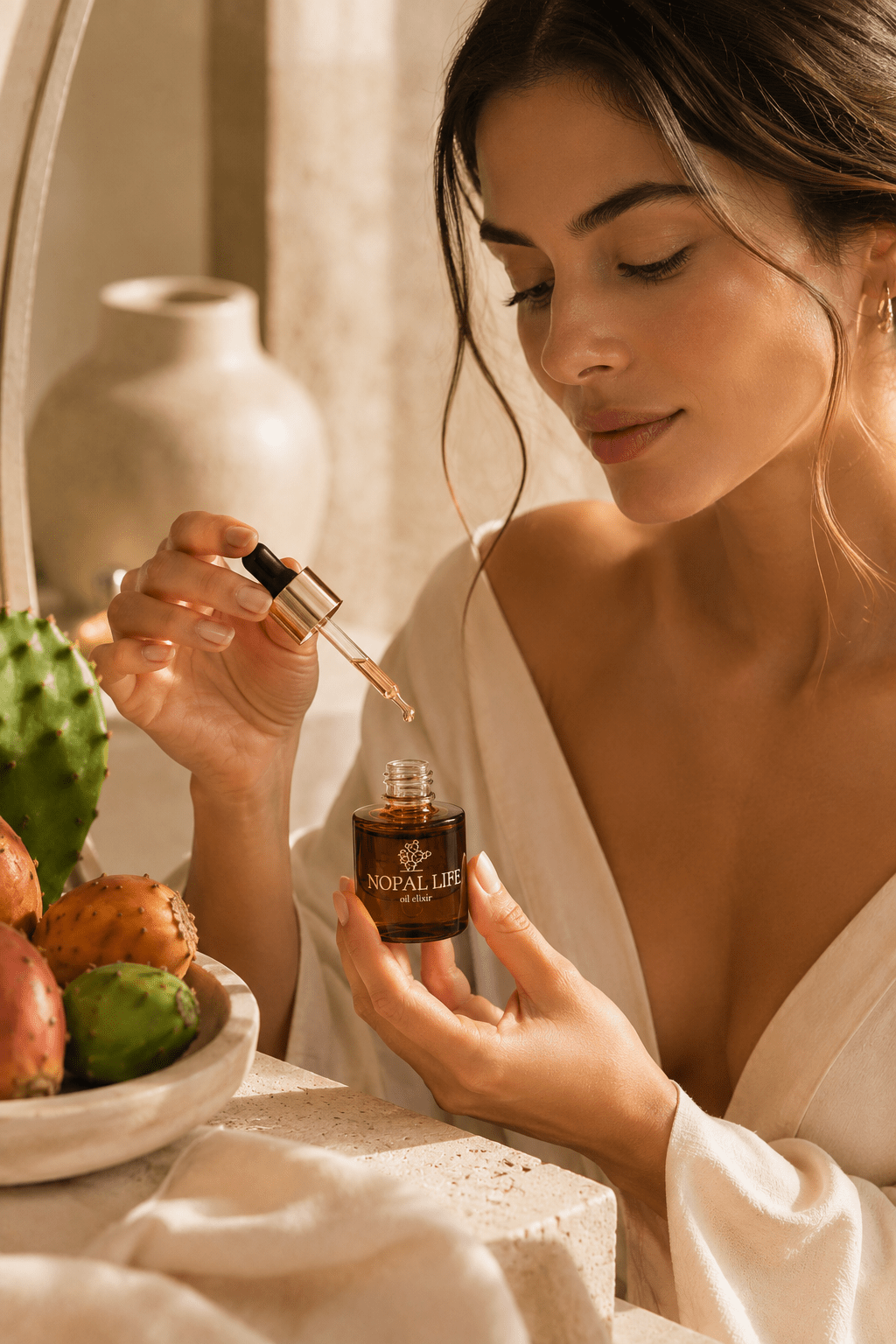
Prickly pear seed oil, extracted from the seeds of the prickly pear fruit, is emollient and semi-occlusive: it softens the skin and slows down water evaporation. Cold-pressed, without heating or solvents, it retains its unsaponifiable fraction. Its texture is that of a dry oil: it absorbs quickly, without the greasy film of heavier vegetable oils.
| Criterion | Hyaluronic Acid Serum | Prickly Pear Seed Oil |
|---|---|---|
| INCI Name | Sodium Hyaluronate | Opuntia Ficus-Indica Seed Oil |
| Function | Attracts and retains water | Softens and limits evaporation |
| Texture | Fluid, non-filming | Dry, satin finish |
| Dose per application | 3 to 4 drops | 1 to 3 drops |
| Place in routine | After cleansing, on damp skin | After serum, before or after cream |
| What it doesn't do alone | Retain captured water | Provide water |
No competition is possible: neither the same phase, nor the same place, nor the same function. Combining them applies the humectant + occlusive principle, the very one on which all moisturizing creams are based—an emulsion of both in a single bottle.
What Prickly Pear Seed Oil Actually Contains
Many texts only mention "rich in vitamin E." Here is the lipid profile of prickly pear seed oil as documented in the literature on Opuntia ficus-indica.
| Constituent | Indicative Proportion | Practical Consequence |
|---|---|---|
| Linoleic Acid (omega-6) | 55 to 65% of fatty acids | Light texture, good tolerance, including for combination skin |
| Oleic Acid (omega-9) | 15 to 22% | Softening and gliding feel upon application |
| Palmitic Acid | 10 to 14% | Stability of the surface film |
| Tocopherols (vitamin E) | High content, gamma dominant | Natural antioxidant that protects oil from oxidation |
| Sterols | Notable unsaponifiable fraction | Marker of an unrefined oil |
Two lessons. The dominance of linoleic acid explains the "dry oil" behavior: these oils are more fluid and less comedogenic than those very rich in oleic acid. And the high tocopherol content has a very concrete effect: the bottle keeps better than average, provided it is protected from light. These proportions vary depending on the origin of the fruits and the year—this is normal for an agricultural product, and this is why a bio, traceable, and cold-pressed oil is better than an anonymous oil.
Not All Hyaluronic Acids Are Created Equal
On the label, the INCI is identical. In the bottle, the molecular weight changes everything.
| Fraction | Molecular Weight | Behavior |
|---|---|---|
| High | > 1,000 kDa | Stays on the surface, forms a flexible film, immediate plumping effect |
| Intermediate | 100 to 1,000 kDa | Compromise between comfort / light sensation |
| Low (hydrolyzed) | < 50 kDa, often ~20 kDa | Penetrates deeper into the stratum corneum |
Confocal Raman spectroscopy studies on human skin have shown that low molecular weight fractions penetrate the stratum corneum more than large fractions, which remain essentially on the surface (Essendoubi et al., Skin Research and Technology, 2016). Hence the interest in formulas combining several molecular weights. Consequence for layering: the more film-forming your serum is, the less fatty matter you need to apply on top; conversely, a very light serum greatly benefits from being sealed.
The Protocol, Second by Second
The key point is not just the order, it's the timing. The fatty substance should be applied 30 to 45 seconds after the serum, while the skin is still fresh, not ten minutes later.
| Time (after serum) | Action | Detail |
|---|---|---|
| Before | Cleanse | Rinse with lukewarm water, pat dry without completely drying: skin remains damp to the touch |
| T0 | Serum | 3 to 4 drops applied with gentle presses, never rubbing |
| + 0 to 30 s | Allow to set | The surface remains supple, not yet dry: this is the useful window |
| + 30 to 45 s | Oil | 2 to 3 drops warmed between palms, from center outwards |
| + 60 s | Eye contour | 1 drop shared between ring fingers, dabbed on the orbital bone |
| + 3 to 4 min | Window closed | Beyond this, oil is applied to skin that is already dry: the benefit of layering decreases |
| In the morning | Sunscreen | Wait 2 to 3 minutes after oil, then apply SPF last |
Three details make a difference. Damp skin: a humectant applied to a perfectly dry surface has less water to capture. Pressing rather than rubbing: the product spreads better and you use less. Direction of application: from the center towards the temples and jawline, which allows covering the entire face with two drops rather than four.
How Many Drops, for Which Skin Type
| Skin Type | Serum | Oil | Face Cream | Frequency |
|---|---|---|---|---|
| Dry skin | 4 drops | 3 in the evening, 2 in the morning | Rich moisturizer in the evening | Morning and evening |
| Normal | 3 drops | 2 in the evening, 1 in the morning | Optional | Daily |
| Combination | 3 drops | 2 in the evening, dry areas in the morning | Light texture on the T-zone | Zoned dosage |
| Oily dehydrated | 3 to 4 drops | 1 in the evening only | Gel rather than cream | Oil 4 to 5 evenings / week |
| Mature skin | 4 drops | 3 in the evening, 2 in the morning | Morning and evening | Daily |
| Sensitive | 3 drops, fragrance-free | 1 in the evening for 7 days, then 2 | Minimalist formula | Progressive |
Two principles govern this table. The amount of serum changes little, the amount of oil changes a lot: all skin types want water; not all want oil. And you also adjust according to the season—often one more drop in January than in July, without the skin type having changed. For combination skin, apply serum everywhere, then reserve oil for the cheeks, temples, and jawline, avoiding the nose and forehead.
Morning or Evening: Both, with Different Dosages
In the morning, the goal is to restore plumpness and create an even base. One to two drops are enough to unify the skin texture and give that satin finish that catches the light. Too generous, and makeup won't last—this is the primary reason some people believe "oils don't work for them" when they're actually applying three times too much. SPF is applied last, without exception: no other product replaces it for preserving radiance and an even complexion.
In the evening, you can be more generous: 3 drops on dry skin, on a still-fresh serum, with a cream on top if the room air is very dry. Upon waking, the skin appears more supple and luminous. There's no need to alternate every other day: the only useful adjustment is the quantity, based on the comfort felt upon waking.
Where to Place Cream and Other Products
Many routines fail not on the duo itself, but on what is put around it. The complete order, from thinnest to richest:
- Gentle cleanser, morning and evening, with lukewarm water.
- Lotion or mist (optional), useful for keeping the surface damp.
- Water-based serum and other water-soluble active ingredients.
- Eye cream, before the richest textures.
- Face cream if you use one.
- Oil, at the end of the evening routine.
- Sunscreen, in the morning only, always last.
Applying oil before cream rather than after is not a mistake: it's a preference. What truly matters is that the water-based phase always comes first and SPF always comes last in the morning.
| Active | Where to place it | Precaution |
|---|---|---|
| Vitamin C | In the morning, before the hydrating serum | Allow 1 minute between the two |
| Niacinamide | Before or with the serum | No incompatibility with fatty substances |
| Retinal | In the evening, between serum and oil | Start 2 evenings a week |
| AHA / BHA | In the evening, alternating | Do not combine with retinal on the same evening |
The layer applied on top does not cancel these active ingredients: it comes after absorption and plays its usual role of comfort—which is precisely what you look for when introducing a demanding active ingredient.
Five Mistakes That Ruin This Layering
Reversing the order. The fatty substance applied first occupies the surface and hinders water diffusion. This is the only truly rigid rule.
Applying serum to completely dry skin. A humectant needs available water; without it, it can paradoxically cause a feeling of tightness.
Waiting too long. Thirty to forty-five seconds are enough. After 3 to 4 minutes, the window closes.
Overloading. Two to three drops cover an entire face. Beyond that, the product remains on the surface and gives that sticky sensation that discourages use.
Changing three products at once. Introduce only one, for at least two weeks of use, observing results.
What You Observe, Week After Week
These observations relate to appearance and comfort and vary from person to person.
| Period | Most frequent finding | To adjust |
|---|---|---|
| Days 1 to 3 | Immediate comfort upon waking, softer surface | Nothing: note the quantity used |
| Week 1 | Less tightness at the end of the day | Remove a drop if the appearance seems heavy in the morning |
| Weeks 2 to 4 | More even skin texture, brighter complexion, less visible fine lines | Stabilize the found dosage |
| Weeks 4 to 8 | Need for touch-ups during the day significantly reduced | Adapt to the season |
If nothing changes after three weeks, the cause is rarely the combination itself: an overly stripping cleanser, very dry air, or a low-concentration serum most often explain the stagnation.
The Benefits Attributed to This Oil
Prickly pear seed oil owes its reputation as much to its rarity as to its composition. The benefits users recognize fall into three categories, all cosmetic.
Comfort. This is the most immediate: supple skin upon waking, without tightness, including for dry and mature skin which naturally lack surface lipids with age.
Radiance. This vitamin E-rich oil leaves a satin finish that catches the light and gives the complexion a more rested appearance. Around the eyes, it helps preserve the smooth appearance of a particularly delicate area.
Skin texture. With regular use, many notice a more uniform texture and visually less pronounced expression lines—an appearance effect, linked to regained comfort, and not a transformation of the skin itself.
Two honest clarifications. First, this vegetable oil is inherently vegan and is one of the simplest natural skincare products: a single ingredient, no additives. Second, it makes no claims about blemishes or established redness: this is not its domain, and medical advice remains the appropriate response in such situations. Many also use it on hair ends, a secondary use where its dry texture works wonders—but the face remains its primary application.
How to Choose Your Prickly Pear Seed Oil: Six Control Points
- A single INCI — Opuntia Ficus-Indica Seed Oil. Other oils in the list indicate a blend.
- Cold-pressed, explicitly mentioned: hot extraction degrades the unsaponifiable fraction.
- Organic certification, for cultivation traceability.
- Amber or violet glass: oils rich in omega-6 are sensitive to light.
- Dropper, essential for precise dosage.
- Color and odor: golden yellow to amber, subtle plant odor. A rancid smell indicates oxidized oil.
A useful benchmark: a dropper delivers approximately 20 drops per milliliter, or nearly 600 drops for a 30 ml bottle — between six and ten months of evening use depending on whether you count 3 or 2 drops. This should be compared with a shelf life of around twelve months after opening: very large formats are only worthwhile if you use them within this period. Store away from light, at a stable temperature, preferably in a bedroom rather than a bathroom.
Adapt this duo to your skin
This combination suits almost all skin profiles, but the quantity, frequency, and complementary care should be calibrated. Mature skin does not require the same treatment as dehydrated combination skin of a twenty-five-year-old, and the same skin does not require the same treatment in February and August.
The Nopal Life Skin Intelligence™ asks a few targeted questions in two minutes and guides you towards the appropriate actions and textures for your profile. To create the duo, the Face Serums collection and cold-pressed prickly pear seed oil offer textures designed for layering; the Hydration & Comfort collection brings together the complementary care for this ritual. You can also browse the Skin Guide to delve deeper into each ingredient.
Frequently Asked Questions
In what order should they be applied?
The aqueous serum first, then the oil, from the most fluid to the richest texture. Reversing the order significantly reduces the benefit of layering.
How long should I wait between the two steps?
About 30 to 45 seconds: enough time for the serum to spread evenly, but not enough for it to dry. After 3 to 4 minutes, the useful window is closed.
How many drops of oil?
2 to 3 in the evening for the entire face, 1 to 2 in the morning. Dehydrated oily skin should stick to 1 drop in the evening. Overloading is the most common mistake.
Do I still need a moisturizer?
Not necessarily: a cream is an emulsion already containing water and fatty substances. In winter or in a very heated home, adding it between the two steps provides extra comfort.
Can oil replace serum?
Is it suitable for the eye contour?
Yes, its light texture is suitable. Only one drop patted onto the orbital bone, never on the mobile eyelid or at the lash line.
How long does it take to see results?
Comfort is noticeable from the first few days; allow 2 to 4 weeks of regular use for skin texture and radiance.
Does the online diagnosis replace a dermatologist?
No. It is a cosmetic guidance tool. In case of persistent redness, significant itching, or established patches, seek the advice of a healthcare professional before introducing new treatments.
In summary
Combining these two ingredients means associating two distinct roles: one provides water, the other retains it and softens. The serum first, on still damp skin; the oil 30 to 45 seconds later, 2 to 3 drops in the evening and 1 to 2 in the morning; sunscreen last when it's daytime. Adjust the quantity to your skin type and the season, allow two to four weeks, and you will have the simplest and most reliable moisturizing routine available.
RECOMMENDED TREATMENT
Cold-pressed prickly pear seed oil · Organic
DISCOVER THIS TREATMENT →
PERSONALIZED ROUTINE
Nopal Life Skin Intelligence™ · 2 minutes
Start my free diagnosis →
Sources
- Ramadan M. F., Mörsel J.-T., "Oil cactus pear (Opuntia ficus-indica L.)", Food Chemistry, 2003 — fatty acid, tocopherol, and sterol composition.
- Essendoubi M., Gobinet C., Reynaud R., Angiboust J.-F., Manfait M., Piot O., "Human skin penetration of hyaluronic acid of different molecular weights as probed by Raman spectroscopy", Skin Research and Technology, 2016.
- CosIng Database of the European Commission — declared denominations and functions: Opuntia Ficus-Indica Seed Oil, Sodium Hyaluronate.
Read more
Information provided for cosmetic and educational purposes; it does not constitute medical advice.
Our anti-aging treatments