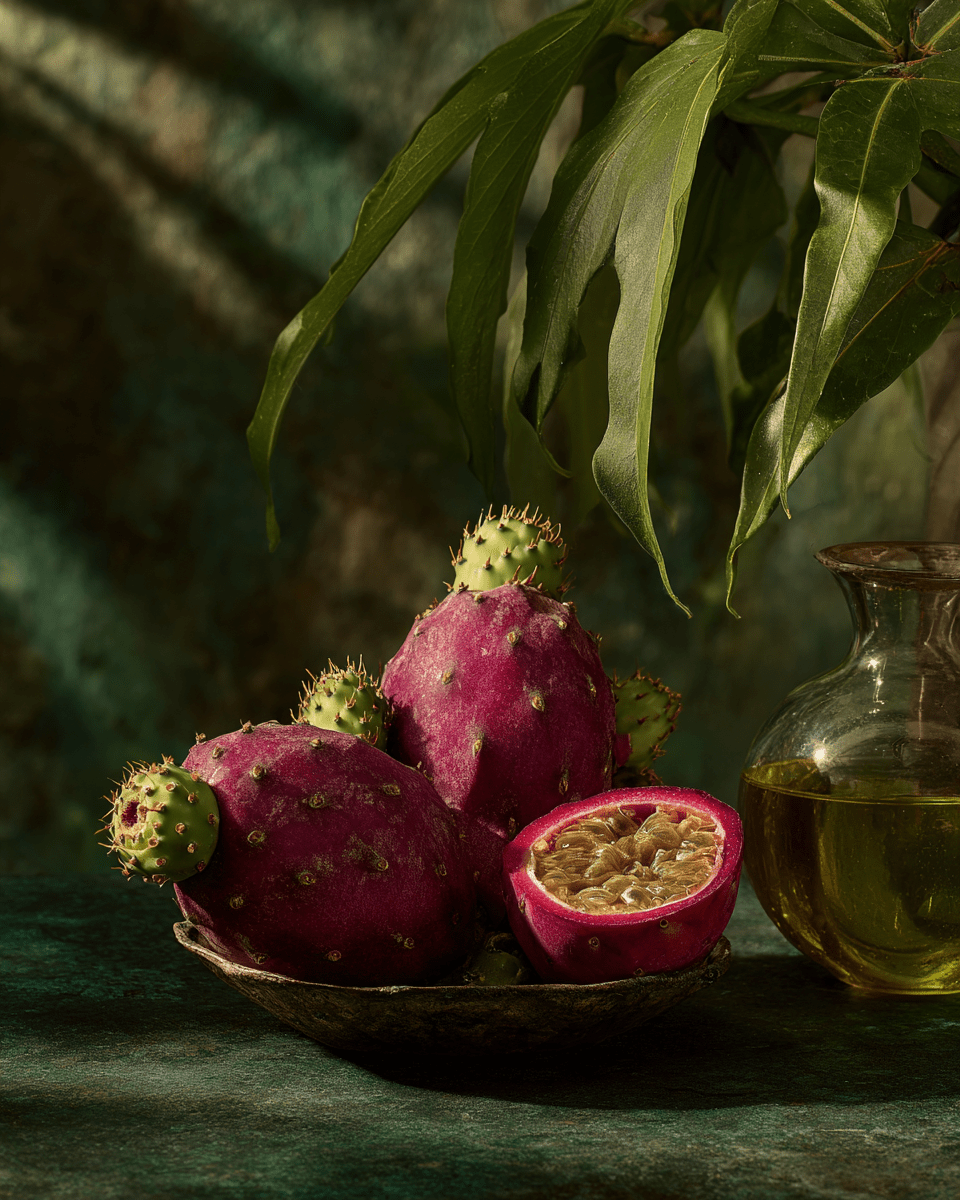
Prickly Pear Seed Oil: natural skincare benefits and routine P1
Caring for your skin begins with understanding what it's experiencing. This guide provides clear benchmarks and concrete actions, with NOPAL LIFE as the guiding principle: demanding nature, from prickly pear to your routine.
Prickly pear seed oil: botanical treasure and exceptional lipid composition
Prickly pear seed oil, cold-pressed from the seeds of Opuntia ficus-indica, is one of the most precious natural active ingredients in the cactus family. Its rarity partly explains its price: each prickly pear fruit contains only 0.1 to 0.4% of its weight in oil, which means it takes about 100 kg of prickly pears—and an entire night of manual labor—to obtain 1 liter of virgin oil. This artisanal extraction cost, mainly carried out in Morocco by Berber women's cooperatives, explains why this oil is often adulterated or diluted in the market. The lipid composition of pure prickly pear seed oil is its true trump card: it contains between 57% and 65% linoleic acid (omega-6), an essential fatty acid that the skin does not produce itself. This linoleic acid content is among the highest in the plant kingdom. This richness in omega-6 is supplemented by tocopherols (vitamin E) in remarkable concentrations—up to 1,000 mg/kg in the best certified oils—as well as plant sterols (beta-sitosterol, campesterol), similar to lipids naturally present on the surface of the epidermis. The vitamin E in prickly pear seed oil is renowned for its antioxidant properties, which help preserve the skin's radiance against daily external aggressions.
Omega-6 and skin comfort: lipid richness at the heart of the active ingredient
Linoleic acid (C18:2 ω-6) is the central molecule of prickly pear seed oil. It is an essential fatty acid naturally present in the surface lipids of the skin, where it contributes to the comfort and suppleness of the epidermis. Skin whose surface lipids are depleted in linoleic acid tends to appear rougher, duller, and more prone to discomfort and tightness. The cosmetic application of linoleic acid, via prickly pear seed oil, helps to supply this type of fatty acid to the skin surface and preserve its comfort. This applies to blemish-prone skin—whose surface lipids are often depleted in linoleate—as well as mature skin, which tends to appear drier over time. With regular cosmetic use, prickly pear seed oil helps maintain hydration, soothe feelings of discomfort, and preserve the skin's supple and comfortable appearance over weeks of use.
Vitamin E, plant sterols, and visible skin radiance
Beyond omega-6s, prickly pear seed oil owes its reputation to its exceptional richness in secondary natural molecules. Tocopherols (vitamin E) in all 4 forms (alpha, beta, gamma, delta-tocopherol) constitute a natural antioxidant complex appreciated for helping to preserve skin radiance. The gamma-tocopherol form, dominant in prickly pear seed oil, is renowned for its soothing properties on feelings of skin discomfort. Phytosterols, particularly beta-sitosterol (structurally similar to the skin's natural lipids), are appreciated components for their affinity with the skin surface and their contribution to comfort. Squalene, naturally present in trace amounts in prickly pear seed oil, is a component also naturally found on the skin's surface and tends to decrease with age. Trace polyphenols (quercetin, caffeic acid) complete the oil's natural antioxidant profile. Together, these molecules create an antioxidant and soothing synergy that helps preserve the skin's firm and plump appearance and a visibly radiant complexion over weeks of daily application.
Mistakes to avoid with prickly pear seed oil
The enthusiasm for prickly pear seed oil has unfortunately led to a market saturated with poor quality products and several common usage errors. The first mistake is to buy uncertified oil without traceability: an adulterated prickly pear seed oil (diluted with argan, sunflower, or sesame) does not have the expected qualities. Demanding a certificate of analysis with a chromatographic profile and a linoleic acid content greater than 55% is essential. The second mistake is to use it as the sole layer of care on dehydrated skin: prickly pear seed oil is a light emollient and occlusive active, but it does not contain humectants. It should be applied to slightly damp skin or as a finisher in a routine containing humectant active ingredients (hyaluronic, glycerin). Thirdly, neglecting storage: this oil is rich in polyunsaturated fatty acids that oxidize quickly in heat and light. Store in a cool, dark place, close immediately after each use, and do not buy large bottles if consumption is slow. Fourthly, not checking extraction quality: only first cold pressing preserves all the active ingredients. Solvent-extracted or refined oils lose a large part of their vitamins and sterols.
Daily use protocol for prickly pear seed oil
Prickly pear seed oil adapts to all skincare routines thanks to its relative lightness and rapid absorption compared to other vegetable oils. In the morning, 3 to 5 drops applied to the face after the hydrating serum, with a gentle massage, constitute a protective and antioxidant finisher before SPF. In the evening, 4 to 6 drops as an overnight finisher allow you to take advantage of rest time for a gentle treatment. For very dry skin, the two-step combination is particularly appreciated: first a layer of moisturizing cream, then 3-4 drops of prickly pear seed oil over it to help preserve hydration. The skin's natural antioxidant capacity tends to decrease with age: daily use of prickly pear seed oil from 25-30 years old is therefore a consistent maintenance approach to help preserve skin radiance and comfort. For an intensive treatment for stressed skin (after sun exposure, harsh winter), an application morning and evening as an overnight mask for 3 weeks helps to regain visibly more supple and radiant skin. For nail and cuticle care, pure prickly pear seed oil is a choice active ingredient to help strengthen them and maintain their hydration.
The Nopal Life approach: prickly pear seed oil at the heart of every treatment
At Nopal Life, prickly pear seed oil is not just another active ingredient: it is the cornerstone of our entire skincare philosophy. Our sourcing is entirely from certified Moroccan cooperatives, with complete traceability from the collection plot to extraction. Each batch undergoes chromatographic analysis guaranteeing a linoleic acid content greater than 57% and a complete absence of adulterants. Nopal Life prickly pear seed oil is a first cold-pressed oil without excessive filtration, which preserves all the tocopherols and plant sterols. It is available throughout our range: pure in dropper bottles for purists, incorporated into our formulated treatments for all skin types. Every Nopal Life routine, whether designed for oily, mature, or sensitive skin, integrates prickly pear seed oil as a key active ingredient, adapted in its proportion and application method to the skin profile. Our free online Skin Intelligence skin diagnostic analyzes your skin profile in 11 questions to suggest the exact routine, with the right active ingredients in the right proportions.
Frequently asked questions
Q: Is prickly pear seed oil suitable for oily and blemish-prone skin?
A: Yes, it is one of the few vegetable oils truly suitable for oily skin. Its richness in linoleic acid (omega-6) provides this type of fatty acid to the skin surface and helps to mattify the appearance of shiny areas. Its lightness and rapid absorption avoid an uncomfortable greasy film.
Q: What is the difference between prickly pear seed oil and argan oil?
A: Argan oil is dominated by oleic acid (omega-9, ~45%) and linoleic acid (~35%). Prickly pear seed oil is dominated by linoleic acid (~60%) and contains 3 times more vitamin E than argan. Argan is more nourishing, prickly pear seed oil is lighter and more appreciated for skin comfort and suppleness.
Q: Can prickly pear seed oil replace a moisturizer?
A: No, not on its own. A vegetable oil is a light emollient and occlusive but is not a humectant. It helps retain water present in the skin but does not provide any. It is used in addition to a moisturizing treatment, not instead of it.
Q: How do I know if prickly pear seed oil is of good quality?
A: Criteria: slightly greenish golden yellow color, light and fresh odor (not rancid), first cold press certification, available CGMS analysis with linoleic > 55%, tinted glass packaging, consistent price (> €80-100 for 30 ml of pure undiluted oil).
Q: Can prickly pear seed oil be used around the eyes?
A: Yes, it is even one of its primary indications. A few drops gently applied to dark circles and fine lines around the eyes with the ring finger (minimal pressure) help maintain hydration, unify skin tone appearance, and reduce the visible appearance of fine lines.
Pure prickly pear seed oil (without additives) is a well-tolerated natural option to help maintain skin comfort and hydration for dry skin.
Q: How many drops to use per application?
A: For the face: 3 to 5 drops in the morning, 4 to 6 drops in the evening. Warm between palms before applying with gentle presses, without friction. Economical use is sufficient because the oil is rich and concentrated.
Q: Can prickly pear seed oil help reduce the appearance of blemish marks?
A: Yes, on recent and shallow marks, it helps reduce their visible appearance and soothe feelings of discomfort. Deep marks require the advice and care of a qualified healthcare professional.
Our star oil
Nopal Life pure prickly pear seed oil: rich in omega-6 and vitamin E for soothed and radiant skin.
Discover the oilFree diagnosis
Find the personalized routine adapted to your skin type in less than 3 minutes.
Take the diagnosisInformation provided for cosmetic and educational purposes; it does not constitute medical advice.
RECOMMENDED CARE
Pure prickly pear seed oil
Natural formula · Origin Algeria
DISCOVER THIS PRODUCT →Read more


Go further than this article
Get our skincare guides by email — and start with your free skin diagnostic: 2 minutes, advice tailored to your skin. We ship to the US, UK, Canada, Australia and 27 European countries; somewhere else? Sign up and you will be the first to know when we deliver to your country.
By signing up, you agree to our privacy policy. Unsubscribe in one click.