Sensitive, dehydrated skin nutrition: skin barrier and prickly pear oil
Behind every beautiful ingredient lies a botanical story and specific uses. This guide to Skin Nutrition for Dehydrated, Sensitive Skin provides you with the essentials: what it is, for which skin types, how to use it — and what to pair it with in a NOPAL LIFE routine.
Skin Nutrition: Why Dehydrated and Sensitive Skin Needs Essential Lipids
Dehydrated skin often feels tight, rough, or uncomfortable. These sensations are frequently associated with a weakened skin barrier — a barrier that is less effective at retaining water in the superficial layers of the epidermis. The quality of the lipids that make up the skin's intercellular cement plays an important role in this feeling of comfort.
Water-based cosmetics can temporarily soothe surface discomfort. Skin nutrition — which involves the supply of essential lipids, unsaturated fatty acids, and omega fatty acids — is now particularly popular in natural cosmetics to help the skin regain suppleness and visible comfort.
In this guide, we explore how dehydrated and sensitive skin reacts to plant lipids, why prickly pear seed oil stands out among all natural active ingredients, and how to integrate this nutrition into a truly suitable routine.
Understanding the Skin Barrier: The Skin's Lipid Shield
The skin barrier is the superficial layer of the skin — the stratum corneum — composed of cells (corneocytes) immersed in a lipid cement. This cement primarily brings together three families of lipids: ceramides, structural lipids, and free fatty acids. When this composition is balanced, the skin maintains its comfort better, appears more resistant to external aggressions (pollution, cold, sun), and retains its healthy appearance.
When it is unbalanced — due to time, oxidative stress, an aggressive routine, or a nutritional deficit — "faults" can appear in this shield. Water evaporates faster, the skin appears drier, more prone to redness and feelings of discomfort. This is precisely where external skin nutrition through vegetable oils rich in essential fatty acids comes into play.
The most prized lipids for barrier comfort are polyunsaturated fatty acids — especially linoleic acid (omega-6) and alpha-linolenic acid (omega-3) — as well as monounsaturated fatty acids like oleic acid (omega-9). These molecules are not produced by the body; they are supplied externally, through diet or topically.
Omega-6, Omega-7, and Unsaturated Fatty Acids: The Ideal Lipid Profile for Sensitive Skin
Not all vegetable oils are equal for skin nutrition. What differentiates a generous oil from a merely emollient one is its fatty acid profile.
Linoleic acid (omega-6) is considered one of the most valuable for sensitive skin. It is related to ceramides, among the most abundant lipids in the stratum corneum. Applied topically, it helps the skin regain a supple and comfortable appearance.
Palmitoleic acid (omega-7) is rarer in vegetable oils. It is a fatty acid naturally present in human skin lipids — it is prized for its local soothing effect and supports the skin's natural renewal. Its presence in a vegetable oil is a good indicator of its biocompatibility with the skin.
Oleic acid (omega-9), in balanced proportion, gives the skin suppleness and comfort, and gives rich oils their unctuous texture and immediate nourishing feel.
The ideal vegetable oil for dehydrated and sensitive skin must therefore combine these three fatty acids in balanced proportions — which few oils offer naturally.
Prickly Pear Seed Oil: Exceptional Skin Nutrition for Dehydrated Skin
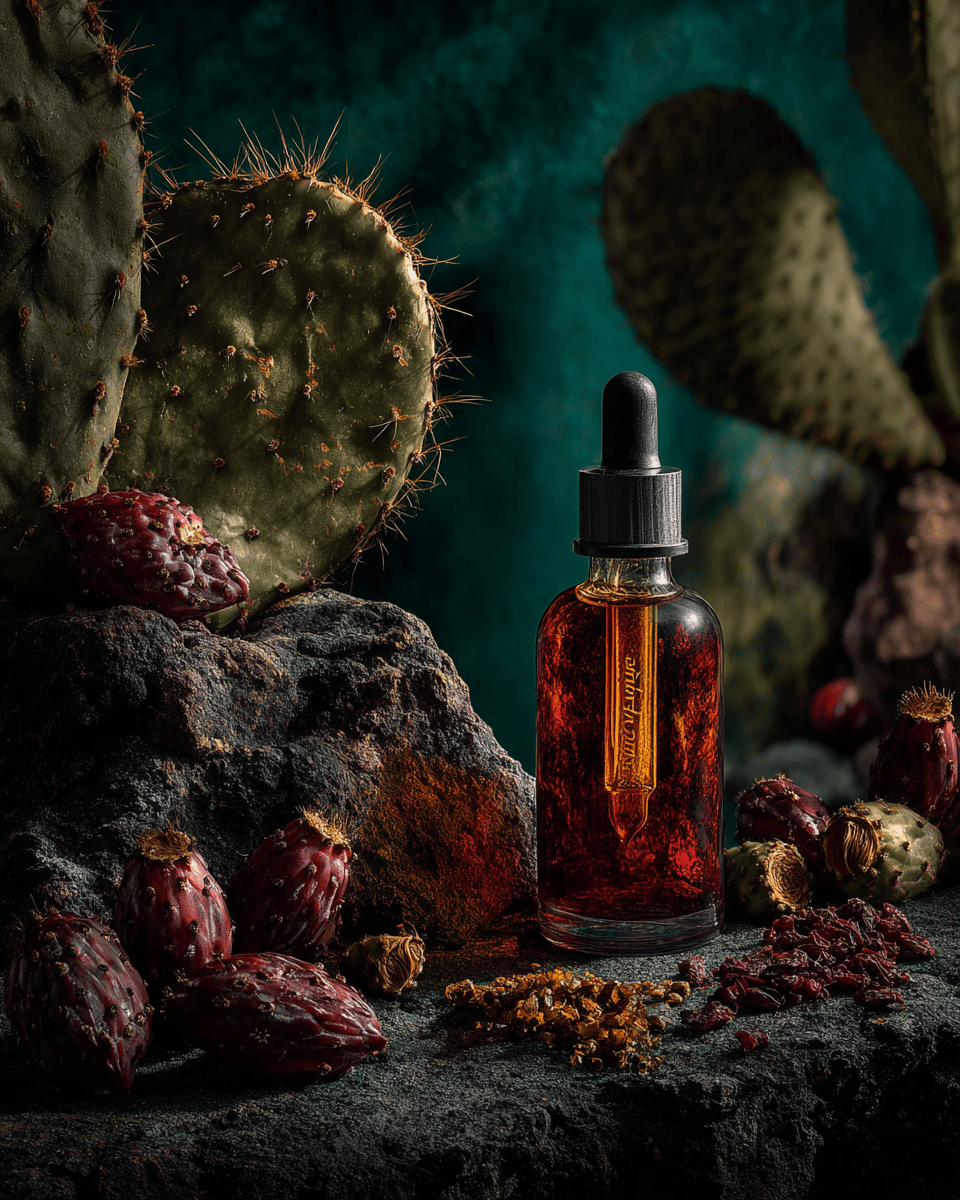
Prickly pear seed oil (Opuntia ficus-indica seed oil) is one of the rare vegetable oils to combine in a single active ingredient all the essential fatty acids prized for skin barrier nutrition and comfort. Cold-pressed from the seeds of the nopal cactus, it is now considered one of the most precious oils in natural cosmetics — and this is the very reason why Nopal Life has built its entire range around it.
Its lipid profile is remarkable: 62 to 70% linoleic acid (omega-6), about 20% oleic acid (omega-9), and traces of palmitoleic acid (omega-7). This concentration of omega-6 is one of the highest in the plant kingdom — superior to rosehip oil, comparable to grape seed oil, but with the added richness of tocopherols (natural vitamin E) valued for its antioxidant properties.
Specifically, applied to dehydrated and sensitive skin, prickly pear seed oil:
- Helps preserve the comfort of the surface lipid film thanks to its richness in omega-6
- Helps limit the sensation of tightness by leaving the skin supple and comfortable
- Helps soothe the appearance of redness and discomfort thanks to its natural soothing properties
- Helps preserve skin radiance thanks to its natural vitamin E
- Improves texture and suppleness without clogging pores
This is why Nopal Life Pure Prickly Pear Seed Oil is formulated 100% pure, cold-pressed, without any additives — to fully preserve this exceptional lipid profile.
Caring for your skin barrier starts here
Discover Pure Prickly Pear Seed Oil — skin nutrition, barrier comfort, natural radiance.
How to Integrate Skin Nutrition into Your Daily Routine
Nourishing your skin barrier doesn't require a complex routine. The result depends on regularity, the correct order of application, and the quality of the oil chosen. Here is the recommended method for dehydrated and sensitive skin.
In the morning: after gentle cleansing and hydrolat misting, apply 3 to 4 drops of prickly pear seed oil to slightly damp skin. The residual moisture creates a natural emulsion that improves lipid distribution. Complete with your usual moisturizer if necessary. The lipid film thus formed helps preserve your skin's comfort throughout the day.
In the evening: evening care is ideal for skin nutrition. After cleansing, apply the oil with a gentle massage to the face and neck. For very dry skin or skin seeking comfort, you can double the quantity and leave it on overnight.
The layering technique: the "lightest to heaviest" rule applies here. The oil should be applied after aqueous serums (hyaluronic, niacinamide) and before thick creams, if you use them. It acts as a lipid seal that helps keep hydrophilic active ingredients in contact with the skin.
For very reactive skin, start with an application twice a week and observe the skin's response before intensifying. Most dehydrated skin immediately tolerates prickly pear seed oil due to its high biocompatibility with human epidermal lipids.
To know your exact skin profile and receive a personalized routine, use the Nopal Life Skin Intelligence™ diagnosis — a tool developed specifically for problematic skin.
Mistakes to Avoid So As Not to Worsen a Weakened Skin Barrier
Certain widespread practices weaken the skin barrier instead of preserving its comfort. Identifying them helps avoid taking "two steps forward, three steps back" in your routine.
Mistake 1 — Over-cleansing the skin. Cleansers containing sulfates (SLS, SLES) not only remove sebum and impurities but also part of the barrier's surface lipids. Cleansing twice a day with these products can make the skin more uncomfortable within a few weeks. Opt for gentle cleansers based on amphoacetates or cocoamidopropyl betaine.
Mistake 2 — Exfoliating too often. Acid (AHA, BHA) and mechanical exfoliants, used at high frequency on already sensitive skin, can leave the barrier less comfortable. Limit exfoliation to once a week maximum on dehydrated skin.
Mistake 3 — Applying oils only to dry skin. An oil applied to completely dry skin creates a surface film but spreads less effectively. Application to slightly damp skin is consistently more pleasant in terms of feel and comfort.
Mistake 4 — Choosing oils rich in oleic acid for reactive sensitive skin. Argan oil, olive oil, vegetable squalane oil are rich in oleic acid (omega-9). For dehydrated skin prone to discomfort, this profile may be less suitable and accentuate the appearance of redness. Prefer oils rich in linoleic acid (omega-6) such as prickly pear seed oil.
Mistake 5 — Neglecting the internal environment. Heating in winter and air conditioning in summer reduce air humidity and accentuate the sensation of dry skin. A humidifier in the bedroom (ideally 45-60% relative humidity) can help maintain skin comfort overnight.
Mistake 6 — Alternating too many different oils. Sensitive skin appreciates regularity. Alternating several vegetable oils week after week can cause transitional reactions. Choose a main oil suited to your skin type and use it for at least 4 weeks before evaluating the results.
For a precise analysis of your skin and to find out which Nopal Life products match your profile, the online diagnosis is available for free.
FAQ — Skin Nutrition, Dehydrated Skin, and Prickly Pear Seed Oil
What is the difference between dry skin and dehydrated skin?
Dry skin is a constitutional skin type — it permanently produces little sebum. Dehydrated skin is a temporary condition that can affect all skin types (even oily): it lacks water in the superficial layers, often related to a weakened skin barrier.
Is prickly pear seed oil suitable for dehydrated oily skin?
Yes. It is even one of its strengths. Its richness in linoleic acid (omega-6) gives it a very low comedogenic index — it does not clog pores. It is appreciated by dehydrated oily skin because it provides comfort without leaving a greasy finish and without making the skin look shiny.
How long does it take to see results from skin nutrition with prickly pear seed oil?
The first results on skin suppleness and comfort are often noticeable within 5 to 10 days of daily use. A more comfortable and supple skin appearance is generally appreciated over 4 to 6 weeks, the time of a natural skin renewal cycle. Consistency is more important than the quantity applied.
Can prickly pear seed oil replace a moisturizer?
It can advantageously replace conventional creams laden with water and emulsifiers for many dehydrated skin types. However, it primarily acts as a nourishing and emollient agent (providing comfort lipids), not as a humectant (water retention). For a complete action, combining it with a humectant active ingredient like hyaluronic acid or urea before application gives the best results.
What is the shelf life (DLC) of prickly pear seed oil?
Thanks to its high content of natural vitamin E (one of the highest in the plant kingdom), prickly pear seed oil is naturally stable. Its shelf life after opening is 12 months when stored away from heat and light — ideally in an opaque glass bottle, at room temperature. A slight rancid odor indicates oxidation: the product should then no longer be used.
How to choose a quality prickly pear seed oil?
Four criteria are decisive: cold pressing (ensures the preservation of fatty acids and antioxidants), traceability of origin (Algeria, Morocco, Tunisia), absence of additives in the INCI composition (only one ingredient: Opuntia Ficus-Indica Seed Oil), and opaque tinted glass packaging. The slightly golden color and a mild, vegetal scent are indicators of freshness and purity.
Your personalized skin nutrition routine
Every skin is unique. Discover Nopal Life pure prickly pear seed oil or get your skin diagnosis for a tailor-made routine adapted to your skin barrier.
Why Choose Nopal Life for Deep and Lasting Hydration
Skin hydration is not limited to applying water to the skin: it relies on film-forming active ingredients that help retain water in the superficial layers of the epidermis. Nopal Life formulates each product around recognized humectant agents (hyaluronic acid, aloe vera, prebiotics) combined with prickly pear seed oil, an exceptional natural emollient that helps seal in moisture and preserve the comfort of the lipid film.
Result: plump, supple, and comfortable-feeling skin throughout the day. Each formulation is dermatologically tested and adapted to your skin type. Get your free diagnosis to identify the ideal hydration routine for you.
RECOMMENDED TREATMENT
Pure Prickly Pear Seed Oil
Natural formula · Origin Algeria
DISCOVER THIS TREATMENT →Read more
Information provided for cosmetic and educational purposes; it does not constitute medical advice.
Our anti-aging treatments