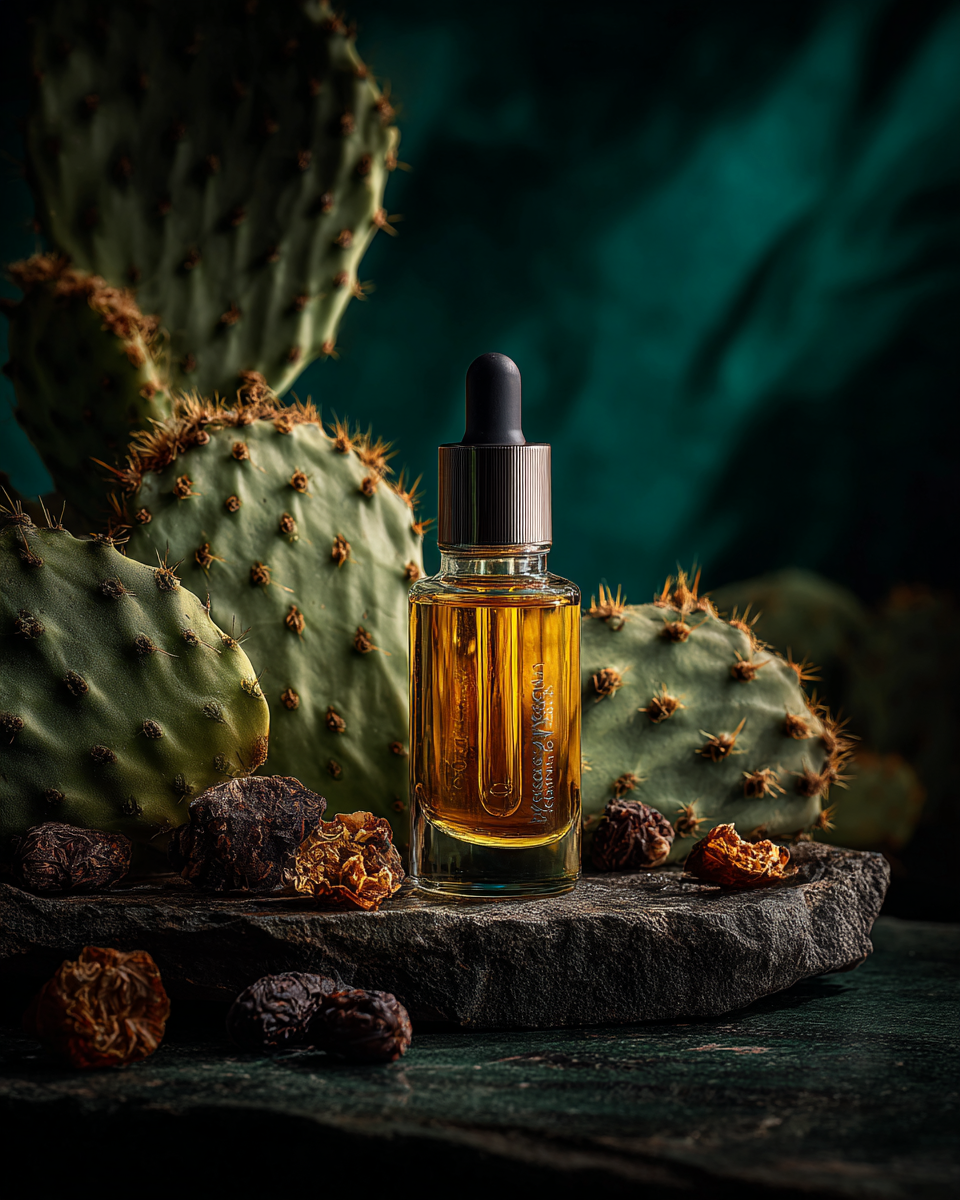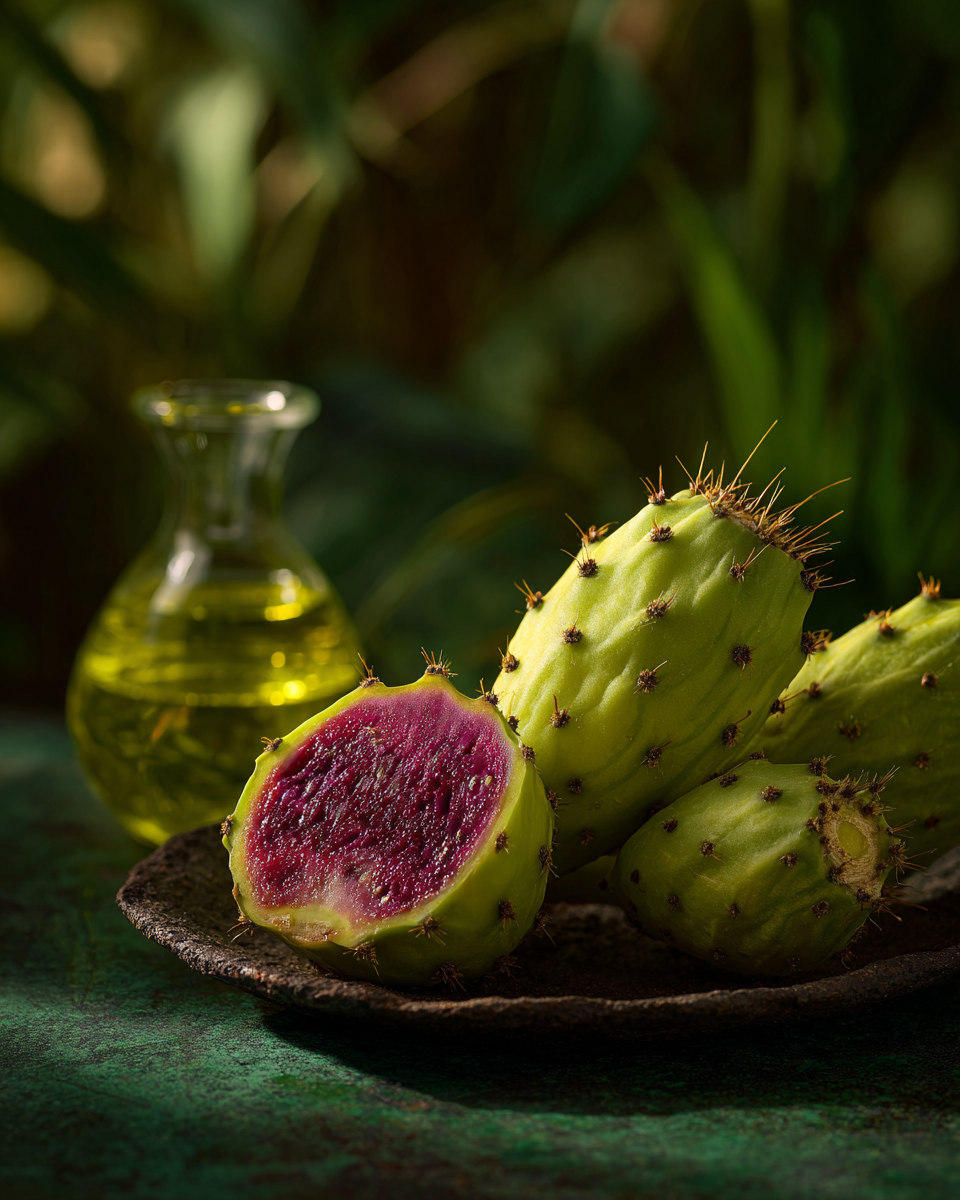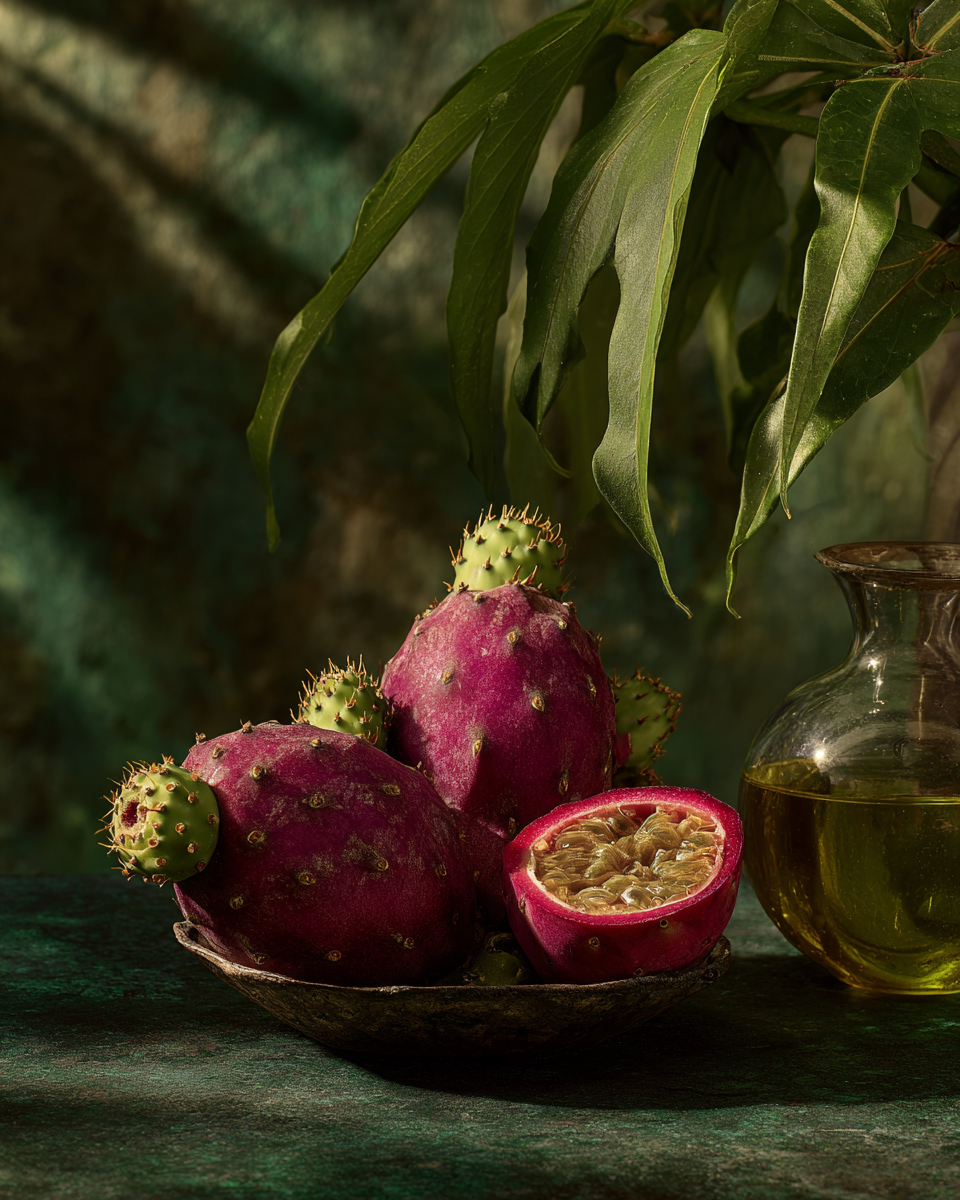
Prickly pear seed oil or squalane: which to choose?
They are both fatty substances, and that's about all they have in common. Prickly pear seed oil is a complete vegetable oil, rich in essential fatty acids that the skin does not produce. Squalane is a unique, neutral molecule, whose appeal lies more in its texture than its composition.
Two Opposing Profiles
| Criterion | Prickly Pear Oil | Squalane |
|---|---|---|
| Composition | complete oil, rich lipid profile | unique, neutral molecule |
| Origin | Opuntia ficus indica seeds | olive or sugarcane |
| Texture | fine, fast absorption | very light, dry to the touch |
| Nutritional intake | high | almost zero |
| Scent | vegetal, discreet | none |
| Skin type | mature skin, dry skin | all skin types, including oily |
What Prickly Pear Seed Oil Does
It provides a significant amount of linoleic acid, an omega-6 that is directly incorporated into the lipids of the skin barrier. Skin that lacks it loses more water and defends itself less effectively.
It also provides a notable amount of tocopherols, which explains its good stability over time and its benefit for mature skin. It is an oil that truly nourishes, and not just a pleasant texture.
Its extraction is demanding: the seeds represent only a fraction of the fruit, and it takes nearly a ton of figs for one liter of oil. Cold pressing preserves its fragile compounds; refining removes them.
Its composition explains the essentials: a high proportion of linoleic acid, vitamin E, and sterols. It is this trio that acts against free radicals, the main driver of visible skin aging.
Sold as prickly pear seed oil, it is found in very uneven qualities. Skin type determines the choice: the benefits of prickly pear oil are seen mostly on dry or mature skin, less so on young and balanced skin.
What Squalane Does
It is an emollient, today obtained from olive or sugarcane. It does not nourish in the strict sense: it provides neither essential lipids, nor antioxidants, nor vitamins.
Its interest lies elsewhere. Its texture is remarkably light, it leaves no film, has no scent, and its tolerance is excellent—even on skin that does not tolerate vegetable oils well. It is an excellent sealant, neutral by design.
Which to Choose
Dry or mature epidermis: vegetable oil, without hesitation. It is the lipid raw material that is missing, and squalane will not provide it.
Oily or reactive skin to oils: squalane, whose lightness and neutrality address most reluctances.
Normal skin: both are suitable. The question becomes a matter of texture and preference.
Do You Really Have to Choose?
No, and many routines use them alternately. Vegetable oil in the evening, when the skin remains in contact with the treatment for a long time; squalane in the morning, under makeup, when lightness is paramount.
Some formulas even combine them: squalane lightens the texture of a richer oil without diluting its contribution.
How to Apply Them
In both cases, as a final step, on skin that is still slightly damp.
Oil: two to three drops, warmed between the palms, applied with presses. One drop is enough for the eye contour.
Squalane: three to four drops, its lightness allowing a slightly larger quantity without a greasy effect.
On perfectly dry skin, both seal skin that has nothing to retain. The gesture then loses most of its effectiveness.
Efficacy: What to Expect
Comfort can be felt from the first few days. Suppleness and skin texture appearance require three to four weeks of regular use—this is the time for surface renewal.
On mature skin, this omega-6 intake gives a clearer result than simple occlusion. This is the main argument in favor of vegetable oil in this area.
Storage and Quality
Squalane is very stable and can be stored without special precautions. Virgin vegetable oil is more fragile: tinted glass, away from heat, and preferably out of the bathroom.
A 30 ml bottle of oil used daily lasts approximately two months. Buy small rather than large: fresh oil is better than economical oil.
Opuntia ficus indica: What the Prickly Pear Produces
Opuntia ficus indica is a cactus cultivated in the arid lands of the Mediterranean basin. Its fruits, prickly pears, contain a multitude of small seeds from which the oil is extracted—the rest of the pulp goes to other uses.
At NOPAL LIFE, the fruits come from family plantations in the arid highlands of eastern Algeria and Kabylia, where the plant grows without irrigation. The oil is obtained 100% by cold pressing, without solvents or heating.
Daily Use: Apply Little, Often
The rule is the same for both fatty substances: a small amount, regularly. Two to three drops are enough for the entire face, warmed between the palms then applied by pressing from the center outwards.
For the eye contour, just one drop, gently dabbed with the tip of the ring finger, without pulling the skin. On the neck and décolleté, an additional drop if the area is dry.
Anti-aging: What Can Reasonably Be Expected
Neither of them makes an established wrinkle disappear, and that must be stated clearly. What they improve is suppleness, regularity of texture, and how the skin catches the light.
On mature skin, vegetable oil is the more effective of the two, because it provides substance and not just occlusion. This benefit is visible over several weeks, not from the first use.
Natural, But Not Magical
The squalane sold today is of plant origin, obtained by transforming olive or sugarcane. "Natural" therefore does not mean "raw": it is an isolated and purified molecule, and that is precisely what gives it its neutrality.
Seed oil, on the other hand, is a raw product in the strict sense. Its richness is its appeal, and its variability from batch to batch is its natural counterpart.
Limitations
These products improve skin suppleness, comfort, and appearance. They have no therapeutic purpose. Persistent dryness or established redness requires medical advice.
Our product for this comparison


Mature skin · Dry skin

Go further than this article
Get our skincare guides by email — and start with your free skin diagnostic: 2 minutes, advice tailored to your skin. We ship to the US, UK, Canada, Australia and 27 European countries; somewhere else? Sign up and you will be the first to know when we deliver to your country.
By signing up, you agree to our privacy policy. Unsubscribe in one click.