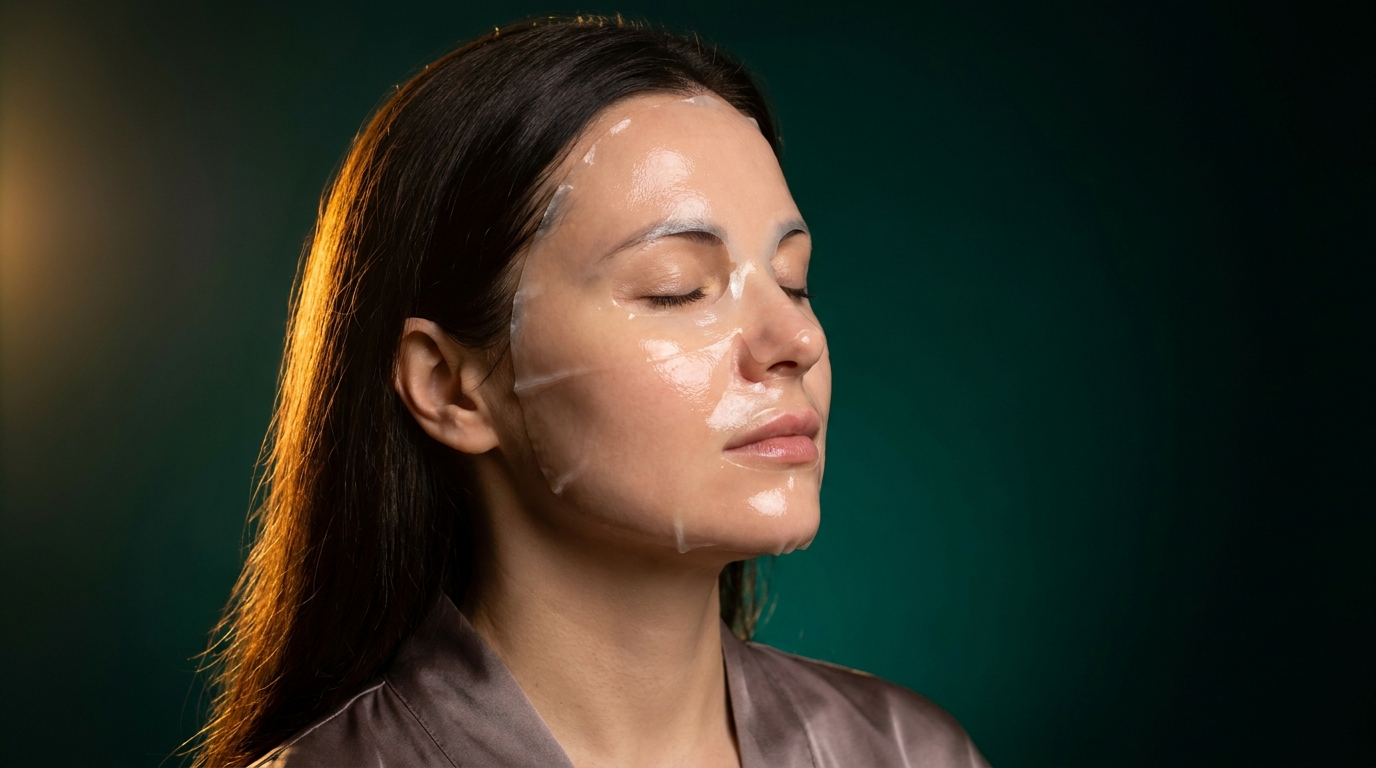
Overnight face mask: how to apply it without suffocating your skin
A night mask is not a richer cream: it's an occlusive layer applied last, whose role is to retain what previous steps have provided. This functional difference dictates everything else – the dosage, its place in the routine, and the frequency. The most common mistake is to apply it like a night cream, in a generous layer, on dry skin: the product then ends up on the pillow without retaining anything, because there was nothing to retain. This page provides specific dosages per skin profile, the exact order of steps, and signs that indicate when to reduce usage.
Why Night Changes Everything
Two phenomena occur during sleep, and they pull in opposite directions.
Transepidermal water loss increases at night: the skin evaporates more between midnight and four in the morning than at any other time of day. This justifies an occlusive layer at bedtime.
In parallel, skin temperature rises slightly and blood flow increases, which enhances the penetration of applied products. An active ingredient tolerated in the morning may therefore sting more in the evening.
These two facts explain the logic behind a night mask: it works by slowing down genuinely increased evaporation, not by delivering miraculous active ingredients while you sleep.
They also explain why the environment matters as much as the product. A bedroom heated to 22°C in winter often drops below 30% relative humidity—under these conditions, the occlusive layer becomes genuinely useful. In humid summer, it is much less so.
What a Night Mask Changes in Your Routine
A night mask is an emulsion or gel rich in humectants and film-forming agents. It slows down transepidermal water loss for several hours, without requiring immediate rinsing.
The stratum corneum contains corneocytes surrounded by lipids. A formula combining glycerin, hyaluronic acid, squalane, and ceramides supports this superficial compartment when the air is dry or the skin feels tight.
The correct indicator is not a visible white layer. Two small pea-sized amounts are sufficient for the face and neck; an overdose mostly increases transfer to the pillow.
Complete Protocol for Dehydrated Skin
On evenings 1 and 4 of the week, cleanse with a gentle milk or gel, then pat without completely drying. Apply three drops of glycerin or hyaluronic acid serum to slightly damp skin.
Take two pea-sized amounts of mask, spread them over the forehead, cheeks, chin, and neck. Smooth from the center outwards for forty-five seconds, then allow the film to form for five minutes before going to bed.
Upon waking, rinse only if the surface remains sticky. Otherwise, wipe with a damp compress and apply appropriate sun protection.
Choosing Between Gel, Gel-Cream, Balm, and Sleeping Pack
A water-based gel is suitable for combination skin looking for freshness. A gel-cream provides more emollients without leaving a thick film.
Balm often contains shea butter, squalane, or caprylic/capric triglycerides. It is better suited for dry areas than a shiny T-zone.
A sleeping pack forms a more continuous film thanks to polymers or gums. It is used once or twice a week, not necessarily every night.
Dosages by Skin Profile
| Profile | Texture | Dose | Frequency |
|---|---|---|---|
| Combination skin | gel-cream | 1 pea-sized amount | 1 night/week |
| Dry skin | cream-balm | 2 pea-sized amounts | 2 to 3 nights/week |
| Sensitive skin | fragrance-free gel | 1 pea-sized amount | 1 night/week |
| Mature skin | rich cream | 2 pea-sized amounts | 2 nights/week |
The Thin Layer Method
Start with an alcohol-free lotion, then apply a hydrating treatment. Wait thirty seconds, add a light cream if the skin is dry, then finish with the mask.
For combination skin, use one pea-sized amount on the cheeks and half a pea-sized amount on the forehead. For dry mature skin, add a drop of squalane to the amount intended for the cheeks, not directly into the jar.
Do not layer an acidic peel, a retinoid, and a thick occlusive layer on the same night. This combination increases the risk of stinging and temporary redness.
Three Measured Variations for Home Use
Gel variation: one teaspoon of cosmetic aloe vera gel, two drops of vegetable glycerin, and one drop of squalane. Mix in a clean bowl, spread in a thin layer, and use immediately.
Cream variation: one teaspoon of neutral cream, two drops of jojoba oil. Mix for thirty seconds, apply to cheeks, then remove excess after fifteen minutes.
Comfort variation: one teaspoon of aloe vera gel and half a teaspoon of colloidal oatmeal. Form a soft paste, apply for ten minutes, remove with lukewarm water; this preparation does not keep.
Frequency, Temperature, and Hygiene
Use this treatment one to three nights a week depending on the season. In winter or in a heated room, two applications may be enough; in humid summer, a light layer is often more comfortable.
Wash the spatula after each use and do not dip a wet finger back into the jar. A homemade preparation containing water must be discarded after application.
Store the product closed, at a stable temperature, away from a radiator. Refrigeration changes the sensation but does not increase moisturizing performance.
To delve deeper into choices, consult our evening routine, our restorative night routine page, and the dehydrated skin protocol.
What Truly Strengthens the Skin Barrier
A night mask acts on a specific compartment, and knowing which one prevents expecting the impossible from it.
The skin barrier is made up of corneocytes and the lipid cement that surrounds them—ceramides, cholesterol, free fatty acids, in relatively constant proportions. When this cement is depleted, evaporation increases and the skin becomes reactive.
Three families of ingredients work on it, with distinct roles. Humectants—glycerin, hyaluronic acid, low-dose urea—attract water. Emollients—squalane, plant esters—fill spaces between corneocytes and soften the surface. Occlusives—butters, waxes, silicones—form the film that slows down water loss.
A formula that contains only the third family smooths without providing anything; a formula that contains only the first lets what it has captured escape. The combination of all three is what distinguishes a good product from a pleasant texture.
Ceramides deserve special mention: these are lipids that the skin produces itself, and providing them topically effectively helps to reconstitute depleted cement. This is one of the rare cases where a cosmetic ingredient directly replaces a missing molecule.
What is then observed is a gradual improvement in comfort and complexion: a restored barrier reflects light better, resulting in a brighter appearance. This radiance comes from the surface condition, not from a brightening ingredient.
The delay is two to four weeks, with regular use. See our skin barrier module.
Adapting to Your Skin Type
The question to ask is not "do I need intense hydration?" but "what is missing?".
Dry skin lacks lipids: it flakes, is rough to the touch, and needs emollients and occlusives. Dehydrated skin lacks water: it feels tight, shows fine lines, and can also be oily — this is a temporary condition, not a type.
This distinction dictates the choice of texture. A rich balm on oily, dehydrated skin creates an uncomfortable film without correcting the lack of water; an aqueous gel on dry skin evaporates without leaving anything behind.
For sensitive skin, the rule is the shortest possible formula and only one night a week to start. The number of ingredients matters more than their nature: the fewer there are, the easier it is to identify a culprit in case of a reaction.


Go further than this article
Get our skincare guides by email — and start with your free skin diagnostic: 2 minutes, advice tailored to your skin. We ship to the US, UK, Canada, Australia and 27 European countries; somewhere else? Sign up and you will be the first to know when we deliver to your country.
By signing up, you agree to our privacy policy. Unsubscribe in one click.