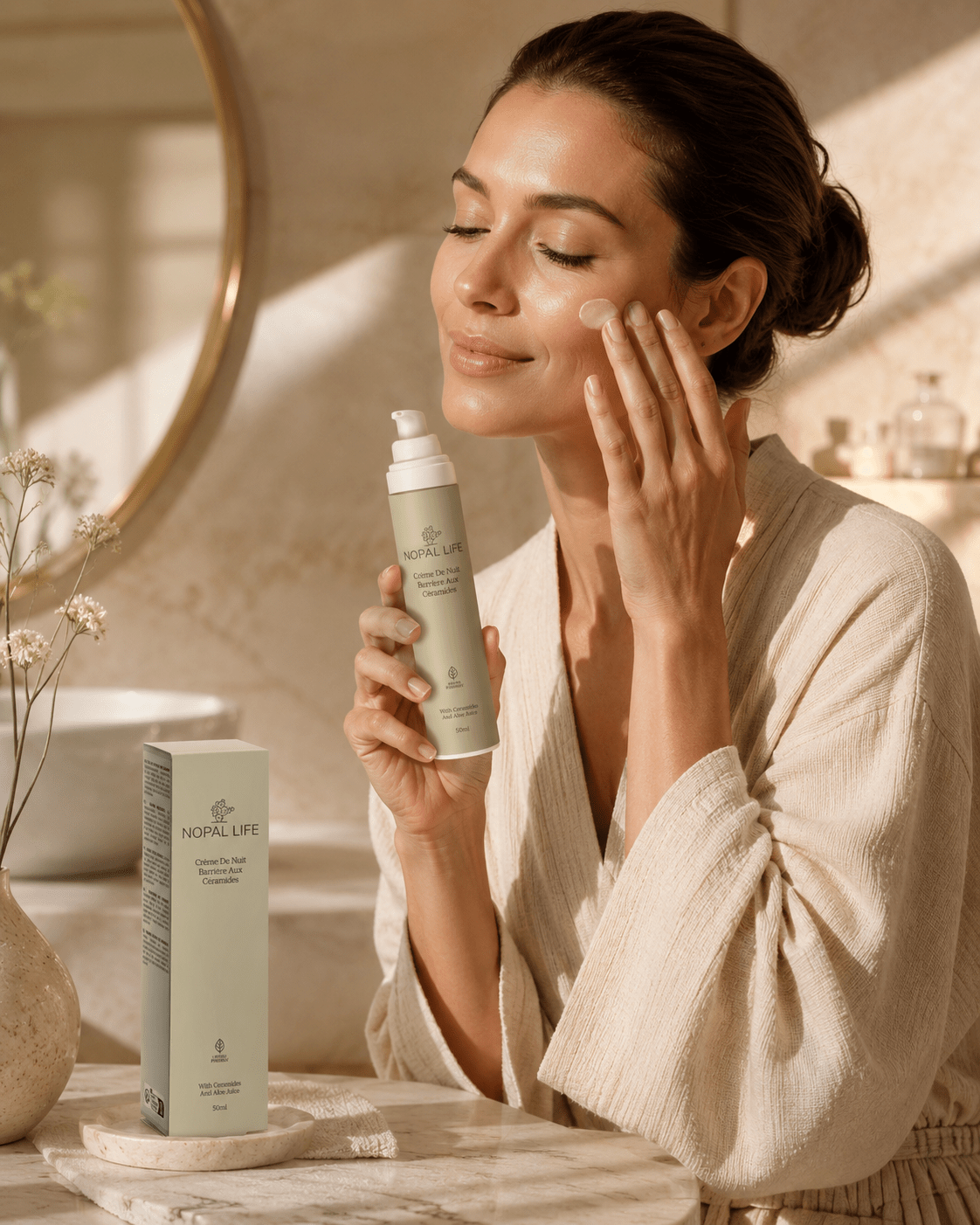
Fine lines: a complete guide Nopal Life
Skin beauty lies in the details of daily life. Through this guide dedicated to fine lines, the Beauty Lab will accompany you with a methodical approach—and always that touch of botanical nutrition dear to NOPAL LIFE.
Fine Lines vs. Wrinkles: Two Realities Not to Be Confused
Often used interchangeably, these two words actually refer to distinct marks. A fine line is a thin, superficial line, usually less than 1 mm, that appears on the surface of the epidermis. A wrinkle, on the other hand, is more pronounced and appears deeper: it settles into the dermis, is accompanied by a loss of plumpness and a visible sagging of facial contours. Understanding this difference is the first useful step, as the skincare routines and active ingredients to prioritize are not quite the same.
There are two main families of fine lines depending on their origin. Expression lines (or dynamic lines) result from repeated facial movements that crease the skin in the same place: crow's feet around the eyes, forehead lines, frown lines between the eyebrows. Dehydration lines appear when the surface lacks water and comfort; they form a fine, tight network, particularly visible on the cheeks and around the eyes, and quickly fade as soon as hydration is restored. This reversibility is the best indicator: a fine line whose appearance significantly improves after a hydrating treatment is almost certainly a dehydration line.
How Fine Lines Form
Two layers of skin are involved. On the surface, the epidermis is protected by a hydrolipidic film that retains water and maintains comfort; when it becomes depleted of lipids, the skin feels tight, its texture becomes more pronounced, and the first dehydration lines appear. Deeper down, the dermis houses collagen and elastin fibers that give the skin its bounce and apparent density. With skin aging, these tissues gradually lose their visible suppleness, making it harder for the skin to return to its smooth appearance after each expression.
This phenomenon is part of a progressive, age-related evolution. Over the years, the skin lacks more lipids and natural moisturizing factors: the skin barrier becomes more fragile, and the texture appears less uniform. Sun exposure significantly accelerates this evolution—UVA rays, in particular, are associated with the premature appearance of visible signs of aging. Conversely, controlled exposure and appropriate care preserve its smooth appearance for longer.
Identifying Your Fine Lines Zone by Zone
Not all fine lines are alike, and they don't require the same approach.
| Zone | Common Fine Line Type | Targeted Action |
|---|---|---|
| Eye Contour | Expression crow's feet and dehydration lines | Gentle eye cream, pH-balanced, rich in hyaluronic acid |
| Forehead | Horizontal expression lines | Peptides and retinol, used progressively |
| Between Eyebrows | Frown lines, dynamic creases | Firming and smoothing treatment, sustained hydration |
| Nasolabial Folds | Creases related to apparent volume loss | Plumping treatment, nourishing lipid base |
| Cheeks | Fine network of dehydration lines | Hyaluronic acid serum and emollient |
| Lip Contour | Fine creases, often accentuated by the sun | Daily photoprotection and nourishing treatment |
Key Cosmetic Active Ingredients
Several ingredients are now well-known in routines that target the appearance of fine lines. None act alone or instantly: it is regular use that makes a visible difference. The table below compares them.
| Active Ingredient | Known for | Usual Form | Recommended Frequency | Appreciated Aspect After |
|---|---|---|---|---|
| Retinol (Vitamin A) | Helps smooth skin texture and unify complexion | Serum or cream, at night | 2 to 3 nights/week, then progressive | 8 to 12 weeks |
| Retinal (Retinaldehyde) | Similar approach to retinol, valued for its gentleness | Serum or cream, at night | Every other night | 8 to 12 weeks |
| Glycolic Acid (AHA) | Supports surface renewal, refines skin texture | Serum or exfoliating treatment | 1 to 3 nights/week | 4 to 8 weeks |
| Hyaluronic Acid | Retains water on the surface, visibly plumps appearance | Serum or cream | Morning and night | From the first applications |
| Niacinamide (Vitamin B3) | Improves comfort and reduces the visibility of fine lines | Serum or cream | Morning and/or night | A few weeks |
| Peptides (Matrixyl, Argireline) | Valued for firm and smooth appearance, expression lines | Serum | Morning and night | 4 to 12 weeks |
| Vitamin C | Antioxidant known to support radiance and even skin tone | Serum, in the morning | In the morning, under SPF | 4 to 8 weeks |
| Prickly Pear Seed Oil | Rich in vitamin E and linoleic acid, helps preserve apparent comfort and suppleness | Oil, at night | Every night | Foundational step, long-term |
Niacinamide and hyaluronic acid combine with everything; retinol and fruit acids, which are more active, are introduced one after the other. Prickly pear seed oil, meanwhile, remains the foundational nourishing treatment.
A Morning and Evening Protocol, Step by Step
An effective routine depends less on the number of products than on their sequence and regularity. Here's a simple framework, to be adapted to your skin type.
Morning — Protect and Hydrate
- Gentle Cleansing: a delicate cleanse that doesn't strip the hydrolipidic film.
- Antioxidant Serum: a few drops of vitamin C to support radiance.
- Hydration: a cream or serum with hyaluronic acid to visibly plump the skin's surface.
- Eye Contour Treatment: a touch of eye cream on this thin and sensitive area.
- SPF 30 minimum: the non-negotiable step, even on cloudy days.
Evening — Nourish and Renew
- Cleansing: remove pollution and residue from the day.
- Targeted Active Ingredient: retinol, retinal, or glycolic acid, alternating and at a progressive frequency.
- Intensive Hydration: a rich cream to restore comfort.
- A few drops of prickly pear seed oil: applied last, they nourish the superficial layers and seal in hydration.
Two principles guide this protocol: introduce only one strong active ingredient at a time, and allow the skin several weeks to reveal the first visible results.
Mistakes to Avoid in Fine Line Care
The first mistake is waiting until fine lines are deeply etched before taking care of them. Prevention is infinitely more effective than correction: daily SPF from a young age, antioxidants (vitamins C and E), and sustained hydration help preserve the skin's smooth appearance for longer. Starting at 40 or 50 is still beneficial, but the visible improvement simply takes more time.
The second mistake is over-exfoliating, believing it will accelerate results. Excess AHA or retinol creates discomfort and redness which, paradoxically, can dull the complexion. It's better to respect the recommended frequencies and gradually increase concentrations. Third mistake: neglecting photoprotection while relying on active ingredients targeting radiance and visible firmness. Without SPF, their apparent benefit is partly compromised by the next day's exposure. Fourth mistake: expecting immediate results, when everything unfolds over several weeks—judging before three months makes no sense.
Prevention: The Actions That Really Matter
Prevention relies on three complementary pillars. The first is photoprotection: a minimum SPF 30 every day (not just in summer), even on cloudy days. UVA rays, associated with the premature appearance of visible signs of aging, penetrate clouds and windows. A wide-brimmed hat and wraparound sunglasses complement the protection of sensitive areas, especially around the eyes and lips.
The second pillar is hydration: well-hydrated skin has fewer surface fine lines and maintains a fresher appearance. A serum with hyaluronic acid followed by an emollient—prickly pear seed oil, for example—helps maintain this optimal level every evening. The third pillar is lifestyle hygiene: sleep, a diet rich in antioxidants, and stress management also matter. It is approaches that combine topical care, photoprotection, and good habits that most lastingly preserve the skin's smooth appearance.
The Nopal Life Approach to Preserving Smooth Skin
At Nopal Life, our approach begins with caring for the skin barrier—the foundation upon which all active ingredients targeting radiance and visible firmness then act. Our Pure Prickly Pear Seed Oil, exceptionally rich in vitamin E and linoleic acid, forms the lipid base of our protocol: applied every evening, it nourishes the superficial layers of the skin, helps preserve its comfort, and maintains its apparent suppleness in the long term.
To build a personalized routine according to your profile, skin type, and goals, our Nopal Life Skin Intelligence guides you in 2 minutes. All our articles on active ingredients targeting radiance and visible firmness are gathered in our Skin Guide.
Frequently Asked Questions about Fine Lines
Q: What is the definition of a fine line, and how does it differ from a wrinkle?
A: A fine line is a thin, superficial line on the skin's surface, often related to dehydration or early expressions. A wrinkle is deeper and appears more pronounced: it is accompanied by a loss of plumpness and a visible sagging of facial contours.
Q: Can the appearance of fine lines truly be diminished with topical treatments?
A: The appearance of dehydration lines can significantly fade with appropriate hydration. The appearance of age-related fine lines visibly improves with retinol, fruit acids, and peptides over 3 to 6 months of regular care. However, a total "disappearance" of deep wrinkles is not realistic with topical treatments alone.
Q: At what age should one start anti-fine line treatments?
A: Prevention starts early, with daily SPF and good hydration. Active ingredients like retinol in small quantities or vitamin C are then introduced gradually. The earlier you care for the skin barrier and photoprotection, the longer the skin's appearance will be preserved.
Q: Does prickly pear seed oil help with the appearance of fine lines?
A: Yes, in several ways. Its vitamin E helps preserve the comfort of the skin's superficial layers. Its linoleic acid contributes to hydration and the maintenance of apparent suppleness. Its sterols support a supple and plump appearance. These foundational actions make it a subtle ally: slower than retinol in the short term, but gentler and perfectly complementary.
Q: Do I need a specific cream for the eye contour area?
A: This very delicate area responds better to dedicated formulas that are gentler and have an adapted pH. The appearance of expression lines (crow's feet) improves with retinol or peptides (Argireline). Dehydration lines around the eyes, on the other hand, respond very well to eye contour creams rich in hyaluronic acid and light emollients.
Q: Can facial massage improve the appearance of fine lines?
A: Massage provides an immediate radiance boost and a feeling of firmer skin. Certain techniques (Gua Sha, kobido) maintain the appearance of a firm face in the moment. Over time, it does not replace cosmetic active ingredients but pleasantly accompanies their use.
Q: Do anti-aging nutritional supplements help with the appearance of fine lines?
A: Supplements based on hydrolyzed marine collagen are valued for supporting the skin's supple appearance and comfort. Coenzyme Q10, vitamin C, and omega-3 are classics for skin well-being. They complement topical treatments without ever replacing them.
Q: How do I know if my fine lines are due to dehydration or age?
A: A simple test: apply an intense moisturizing treatment (mask or rich cream) and observe after 30 minutes. If the appearance of fine lines significantly diminishes, they are primarily due to dehydration. If they persist, an age-related component dominates. In reality, most combine both, which our diagnosis helps to distinguish.
RECOMMENDED TREATMENT
Pure Prickly Pear Seed Oil
Natural formula · Origin Algeria
DISCOVER THIS TREATMENT →Read more
Information provided for cosmetic and educational purposes; it does not constitute medical advice.


Go further than this article
Get our skincare guides by email — and start with your free skin diagnostic: 2 minutes, advice tailored to your skin. We ship to the US, UK, Canada, Australia and 27 European countries; somewhere else? Sign up and you will be the first to know when we deliver to your country.
By signing up, you agree to our privacy policy. Unsubscribe in one click.