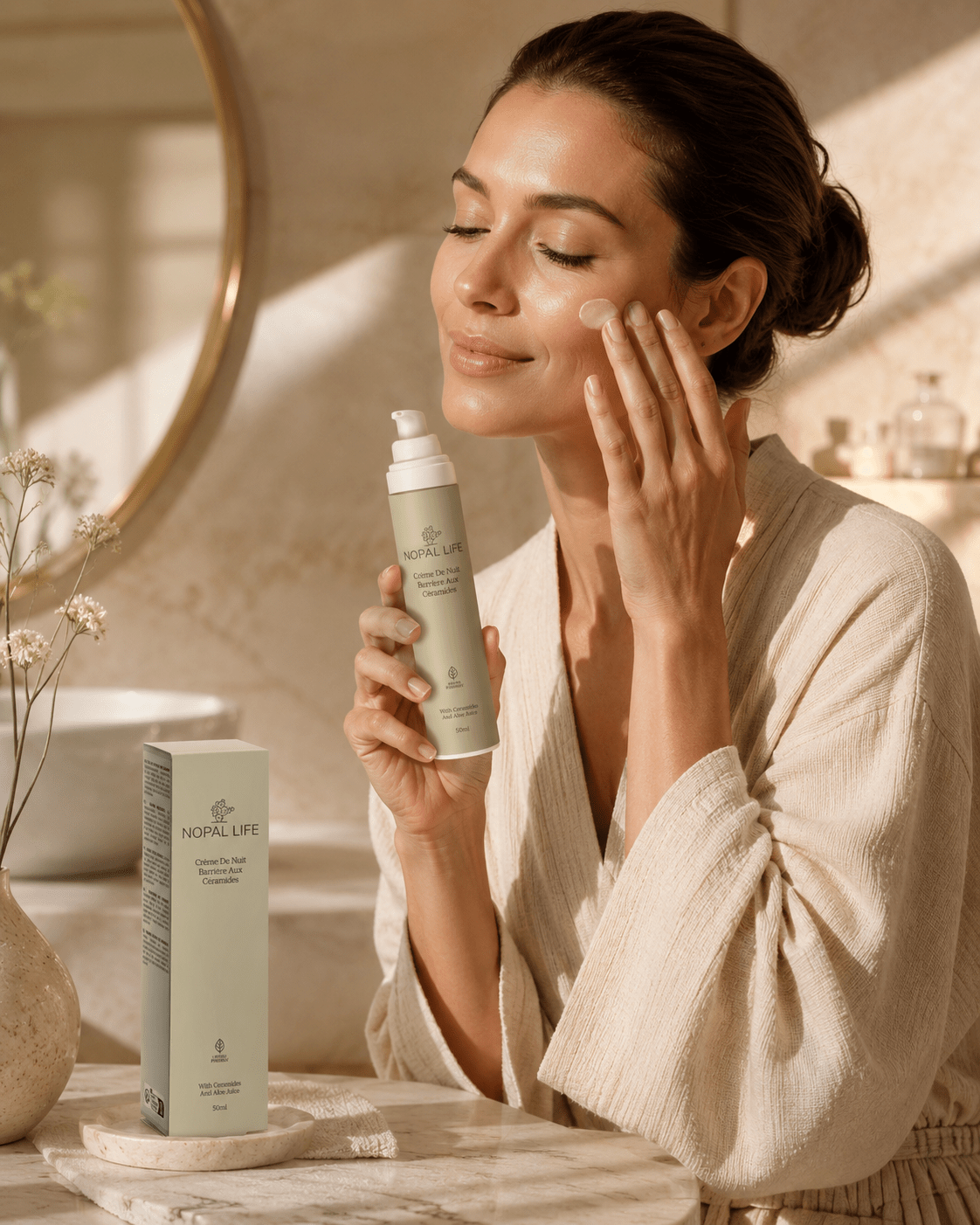
Skin barrier: understanding and soothing your skin
Redness, tightness, reactivity to the slightest change: sensitive skin requires gentleness and discernment. This guide helps you understand the natural barrier that is your skin, and then regain a lasting sense of calm through carefully chosen skincare and the delicate touch of a NOPAL LIFE ritual.
Understanding this barrier between oneself and the world
At the interface between the body and its environment, the skin barrier performs two complementary missions: slowing down water evaporation to the outside—what specialists call insensible water loss, or TEWL—and acting as a shield against external aggressions, whether allergens, irritants, sun, or microorganisms. It is called the skin barrier in English, and its essentially protective role primarily relies on the stratum corneum, the outermost layer of the epidermis.
This barrier is often described using the image of a "brick wall": corneocytes—differentiated, flattened, and anucleated keratinocytes—form the bricks, while the lipids surrounding them act as the mortar. This fatty cement is arranged in ordered lamellae, where ceramides, structural lipids, and free fatty acids mingle. It is this precise arrangement that gives the skin its resilience, comfort, and ability to remain at ease in the face of external aggressions.
The stratum corneum, thin but decisive
Barely 10 to 20 µm thick, this layer superimposes fifteen to twenty rows of corneocytes. Each cell is enveloped by a rigid protein membrane containing loricrin, involucrin, and filaggrin. The latter plays a unique role: by degrading, it releases the components of NMF (Natural Moisturizing Factor), recognized for their role in maintaining good surface hydration.
The renewal of this layer—desquamation—is the key step in a finely regulated rhythm. This is a natural renewal that the skin continuously performs, without us even thinking about it. An unbalanced pH, a lack of hydration, or poorly adjusted products are enough to disrupt it: the layer thickens, cells accumulate, and the complexion can appear dull and rough. Supporting this process gently helps preserve a smoother-looking skin texture.
| Stratum corneum thickness | 10 to 20 µm |
| Superimposed corneocyte layers | 15 to 20 |
| Balanced surface pH | 4.5 to 5.5 |
| Preferred rinsing water | 34 to 36 °C |
| Linoleic acid in prickly pear seed oil | 60 to 65 % |
| First sensations of relief | 1 to 2 weeks |
Recognizing a weakened barrier
A healthy skin barrier is barely noticeable: the skin remains supple, calm, and not very reactive to external aggressions. Conversely, a weakened surface shows multiple warning signs. Sensitivity increases, redness appears after familiar products, persistent dry skin despite creams, and a simple serum can cause a slight tingling sensation. Stress, fatigue, or harsh climates often accentuate this temporary fragility.
These manifestations do not mean "damaged" skin in a definitive way: most often, a superficially damaged barrier regains the appearance of healthy skin as soon as it is given the lipids and calm it lacks. Even skin damaged by cold, wind, or excessive treatment can recover: it retains a good capacity for natural renewal; it is still necessary to distinguish a temporary reaction from an established sensitivity—this is the whole point of carefully observing your skin.
Ceramides, NMF, and vegetable oils: the comfort trio
Among the lipids of the mortar, ceramides hold a prominent place. There are several subfamilies, each contributing to the order of the lamellae. Acylceramides (CER1/EOS) are often cited for their role in the cohesion of the structure. The presence of linoleic acid—an omega-6—is frequently mentioned as an indicator of comfortable skin; dry skin often lacks it, which explains the benefit of vegetable oils rich in it.
The NMF, located in the heart of the corneocytes, is the intrinsic hygroscopic system of the stratum. Its constituents—amino acids, PCA, urea, lactates—capture ambient moisture and support cell suppleness. As for natural ingredients, not all oils are equal: their omega-6 content varies significantly, as summarized in the table below.
| Prickly pear seed oil | 60 to 65 % |
| Hemp oil | 50 to 60 % |
| Rosehip oil | 44 to 48 % |
| Argan oil | 30 to 36 % |
| Jojoba oil (liquid wax) | minimal content |
Prickly pear seed oil, this green gold of the Maghreb, is among the most generous in omega-6. It provides this lipid benchmark cherished by dry complexions and leaves an pleasant sensation of suppleness on the surface—a comfort asset that sensitive skin seeks.
Reading your skincare products carefully: what soothes the surface
Understanding the skin barrier helps choose skincare products more accurately. On a label, a few families of ingredients frequently appear in formulas designed for comfort: ceramides and structural lipids, which mimic the composition of the mortar; soothing active ingredients and humectants like glycerin, useful for surface hydration; finally, vegetable oils rich in omega-6, including prickly pear seed oil. These natural ingredients are not medicinal: they simply provide the skin with comfort cues it appreciates.
The format also matters. A light serum slips under a richer cream; a vegetable oil is applied last, like a protective veil. For sensitive faces, shorter formulas, without unnecessary fragrance, and regular use are better than an accumulation of products. For daytime, appropriate sun protection completes the routine: this protective action helps preserve surface lipids against the sun's UV rays. The idea remains the same—gently reinforce the skin's ability to remain comfortable, rather than trying to restore everything by force.
Actions that put the epidermis to the test
Several habits weaken the skin barrier without us realizing it. The most common mistake is using overly stripping cleansers. Sulfated surfactants (SLS, SLES) remove dirt, but also part of the surface lipid film; the pH then climbs from its equilibrium zone to 7-8, and tightness sets in. A gentle, low-pH, sulfate-free cleansing formula makes all the difference for facial skin.
Next come excessive exfoliation—active ingredients like AHAs, BHAs, or retinols, used too frequently, weaken the surface—and neglected photoprotection: without sun protection, the sun's UV rays put more strain on surface lipids and make the skin more vulnerable to external aggressions. Too hot water does the rest: above 37°C, the fatty film is put to the test, whereas lukewarm water spares it. Finally, tobacco, daily stress, and a diet poor in omega-fats weaken the epidermis from within. Multiplying products does not always help: a few well-chosen treatments are better than an accumulation of serums and creams.
Regaining comfort, day after day
Helping a weakened skin barrier regain its comfort follows a clear, two-step logic. The first step is to eliminate what irritates; the second, to reintroduce nourishing lipids in formulas similar to the skin's natural composition. Applied in the evening, a few drops of prickly pear seed oil create an emollient veil that helps limit nocturnal water loss and reinforces the sensation of comfort; its vitamin E, appreciated for its antioxidant profile, complements this protective veil. For a detailed, week-by-week protocol, our skin barrier: what to do guide accompanies you step by step.
The Nopal Life Vision
At Nopal Life, the balance of this skin barrier is the foundation of all lasting beauty. Before even aiming for radiance or visible firmness, skin must be comfortable. This is why our Pure Prickly Pear Seed Oil is designed to maximize omega-6 intake, this lipid benchmark sought after by dry skin. Our advice always starts from this principle: help the skin first restore the comfort of its surface, before any other ambition. These few tips, in essence, boil down to a very simple beauty idea—beautiful skin begins with a soothed barrier. Want to clarify your needs? Start my free diagnosis guides you towards actions adapted to your skin.
Frequently Asked Questions
Q: How do I know if my skin barrier is weakened?
A: The most commonly described signs are skin that feels tight after cleansing, reactive redness to usual skincare products, persistent dry skin despite creams, and a tingling sensation when using products.
Q: Do ceramides in cream provide real comfort?
A: Yes, they are highly valued. Topical ceramides (especially CER NP and CER AP) integrate into the space between corneocytes and contribute to the comfort of the lamellar structure. Their benefit is optimized when combined with structural lipids and free fatty acids, in ratios close to natural ones.
Q: Does hot water really put the surface to the test?
A: Yes. Above 40 °C, water puts more strain on the lipid film and raises the pH, which accentuates discomfort. Long, hot showers, repeated, weigh on dry skin; short, lukewarm water passes are a simple and appreciated measure.
Q: Is the skin microbiome part of the barrier?
A: Yes, in a broad sense. This ecosystem of microorganisms living on the surface helps maintain a slightly acidic pH and contributes to the balance of healthy skin; taking care of it also means preserving the comfort of the barrier.
Q: How long does it take to regain comfort?
A: Generally, two to six weeks, depending on the extent of the weakening and the regularity of care. The first sensations—less dryness, less reactivity—often appear within one to two weeks, then well-being gradually sets in.
Q: Can I use retinol if my skin is weakened?
A: It's better to wait. This type of powerful active ingredient can, in the first instance, accentuate the discomfort of an already sensitized surface. First soothe for four to six weeks of gentle and nourishing care, then reintroduce it gradually, at a low concentration and by monitoring tolerance.
Q: Does diet affect skin comfort?
A: It plays a part. Omega-3s and omega-6s in the diet are nutritional benchmarks associated with skin well-being; an omega-6 deficiency often results in a less supple surface. Vitamins A, C, E, and zinc are also frequently cited to support skin balance and radiance.
Read more
Information provided for cosmetic and educational purposes; it does not constitute medical advice.


Go further than this article
Get our skincare guides by email — and start with your free skin diagnostic: 2 minutes, advice tailored to your skin. We ship to the US, UK, Canada, Australia and 27 European countries; somewhere else? Sign up and you will be the first to know when we deliver to your country.
By signing up, you agree to our privacy policy. Unsubscribe in one click.