Vitamin C or retinol: which one for which goal?
These are the two most studied anti-aging ingredients, and they don't target the same things. Vitamin C works on radiance, dark spots, and protection against free radicals. Retinol works on cell renewal, wrinkles, and texture. One in the morning, the other in the evening.
The comparative table
| Criterion | Vitamin C | Retinol |
|---|---|---|
| Concern | radiance, dark spots, dull complexion | wrinkles, texture, pores |
| Time of Day | morning | evening |
| Tolerance | good, sometimes tingling | irritating at first |
| Onset of results | 4 to 8 weeks | 3 to 6 months |
| Sun | complements protection | increases sensitivity |
| Stability | fragile to air and light | fragile to light |
What Vitamin C Does
It is a water-soluble antioxidant that neutralizes some of the free radicals generated by exposure and pollution. This justifies its use in the morning, in addition to sun protection.
It also acts on brown spots and skin tone evenness, and is involved in collagen synthesis, which explains its place in anti-aging routines.
Its difficulty is its stability. Pure ascorbic acid oxidizes quickly: a serum that has turned orange has lost most of its benefits. Stabilized derivatives are more reliable and act more slowly.
What Retinol Does
It is a derivative of vitamin A, and the active ingredient with the most documented effect on the signs of aging. It accelerates the renewal of surface cells and supports collagen production.
Its results focus on established wrinkles, skin texture, and the appearance of pores. They are real and slow: expect three to six months of regular use.
Its counterpart is initial irritation—redness, flaking, increased sensitivity—which usually lasts a few weeks and subsides if you progress slowly.
Which one to choose
Dull complexion, dark spots, lack of radiance: Vitamin C, the only one of the two to work directly on these points.
Established wrinkles, irregular texture, prominent pores: Retinol, unmatched in this area.
Sensitive skin: Start with Vitamin C, which is better tolerated, and reserve Retinol for later—or turn to Bakuchiol.
First active in your life: Vitamin C. Retinol, when poorly introduced, discourages many people from the second week.
Using both
This is the most complete anti-aging routine, and separating them throughout the day resolves most difficulties.
Morning: Vitamin C serum on clean skin, then a cream, then sun protection.
Evening: Retinol on clean, dry skin, then a cream.
This organization avoids the accumulation of irritants in a single application and respects the time when each is most useful.
Introducing retinol without burning yourself
Weeks 1 and 2: two evenings a week, on perfectly dry skin.
Weeks 3 and 4: every other evening if tolerance allows.
Then: every evening, if the skin tolerates it—many do very well at five times a week.
The sandwich technique helps: a cream, retinol, then a cream on top. The effect is slightly attenuated, tolerance significantly better.
Sun, non-negotiable
Retinol increases sensitivity to ultraviolet rays, and Vitamin C loses all interest if what it helps preserve is not protected.
Daily sun protection is therefore not an optional addition to this routine: it is what makes both active ingredients useful. Without it, you're bailing out a leaky boat.
Storing your serums
Both are sensitive to light and air. Opaque bottle, pump rather than dropper, away from heat and out of the bathroom.
Buy in small volumes rather than large formats: a fresh serum is better than an economical serum opened a year ago.
Limitations
These products are cosmetics. They improve the appearance of the skin without treating any condition. Retinol is not recommended during pregnancy and breastfeeding: seek professional medical advice.
They are not chosen, they are alternated
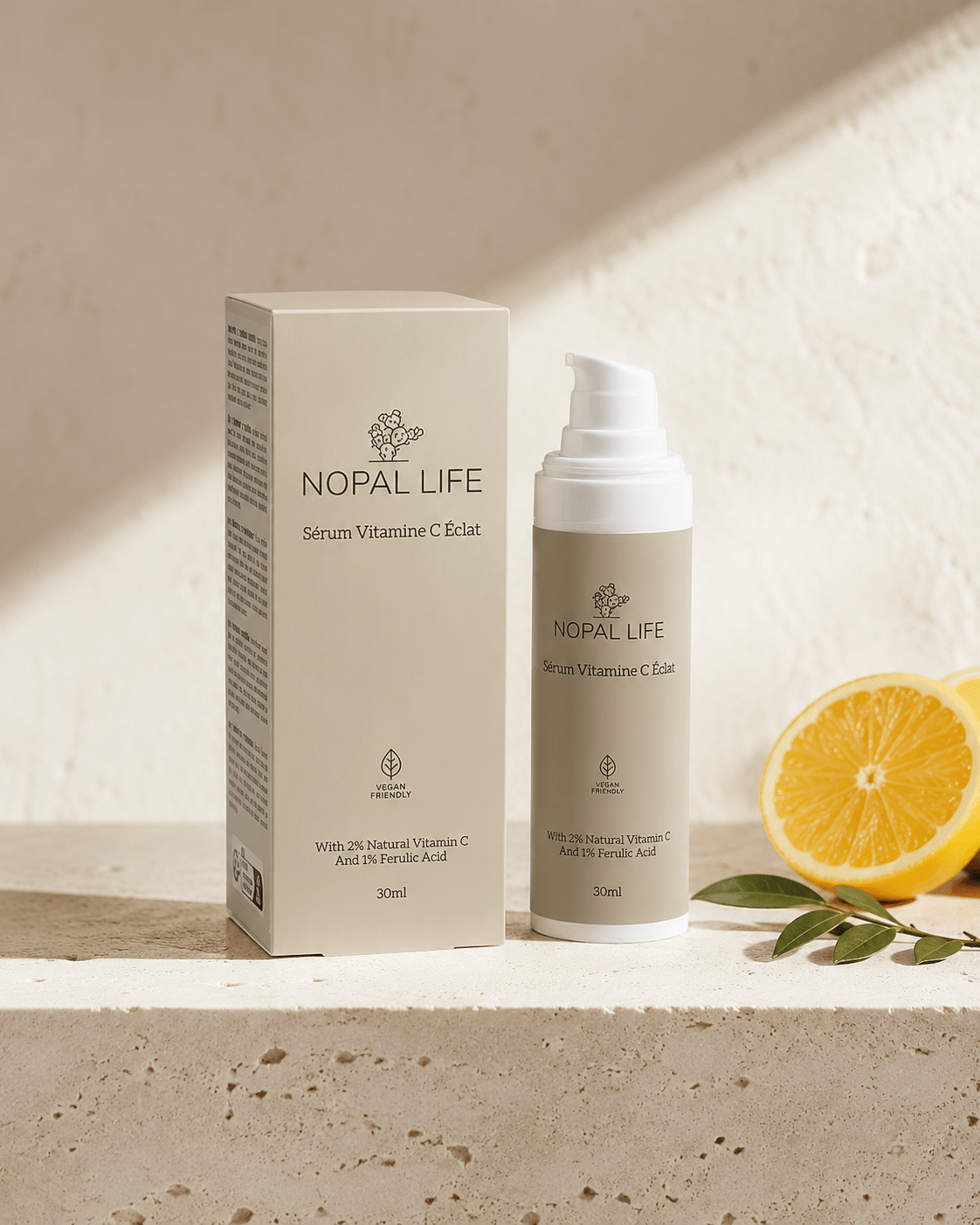
Vitamin C in the morning because it supports protection, retinol in the evening because light degrades it: the schedule settles the question better than a comparison. A Vitamin C concentrated serum occupies the first slot, under cream and sunscreen.
Our anti-aging treatments