Gel face masks: textures, dosage, and proper use
A gel mask provides water and humectants, and that's about it—which is already helpful, but significantly less than what the cooling sensation suggests. A gel texture doesn't imply a high concentration of active ingredients or deep penetration: it describes a system where polymers retain water. The result largely depends on three things: what you apply afterward, the amount used, and the chosen format. This page explains how a gel actually works, when it's appropriate, and for what skin types it's not sufficient on its own.
How a gel holds up
A cosmetic gel is an aqueous solution—often 80 to 95% water—immobilized by a polymer network.
Carbomer creates clear, light gels; it requires precise neutralization, as the network only forms above a certain pH. Xanthan gum, of natural origin, thickens at 0.2 to 1%, but becomes stringy beyond that. Hydroxyethylcellulose gives a more slippery feel, while alginate provides flexible textures.
This point is worth noting: viscosity does not measure hydration. A very thick gel might just be highly gelled water with very few humectants; a fluid gel could be richly dosed with glycerin. The texture informs about the polymer, not the effective formula.
Humectants are what matter: vegetable glycerin, hyaluronic acid, beta-glucan, urea in low doses. They attract and retain water in the stratum corneum.
Look at their position in the INCI list: glycerin in third position significantly impacts the formula, the same ingredient mentioned after preservatives means it has negligible effect.
The trap of humectants alone
This mechanism explains the most common complaint: "my gel leaves my skin feeling tight."
A humectant attracts water, but it doesn't choose where it comes from. In a humid environment, it draws water from the ambient air. In dry air—heating in winter, air conditioning, airplanes—it can draw water from the deeper layers of the epidermis and bring it to the surface, where it evaporates.
The result is skin that appears hydrated for twenty minutes then drier than before. This isn't a product defect; it's the normal functioning of a humectant used without an occlusive.
The correction is simple: always cover a gel with a cream. Squalane, ceramides, shea butter, or simple vegetable oil—the function is to limit the evaporation of what the gel has just provided.
For dehydrated skin, this second layer is not optional. See also our hydration routine, which details the complementary roles of humectants, emollients, and occlusives.
Three formats, three uses
| Format | Quantity | Duration | End of step | What it's for |
|---|---|---|---|---|
| Rinse-off gel | 1 tsp | 8 to 15 min | rinse, then cream | occasional boost, immediate effect |
| Sleeping mask | 1 dab | 6 to 8 h | cleanse upon waking | nighttime occlusion |
| Hydrogel patch | 1 pair | 10 to 20 min | remove without rinsing | targeted area |
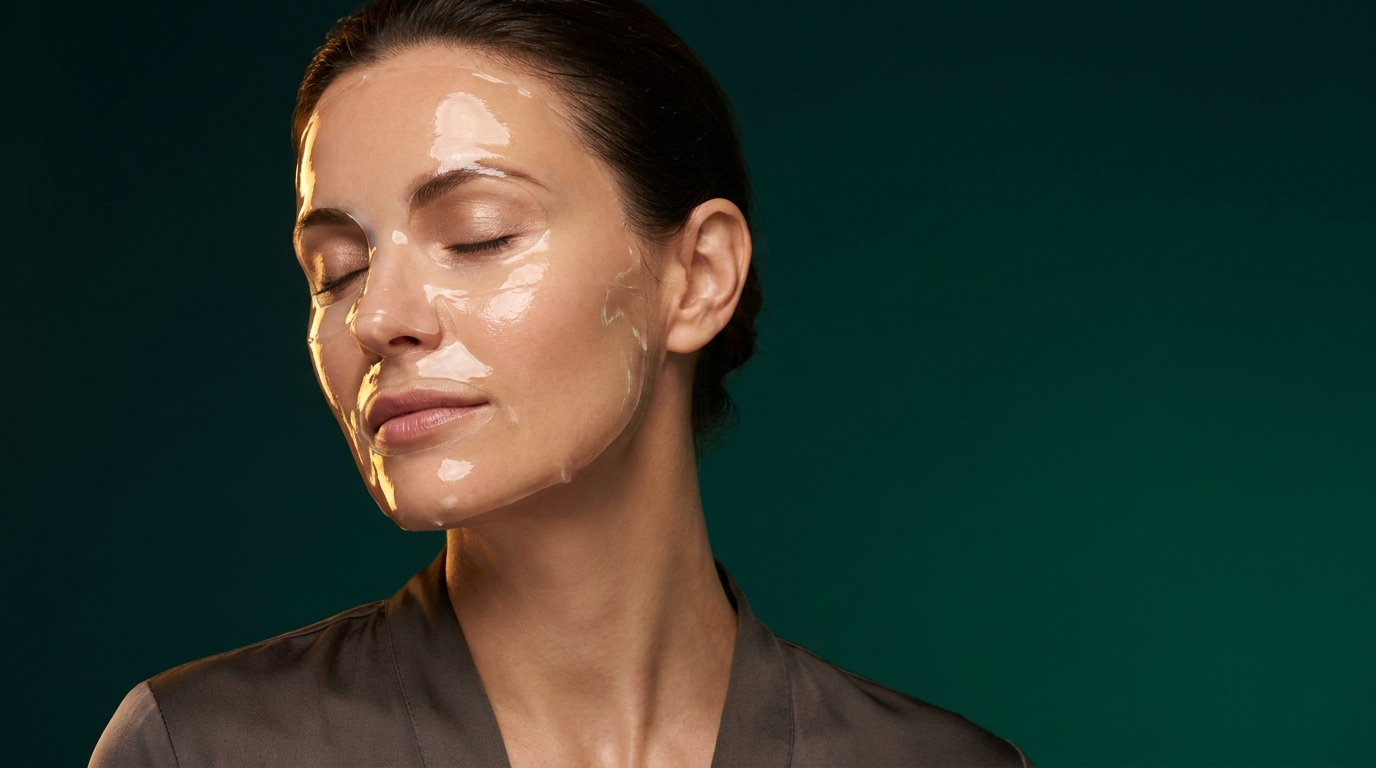
| Gel sheet mask | 1 unit | 10 to 15 min | pat in residue | short occlusion, full face |
The most common confusion concerns the sleeping mask: it should be dosed like a cream, not a mask. A thick layer doesn't work better—it sticks to hair and pillows, and half the product ends up on the fabric.
Patches cover a small area, usually the eye contour. They are not rinsed: you pat the residue until absorbed.
For the eye contour specifically, the useful amount is that of a grain of rice per side. More than that migrates into the eye and causes tearing and stinging.
A quick aloe recipe
Simple, honest about what it provides, and risk-free if used immediately.
Mix one tablespoon of cosmetic aloe vera gel, one teaspoon of distilled water, and two drops of glycerin. Apply immediately to clean skin, leave for eight minutes, rinse with lukewarm water, then apply a cream.
Do not store any leftovers. An aqueous preparation without a validated preservative system contaminates within a few hours, even in the refrigerator. Cold slows proliferation, it doesn't prevent it. Prepare a single dose in a clean bowl and discard the rest.
What this recipe provides: water, a humectant, a fresh sensation. What it doesn't provide: no measured active ingredients, no stability, no controlled pH. It's a comfort gesture, to be honestly compared to a formulated product rather than replacing it.
Oily skin: the false lightness
A fresh texture seems suitable for oily skin, but that's not always true.
Two ingredients to check. Denatured alcohol at the top of the list gives an immediate matte impression by evaporating, but it dehydrates—and dehydrated oily skin often produces more sebum in reaction. High amounts of polymers, on the other hand, leave a film that becomes sticky under sebum by the end of the day.
Quantity matters as much as the formula: half a teaspoon is enough for the entire face. Doubling the layer doubles the film without improving the result.
And oily skin needs hydration just like any other. The confusion between oily and hydrated leads to eliminating hydrating care, which worsens the problem one was trying to treat.
Storing and recognizing a product to discard
- Immediately close the jar or pump after use.
- Use a clean spatula rather than fingers for jar formats.
- Respect the PAO symbol—the small open jar with a number of months—usually six or twelve months.
- Never freeze a gel: extreme cold breaks the polymer network and the texture does not recover.
- Discard at the slightest change in odor, color, viscosity, or in case of phase separation.
A pump or tube format protects significantly better than an open jar, where every finger-dip introduces microbial flora. For a very aqueous product, this difference is not negligible.
Refrigeration enhances the sensation of freshness—which is pleasant, especially for patches—but it never remedies already established contamination.
Knowing if the product is right for you
A one-week protocol prevents attributing a stinging sensation to the wrong product.
Day 1: a small amount under the jawline, ten minutes, then rinse. Days 2 and 3: nothing new, observe. Day 4: apply to the entire face, eight minutes. Day 7: repeat if the skin remains comfortable.
Throughout the trial, keep using the same cleanser and cream. Changing two things at once makes the result uninterpretable.
The most reliable evaluation criterion is comfort after thirty minutes, not the sensation right after leaving the bathroom. Residual water on the surface gives an impression of suppleness that disappears with it, and this is what leads to favorably judging products that don't last.
What a gel mask doesn't do
It doesn't replace a cream for lipid-deficient skin. The water it provides evaporates if nothing retains it.
It doesn't correct dehydration caused by a harsh routine—overly aggressive cleanser, excessively hot water, too frequent exfoliation. As long as the cause remains, the gel only compensates for a few hours.
It does not penetrate the dermis and does not alter established wrinkles or pore size.
And immediate coolness is not proof of efficacy: it comes from the evaporation of water on the surface, just like a compress of plain water.
What it does do, however, is real: it makes the stratum corneum more supple, improves appearance for a few hours, and is pleasant. A comfort treatment used correctly—provided you know that's what you're buying.


Go further than this article
Get our skincare guides by email — and start with your free skin diagnostic: 2 minutes, advice tailored to your skin. We ship to the US, UK, Canada, Australia and 27 European countries; somewhere else? Sign up and you will be the first to know when we deliver to your country.
By signing up, you agree to our privacy policy. Unsubscribe in one click.