Men's face mask: beard, shaving and useful areas
What really sets a men's mask apart is not the woody scent or the black bottle: it's shaving. A blade passed two to five times a week removes part of the stratum corneum and leaves micro-cuts—a mechanical stress that no "for her" formula has to deal with. Added to this are the beard, which complicates application and rinsing, and an average higher sebum production. The rest—skin physiology, useful ingredients, mistakes to avoid—is identical. This page starts from these three real constraints to explain what to apply, where, and when.
What shaving does to the skin
Understanding this point determines the entire subsequent schedule.
A blade doesn't just cut hair. It scrapes the surface of the stratum corneum and removes a part of it: shaving is, in fact, a mechanical exfoliation, the most frequent and the least recognized as such.
It also leaves invisible micro-cuts, entry points for everything applied afterwards. This is why an acid applied to skin shaved that same morning penetrates much more than expected and causes a burn.
Finally, it exposes the skin to a chemical accumulation: alkaline foam, often alcohol-based aftershave, and then possibly an absorbent mask. Three aggressions of the same type within the same hour.
The practical consequence is a simple rule: twenty-four hours between the blade and any exfoliating product—acid, highly absorbent clay, scrub. The other way around too: no shaving within twenty-four hours after an acid.
What is marketing, what is skin-related
Male skin generally has a thicker dermis, higher hair density, and greater sebum production, maintained by androgens. Pores are often more visible on the T-zone.
But these differences are averages, and the variation between two men far exceeds the average gender gap. A man with dry skin exists, and a strong clay is as unsuitable for him as it is for anyone else.
Three sensory markers systematically appear in this category, and none provide a skin benefit. Menthol activates cold receptors: the sensation is intense, the effect on sebum is nil, and under an occlusive mask, it increases stinging. Charcoal adsorbs surface lipids as clay would, without demonstrated superiority—and it stains light hair. Finally, intense fragrance is the leading cause of contact allergy in cosmetics.
The useful selection criterion is therefore not the product aisle but the actual condition of your skin: shininess at the end of the day, tightness after cleansing, razor burn, ingrown hairs, blackheads on the nose.
Clay on the T-zone: the protocol
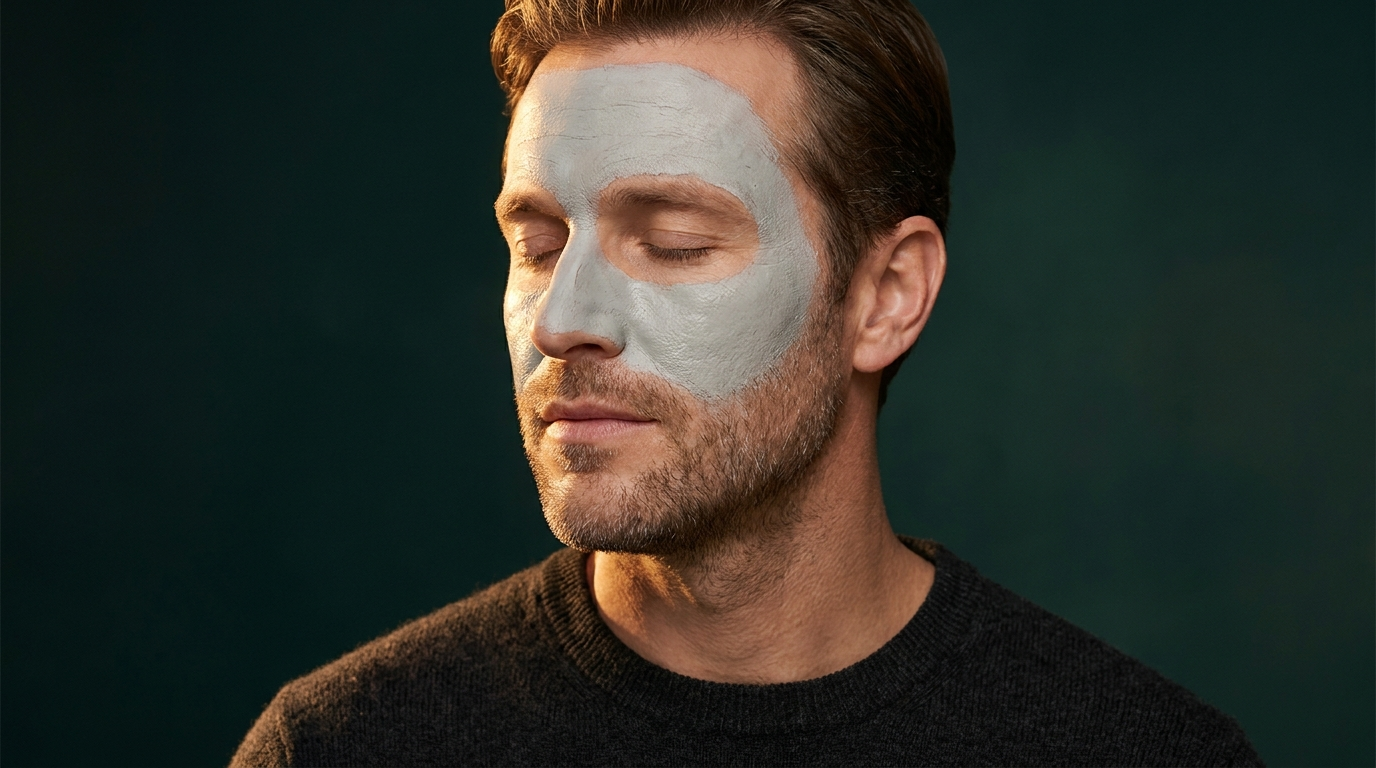
This is the most suitable action when shine dominates on the forehead, nose, and chin.
Mix one tablespoon of kaolin, two teaspoons of lukewarm water, and half a teaspoon of glycerin. Glycerin is not a detail: it prevents the clay from drying too quickly and pulling on the skin.
Spread only on the T-zone, avoiding the cheeks and any area shaved that day. Leave on for six minutes.
Moisten with wet fingers before rinsing: the clay reactivates and detaches itself, which avoids rubbing.
Never let it crack. Dry clay stops absorbing sebum and starts drawing water from the skin—this is the mistake that explains the sensation of tightness wrongly attributed to the product.
Once a week is enough. Space out if the skin feels tight after rinsing.
Comfort mask after shaving or exposure
To be used on the day of shaving, or after cold, wind, or a day outdoors.
Mix one tablespoon of aloe gel, one teaspoon of honey, and half a teaspoon of jojoba oil. Aloe and honey provide water and retain it, while jojoba provides lipids that limit evaporation.
Apply for eight minutes on areas without visible irritation, then rinse with lukewarm water and apply a cream.
Prepare a single dose and discard the rest: a preparation containing water and handled with fingers does not keep, even in the refrigerator.
Two caveats. Honey is a recognized contact allergen, especially for people sensitive to pollen or hymenoptera stings: test under the jaw before the first full application. And on an open shaving cut, do not apply anything.
Applying with a beard
| Situation | Where to apply | Quantity | Removal |
|---|---|---|---|
| Clean-shaven skin | T-zone or entire face | thin layer | standard rinse |
| Three-day beard | between hairs, very thin layer | 1/2 tsp | rinse thoroughly |
| Full beard | forehead, nose, upper cheeks only | 1/2 tsp | avoid hair mass |
| Shaved head | forehead and scalp | thin layer | sunscreen afterwards |
The rule derived from the table: the denser the beard, the more the mask is limited to uncovered areas. Clay caught in the hair is difficult to rinse out, and residual bits cause itching.
A clean synthetic brush spreads the product better around short hairs than finger application, and deposits a more even layer. Wash it after each use and let it dry completely, head down.
For a full beard, the skin underneath requires separate care—beard oil or serum applied at the root—rather than a mask.
Finally, on a shaved head, the mask provides no sun protection and the exposed surface is much larger than a face. Adjust the amount of sunscreen accordingly.
Razor burn, ingrown hairs, blackheads: three distinct problems
They are often confused, and the same product does not treat them.
Razor burn is an immediate mechanical irritation: redness, warmth, stinging within an hour of using the blade. It relates to technique—new blade, shaving with the grain, skin and hair properly softened with warm water—not a mask. The useful action is to apply nothing active that day.
Ingrown hair forms when the cut hair grows back under the skin instead of exiting the follicle. Gentle and regular exfoliation, away from shaving, clears the opening and prevents its formation. For an already ingrown and inflamed hair, leave the area alone and never extract with tweezers.
A blackhead is a plug of oxidized sebum inside the pilosebaceous canal—it has no relation to shaving. No mask reaches the inside of the pore; only a fat-soluble active ingredient enters it. A product with salicylic acid, applied away from the blade, is the appropriate tool. See our blemish routine.
Choosing your mask according to your skin type
The "men's facial care" section categorizes by packaging; it should categorize by need.
For oily skin, shiny from midday across the entire face, a weekly clay mask on the T-zone remains the best choice. Kaolin suits most skin types; rhassoul and bentonite, being more absorbent, are reserved for truly oily skin.
For combination skin—the most common configuration—application is by zone: clay on the forehead and nose, moisturizing mask on the cheeks, all on the same evening. Treating the entire face with a single product will inevitably mistreat half of it.
For dry or dehydrated skin, which feels tight after cleansing, clay should be avoided. A cream mask containing glycerin, panthenol, or hyaluronic acid nourishes without stripping and can be applied to the entire face.
For sensitive skin, recognizable by redness and easy stinging, the rule is the shortest possible formula, without fragrance, menthol, or alcohol. Application time should be halved.
A word on the eye contour: none of these preparations belong there. The skin there measures less than a millimeter and cannot tolerate clay, acids, or the pulling of removal. Keep at least a centimeter away from this area.
As for masks marketed as anti-aging, they fall under a different logic: signs of skin aging occur in the dermis and respond to daily active ingredients—retinoids, vitamin C—and especially to sun protection. A weekly mask improves immediate appearance, not established relief.
A sustainable weekly routine
- A cleanser with a pH close to 5-6, morning and evening. A very alkaline shaving foam is already enough to shift the skin's pH; no need to add more.
- One mask per week, at most, chosen according to the dominant need.
- Never a mask on shaving day, except for the comfort mask described above.
- A cream after each rinse, fragrance-free if skin reacts.
- Sunscreen every morning, including and especially on a shaved head.
To know if the action is effective, test it for a month: kaolin in week 1, hydrating mask in week 2, no application in week 3, then in week 4 only the one that provided a benefit.
Photograph your forehead and nose in the same light, at the same time. Visual memory is a poor judge of progressive changes, and the immediate effect after rinsing means nothing: all skin is temporarily smooth after coming out of water.
What a mask does not do
It does not permanently reduce sebum production, which depends on androgens and genetics. It removes what is on the surface, for a few hours.
It does not tighten pores, whose diameter cannot be modified by a topically applied product.
It does not compensate for an unsuitable shaving technique. If the skin burns after every pass, it's the blade, its freshness, or the direction of shaving that needs changing—not the product applied afterwards.
And it does not replace daily cream or sun protection. It is a one-time action on a specific area, useful for that purpose and nothing more.


Go further than this article
Get our skincare guides by email — and start with your free skin diagnostic: 2 minutes, advice tailored to your skin. We ship to the US, UK, Canada, Australia and 27 European countries; somewhere else? Sign up and you will be the first to know when we deliver to your country.
By signing up, you agree to our privacy policy. Unsubscribe in one click.