Hydrogel facial mask: structure, application, and evidence
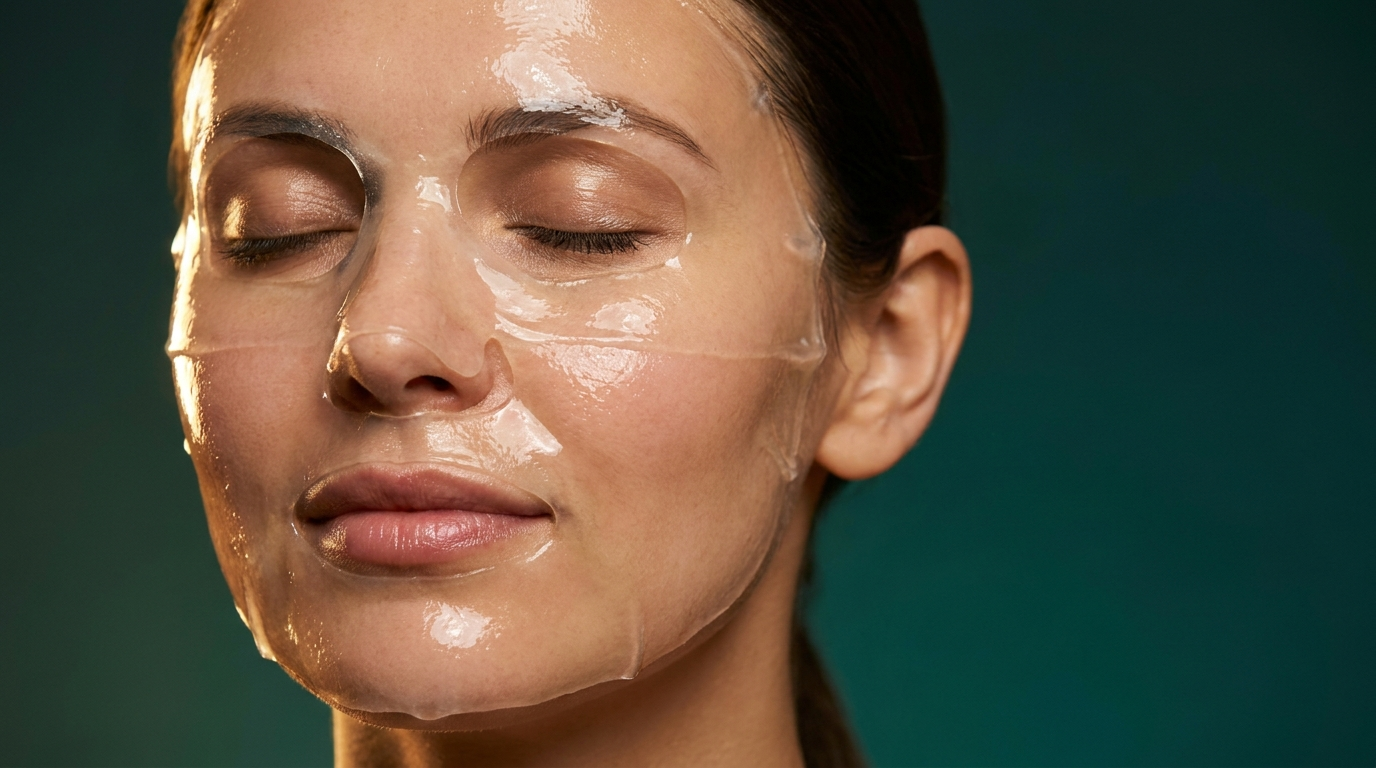
A hydrogel face mask is a water-saturated material that conforms to the contours of the face and creates temporary occlusion; its main purpose is surface hydration. The quality depends on the polymer network, the serum, adherence, and application time. A thick or transparent texture does not indicate deeper action.
A Water-Saturated Polymer Network
A hydrogel is a three-dimensional network of hydrophilic polymers capable of absorbing a large amount of water without dissolving. Alginate, carrageenan, gelatin, cellulose, polyacrylate, or hyaluronic acid can be part of this structure.
The mask remains flexible because water is trapped within the network. The occlusive sensation slows down evaporation during the application time.
Monobloc Hydrogel, Patches, and Biocellulose Masks
| Support | Composition | Contact | Key Benefit |
| Monobloc Hydrogel | Cross-linked gel | Very close | Cooling sensation |
| Hydrogel Patch | Thick gel | Targeted area | Eye contour |
| Biocellulose | Fibers + serum | Very conformable | Adherence |
| Fabric | Non-woven + serum | Variable | Lower cost |
A hydrogel face mask is often heavier and more occlusive than a fabric mask. Biocellulose is not strictly speaking a hydrogel, even though both formats are sold in the same category.
What Hydration Measurements Show
Studies on gelatin-hyaluronic acid membranes showed a significant increase in surface moisture after ten minutes. These results concern a specific experimental material and do not describe all commercial products.
A preliminary study published in 2026 on an alginate-nanodispersion mask observed variations in hydration, elasticity, and water loss after a sixty-minute application. The small sample size requires cautious interpretation.
Read the INCI list before checking the number of active ingredients
The first part of the INCI list reveals the base: water, glycerin, butylene glycol, polymers, then active ingredients and preservatives. Ten plant extracts listed after the fragrance do not guarantee a high dose.
Look for a fragrance-free formula if your skin is sensitive. Hydrogels create occlusion, which can increase the contact of each component with the skin.
Fifteen-Minute Protocol Without Letting It Dry
Cleanse, dry, then open the sachet. Remove the protective films, place the lower part first, then the upper part. Smooth from the center outwards.
Leave on for fifteen minutes. Remove before the mask retracts or dries. Massage the remaining serum for thirty seconds, then apply a cream if your skin feels tight.
- Clean, dry face
- Films removed
- 15 minutes
- Remove before drying
- Cream if necessary
Why the Product Slides and How to Correct It
The weight of the gel, an overly moist face, or a poorly adapted cut can cause it to slide. Lie down for five minutes or make two small incisions at the edge of the chin if the manufacturer allows it.
Do not fix the mask with plastic film. Additional occlusion increases heat and the risk of discomfort.
Refrigeration, Travel, and Storage
A sealed sachet can be placed in the refrigerator for twenty minutes. Do not freeze it. Frozen gel becomes rigid and can crack.
An opened sachet is for single use. The remaining serum is not designed to be stored for several days in another container.
Sensitive, Mature, or Dehydrated Skin
For sensitive skin, prioritize panthenol, beta-glucan, glycerin, and the absence of fragrance. Mature skin may look for peptides or niacinamide, but the actual dose must be documented.
For dehydrated skin, the mask primarily improves surface water content. A lipid-rich cream prolongs comfort after removal.
The hydrogel face mask here specifically refers to this need, with its own gestures, doses, and limitations.
The mechanical strength of the gel determines whether it tears upon removal. A higher polymer concentration often increases resistance but can decrease serum release.
The mesh size of the network controls the diffusion of water and molecules. A bulky active ingredient may remain trapped more than a small humectant.
Alginate forms gels in the presence of calcium ions. Powder masks that require mixing often use this reaction to create a molding film.
A two-part mask better conforms to the contours of the nose and chin. Poor adherence creates air pockets where occlusion is weaker.
Corneometer measurements reflect the water in the stratum corneum. They do not demonstrate a modification of fibroblasts or collagen.
A cooling sensation comes from water and evaporation. It does not prove a lasting decongestant action.
Under-eye patches sometimes contain a lot of silicone or film-forming polymers. Two applications per week are sufficient to assess their usefulness.
A scented hydrogel mask can become more irritating under occlusion. Reactive skin benefits from choosing a shorter formula.
What Hydrogel Does Not Prove
A transparent and thick hydrogel face mask does not guarantee penetration into the dermis. The majority of the immediate effect comes from occlusion, water, and humectants.
The format does not replace a daily routine. Nor does it justify a high price without clear composition, finished product testing, and proper packaging.
PERSONALIZED ROUTINE
Nopal Life Skin Intelligence™
Free diagnostic · 2 minutes
DISCOVER MY ROUTINE →


Go further than this article
Get our skincare guides by email — and start with your free skin diagnostic: 2 minutes, advice tailored to your skin. We ship to the US, UK, Canada, Australia and 27 European countries; somewhere else? Sign up and you will be the first to know when we deliver to your country.
By signing up, you agree to our privacy policy. Unsubscribe in one click.