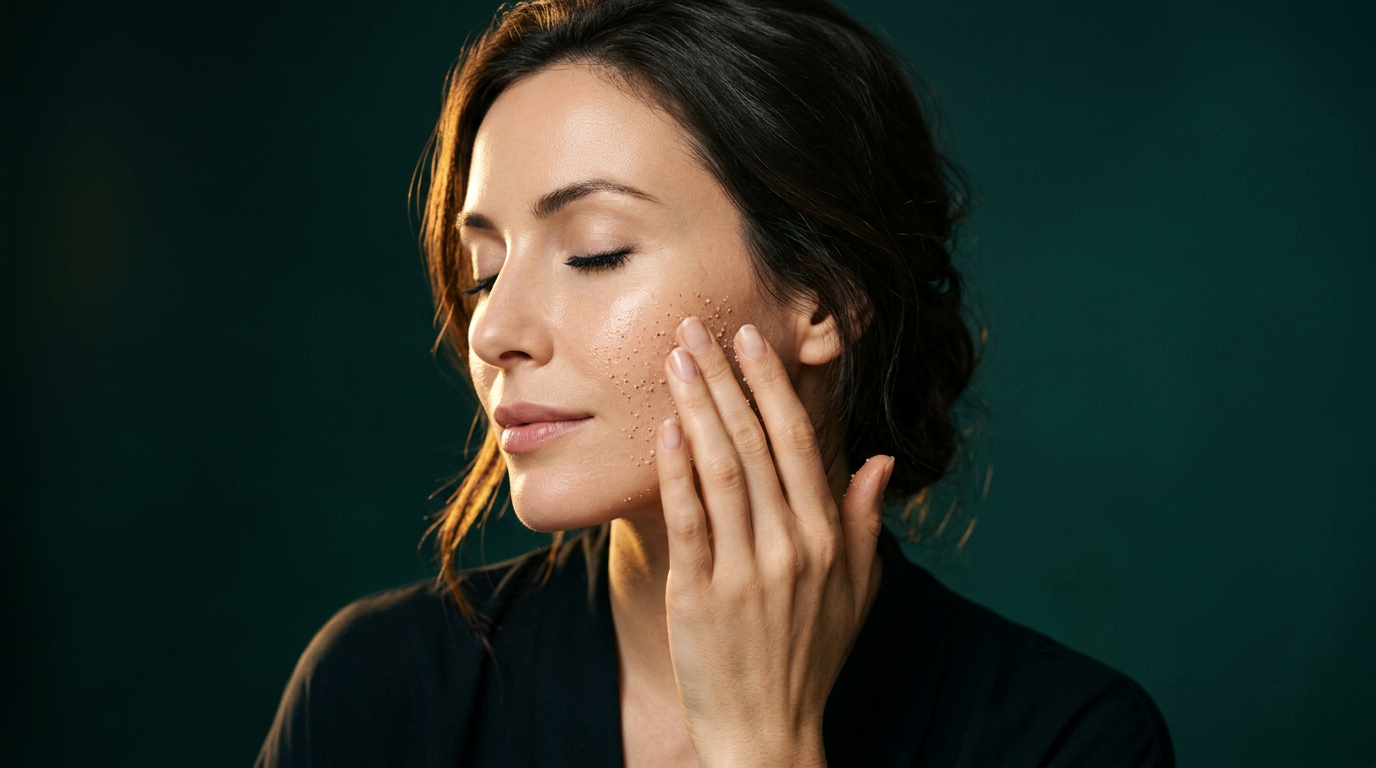
homemade facial scrub: exfoliate in moderation
A homemade exfoliant should smooth without scratching. Irregular grains, kitchen acids, and excessive pressure lead to unpredictable results. A safe recipe prioritizes fine powder, a moist base, and a very short massage time.
Choosing a homemade facial scrub is based on observable criteria, reproducible doses, and monitored tolerance over time.
The stratum corneum naturally renews itself. Exfoliation speeds up the removal of superficial cells, but it should not aim to remove an entire "dead layer." An overly stripped surface loses more water and becomes more reactive.
Mechanical, enzymatic, and acid: three distinct approaches
Mechanical exfoliation uses particle friction. Enzymatic exfoliation employs proteases like papain to weaken certain surface bonds. Acids alter the cohesion between corneocytes depending on their concentration and pH.
At home, the risk comes from imprecision. Fruit juice provides neither reliable concentration nor controlled pH. Sifted cosmetic powder is more predictable than coarse sugar or coffee grounds.
The article on exfoliation compares these methods and their limitations.
Why sugar, salt, and coffee are problematic
Salt and sugar crystals have edges that change during massage. On the face, they can create uneven friction. Coffee grounds have varying particle sizes and pressure that is difficult to gauge.
The body sometimes tolerates these textures better on thicker areas, but the face requires fine and regular granulation. Softness perceived by touch does not guarantee low abrasion at a microscopic level.
A very fine cosmetic flour or colloidal oatmeal offers more control.
Rice flour variation: mattifying without overdoing it
Half a teaspoon of very fine rice flour can be mixed with a neutral gel base. The amount of powder should remain small to avoid a dry paste. Massage for less than twenty seconds.
The powder absorbs some of the oily film and provides an immediate matte finish. This effect does not mean that pores have changed size or that the skin will produce less lipids.
The guide rice flour mask offers a complementary use without prolonged abrasion.
Weekly protocol and stop signals
Once a week is sufficient to start. If the skin remains supple and redness-free the next day, the frequency can be maintained. Twice a week is a reasonable maximum for many skin types, but some skins don't need it.
- Do not exfoliate after intense sun exposure.
- Avoid using on the same evening as a retinoid or acid.
- Use pressure comparable to the weight of your fingers.
- Rinse before the paste dries completely.
- Discontinue if burning or peeling occurs.
| Homemade ingredient | Main risk | More predictable option |
| Sugar | Sharp edges and variable pressure | Fine cosmetic powder |
| Lemon | Very acidic pH and sun sensitivity | Formulated and stable active ingredient |
| Baking soda | High alkalinity | Cleanser with appropriate pH |
| Coffee grounds | Irregular particle size | Colloidal oatmeal |
Lemon is not a measured cosmetic acid
Lemon juice has a pH close to 2, and its composition varies depending on the fruit. It also contains compounds that can increase light sensitivity. Applied before exposure, it can promote marks instead of evening out skin tone.
A product based on lactic or glycolic acid indicates a concentration, pH, and instructions. This standardization allows for more controlled use.
The page on lactic acid shows the difference between a formulated active ingredient and a food ingredient.
Hygiene and preservation: prepare just before use
Water transforms a dry powder into a favorable environment for microorganisms. Without a validated preservative system, the preparation must be used immediately. Refrigeration does not sterilize a recipe.
Use a clean bowl, a dry spoon, and potable water. Do not dip your fingers into a jar intended for multiple uses. If the powder smells damp or forms clumps, replace it.
The safety of a recipe depends as much on hygiene as on the choice of ingredient.
Choosing between fine powder and formulated exfoliant
A homemade powder primarily acts through friction, even when it feels soft. An enzymatic exfoliant with papain or bromelain breaks down surface proteins, while lactic acid works according to its concentration and pH. These three methods should not be combined on the same evening. For sensitive skin, choose only one method every ten days. For oily and thick skin, a weekly frequency may be tolerated. For dry mature skin, a formulated product at a low concentration is often more reproducible than a household grain.
After exfoliation, do not use a cleansing brush, retinol, or very acidic vitamin C for twenty-four hours if the skin is reactive. Apply a serum with glycerin or panthenol, then a cream with squalane or ceramides. The next day, use an adequate amount of SPF 50+. Photograph the texture in the same spot before and after four applications. An improvement in touch does not justify increasing pressure or frequency, as excess often manifests after several sessions.
Pressure is as important as the ingredient. Place your index and middle fingers flat and move the skin without creasing it. Six light circles on the T-zone are enough; more turns fine powder into repeated abrasion. Time the action to stay under thirty seconds. Rinse until all particles are completely gone, especially around the nostrils and hairline.
Oat recipe, single use. Pour one tablespoon of very fine oat powder into a clean bowl. Add two teaspoons of lukewarm water and half a teaspoon of honey. Mix until a smooth paste is obtained, apply to damp face, leave on for five minutes, massage for ten seconds, then rinse with lukewarm water.
Rice recipe for combination skin. Mix one tablespoon of rice flour, one teaspoon of aloe vera gel, and one teaspoon of water. Spread a thin layer on the T-zone, leave on for three minutes, then remove with very light movements. Do not use this paste more than once a week.
Grain-free variation for sensitive skin. Mix one tablespoon of plain unsweetened yogurt and one teaspoon of colloidal oatmeal. Apply to cheeks without massaging, leave on for five minutes, then rinse. Yogurt contains lactic acid, but its concentration is not standardized: keep the time short.
| Base | Quantity | Skin type | Frequency |
| Fine oats | 1 tbsp | Dry or sensitive | Once a week |
| Rice flour | 1 tbsp | Combination | Once a week |
| White clay | 2 tsp | Localized oily | Every 10 days |
For blackheads, do not scrub with sugar or salt. Prefer a formulated salicylic acid product between 0.5 and 2%, used according to instructions. Tea tree should not be applied undiluted: concentrated essential oil increases the risk of reaction.
Prepare the mixture just before use. Wash the bowl and spoon, dry them, then discard the rest. A preparation containing water, honey, or yogurt does not have a validated preservative system and should not be stored for several days.
On the chosen evening, cleanse the face, pat dry lightly, apply the recipe, time the application, rinse with lukewarm water, then spread a small amount of simple cream. Avoid retinol, glycolic acid, and acidic vitamin C for twenty-four hours if skin is reactive.
Observe the skin the next morning. Persistent redness, a burning sensation, or patches necessitate stopping. The protocol should improve texture without stripping the hydrolipidic film.
Kaolin recipe for the T-zone. Mix two teaspoons of white clay, one teaspoon of water, and one teaspoon of aloe vera gel. Spread on the nose and chin, keep the paste moist for four minutes, then rinse before it dries completely.
Prickly pear powder recipe. Pour one tablespoon of very fine powder, two teaspoons of water, and half a teaspoon of diluted glycerin. Mix until a smooth paste is obtained, apply for five minutes, then remove without heavy massage.
Quick honey recipe. Mix one teaspoon of honey, one teaspoon of plain yogurt, and one teaspoon of oats. Apply to damp skin for five minutes, massage for only five seconds, then rinse with lukewarm water.
Use a measuring spoon and a timer. A precise recipe allows for reproducing the same protocol and identifying the cause of a reaction. Do not modify the powder, duration, and frequency all at once.
For blemish-prone skin, concentrate powders on thicker areas and avoid open lesions. For mature skin, limit mechanical massage and opt for a fine paste. For dehydrated skin, finish with a cream containing glycerin and ceramides.
Honey-free recipe for oily skin. Mix one tablespoon of chickpea flour, two teaspoons of water, and one teaspoon of aloe vera gel. Spread a thin layer, leave on for four minutes, moisten with fingertips, then rinse without prolonged rubbing.
Yogurt and rice recipe. Mix one tablespoon of plain yogurt, one teaspoon of rice flour, and half a teaspoon of water. Apply to the face, avoiding the eye area, leave on for five minutes, then rinse. Do not add lemon or essential oils.
Granulometry control. Rub a pinch of powder between two damp fingers. If grains remain distinctly palpable, sift the powder or choose a finer grind. An angular particle can multiply micro-friction without improving exfoliation.
A homemade scrub should remain occasional. Space two sessions at least seven days apart and observe the skin for twenty-four hours. If the face feels tight, red, or peels, stop and return to a gentle cleanser, a simple cream, and sun protection.
Very fine bran recipe, reserved for non-sensitive skin. Mix one tablespoon of sifted oat bran, two teaspoons of water, and one teaspoon of honey. Apply to damp skin, leave on for three minutes, perform a maximum of five circular movements, then rinse with lukewarm water. Do not use this formula on skin that is itchy, peeling, or has red areas. Finish with a small amount of unscented cream and wait seven days before any new exfoliation.
Always time it.
What a scrub does not change
It does not erase deep wrinkles, tighten pores, or transform skin type. The immediate smoothing comes from the removal of superficial irregularities and the water provided during the process.
It is not suitable for skin that is itchy, has persistent redness, or lesions. Professional advice is preferable before any additional manipulation.
The best homemade exfoliation is rare, light, and discontinued as soon as the skin shows signs of excess.
What fine powder changes compared to sugar
The criticism of sugar and salt is not the exfoliation itself, but the sharp edge of the grain and the subsequent stripping. A finely ground seed powder in an oily base avoids both: this is the principle of a prickly pear exfoliating soap, where the fats compensate for what the powder removes.


Go further than this article
Get our skincare guides by email — and start with your free skin diagnostic: 2 minutes, advice tailored to your skin. We ship to the US, UK, Canada, Australia and 27 European countries; somewhere else? Sign up and you will be the first to know when we deliver to your country.
By signing up, you agree to our privacy policy. Unsubscribe in one click.