Combining vitamin C and panthenol: the method
This combination makes vitamin C accessible to skins that tolerate it poorly. Panthenol soothes and retains water; vitamin C corrects complexion and protects. One makes the other tolerable, which is rarely stated so clearly.
Key points
- Order: vitamin C first, then panthenol.
- Skin: damp when applying.
- Progression: panthenol alone for three weeks, then vitamin C.
- Essential: a moisturizer and sunscreen.
- Timelines: a few days, then 4 to 8 weeks.
Why this combination solves a real problem
Many people give up on vitamin C because of tingling. This rarely comes from the active ingredient itself: it comes from an overly permeable skin barrier, which allows it to reach layers where it doesn't belong.
Panthenol specifically addresses this issue. Over two to three weeks, the barrier becomes more watertight, and the same vitamin C, at the same dosage, stops stinging.
The problem wasn't the product: it was the skin receiving it.
Order of application
Both are water-soluble, but vitamin C goes first: it's the demanding active ingredient, and it needs to reach the skin without intermediaries.
Panthenol comes next, followed by a moisturizer. Many formulas combine the two in the same serum, precisely for this reason of tolerance.
The progression, week by week
Weeks 1 to 3: panthenol alone, morning and evening. Give it time to work on comfort.
Week 4: add vitamin C every other day.
Week 5 and beyond: every day if all goes well.
For truly reactive skin, choose a stabilized vitamin C derivative rather than pure ascorbic acid. Tolerance is much better, at the cost of slower action.
What vitamin C provides
Antioxidant action against free radicals, action on dark spots, and a role in collagen production. It is a corrective active ingredient whose effects are measured over four to eight weeks.
Its fragility requires precautions: opaque bottle, pump, small volumes. A vitamin C serum that has turned orange is no longer useful.
Its action focuses on radiance and protection against oxidation produced by radiation. It is a morning active ingredient, and sunscreen applied over it doubles the benefit instead of replacing it.
On irritated skin, it requires slow introduction. The different derivatives—ascorbyl glucoside, ascorbyl phosphate—are better tolerated than pure ascorbic acid, with more progressive action and better stability over time.
What panthenol provides
Rapid soothing and water retention, with one of the best tolerances in cosmetics. Its effect on comfort is felt within a few days.
Panthenol does not act on spots or complexion. Its role here is to enable the use of an active ingredient that, alone, would be abandoned.
It retains water in the superficial layers and calms feelings of discomfort. This double action makes it the natural complement to a demanding active ingredient: it precisely compensates for what vitamin C can cost in terms of tolerance.
Its presence often allows one to maintain a routine that would otherwise have been abandoned. In skincare, consistency outweighs potency, and a well-tolerated active ingredient for six months is better than a strong active ingredient stopped after three weeks.
The daily protocol
After gentle cleansing, pat dry without rubbing. Vitamin C on still damp skin, then panthenol, wait one minute, then a moisturizer.
Finish with sun protection in the morning. An antioxidant routine without sun protection is a contradiction: you try to limit damage while letting its cause act.
Adding other active ingredients
Panthenol combines with almost everything. With niacinamide, hyaluronic acid or a cream with ceramides, no difficulty.
With retinol, keep vitamin C in the morning and retinoid at night—panthenol can accompany both moments. This is the most comfortable separation.
Hyaluronic acid can be easily incorporated between the two, on damp skin. Niacinamide is usually applied in the morning, alternately; retinol, on the other hand, is reserved for the evening, and never in the same application as vitamin C.
This is the general rule for skincare: one strong active ingredient per time of day. On irritated skin, this principle is even more important, and panthenol remains the only addition that requires no precautions.
According to your skin type
Reactive skin: the central indication for this combination.
Oily skin: suitable as is, with a light gel-cream.
Dry skin: add a rich cream or oil after panthenol.
Normal skin: vitamin C alone is often sufficient, with panthenol providing comfort.
On what timelines to judge
Comfort returns in a few days thanks to panthenol. The radiance provided by vitamin C is noticeable in four to six weeks, while spots take two to three months.
Only change one parameter at a time during this period, otherwise the result will be unassignable.
A combination that prevents abandonment
Vitamin C is the active ingredient that people give up on the most. Rarely because it is ineffective—most often because it tingles and one concludes that it is unsuitable.
Panthenol addresses this precise point. This is the most concrete reason to combine the two, and it is better than an argument of cumulative efficacy.
Forms of vitamin C to know
Pure ascorbic acid is the most effective and the most demanding. Stabilized derivatives—ascorbyl glucoside, tetrahexyldecyl ascorbate—are gentler and act more slowly.
On reactive skin accompanied by panthenol, a stabilized derivative is the best starting point. You can switch to ascorbic acid later if you wish.
The pH determines everything with this active ingredient. Pure ascorbic acid requires an acidic environment, around 3.5, which explains the tingling reported on delicate skin. Its derivatives work at neutral pH and can be applied without this constraint.
These forms combine differently with the rest of the routine. Vitamin C and hyaluronic acid coexist without difficulty; vitamin C and niacinamide need to be separated during the day on reactive skin; vitamin C and retinol are never applied at the same time, as the oxidative stress of one cancels out the work of the other.
What sun protection changes
An antioxidant routine without sun protection is like bailing out a leaky boat. This is particularly true for spots, which darken with the slightest exposure to radiation.
In the morning, always finish with sun care. This is the step that conditions the result of everything that precedes, including panthenol.
On hair and scalp
Panthenol is widely used in hair care, where it improves suppleness and limits breakage during detangling. Vitamin C has no established use in this context.
If you use a panthenol serum, any remaining product applied to dry lengths will not be wasted—though don't expect too much from it.
The final word
None of this cures anything. A cosmetic acts on appearance and comfort, and stops there. A persistent lesion or an evolving spot requires a consultation, not an additional bottle.
Panthenol makes vitamin C tolerable
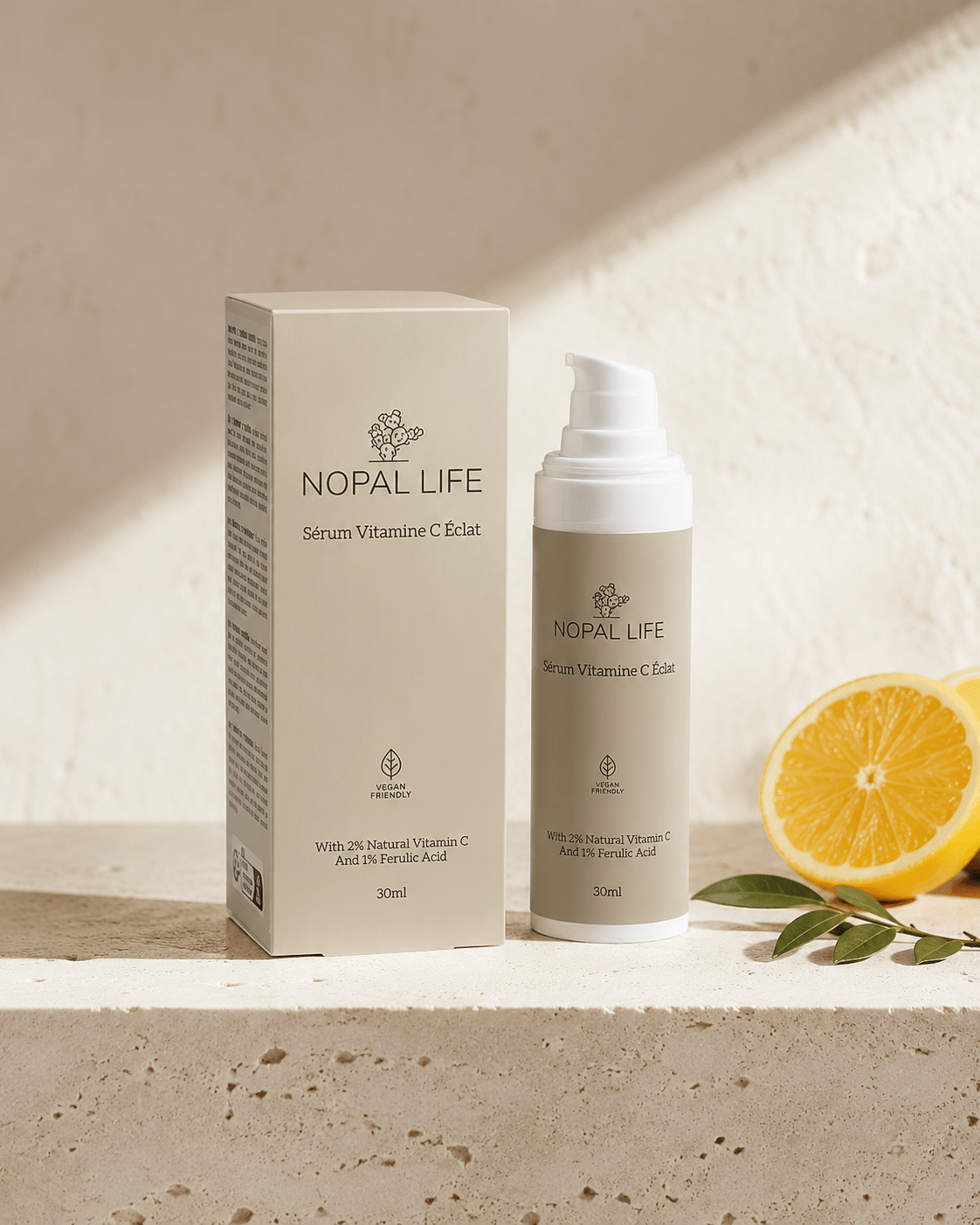
This is its true role in this pair: it doesn't enhance the action of ascorbic acid; it absorbs the discomfort of the first few weeks. A vitamin C glow serum in the morning, a panthenol treatment over it, and the routine lasts long enough to see some results.
Our anti-aging treatments