Vitamin C or Squalane: Which One for Your Skin?
One is an active ingredient, the other a texture: the question is poorly posed. Vitamin C is a water-soluble antioxidant that works on radiance and dark spots. Squalane is a neutral emollient, without its own active properties, whose value lies in its lightness and tolerance. They occupy two different places in a routine.
What distinguishes them
| Criterion | Vitamin C | Squalane |
|---|---|---|
| Nature | antioxidant active ingredient | neutral emollient |
| Solubility | water-soluble | lipid-soluble |
| Place in routine | serum, early | final step |
| Action | radiance, dark spots, free radicals | seals, softens |
| Tolerance | good, sometimes tingling | excellent |
| Stability | fragile in air and light | very stable |
What Vitamin C does
It neutralizes some of the free radicals generated by exposure and pollution, which justifies its use in the morning. It also works on dark spots and skin tone uniformity, and is involved in collagen production.
Its difficulty is its stability. Pure ascorbic acid oxidizes quickly on contact with air: a serum that has turned orange has lost most of its benefit. Stabilized derivatives, such as tetrahexyldecyl ascorbate, are more reliable, lipid-soluble, and act more slowly.
What Squalane does
It provides neither vitamins, antioxidants, nor essential fatty acids. It is a neutral emollient, whose function is to seal the routine and soften the surface.
Its texture is remarkably light, it leaves no film and has no scent. Its tolerance is excellent, including on sensitive skin and on those who cannot tolerate vegetable oils. It penetrates quickly, making it comfortable even in the morning under makeup.
Where squalane comes from today
A question often comes up, and it is legitimate. Squalene was historically extracted from shark liver oil. This is no longer the case for common cosmetic products: squalane sold today is of plant origin, obtained from olive or sugarcane.
The mention "plant-derived" generally appears on the packaging. In its absence, the question deserves to be asked to the brand.
Which one to choose
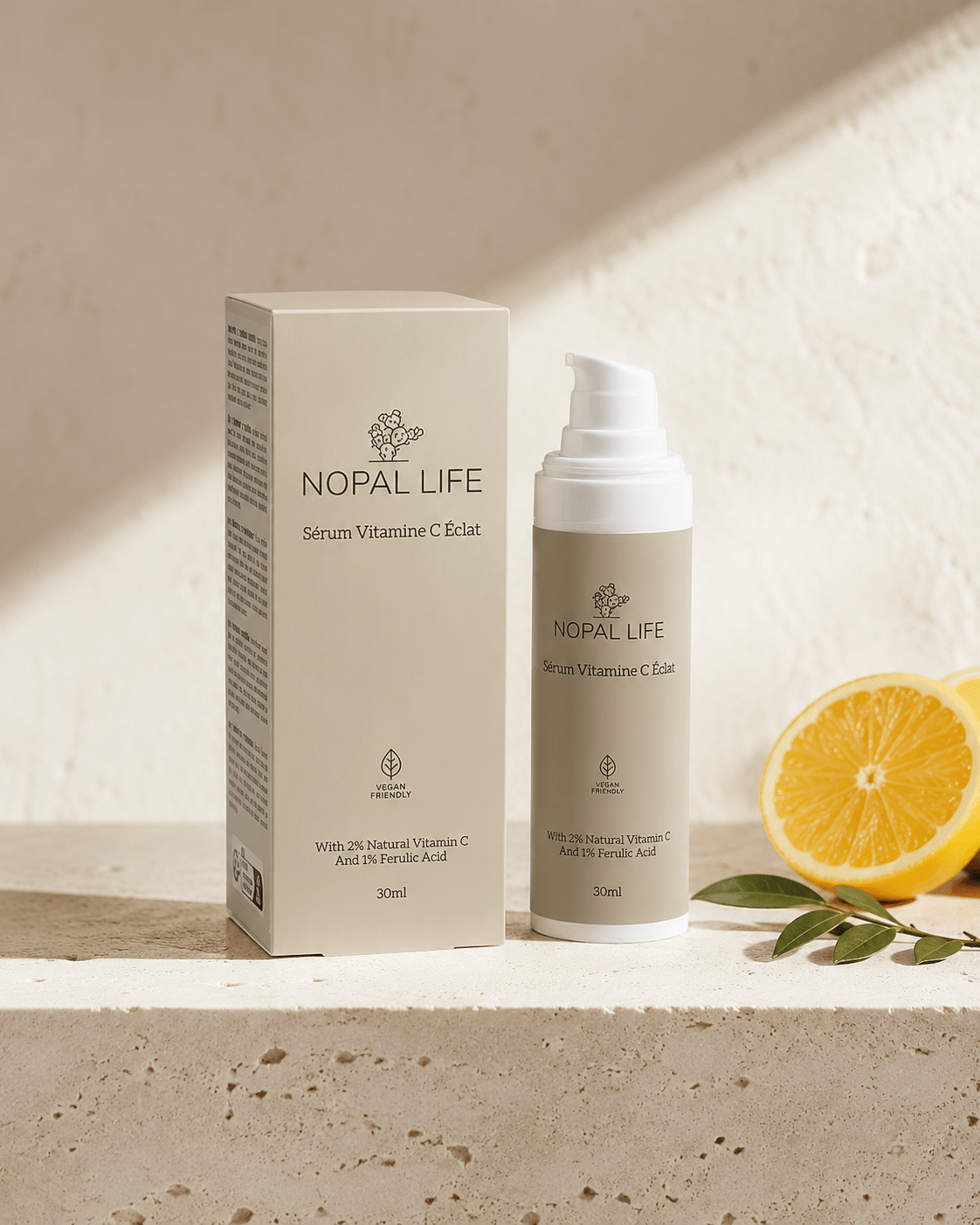
Dull complexion, dark spots, lack of radiance: vitamin C, the only one of the two to act on these points.
Skin lacking comfort, unable to tolerate rich textures: squalane.
When in doubt: both. They do not overlap in any way and their combination poses no difficulty.
Using them together
This is the most common and logical use. Aqueous before oily, as always.
1. Gentle cleansing.
2. Vitamin C serum on clean skin, a few drops.
3. Wait one minute.
4. Three to four drops of squalane — its lightness allows for a slightly larger amount than a vegetable oil.
5. Sun protection in the morning.
A special case: lipid-soluble vitamin C
Some serums directly combine squalane with a lipid-soluble vitamin C derivative. The logic is different: squalane acts as a vehicle, and the entire product is applied in a single step.
These formulas are gentle and well-tolerated, with a more gradual action than classic ascorbic acid. This is a good choice for sensitive skin that cannot tolerate concentrated aqueous serums.
What squalane will not do
It does not hydrate in the strict sense: it retains existing water without providing any. On dehydrated skin, add a humectant underneath, otherwise you are sealing an empty surface.
It does not nourish either. If your skin lacks lipids, a vegetable oil rich in essential fatty acids will do more — see our ingredient fact sheet.
Storing your products
Squalane is very stable and requires no special precautions. Vitamin C is demanding: opaque bottle, pump rather than dropper, small volumes, away from heat.
A serum that has turned orange should be replaced, regardless of its price.
100% plant-derived origin
Cosmetic squalane is now obtained from olive oil or sugarcane, then hydrogenated to make it stable. The result is a 100% pure molecule, odorless and colorless, which can be stored for years without going rancid.
This purity explains its tolerance: there is nothing else in it. This is also what distinguishes it from a vegetable oil, whose richness is both its advantage and its variability.
Which skin types benefit
Almost all, which is rare for a fatty substance. Oily skin appreciates it for its fine texture, dry skin for its comfort, reactive skin for its lack of additives.
The sensations it leaves are its signature: supple skin, never shiny, and no residue to the touch about ten minutes after application.
Improving skin elasticity: what is realistic
Well-hydrated skin appears more supple, and this is often mistakenly called an increase in elasticity. True elasticity depends on dermal fibers and cannot be changed by cosmetic means.
What vitamin C brings to this area is indirect: it is involved in the synthesis of collagen. Squalane, however, does not participate at all — it simply makes the skin more comfortable, which is not the same thing.
Limitations
None of this cures. A cosmetic acts on appearance and comfort, and stops there. If your skin remains uncomfortable after several weeks of an adapted routine, you should see a dermatologist, not another bottle.
Squalane does not correct anything
It provides comfort and a silky finish, but it does not act on dark spots or skin tone uniformity. If your complexion is your concern, squalane will never replace a vitamin C serum — it accompanies it, in a subsequent layer.
Our anti-aging treatments