Prickly pear oil composition: the numbers
Key takeaways
- The lipid profile is dominated by linoleic acid, approximately 60-62% according to literature — 48.40% in our 2026 batch of the total, followed by oleic (15-22%) and palmitic (12-14%): an "omega-6 predominant" profile, rare among renowned anti-aging actives.
- Vitamin E is not what you might expect: the dominant fraction is gamma-tocopherol, around 80-90% of the total, not the alpha-tocopherol found in common oils. Almost no product sheets specify this.
- Total tocopherols range between 700 and 1,000 mg/kg depending on the terroir and vintage — a similar order of magnitude to argan, but with a very different distribution.
- The unsaponifiable fraction (1-2%) is rich in phytosterols, of which β-sitosterol represents approximately 70%.
- Our analytical certificate reading guide (five numerical indicators) and our five reception checks, which can be performed without equipment, allow you to verify for yourself that a purchase matches this description.
What distinguishes prickly pear seed oil is not a single ingredient, but an unusual combination: a largely predominant essential fatty acid, a particular type of tocopherols, and a dense unsaponifiable fraction. Here, with supporting figures, is what a bottle actually contains — and how to verify that what you have in your hands matches the description.
What the bottle actually contains
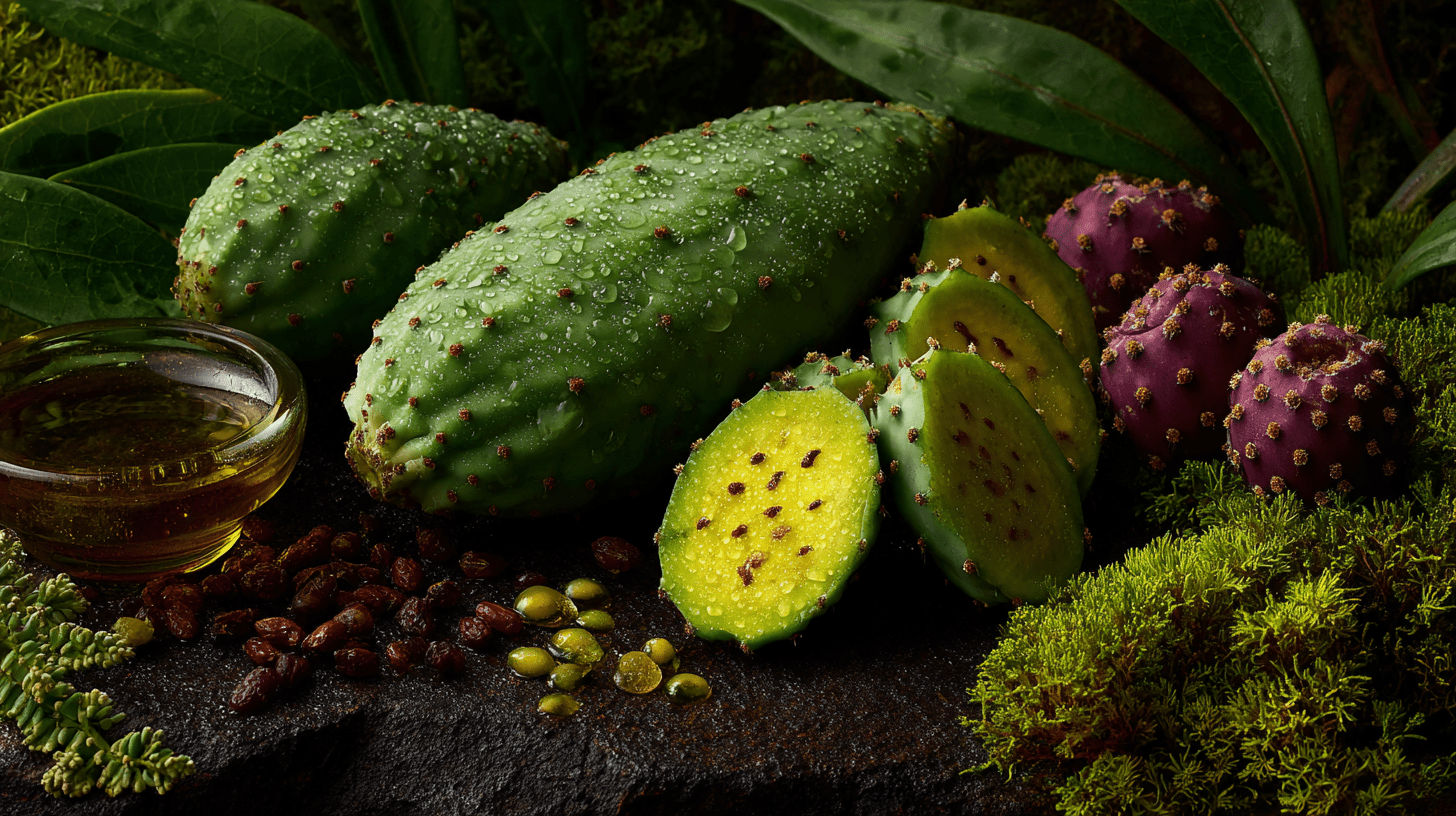
The oil is obtained by pressing the seeds of the prickly pear fruit, Opuntia ficus-indica, a cactus native to the American continent, acclimatized for centuries around the Mediterranean basin and North Africa. It is not a pulp extract: the fruit pulp is watery and mucilaginous, yielding powders and hydrosols, never a fatty substance. All the fatty matter is concentrated in the tiny seeds, which represent a modest portion of the fruit's weight and contain only a small proportion themselves.
Chemically, what is called a vegetable oil is divided into two unequal fractions. One, called saponifiable, represents 98-99% of the weight: these are triglycerides, meaning fatty acids assembled in threes around a glycerol molecule. The second, the unsaponifiable fraction, weighs only 1-2% — but it concentrates tocopherols, sterols, carotenoids, and phenolic compounds. In a cosmetic formula, the major fraction determines the texture and affinity with the skin; the second determines stability and most of the desired properties.
Here is the overall distribution, as it emerges from published studies on these seeds. The values are orders of magnitude: as with any agricultural raw material, they vary with terroir, variety, harvest year, and extraction process.
| Fraction | Compound | Share of Total | Role in Cosmetics |
|---|---|---|---|
|
Saponifiable 98 – 99 % |
Linoleic (C18:2, omega‑6) | 60 – 62 % of fatty acids | Essential chain, strong affinity with stratum corneum lipids |
| Oleic (C18:1, omega‑9) | 15 – 22 % | Suppleness, feel, aids penetration | |
| Palmitic (C16:0) | 12 – 14 % | Body and texture hold | |
| Stearic (C18:0) | 3 – 4 % | Stability of lipid structure | |
|
Unsaponifiable 1 – 2 % |
Tocopherols (vitamin E), of which gamma 80 – 90 % | 700 – 1,000 mg/kg | Antioxidant; also protects the oil itself from rancidity |
| Phytosterols, of which β‑sitosterol ≈ 70 % | ≈ 8 – 10 g/kg | Contribute to suppleness and good tolerance | |
| Phenolic compounds | Traces | Enhance resistance to oxidation | |
| Carotenoids and pigments | Traces | Give the characteristic golden yellow tint |
Three key insights emerge, structuring the rest of this article. Firstly, it is an omega-6 predominant fat, which is far from the norm in this category of skincare. Secondly, its antioxidant fraction does not belong to the same family as that of common oils. Finally, its unsaponifiable fraction is proportionally dense, which an aggressive extraction process is enough to deplete. For an overview of the uses resulting from this profile, the article Prickly Pear Seed Oil: All its benefits for the skin usefully complements this technical reading.
The lipid profile, with supporting figures
The fatty acids in a vegetable fat are not interchangeable. Their chain length and number of double bonds determine fluidity, penetration speed, the feel left on the skin, and susceptibility to oxidation. A lipid profile is therefore the functional identity card of an oil: two samples at the same price and color can behave radically differently depending on the distribution of their chains.
Linoleic, predominant and essential
At 60-62% of the total, it is largely dominant. The term essential fatty acid is not an advertising claim: it means that the human body does not have the necessary enzymes to synthesize it and must therefore receive it from external sources. On a cutaneous level, this chain is incorporated into the structure of type 1 ceramides, the lipids that cement the corneocytes of the stratum corneum and limit transepidermal water loss.
A practical consequence follows. Fats very rich in linoleic acid have a marked affinity with the surface lipid matrix: they integrate into it instead of remaining as a film, which explains their dry feel and rapid penetration. This is exactly the sensation described by users — a small amount disappears in one to two minutes, with no residual greasy film, whereas an oleic-dominated oil remains perceptible much longer.
This same characteristic explains good tolerance on combination to oily skin types, whose surface film is often relatively poor in linoleic acid. A substance that mainly provides oleic acid is less well accepted there; a linoleic oil blends better. This topic is expanded in Prickly Pear Oil for oily skin: Is it suitable?.
The flip side: the more double bonds a chain has, the more susceptible it is to oxidation. An oil with 60% linoleic acid is intrinsically more fragile than an oil with 60% oleic acid. This is precisely what makes its natural tocopherol content so crucial — we'll get to that.
Oleic and saturated chains
Oleic, between 15 and 22%, plays a secondary but useful role. Monounsaturated and more stable, it softens the texture and facilitates the diffusion of lipophilic compounds through the initial layers. Its moderate proportion strikes a happy balance: enough to provide comfort, not enough to feel heavy.
Saturated chains — palmitic around 12-14%, stearic 3-4% — form the structural backbone. They are often wrongly described as inert ingredients; in reality, they contribute to the hold of the skin film and the sensation of nourishment. Their contained proportion prevents the oil from solidifying or thickening at cool temperatures, unlike shea butter or coconut oil, which are solid at room temperature.
The comparative table: seven oils, one unit of measurement
Comparing oils solely based on advertising claims leads nowhere. Comparing their lipid profiles, however, allows for informed choices. Here are the accepted orders of magnitude for seven common fats in natural cosmetics.
| Vegetable Oil | Linoleic | Oleic | Total Vitamin E | Texture / feel | Most suitable skin profile |
|---|---|---|---|---|---|
| Prickly Pear Seed | 60 – 62 % | 15 – 22 % |
700 – 1,000 mg/kg (gamma dominant) |
Very dry, penetrates in 1 – 2 min | Mature skin, dry dehydrated skin, combination areas |
| Argan | 29 – 36 % | 43 – 49 % | 600 – 700 mg/kg (gamma dominant) |
Moderately rich, supple | Normal to dry skin, hair, body |
| Rosehip | 44 – 50 % + 30 – 35 % alpha‑linolenic |
14 – 16 % | Low to moderate | Dry, but rapid oxidation | Marked skin; demanding storage |
| Grapeseed | 58 – 78 % | 12 – 25 % | Moderate | Very fluid, light | Combination areas, body use |
| Sweet Almond | 20 – 30 % | 60 – 70 % | Moderate | Enveloping, light film | Dry skin, infants, massage |
| Jojoba (liquid wax) | ≈ 5 % | 5 – 15 % | Moderate | Dry, non-film-forming, very stable | Combination to oily areas, scalp |
| Virgin Olive | 3 – 21 % | 55 – 83 % | 150 – 250 mg/kg | Rich, persistent | Very dry skin, body |
This table highlights a unique position. Highly linoleic fats exist — grapeseed, sunflower — but they are rarely as well-endowed with tocopherols. Oils very rich in antioxidants also exist, but they are most often oleic, and therefore heavier. The combination of these two characteristics makes this profile uncommon, and justifies its placement in the high-end skincare category rather than among basic ingredients. A detailed comparison with argan is offered in Prickly Pear or Argan: which oil to choose?.
Vitamin E: the gamma-tocopherol surprise
This is the most often overlooked, yet most interesting point. Almost all product sheets simply announce a "record vitamin E content." The statement is true but incomplete: what matters at least as much as the quantity is the nature of the tocopherols present.
Alpha, gamma: two forms that don't do the same job
This molecule is not just one; it is a family of eight related compounds: four tocopherols (alpha, beta, gamma, delta) and four tocotrienols. They share a chromanol nucleus carrying a phenol function, but differ in the number and position of methyl groups on this nucleus—a structural detail that changes their entire behavior.
- Alpha-tocopherol is the most studied form in nutrition, the one with the highest vitamin activity in the physiological sense. It is also the major form in sunflower and most added antioxidants in formulas, under the INCI names Tocopherol or Tocopheryl Acetate.
- Gamma-tocopherol has lower nominal vitamin activity but remarkable antioxidant power in the lipid phase—precisely in the environment where fatty chains are found. It effectively intercepts certain reactive species that alpha neutralizes less effectively.
In prickly pear seeds, gamma represents the bulk of the total, around 80 to 90% of the measured tocopherols. This dominance is not anecdotal: it explains how a fat so highly unsaturated—and therefore theoretically fragile—can maintain good stability. Nature has provided the preservative along with the substrate to protect.
What this means for the skin
Two mechanisms overlap, and it is useful not to confuse them.
The first concerns the oil itself. Tocopherols delay the oxidation of linoleic chains, i.e., rancidity. A freshly pressed and well-endowed batch retains its discreet vegetal scent and fluidity longer than a material depleted by refining. This is a gain in stability, measurable in the laboratory by the peroxide value.
The second concerns the skin. Applied topically, these antioxidants join those naturally present in the skin's film. They help limit the visible effects of oxidative stress caused by solar radiation, atmospheric pollution, and tobacco smoke — which, over time, translates into a more even appearance and a less dull complexion. This is a cosmetic contribution to the skin's appearance, not a therapeutic action. The topic is further explored in Vitamin E and prickly pear: an antioxidant duo, and the contribution of phenolic pigments in Prickly pear polyphenols: antioxidants and radiance.
How to read an announced content
Units vary from one product sheet to another, which makes comparisons tricky. Here are the useful equivalences.
| Unit encountered | Equivalence | Expected value here | Note |
|---|---|---|---|
| mg/kg (ppm) | Reference | 700 – 1,000 | Most common unit on analysis certificates |
| mg/100 g | ÷ 10 compared to mg/kg | 70 – 100 | Unit for nutritional use |
| % | 1 % = 10,000 mg/kg | 0.07 – 0.10 % | An announced "1 %" indicates an addition, not a natural content |
| IU | Translates alpha activity only | Less relevant here | Underestimates a material whose tocopherols are predominantly gamma |
The last line deserves attention. Expressing a gamma-rich fat in international units only measures a small part of what it contains, since this unit was designed to account for alpha activity. The sample will appear poor when it is richly endowed. This is a perfect example of an accurate yet misleading figure.
Plant sterols: the fraction that refining erases
After fatty chains and tocopherols, phytosterols constitute the third pillar. These are sterol alcohols from plants, structurally similar to animal cholesterol — a proximity that is not insignificant, since cholesterol is one of the three constitutive lipids of the intercorneocyte cement, alongside ceramides and free fatty acids.
They are found here in the order of 8 to 10 grams per kilogram, or about 1% of the weight, with a clear dominance of β‑sitosterol — around 70% of total sterols. Campesterol and stigmasterol complete the ensemble in smaller proportions.
What this fraction provides comes down to three points, which must be stated precisely so as not to attribute virtues to the oil that do not fall within the scope of cosmetics:
- Structural compatibility. The resemblance of phytosterols to cutaneous cholesterol promotes their integration into the surface film rather than their simple deposition.
- Comfort. Lipid-rich unsaponifiables are known for their good tolerance on reactive and dry skin, where they help maintain a feeling of suppleness.
- Water retention. By contributing to the cohesion of the skin film, this fraction helps limit evaporation, and thus maintain surface hydration.
The decisive point is elsewhere: this fraction is thermolabile and solvent-soluble. Classic refining—bleaching earth treatment, high-temperature deodorization, possible hexane extraction—eliminates a large part of it, while also removing pigments and a portion of tocopherols. The triglyceride remains, but most of the beneficial properties disappear. This is why the mention virgin, cold-pressed is not a stylistic argument, but a technical requirement.
Polyphenols, pigments, and minor compounds
The last few percent of the unsaponifiable fraction gather trace ingredients that contribute to the overall composition. Phenolic compounds enhance overall resistance to oxidation by complementing tocopherols. Carotenoids and related pigments give the golden yellow to amber hue, which varies in intensity depending on the terroir and the year.
This color is a useful visual indicator. An authentic, unrefined material has a clear golden yellow hue, sometimes slightly green. A nearly colorless liquid has most likely been decolorized: the process that removes pigments also removes some of what accompanies them. Conversely, a very dark or brownish hue may indicate an old or heated batch.
Finally, a word about what is not present, and which is just as structuring. There is no water, mucilage, or betalains—the characteristic red pigments of the fruit pulp and powder. The lipid from the seeds and the fruit powder are two distinct things, derived from two different parts of the same plant, with unrelated compositions. Confusion is frequent in poorly written descriptions; it can be resolved by reading the ingredient list, which should include the INCI name Opuntia Ficus-Indica Seed Oil.
From fruit to bottle: what extraction preserves or destroys
A composition is only valuable if it reaches the skin intact. Between the field and packaging, several steps can significantly deplete it. The detailed process is described in Prickly Pear: From Fruit to Oil, the Extraction Process; here's what to remember.
The five crucial steps
- Harvesting. Fruits are picked ripe, by hand, due to the glochids—fine spines that prevent any brutal mechanization.
- Seed separation. The pulp is removed, the seeds are collected, washed, and then dried. Improper drying, at too high a temperature, already degrades tocopherols even before pressing.
- Pressing. This is the critical point. Cold pressing keeps the material below a moderate thermal threshold, generally stated as below 40 °C during the first press. Beyond that, what is gained in yield is lost in the unsaponifiable fraction.
- Filtration. A simple mechanical filtration, on paper or cloth, is sufficient to clarify the liquid without removing anything essential.
- Packaging. The container must be tinted glass, amber or violet, and airtight. Linoleic-rich oil enclosed in transparent plastic loses its benefits within a few weeks of light exposure.
Cold-pressed vs. refined: the honest comparison
| Criterion | Virgin, cold-pressed | Refined or solvent-extracted |
|---|---|---|
| Lipid profile | 60 – 62% linoleic | Slightly modified: triglycerides are resistant |
| Total tocopherols | 700 – 1,000 mg/kg | Greatly reduced by deodorization |
| Phytosterols | ≈ 8 – 10 g/kg | Removed by bleaching earth |
| Color | Golden yellow to amber | Pale to almost colorless |
| Odor | Vegetal, subtle, slightly nutty | Neutral, odorless |
| Texture | Fluid, dry touch | Fluid, often more neutral touch |
| Industrial yield | Low | Significantly higher |
| Production cost | High | Reduced |
The second column explains why some products sold under the same name cost three times less: they are not the same materials. In terms of triglycerides, they are similar; in terms of cosmetic benefits, they are not. The mention virgin and the absence of any solvent in the technical sheet are therefore the first two filters to apply. To go further: Why Cold Pressing Changes Everything.
Labels and mentions: what a certification guarantees
Labels accumulate signs of trust, and not all relate to the same thing. Four families of information coexist, which it's best to distinguish before paying extra for one of them.
| Mention | What it guarantees | What it doesn't say |
|---|---|---|
| Organic certification (COSMOS standard, Ecocert control) | Cultivation method without synthetic inputs, minimum proportion of organically farmed materials, authorized processes listed | Nothing about the freshness of the batch you are buying |
| Virgin, cold-pressed | Absence of refining, decolorization, deodorization, and solvent | Nothing about origin or cultivation method |
| Declared origin (country, region, cooperative) | Traceability of the material and possibility to trace the supply chain | Nothing about the extraction process itself |
| Batch number + analysis date | Link of the certificate to the bottle you are holding | Nothing about storage conditions after shipment |
The lesson is simple: an organic certification issued under the COSMOS standard and verified by an organization like Ecocert is an excellent signal regarding cultivation, but it does not replace either the virgin mention or the traceability of origin. A certified organic material can perfectly well be refined. Information must be checked separately, and it is their combination that is authoritative. The role of terroir is detailed in Terroir and Prickly Pear.
Why such a yield explains the price
The question of price comes up systematically, and it has a strictly material answer. The yield of this raw material is among the lowest in plant-based cosmetics. The orders of magnitude generally accepted in the industry highlight the problem.
| Step | Order of magnitude | Impact on cost |
|---|---|---|
| Fruits needed | ≈ 1 ton | Hand-picked, one by one |
| Seeds obtained | ≈ 30 kg | Approximately 3% of the fruit's weight |
| Volume extracted without heating | ≈ 1 liter | The rest goes to pomace |
| Labor | Very high | Harvesting and washing seeds are difficult to mechanize |
| Observed retail price | Several tens of euros for 30 ml | Compared to a few euros for a basic fat |
In other words, a considerable amount of material is needed to fill a single 30 ml container. A product advertised as pure, extracted without heating, and sold at the price of sunflower oil cannot be: somewhere in the chain, there has been dilution with a carrier, refining, or solvent extraction. The complete reasoning is detailed in Why Prickly Pear Seed Oil Costs More?.
A practical consequence of this rarity is that it is used in very small quantities. Three to four drops are enough for the entire face, and just one for the eye contour. At this rate, 30 ml covers several months of daily application, which brings the cost per use to a very reasonable level. The listed price is impressive; the price per use, much less so. At NOPAL LIFE, shipping is free for orders over €80: for a format of this size, free shipping further reduces the budget.
Reading an analysis certificate: the five important indicators
This is the most useful part of this article if you regularly purchase this type of material. A reliable supplier provides an analysis certificate, or at least a technical data sheet. These documents are written in laboratory language that can be off-putting, but they can be read in five lines. Here they are, with the expected values for virgin cosmetic quality.
| Indicator | What it measures | Expected value | What an abnormal value signals |
|---|---|---|---|
|
Peroxide value (meq O₂/kg) |
The degree of oxidation already underway | < 10; ideally < 5 for a fresh batch | Old material, poorly stored, or heated during extraction |
|
Acid value or free acidity (% expressed as oleic) |
The proportion of chains detached from their glycerol | < 2% for virgin quality | Degraded seeds before pressing, humid storage |
|
Iodine value (g I₂/100 g) |
The overall degree of unsaturation | 130 – 150, consistent with 60% linoleic | A significantly lower value indicates a cut with a more saturated fat |
|
Saponification value (mg KOH/g) |
The average chain length | ≈ 185 – 195 | A significant deviation suggests a blend with a material of a different nature |
|
Unsaponifiables (%) |
The sterol, tocopherol, pigment fraction | 1 – 2% | A low value is characteristic of refining |
Three of these five indicators are truly discriminatory. The peroxide value tells you if the batch is fresh. The iodine value tells you if it is truly what it claims to be, as it is mathematically linked to the degree of unsaturation: dilution in a more saturated carrier immediately reveals it. The unsaponifiable content tells you if it has been refined. The other two complete the evidence without being decisive on their own.
One detail separates serious suppliers from others: the presence, on the certificate, of the batch number and the analysis date. An undated document or one without a batch reference proves nothing about the bottle you hold. Ask for it: a producer who controls their supply chain will provide it without difficulty. This is a much more solid quality criterion than an isolated customer review or an average rating displayed on a sales page—a high rating indicates satisfaction of use and service, never the active ingredient content: it is a trust rating, not a composition rating.
The home test: five checks upon receipt
You don't have a laboratory at your disposal, and that's perfectly fine: five simple observations can already rule out most dubious purchases. This protocol is performed once, upon receipt. The first four checks can be completed in six minutes flat; the fifth, the cold test, requires half an hour of waiting. The whole process does not replace an analysis, but it identifies gross defects.
| Indicator | Action | Expected result | Warning sign |
|---|---|---|---|
| T 0 | Pour a stream of material onto a white saucer, observe in daylight | Clear golden yellow, sometimes slightly green, perfectly limpid | Almost colorless (refining) or brownish (oxidation) |
| T + 1 min | Bring to the nose, sniff gently | Subtle vegetal odor, slightly nutty or roasted seed-like | No odor at all (deodorization) or old seed odor |
| T + 2 min | Place 2 drops on the back of the hand, spread without massaging | Absorbed in 1 to 2 minutes, dry touch, no residual greasy film | Greasy film persisting after 5 minutes: oleic profile, therefore probable cut |
| T + 4 min | Place a trace on white absorbent paper, wait | Homogeneous translucent halo, without colored ring | Double halo or distinct ring: mixture of two fats |
|
T + 6 min read at + 30 min |
Place the bottle in the refrigerator, observe after 30 minutes | Remains fluid and clear in the cold | Solidification, haze, or deposit: presence of foreign saturated material |
The cold test deserves an explanation. A material where 75 to 84% of the chains are unsaturated—linoleic and oleic combined—remains liquid and clear at refrigerator temperature. A fat rich in saturated chains—coconut, palm, shea—becomes cloudy or solidifies under the same conditions. A cut is thus revealed in half an hour, without any equipment. This is the simplest and most telling control in the series. Other authenticity criteria are gathered in How to Recognize Quality Prickly Pear Seed Oil?.
A composition is only valuable if it arrives intact
NOPAL LIFE oil is virgin, cold-pressed, unrefined, certified organic, and packaged in tinted glass: the proportions described here are those of the bottle, not those of a theoretical table. A very small amount is enough for the face.
What this composition changes according to your skin
A lipid profile is not an abstraction: it determines for whom this oil is suitable, in what dose, and at what time. Here is the practical translation, profile by profile.
| Skin type | What plays a role in the composition | Dose (drops) | Time | Application |
|---|---|---|---|---|
| Mature skin | Tocopherols + phytosterols | 4 | Every night | On damp skin after toner, pressing with palms |
| Dry skin | Linoleic + unsaponifiables | 4 | Morning and evening | Alone, or mixed with moisturizer |
| Dehydrated skin | Linoleic helps limit water loss | 3 | At the end of the day | Always after a water-based serum, never in its place |
| Combination zones | Dry touch of linoleic profile | 2 – 3 | Every night | On cheeks and surrounding areas, more lightly on the median zone |
| Oily tendency | Low comedogenic potential of linoleic profile | 2 | 3 to 4 times a week, at night | In a very thin layer, after testing on a limited area |
| Reactive skin | Sterols and absence of added fragrance | 2 | Every night | After a test in the crook of the elbow for 24 hours |
A general principle: application is done on skin that is still slightly damp. Fatty substances do not provide water — they help retain it. On perfectly dry skin, the film seals a surface that has nothing to retain; after a mist or toner, it locks in the water provided. This is a nuance of a few seconds in the gesture, and it changes the perceived result.
Its place in a complete routine
The order rule is universal in cosmetics: from the most fluid to the richest. A coherent routine is therefore structured as follows, with variations depending on the season and skin type.
- Cleansing. Gentle foam or gel, never an alkaline soap that would leave skin feeling tight.
- Toner or mist. Often skipped, yet crucial step: it provides the water that the fatty substance will then retain.
- Water-based serum. Hyaluronic at night, radiance formula upon waking depending on needs.
- Oil. Three to four drops, warmed between palms, applied by pressing.
- Cream. Optional on combination zones, recommended on dry and mature skin, where it extends the film's hold.
- Sun protection upon waking, regardless of the season.
A small dose can also be mixed directly into the palm with a day cream: the texture is enriched without compromising the stability of the formula. On the other hand, applying the fatty substance first significantly limits the penetration of subsequent water-based treatments — this is the most common mistake. The choice between morning and evening is discussed in Prickly Pear Seed Oil: Morning or Evening?, and detailed instructions in How to Use it on the Face.
The eye contour, a special case
The skin around the eyes is significantly thinner than that of the rest of the face and much less supplied with sebaceous glands. It therefore particularly benefits from a fine, fragrance-free fatty substance — which this oil is by nature.
The application requires moderation. Only one drop for both areas, warmed between the index and ring fingers, applied with small presses on the orbital bone, never on the mobile eyelid or at the base of the eyelashes. Natural migration does the rest. Excess applied at night often results in swollen eyelids upon waking: it's simply a matter of quantity. The detailed gesture is covered in Prickly Pear Seed Oil and Eye Contour.
Composition, age and signs of time
With age, surface lipid production decreases, cell renewal slows down, and the skin barrier retains water less effectively. Mature skin then presents a thinner epidermis, a less regular texture, and more visible dehydration lines. This is precisely the ground on which an input of linoleic acid and unsaponifiables makes sense: it helps preserve suppleness and comfort, and contributes to attenuating the appearance of surface wrinkles related to lack of water.
It is important to be accurate about what this means. A cosmetic formula acts on appearance, not on deep structure. This oil helps limit the visible effects of oxidative stress and preserves surface hydration; it does not alter biological aging and does not make established wrinkles disappear. This is what the article Prickly Pear Seed Oil and Wrinkles: What Does Research Say? reminds us, which reviews the state of knowledge. Distinguishing a documented cosmetic benefit from an excessive promise remains, at any age, the primary criterion for a brand's seriousness.
And for hair?
The same composition finds a hair use, with a different logic. On lengths and ends, linoleic acid and sterols help preserve fiber suppleness and tame dry or porous hair; on the scalp, the lightness of the profile avoids the overload caused by heavier fatty substances. A minimal quantity is sufficient on medium-long hair, as a pre-shampoo treatment or as a finishing touch on damp strands. The complete use is described in Prickly Pear Seed Oil for Hair.
Preserving the bottle so that its composition lasts
Everything mentioned above can be ruined in a few weeks by poor storage. A material with 60% linoleic acid is, by design, sensitive to three factors: light, heat, and oxygen. Tocopherols delay oxidation, but they do not prevent it indefinitely.
| Factor | Consequence on composition | Good practice |
|---|---|---|
| Light | Degrades tocopherols and initiates oxidation of unsaturated chains | Amber or violet tinted glass, stored in a closed cupboard |
| Heat | Accelerates all oxidation reactions | 15 to 20 °C; never on a bathroom shelf exposed to steam |
| Oxygen | Direct reactant of oxidation | Cap tightly closed; prefer a dropper or pump |
| Time after opening | Gradual loss of the fragile fraction | Refer to the PAO (period after opening) symbol |
| Contact with fingers | Introduction of water and microorganisms | Never recap a touched dropper; pour into the palm |
The warning sign is simple and unmistakable: a spoiled material develops an odor of old seed, distinctly different from the subtle vegetal scent it had initially. At this stage, the antioxidant fraction is depleted and the oil is no longer suitable for facial use. Good practices are detailed in Storing Your Prickly Pear Seed Oil.
Five common misconceptions about this composition
- "It contains collagen." No. No vegetable oil contains it: collagen is an animal protein. What is provided are lipids and antioxidants.
- "The higher the announced vitamin E content, the better." Not necessarily. A very high number can indicate an addition of synthetic tocopherol as a formula antioxidant, perfectly legal but unrelated to natural richness. The product's ingredient list clarifies: if Tocopherol is listed as a separate entry, it has been added.
- "An organic oil is necessarily cold-pressed." No. Organic certification, under COSMOS standards and Ecocert control, pertains to the cultivation method and formula composition, not the extraction process.
- "Seed oil and fruit powder are the same thing." No: one comes from the seeds, the other from the whole dried fruit. Compositions and uses are unrelated.
- "An oil that penetrates quickly is diluted." It's the opposite. Rapid penetration is the hallmark of a strongly linoleic profile. A persistent greasy film rather suggests an oleic profile — therefore, likely a cut here.
Frequently Asked Questions
- What is the most important component?
- None is isolated. The value lies in the combination of linoleic acid (60 to 62% of fatty acids according to literature, 48.40% on our 2026 batch) and tocopherols (700 to 1,000 mg/kg; 1,376 mg/kg on our batch, CRAPC S14-01/2026 bulletin), the latter protecting the former from oxidation. A very unsaturated essential chain without antioxidant provision would be fragile; a material rich in antioxidants but poor in linoleic acid would be less skin-compatible. It's the pair that makes the difference.
- Does it really contain more than other oils?
- It is among the best-endowed, with 700 to 1,000 mg/kg of total tocopherols, an order of magnitude comparable to argan oil. The true singularity is not the quantity but the distribution: 80 to 90% gamma-tocopherol, whereas most common fatty substances are dominated by alpha. This form is particularly effective in the lipid phase.
- What is the difference between alpha- and gamma-tocopherol?
- These are two members of the same family, differing by the position of their methyl groups. Alpha has the highest vitamin activity in the nutritional sense; gamma has remarkable antioxidant power in fatty environments, making it an excellent protector of unsaturated chains. Neither is "better" in absolute terms: they do not fulfill the same function.
- Is this composition suitable for oily skin?
- Yes, and it is even one of the few fatty substances suitable in this case. A linoleic-dominated profile has low comedogenic potential and strong affinity with the surface film, which explains the good tolerance observed. The reasonable protocol is a very light application at the end of the day, three to four times a week, after a test on a limited area for a few days.
- Does the composition change with quality?
- The lipid profile varies little: triglycerides are quite resistant to treatments. However, the unsaponifiable fraction — tocopherols, phytosterols, pigments — is very sensitive. A refined or deodorized material loses a significant part of it, which is evident in its pale color, lack of odor, and an unsaponifiable content below 1% on the certificate of analysis.
- What color should an authentic oil have?
- Clear golden yellow, sometimes with a slightly green tinge, and always limpid. This color comes from the carotenoids in the seed. A nearly colorless liquid has been decolorized; a brownish or cloudy tint suggests an old or poorly stored batch. Color alone proves nothing, but it is the first visual filter.
- What do "virgin" and "first cold press" mean?
- "Virgin" means there has been no chemical treatment — no refining, decolorization, deodorization, or solvents. The second mention indicates a first pass under pressure, conducted without intentional heating, generally stated to be below 40 °C. Both are necessary: this guarantees the preservation of the unsaponifiable fraction.
- How to check for adulteration?
- Three checks. On the certificate of analysis, the iodine value should be between 130 and 150: a significantly lower value betrays a mixture with a more saturated material. At home, placing it in the refrigerator for 30 minutes will reveal any foreign saturated material as a haze or deposit. Finally, a trace on absorbent paper should leave a homogeneous halo, without a double ring.
- Why this price?
- Because of the yield. It takes about one ton of hand-picked fruits to obtain about 30 kg of seeds, which will yield about one liter after pressing. This is in addition to significant labor, as seed separation is difficult to mechanize. Relative to actual use — a minimal quantity per application — a 30 ml format still covers several months.
- How much should be applied?
- Three to four drops for the entire face, only one for the eye area, two to three on a combination zone, and two for oily skin. The gesture consists of warming the oil between the palms then applying it by pressing onto slightly damp skin, rather than spreading it by rubbing. Below this dose, coverage is incomplete; above, the excess remains on the surface with no additional benefit.
- Can it be used on the eye contour?
- Yes, respecting the dose: one drop for both areas, applied with small presses on the orbital bone, never on the mobile eyelid or at the base of the eyelashes. The fineness of the linoleic profile and the absence of added fragrance are well suited to this area. Excess frequently results in swollen eyelids upon waking, which is due to the quantity applied.
- Should an organic oil be chosen?
- It is preferable, but insufficient on its own. An organic certification issued under COSMOS standards, verified by a certifying body such as Ecocert, guarantees the cultivation method and the absence of synthetic inputs. It says nothing about the extraction process: a certified material can be refined. Therefore, the mention "virgin" and the declared origin must be checked separately.
- How long does it keep after opening?
- Refer to the PAO symbol on the packaging, which indicates the period after opening determined by the manufacturer. Three factors shorten this period: light, heat, and oxygen. A tinted glass, closed after each use and stored between 15 and 20 °C outside the bathroom, will easily last the advertised duration. The warning sign is olfactory: an old seed smell indicates that the antioxidant fraction is depleted.
- Seeds or fruit: what's the difference?
- These are two distinct materials from the same plant. The oil comes from the seeds: it is lipidic, rich in linoleic acid and tocopherols, and contains neither water nor mucilage. The powder comes from the whole dried fruit: it provides mucilages and pigments, and is used in masks or aqueous formulas. The INCI name clarifies any ambiguity — Opuntia Ficus-Indica Seed Oil for the oil.
- Can it be mixed with other treatments?
- Yes, provided the order is respected. Water-based textures — mist, toner, serum — are applied first; the fatty substance comes next, as it seals in what has been applied. Mixed in the palm with a moisturizer, a small amount enriches its texture without compromising the formula's stability. However, applying it first severely limits the penetration of subsequent water-based treatments.
- Is it suitable for dry and mature skin?
- This is the area where this profile is most relevant. Dry skin lacks surface lipids; mature skin combines this deficit with less effective water retention. The supply of linoleic acid, phytosterols, and antioxidants helps maintain suppleness, apparent elasticity, and even skin texture. A nightly application, on damp skin, possibly supplemented with a richer treatment, constitutes a suitable regimen.
In summary
Three figures are enough to characterize this oil. 60 to 62% linoleic acid, an essential chain highly compatible with the lipid cement of the stratum corneum, which explains its rapid penetration and dry feel. 700 to 1,000 mg/kg tocopherols, 80-90% dominated by gamma, a particularly effective form in fatty environments and responsible for the stability of a highly unsaturated substance. 1 to 2% unsaponifiables rich in β-sitosterol, a subtle but decisive fraction, and the first victim of refining.
These values are not found on a label. They are verified on a certificate of analysis — peroxide value under 10, iodine value between 130 and 150, unsaponifiables between 1 and 2% — and can be roughly checked at home, without equipment, by color, smell, absorption rate, and behavior in cold temperatures. A purchase that passes these five checks is likely to genuinely contain what is described here. A purchase that fails any of them, regardless of its price, is not what is discussed in this article.
THE REFERENCE TREATMENT
Pure Prickly Pear Seed Oil
Virgin, cold-pressed, organic · 30 ml · Free delivery from €80
DISCOVER THIS TREATMENT →COMPLEMENTARY TREATMENT
Vitalizing Eye Contour Serum
Delicate area · to alternate with the daily drop
DISCOVER THIS TREATMENT →PERSONALIZED ROUTINE
Nopal Life Skin Intelligence™
Free diagnosis · 2 minutes
START MY FREE DIAGNOSIS →Sources
- Ramadan M.F., Mörsel J.-T. "Oil cactus pear (Opuntia ficus-indica L.)", Food Chemistry, 2003, vol. 82(3), p. 339‑345 — fatty acid profile, tocopherols, and sterols of seeds.
- Ennouri M., Evelyne B., Laurence M., Hamadi A. "Fatty acid composition and rheological behaviour of prickly pear seed oils", Food Chemistry, 2005, vol. 93(3), p. 431‑437.
- Regulation (EC) No 1223/2009 of the European Parliament and of the Council on cosmetic products — INCI nomenclature and labeling requirements.
- ISO 3960 standard (peroxide value) and ISO 660 standard (acid value and acidity) — animal and vegetable fats and oils.
- COSMOS-standard reference for organic and natural cosmetics, applied in France by certification bodies such as Ecocert Greenlife.
Information provided for cosmetic and educational purposes; it does not constitute medical advice and does not replace consultation with a healthcare professional.
This ingredient in our range


Mature skin · Dry skin

Go further than this article
Get our skincare guides by email — and start with your free skin diagnostic: 2 minutes, advice tailored to your skin. We ship to the US, UK, Canada, Australia and 27 European countries; somewhere else? Sign up and you will be the first to know when we deliver to your country.
By signing up, you agree to our privacy policy. Unsubscribe in one click.