Prickly pear oil or shea butter: which one to choose?
They are separated by everything, starting with their texture. Prickly pear seed oil is fluid, fine, and absorbs quickly despite its richness. Shea butter is solid at room temperature, thick, and forms a protective layer on the surface. One nourishes relatively deeply, the other covers.
The comparative table
| Criterion | Prickly Pear Seed Oil | Shea Butter |
|---|---|---|
| Texture | fluid, fast absorption | solid, thick, occlusive |
| Dominant acid | linoleic (omega-6) | oleic and stearic |
| Antioxidants | tocopherols, in quantity | present, more modest |
| Face | yes, including combination skin | very dehydrated skin only |
| Body and hair | yes, in small quantity | excellent, generous use |
| Price | very high | moderate |
What prickly pear seed oil contains
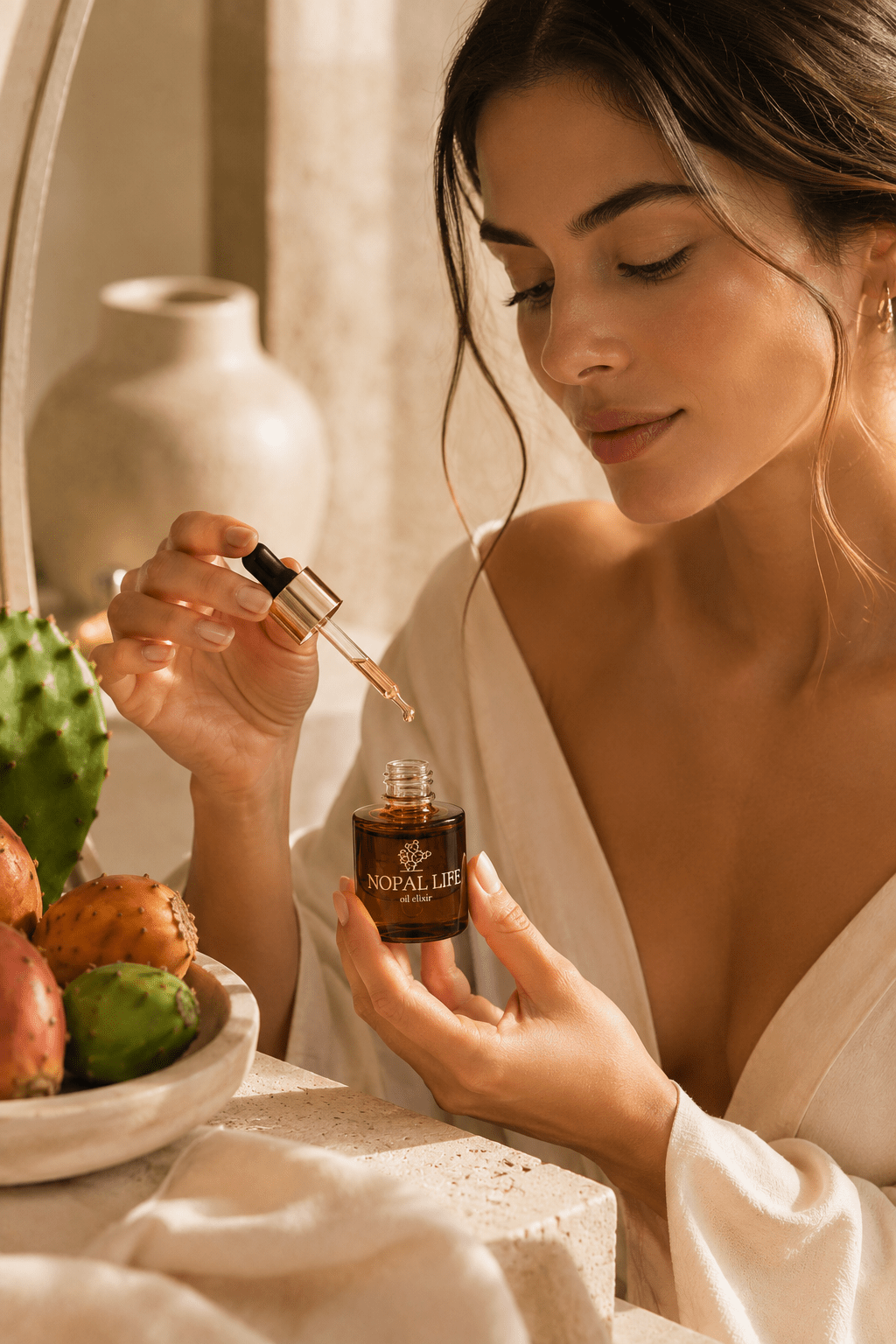
Extracted from the seeds of the Opuntia ficus indica fruit, prickly pear seed oil has one of the richest linoleic acid profiles in plant cosmetics — often over 60%. This essential fatty acid is directly involved in the composition of the skin barrier.
It is also rich in vitamin E in the form of tocopherols, which gives it antioxidant properties and good stability. These compounds are fragile: only a first cold pressing preserves them.
At NOPAL LIFE, prickly pears come from family plantations in the arid highlands of eastern Algeria and Kabylie, where the cactus grows without irrigation.
What shea butter contains
Derived from shea tree nuts, it is dominated by oleic acid and stearic acid — fatty acids that the skin tolerates well but are not strictly essential. Its unsaponifiable fraction, rich in protective compounds, accounts for a large part of its interest.
Its strength is occlusion. Applied in a layer, it very effectively limits evaporation, making it a natural reference care for the most exposed areas.
Which one for the face
Dry to normal skin: prickly pear seed oil. Its fineness and omega-6 content are better suited for the face.
Very dry skin, in winter: shea butter in a thin layer, or both layered.
Combination or blemish-prone skin: the oil, in a small amount. Shea butter is too occlusive for these skin types.
Which one for body and hair
Here, the ratio largely reverses. Shea butter is applied generously to elbows, knees, heels, and hands, at a cost that allows this use.
Prickly pear seed oil can still be used everywhere, but its price encourages reserving it for the face and décolleté. For hair, a single drop on the ends is enough — shea butter, on the other hand, is worked in as a pre-shampoo mask.
The price question
The difference is considerable and is explained by the yield. It takes nearly a ton of prickly pears to obtain one liter of oil; shea nuts, on the other hand, are naturally rich in fat and easy to collect.
It is therefore not a matter of commercial positioning. Of equal quality, a bottle of prickly pear seed oil will always cost several times the price of an equivalent pot of shea butter.
How to apply them
The oil: two to three drops for the face, as the last step, on slightly damp skin, warmed between the palms. One drop on the eye contour.
The butter: a small amount taken with the fingertips and warmed until fluid. Applied cold, it remains in clumps and penetrates poorly.
In both cases, damp skin significantly improves the result. A fatty substance retains the water present; it does not provide any.
Layering them
This is a good option in winter or for very dry skin. Prickly pear seed oil first, for its essential fatty acid and antioxidant content; then shea butter, in a thin layer, to seal everything in.
For the face, reserve this layering for the evening. It is too rich for the morning, under makeup.
Benefits and properties: making distinctions
Both improve skin suppleness and comfort. Prickly pear seed oil adds an antioxidant contribution that shea butter does not provide at the same level; shea butter offers surface protection that oil does not equal.
Neither erases an established wrinkle nor treats anything. For skin aging, protection against radiation remains the determining factor.
Two profiles, two ways to strengthen the skin
Prickly pear seed oil strengthens the barrier by input: it provides an omega-6 that is part of the composition of skin lipids. Shea butter strengthens it by protection: it limits losses without providing anything essential.
Both approaches are valid and not interchangeable. On very damaged skin, the combination of the two produces a result that neither produces alone.
Vitamins, fatty acids, and unsaponifiable fraction
Prickly pear seed oil is rich in essential fatty acids and natural vitamin E. Shea butter, on the other hand, draws much of its interest from its unsaponifiable fraction, rich in compounds that soothe and protect.
These vitamins and fatty acids act on different levels: some nourish the structure, others soothe the surface. This is why both often appear in the same formulas.
Compared to argan oil and other vegetable oils
Argan oil is the most frequent point of comparison. Its profile is richer in oleic acid and less in linoleic, which makes it a little more occlusive and a little less suitable for combination skin.
Prickly pear seed oil is distinguished primarily by its tocopherol content, which is higher than most common vegetable oils. It is this particularity, and its very low yield, that explain its positioning.
Skin elasticity and anti-aging properties
The anti-aging properties attributed to them are based on two distinct mechanisms. Antioxidants limit damage caused by free radicals. Fatty substances maintain a barrier which, better supplied, leaves the skin more supple.
Neither acts on skin elasticity in terms of dermal fibers. In this respect, only protection against radiation produces a documented effect.
Sensitive skin: which to choose
Both are well tolerated. Shea butter has the advantage of a very simple composition, which limits the risk of reaction; prickly pear seed oil, when pure, contains no fragrance or additives.
When in doubt, apply a small amount to the crook of your elbow for two days before extending use to your face. This simple test avoids many inconveniences.
Limitations
These are cosmetic treatments. They act on the appearance, suppleness, and comfort of the skin, without a curative purpose. Extreme dryness or persistent lesions require medical advice.
Our anti-aging treatments