Hyaluronic acid for skin: molecular weights and effects
On a product label, three words change everything, and almost no one explains them: fermented, kilodalton, multi-fraction. The first indicates the origin of hyaluronic acid. The second tells you how deeply it penetrates. The third indicates whether the formula works on one layer or three. Mature skin that has lost its radiance will not react in the same way depending on the answer. This guide breaks down these three parameters, with supporting figures, and proposes a timed application protocol that we use at Nopal Life to get the best out of an ingredient that, if applied incorrectly, can do the exact opposite of what is expected.
Key takeaways
- Fermented hyaluronic acid on a plant substrate is chemically identical to that of animal origin. What changes is the very precise control of molecular weight at the end of production — and it is this control, not the origin itself, that is visible on the face.
- Three families of molecular weights coexist in a good formula: above 1,000 kDa (surface film), 100 to 1,000 kDa (superficial layers), 5 to 100 kDa (fine fraction, the most diffusible). A mono-fraction formula quickly reaches its limit.
- The application window is as important as the formula: 60 seconds after rinsing, on still damp skin, followed by a fatty substance within the minute. Beyond this time frame, the measurable benefit at home collapses.
- Below 40% relative humidity in the room, a humectant applied alone worsens the sensation of tightness. The occlusive step is not an option; it is half of the protocol.
- For firmness and fine lines and wrinkles caused by dehydration, the realistic time frame is 8 to 12 weeks with twice-daily use. The immediate plumping effect, however, is visible in 30 minutes: these are two distinct phenomena that should not be confused.
Fermented, plant-based, vegan: what these words really mean
Hyaluronic acid has become the most cited hydrating active ingredient in contemporary cosmetics. It appears in fifteen-euro serums as well as in one hundred and fifty-euro creams. This omnipresence has led to a perverse consequence: the name has become a standalone commercial argument, disconnected from the raw material actually used. Yet, between two products that both display "hyaluronic acid" on the front, the difference in behavior can be considerable.
Historically, the raw material was extracted from rooster combs. The process worked, but it had three drawbacks: difficult traceability, significant batch-to-batch variability, and a protein residue profile that raised concerns for the most reactive skin types. Bio-fermentation has rendered this method obsolete in almost all modern formulations.
The principle is simple. Selected bacterial strains cultivated in a fermenter—historically Streptococcus zooepidemicus, and increasingly recombinant strains of Bacillus subtilis today, which avoid any animal input in the culture medium—are fed with plant sugars: beet molasses, non-GMO corn glucose, wheat derivatives. These bacteria naturally excrete hyaluronic acid into the medium. It is then harvested, purified, filtered, and dried. The resulting chain is a glycosaminoglycan strictly identical to what the body produces itself: an alternation of glucuronic acid and N-acetylglucosamine units. Structurally identical, therefore identical in terms of its hydrating properties.
The true added value of the fermentation process lies elsewhere, and it is rarely explained: control over chain length. By manipulating the strain, fermentation duration, medium pH, and downstream controlled hydrolysis steps, a producer can generate batches calibrated at 1,500 kDa, 300 kDa, or 10 kDa with a reproducibility that animal extraction never allowed. It is this calibration that enables the multi-fraction formulas we will discuss. Without fermentation, there are no bespoke molecular weights.
At Nopal Life, this requirement for plant-based origin is part of a broader philosophy: to formulate pleasant, traceable, and skin- and planet-friendly skincare products. Our approach systematically combines hyaluronic acid with cold-pressed prickly pear seed oil, for a physical reason that we detail below: a humectant without a fatty substance behind it is half a job.
Plant-based doesn't magically mean better tolerated
An honest clarification is necessary. Sometimes, it is said that fermented hyaluronic acid would be "gentler" or "better absorbed." This is inaccurate: the final chain is the same, and the body does not differentiate. What varies are the residual impurities—bacterial endotoxins, substrate fragments, fermentation proteins. A poorly purified fermented hyaluronic acid will be less well tolerated than a very pure animal hyaluronic acid. The relevant criterion is therefore not "plant-based or animal," but the purification grade. So-called premium cosmetic grades fall below the endotoxin thresholds required for injectable uses. This is the information that should be available, and which no brand displays.
The three molecular weights, compared line by line
Understanding this component hinges on one unit: the kilodalton (kDa), which measures the mass of a molecule. A hyaluronic acid chain can be 5 kDa or 2,000 kDa depending on the number of units it contains. And depending on this size, it behaves very differently once applied.
The analogy that works best: imagine a brick wall whose joints are the spaces between corneocytes. A ball the size of the joint passes through. A ball ten times larger sits on top. Hyaluronic acid works this way, except that the "ball" is a flexible coil that deforms, making the boundary gradual rather than sharp.
Here's how the three main fractions used in formulation are distributed. This table is the core of the subject: keep it in mind when you read an ingredient list.
| Fraction | Mass (kDa) | Where it stops | Sensation upon application | Perceived timeframe | Common dosage |
|---|---|---|---|---|---|
| High | 1,000 – 2,000 | Surface of stratum corneum, does not penetrate | Smooth film, slight tightening upon drying, sticky if overused | Immediate (5 to 30 min) | 0.05 – 0.2% |
| Medium | 100 – 1,000 | Upper layers of the epidermis | Melting, no perceptible film, rapid absorption | A few days to 2 weeks | 0.1 – 0.5% |
| Low (hydrolyzed) | 5 – 100 | Deep layers, first dermal layers | No sensation, very fluid texture | 4 to 8 weeks | 0.1 – 0.3% |
| Cross-linked (crosspolymer) | Network, non-linear | Surface, gradual release | Supple rebound, long-lasting hold | Immediate then prolonged over 8 to 12 h | 0.05 – 0.15% |
Typical dosage ranges in cosmetic formulation. These vary depending on the desired viscosity and the presence of other humectants (glycerin, betaine).
High molecular weight: the film that retains
Beyond 1,000 kDa, the chains are too long to sneak between the corneocytes. They organize themselves into a hydrated, invisible, flexible network on the surface, which slows down evaporation. This is the most immediately perceptible mechanism: the surface appears smoothed within minutes, micro-reliefs are optically filled, the complexion gains uniformity. On mature skin whose surface barrier has thinned and allows more moisture to escape, this film plays an appreciable buffering role against external aggressions—wind, air conditioning, heating.
Its drawback: it is superficial in the literal sense. It does nothing for the underlying layers, and it washes off with the first cleanse. It's a comfort, not deep work.
Medium molecular weight: the binding fraction
Between 100 and 1,000 kDa, we are in a transitional zone. These chains penetrate the upper layers of the epidermis, where they help retain the intercellular cement. This is the least spectacular fraction and probably the most useful on a daily basis: it provides that subtle suppleness that is most noticeable when it's lacking. After two to three weeks of regular use, the feeling of tightness at the end of the day significantly recedes.
Low molecular weight: the fine fraction, and its nuance
Below 100 kDa — and especially below 50 kDa — we speak of hydrolyzed hyaluronic acid. These short fragments diffuse into the most superficial layers of the papillary dermis. This is the fraction that contributes most to the plump appearance and suppleness of mature skin, and the one whose benefits take the longest to become visible.
However, a nuance must be made that few brands acknowledge: very short fragments, below approximately 10 kDa, are less well tolerated by reactive skin when generously dosed. This is why serious formulas use them sparingly and always combine them with longer chains. Smaller is therefore not better: there is a working window, roughly between 10 and 50 kDa, where diffusion is good without compromising comfort. A bottle that claims to have "the smallest hyaluronic acid on the market" as a commercial argument deserves caution rather than enthusiasm.
Why a multi-fraction formula consistently outperforms a single-fraction formula
Each layer has a different need, and a single chain size cannot meet three needs. A formula that combines high, medium, and low fractions produces a stepped action: immediate visible comfort thanks to the surface film, established suppleness in two to three weeks thanks to the medium fraction, and a denser appearance in two to three months thanks to the fine fraction. This is exactly the profile that dull mature skin requires, because its problem is itself multi-layered: less moisture retained on the surface, depleted endogenous hyaluronic acid reserves, and slower renewal that accumulates dehydrated corneocytes.
What changes with age, and what cosmetics can do about it
To understand why this component is specifically recommended for mature skin, one must look at what transforms over the decades. Three developments accumulate, and they do not have the same degree of accessibility for a formula applied topically.
First stage: the epidermis thins and dehydrates. The stratum corneum retains moisture less effectively, the production of intercellular lipids decreases, and the natural moisturizing factor becomes scarce. Result: a less impervious barrier, higher insensible water loss, more frequent tightness. This is the level at which a topical humectant works best, because it is directly accessible.
Second stage: the dermis loses its turgor. The dermal extracellular matrix naturally contains a significant reserve of glycosaminoglycans, including endogenous hyaluronic acid. This reserve decreases with age, leading to a loss of volume that visually translates into a less plump appearance. A topical application does not reach this deep reserve—let's be clear—but it works on the overlying layers, which is enough to change the overall perception.
Third stage: the support network reorganizes. The collagen and elastin fibers, which form the framework of the dermis, become scarcer and reorganize differently with age. This phenomenon governs most of the structural sagging. No hydrating active ingredient applied topically intervenes at this level: it must be said, because many communications maintain ambiguity. A humectant has no action on the deep fibrous architecture, and it does not modify collagen. It acts on moisture, and moisture acts on appearance.
This breakdown has an important practical consequence: it allows us to distinguish between wrinkles that respond to hydration and those that do not. So-called dehydration lines and wrinkles — fine, superficial, more pronounced in the morning or in dry weather, lessened after a shower — genuinely improve with a good protocol. Established expression lines and structural folds, however, will not change. Knowing which ones you have in the mirror avoids many disappointments and unnecessary purchases.
At what age to start, and with what texture
The question often arises, and the honest answer is: when it feels tight. It's not an age, it's a signal. Some skin types feel this need as early as their twenties due to climate or lifestyle, others not until forty-five. What really changes with age is rather the adapted galenic form: a light gel is very suitable for young and combination skin, while mature dry skin will require a richer cream or the addition of a vegetable oil. The same active ingredient, different carriers. The richest creams are not always the most effective: they are primarily the most occlusive, which is a specific function and not a general quality.
| Profile | Main signal | Recommended vehicle | Occlusive step |
|---|---|---|---|
| Mature dry | Permanent tightness, dull complexion | Multi-fraction serum + rich cream | Essential, morning and evening |
| Mature combination | Shiny T-zone, tight cheeks | Gel-cream, oil on cheeks only | Targeted by zone |
| Reactive and thin | Temporary redness, stinging | Fragrance-free formula, short ingredient list | Simple emollient, no added active ingredients |
| Dehydrated but oily | Simultaneous shine and discomfort | Fluid gel, watery textures | Minimal, non-comedogenic fluid |
How deep does it really go? The question of penetration
The diffusion of topical hyaluronic acid fuels a twenty-year-old debate, sustained by two equally excessive camps. On one side, those who claim it "doesn't penetrate at all." On the other, advertising claims that suggest deep reconstruction. The reality comes down to one sentence: penetration depends on size, vehicle, and barrier condition.
The stratum corneum allows hydrophilic molecules of low mass to pass according to a gradient that decreases very quickly with size. Reference works on permeability place the practical limit of passive passage around 500 daltons for lipophilic compounds — but hyaluronic acid, which is hydrophilic and highly hydrated, partially escapes this rule by taking the aqueous intercorneocyte pathway and the pilosebaceous annexes. Hydrolyzed fractions therefore cross the stratum corneum, contrary to dogma, but to a depth that remains modest: epidermis, dermo-epidermal junction, at most the first microns of the papillary dermis.
Three factors strongly modulate this passage, and two of them depend entirely on you.
1. The hydration state of the stratum corneum at the time of application
A hydrated stratum corneum is an "open" stratum corneum: corneocytes swell, intercellular spaces widen, and the humidity gradient draws hydrophilic molecules inward. A dry stratum corneum does the opposite: it compacts and repels. This is the physical reason why applying to damp skin is not a magazine tip but a condition for effectiveness.
2. The vehicle and the role of fatty substances
The topical bioavailability of a hydrophilic compound largely depends on what accompanies it. The combination of hyaluronic acid + prickly pear oil (Opuntia ficus-indica) works particularly well for a physicochemical reason: this oil is exceptionally rich in linoleic acid, an omega-6 polyunsaturated lipid that dominates its profile. This lipid is a natural component of the barrier's ceramides; applied topically, it integrates into the lipid lamellae and temporarily softens their organization. A more fluid intercellular space provides a more permeable pathway for hydrophilic molecules applied just before.
This is also why the order of application is not interchangeable: humectant first on damp skin, then the fatty substance. Reversed, the fatty substance forms a barrier that the aqueous phase can no longer cross, and the two products neutralize each other.
3. The pH of the formula
Hyaluronic acid is stable and fully functional within a wide pH window, with optimal retention around neutrality, between 6.0 and 7.0. In a frankly acidic environment — typically an exfoliant formulated at pH 3.5 — the chain undergoes slow hydrolysis that fragments it and reduces its hydrodynamic volume. This is not dramatic for a one-time application, but it explains why mixing an exfoliant and hyaluronic acid in your palm is a bad idea: you degrade both before even touching your face.
The 60-second protocol: the window that changes everything
Here is the most actionable element of this guide, and the one we repeat most often to people who write to us saying "it does nothing for me." Nine times out of ten, the formula is not the issue: it's the timing.
After rinsing, the stratum corneum is saturated. This saturation does not last: evaporation brings it back to its baseline state in two to three minutes in an ordinary room, even faster if the air is dry. The entire useful window is therefore contained within these few seconds. Here's how we break it down.
Timed protocol — morning and evening
T+0 s — End of rinsing. Gentle, sulfate-free cleanser, lukewarm, not hot. Heat strips surface lipids and causes you to lose the benefit before you even begin.
T+5 s — Pat, do not dry. A clean towel, two light presses. The goal is to remove drops, not the film of water. The surface should remain visibly satin, never dripping.
T+15 s — Apply 3 to 4 drops of serum. Distribute over the areas to be treated without spreading flat: dab. Dabbing displaces less moisture than smoothing and distributes the formula better over contours. Forehead, cheekbones, lines, neck.
T+45 s — Let it absorb. Do nothing for about thirty seconds. The texture changes from liquid to a flexible film; this is when the surface fraction organizes itself.
T+75 s — Seal. A hazelnut-sized amount of emollient or 3 drops of vegetable oil, warmed between the palms, applied with pressure over the entire face. Without this step, all the previous work evaporates in twenty minutes.
T+3 min — Photoprotection (morning only). SPF 30 minimum over the sealed layer. Photo-induced skin aging remains the primary factor to address; no humectant compensates for unprotected exposure.
The test that proves the window exists. Try it for a week, dividing your face in two. Left side: application within 60 seconds after rinsing. Right side: same formula, but three minutes later, on perfectly dry skin. Same amount, same emollient afterward. After five to seven days, compare the feeling of tightness at the end of the day and the appearance of the skin texture in grazing light. The difference is usually clear enough to be perceived without an instrument. This is the test we recommend to anyone who is convinced that "it doesn't work."
Adjust the dose to the time of day
In the evening, you can double the amount applied. Epidermal permeability naturally increases during the night, and surface temperature rises by a few tenths of a degree, two conditions that favor the diffusion of the finest fractions. Since the peak of cell renewal typically occurs between 10 PM and 2 AM, evening application benefits from being done before 10 PM rather than at bedtime.
For particularly dull skin, an occlusive mask for 20 minutes once a week usefully complements the routine. The saturation of corneocytes immediately improves the appearance of radiance: swollen and aligned corneocytes reflect light more regularly than flattened and desquamating corneocytes, which diffuse it in all directions and produce that characteristic gray appearance. This is optics, not biology — and that's why the change is so rapid.
If you don't know which fraction and texture match your profile, our personalized skin diagnosis will guide you in two minutes.
The 40% humidity threshold: when the humectant turns against you
This is the most counter-intuitive point of the topic, and the one that explains most disappointments. Hyaluronic acid is hygroscopic: it captures available moisture around it, indiscriminately as to its origin. When the ambient air is humid, it draws from the air. When the air is dry, it draws from the only accessible reservoir: the underlying layers, which it pulls to the surface where they evaporate. The result is more pronounced tightness after application than before.
The practical threshold is around 40% relative humidity. Above this, a humectant alone remains comfortable. Below it, the occlusive step becomes mandatory. An indoor hygrometer costs about ten euros and definitively resolves the issue — it's probably the best information/price ratio for an entire routine.
| Situation | Relative humidity | Risk | Protocol adjustment |
|---|---|---|---|
| Heated apartment, winter | 25 – 35 % | High | Systematic occlusion, double the occlusive layer in the evening |
| Air-conditioned office, summer | 30 – 40 % | High | Thermal mist before reapplication, then light emollient |
| Airplane cabin | 10 – 20 % | Very high | Occlusive balm alone, avoid naked humectant |
| Temperate interior, mid-season | 45 – 55 % | Low | Standard protocol, light occlusion sufficient |
| Humid coastal climate | 60 – 75 % | None | Fluid texture, heavy occlusion becomes uncomfortable |
Apparent firmness: what you can honestly expect, week by week
The perceived firmness of a face relies on several parameters: the density of the dermal support network, the tension of the fibers, the turgidity of the extracellular matrix, and the state of hydration that plumps or deflates the whole. A topical formula does not act on all these parameters. It essentially acts on the latter, with an indirect influence on the perception of the others — which is already visually considerable, but needs to be correctly named.
Here is the realistic timeline, as we describe it to people starting a consistent routine. It is deliberately conservative: it's better to be pleasantly surprised.
| Timeline | What's happening | What becomes noticeable | How to check at home |
|---|---|---|---|
| 30 minutes | Hydrated surface film, optical filling of micro-reliefs | Immediate plumped appearance, more even complexion | Photo in natural side light, before/after |
| Week 2 | Medium fraction established in the epidermis | Significantly reduced end-of-day tightness | Note sensation at 6 PM, daily, on a scale of 0 to 5 |
| Week 4 | Refined skin texture, calmed desquamation | Makeup lasts better, less clinging in creases | Observation of foundation after 4 hours of wear |
| Week 8 | Fine fraction at its full cumulative effect | Appearance of dehydration wrinkles and fine lines reduced | Identically framed photo, same time, same light |
| Week 12 | Established regularity, stabilized result | Globally softer and more luminous appearance | Comparison of the complete photo series |
The photo method, in practice. Always take the picture in the same spot, at the same time, with a lateral light source at 45° — a north-facing window is ideal as it doesn't vary with direct sunlight. No makeup, relaxed features, neutral expression. One photo per week, never more: daily observation doesn't perceive slow changes, and you'll get discouraged for nothing. This is the only self-assessment method that resists suggestion.
Topical care or injections: two logics not to be confused
There is a difference in nature, and not just in degree, between cosmetic care and an act of aesthetic medicine. The confusion is perpetuated by the fact that the same ingredient name appears on both sides — but it is neither the same form, nor the same procedure, nor the same objective.
Injections performed by a doctor use highly cross-linked hyaluronic acid, meaning its chains have been linked together to form a viscoelastic gel highly resistant to degradation. This gel is mechanically deposited in the deep dermis or hypodermis, in quantities and depths incomparable to what a surface formula can achieve. The result is volumetric and immediate, with persistence measured in months.
A topical application does nothing of the sort and cannot. The orders of magnitude for depth, quantity, and permanence are completely different. Any communication that suggests "needle-free plumping" maintains an ambiguity that should be recognized. Injections and daily care are not opposed; they simply operate on different playing fields.
| Criterion | Topical cosmetic care | Injections (aesthetic medicine) |
|---|---|---|
| Form used | Free chains, multi-molecular weights | Highly cross-linked gel |
| Achieved depth | Stratum corneum, epidermis, superficial papillary dermis | Deep dermis, hypodermis |
| Nature of result | Hydration, comfort, smoothed appearance | Localized mechanical volume |
| Delay | 30 min (surface) to 12 weeks (cumulative) | Immediate |
| Remanence | Duration of regular use | Several months depending on the reference |
| Framework | European Cosmetic Regulation | Medical device, medical act |
What cosmetics do, however, they do well and over time: maintain good hydration, support comfort, preserve a firm and smooth appearance, and maintain a healthy barrier against external aggressions. These are modest benefits taken in isolation, and considerable when accumulated over years. This is the gamble of daily gestures against punctual intervention, and there is no shame in stating it this way.
Decoding INCI: the only place where the truth is written
The front of a bottle is about communication. The INCI list, however, is regulated. In Europe, the cosmetic regulation imposes a standardized nomenclature and a decreasing order of concentration down to 1%. It is there, and nowhere else, that the true quality of a formula can be read.
| INCI Name | What it is | Indicative weight | What it brings you | Selling price benchmark |
|---|---|---|---|---|
| Hyaluronic Acid | Free acid form, less stable in solution | Variable, often high | Surface film, immediate smoothing effect | Entry level |
| Sodium Hyaluronate | Sodium salt form, more stable and more soluble | Medium to high | The reliable standard, good compromise | Mid-range |
| Hydrolyzed Hyaluronic Acid | Chains fragmented by controlled hydrolysis | Low (5 – 100 kDa) | The diffusible fraction, medium-term result | Mid to high-range |
| Sodium Hyaluronate Crosspolymer | Cross-linked network with gradual release | Structure, non-linear | Long-lasting hold, supple bounce | High-range |
| “… Ferment Filtrate” | Mention indicating obtention by fermentation | Not specified | Indicator of non-animal origin | Variable |
How to read this table in a store, in ten seconds. Look for at least two different family names to appear. A single mention means a single chain size, thus a single-stage formula. Two or three mentions, including a hydrolyzed form, indicate a multi-fraction approach. This is the only sorting criterion that works without knowing the complete formula.
Also check the position in the list. An ingredient listed after perfume or a preservative is present in trace amounts: its real contribution to the announced benefits is negligible. Conversely, a mention located in the first five lines of an aqueous formula is generally well-dosed. For the moisturizing properties of a bottle, the combined presence of glycerin and betaine is a good sign: these complementary humectants work on different retention scales and secure the result.
Serum, cream, eye contour: which texture for which use
This component does not provide the same service depending on the medium that carries it. Choosing the right galenic form avoids a lot of trial and error and unnecessary expenses.
| Format | Preferred fractions | Dose per application | For whom |
|---|---|---|---|
| Aqueous serum | Low + medium, a little high | 3 to 4 drops | All profiles, protocol base |
| Gel fluid | High + medium | A small amount | Mixed to oily dehydrated profiles, humid climate |
| Rich cream | High, in support of fatty substances | A generous amount | Dry mature skin, cold season |
| Eye contour care | Low + cross-linked, reduced dosages | A grain of rice per eye | Periorbital dehydration lines |
| Occlusive mask | Mainly high | 20 minutes, once a week | Radiance boost before an event, dull complexions |
A word about the eye contour, an area where mistakes are most visible. The skin here is significantly thinner, with a more permeable barrier and slower lymphatic drainage. A too generous dose, applied too close to the ciliary margin, can migrate during the night and accentuate puffiness upon waking—exactly the opposite of the desired result. The rule is simple: a grain of rice, placed on the orbital bone and not on the movable eyelid, tapped with the ring finger, which is the weakest finger. The formula naturally migrates upwards by capillarity.
The synergy of prickly pear: why we always combine the two
A humectant alone is an incomplete tool. It provides, but it doesn't offer anything to retain. This is the role of lipids, and this is where our signature raw material comes in.
Prickly pear seed oil has a rare profile: a very high linoleic content, a significant oleic content, and a richness in natural tocopherols superior to most vegetable skincare oils. This combination makes it a natural partner for hyaluronic acid for three concrete reasons.
It seals without suffocating. Its dry texture and rapid penetration allow for the creation of an occlusive layer sufficient to slow down evaporation, without the heavy film of a vegetable butter. On mature skin that needs comfort but not a mask-like sensation, this is the right compromise.
It nourishes the surface lipid structure. Linoleic acid is a component of the barrier; its topical application helps to strengthen this architecture, which mechanically improves medium-term retention. In other words, it makes the skin better at retaining what hyaluronic acid has provided.
It provides antioxidant support. The tocopherols and plant sterols it contains help to preserve the surface film against daily aggressions—pollution, temperature variations, light. This is not spectacular in the short term, it is a long-term effort that makes sense over years.
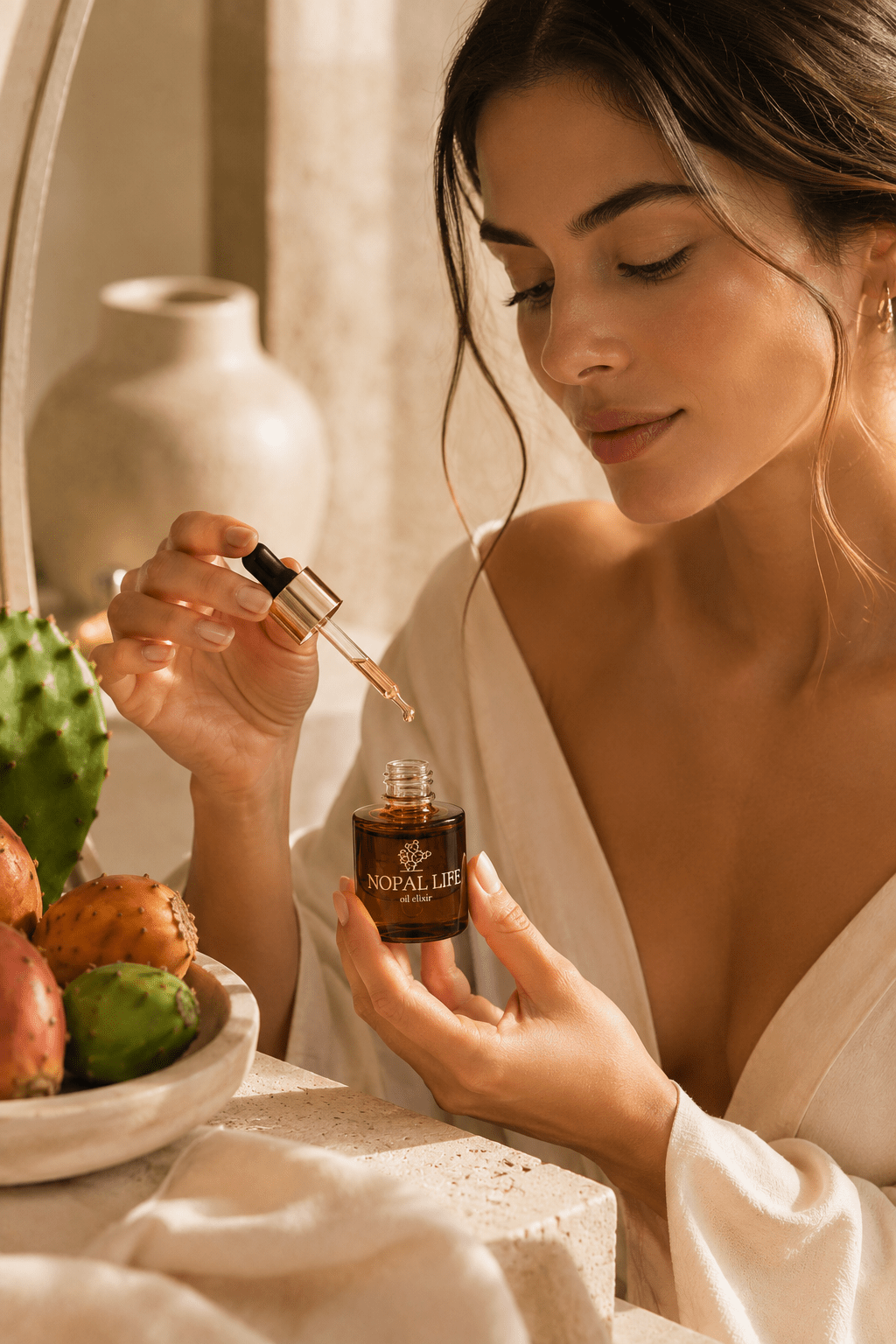
Our pure cold-pressed prickly pear oil is designed to play precisely this role as a second layer in the carefully timed protocol described above: three drops warmed between the palms, applied with pressure seventy-five seconds after the aqueous phase. It is this combined action, more than either one taken in isolation, that produces the result.
What other active ingredients to combine, and which to space out
A bottle never lives alone in a bathroom. The question of combinations is therefore central, and it is easily settled as soon as one reasons in terms of pH and function rather than brands.
Natural allies. Vitamin E, ceramides, squalane, and vegetable oils rich in fatty substances all act as a second layer: they retain what hyaluronic acid has brought. Niacinamide, which is very well tolerated and stable at neutral pH, combines easily. Panthenol and glycerin, other humectants, work on different retention scales and strengthen the whole without competition. These active ingredients accumulate even better as they do not target the same function.
Combinations to space out. Exfoliants—glycolic, lactic, mandelic—and vitamin C in pure ascorbic form are formulated at low pH to remain active. This is not an absolute incompatibility; it's a matter of sequence: apply them at another time of day, or wait for the surface pH to rebalance, which takes about twenty to thirty minutes. Retinoids, on the other hand, combine very well with a humectant input—it's even highly recommended, as the discomfort they cause at the beginning of use is precisely managed by good barrier support.
| Associated active ingredient | Compatibility | How to proceed |
|---|---|---|
| Niacinamide | Excellent | Same application, in any order |
| Ceramides, squalane, oils | Excellent | Always after, never before |
| Retinoids | Good, recommended | Aqueous phase first, retinoid next, in the evening |
| Vitamin C (ascorbic form) | To be spaced out | Vitamin C in the morning, humectant phase in the evening, or 30 min apart |
| AHA / BHA | To be spaced out | Exfoliant in the evening, never mixed in the palm |
| Sunscreen filters | Excellent | As a last layer, in the morning, SPF 30 minimum |
How much should a good serum cost, and why are the differences enormous
On the same shelf, you can find serums for twelve euros and others for one hundred and forty. The difference in selling price only partially reflects the difference in formulation, and it's worth understanding what lies behind it.
The raw material accounts for little in the final cost: effective dosages are in the order of a few tenths of a percent. What matters is the chosen grade—a calibrated and purified hydrolyzed hyaluronic acid costs several times the price of a standard grade—the number of assembled fractions, the airless bottle that protects the formula, and of course, factors unrelated to the composition: marketing, distribution, range positioning.
A useful benchmark: beyond a certain price, you are no longer paying for the formulation. Below a certain threshold, however, it is mechanically impossible to offer a multi-fraction assembly in a protected bottle. The reasonable zone is therefore in the mid-range, and the best way to check remains reading the INCI list described above: two or three family names, positioned high, and a short composition without superfluous excipients.
The calculation we never make. Relate the price to the number of applications rather than the bottle. A 30 ml container used at a rate of 3 to 4 drops twice a day lasts approximately two and a half months, or nearly 150 applications. A reference at €45 then costs about thirty cents per application—and a €15 reference that requires you to use twice as much because it is not very concentrated is not necessarily the most economical option. It is this cost per application, not the advertised price, that should guide the decision.
The six mistakes that ruin a good formula
Hyaluronic acid is known for being universal and well-tolerated. It is. But it is also one of the easiest active ingredients to misuse, precisely because it is believed to be risk-free and goes unquestioned.
Mistake 1 — Applying to dry skin in a dry environment. This is by far the most common and the only one that can produce frankly negative effects. Refer to the 40% relative humidity threshold: below this, a naked humectant draws from your reserves. The correction is twofold: apply to damp skin and always seal it in.
Mistake 2 — Settling for a single-fraction formula. A composition containing only high molecular weight hyaluronic acid works on the surface and nothing else. For young, well-hydrated skin, this is sufficient. For mature skin, it's a missed opportunity. Look for at least two different INCI names.
Mistake 3 — Mixing with an exfoliant in your palm. AHAs with a pH below 4 fragment the chain. Separate applications by at least thirty minutes, or dissociate the times: exfoliants in the evening, humectant phase in the morning. This separation also applies to pure ascorbic acid, formulated at low pH.
Mistake 4 — Believing in occasional intensive treatments. The retention capacity resets with each application; nothing is stored. A modest and regular twice-daily routine provides infinitely more than an intensive treatment followed by three weeks of neglect. This is the number one parameter, even before choosing the brand.
Mistake 5 — Diluting with hard water. Calcium and magnesium ions in hard water interact with the negative charges of the chain, reducing its effective hydration. For homemade preparations or rinse-off formulas, filtered or thermal water avoids this problem.
Mistake 6 — Neglecting sun protection. Hyaluronic acid is not photosensitizing. But no benefit obtained on firm appearance can withstand unprotected sun exposure, as UV radiation remains the primary driver of visible skin aging. A minimum SPF 30 in the morning is not an add-on: it's the condition that makes the rest worthwhile.
FAQ — your questions about plant-based hyaluronic acid
Is the fermented version really different from the animal version?
Chemically, the final chain is identical: it's the same glycosaminoglycan. Differences relate to traceability, the absence of animal inputs, batch reproducibility, and especially the ability to precisely calibrate the molecular weight at the end of production. This last point has the most influence on the final result.
Which molecular weight should you choose for mature, dull skin?
No single one is sufficient. The combination that best suits this profile combines a high fraction (above 1,000 kDa) for immediate comfort and a smoothed appearance, a medium fraction (100 to 1,000 kDa) for suppleness established within two to three weeks, and a low fraction (5 to 100 kDa) for the cumulative contribution over two or three months to a firm appearance.
Can it be used on oily or blemish-prone skin?
Yes, and it's often relevant. Oily skin can also be dehydrated: sebum and hydration are two distinct things. Hyaluronic acid is non-comedogenic and does not clog pores. Opt for a gel or a light texture rather than a rich cream, and keep the occlusive step minimal.
What concentration should I look for?
Noticeable effects appear from 0.1% for an isolated fraction. By adding the ranges from the table above, a well-constructed multi-fraction formula is between 0.3% and 1.2% for all fractions combined. Beyond that, the gain diminishes while the texture becomes sticky — a very high concentration advertised as a commercial argument is therefore not a sign of quality.
How long does it take to see results?
The plumped-up surface appearance is visible within 30 minutes. The reduction in end-of-day tightness sets in around the second week. The reduction in the appearance of dehydration lines and wrinkles requires 8 weeks, with stabilization around 12 weeks, with regular twice-daily use.
Is it compatible with sensitive skin?
It is one of the best tolerated active ingredients in cosmetics. Problems almost always come from excipients — denatured alcohol, fragrance, certain preservatives — and not from the chain itself. A fragrance- and alcohol-free composition is suitable for the most reactive skins.
Before or after prickly pear oil?
Before, always. Hyaluronic acid is hydrophilic and is applied first to damp skin. The oil, which is lipophilic, comes next to seal. Reversing the order means applying a greasy barrier that the aqueous phase will not penetrate — the two neutralize each other.
Can it trigger an allergic reaction?
True reactions to the chain itself are exceptional. However, fermentation residues or insufficiently eliminated substrate impurities can bother very reactive individuals. It is the purification grade that makes the difference, not the plant or animal origin.
Do I need a cream in addition to the serum?
Yes, in the vast majority of cases. The aqueous phase provides, creams and oils retain. The only context where you can do without it is a very humid climate combined with naturally oily skin — and even there, a light fluid texture is still preferable.
Does the English term hyaluronic acid on an imported label mean something different?
No, it is simply the international INCI name, identical in France and abroad. Since the nomenclature is universal, it allows you to compare two products purchased anywhere in the world with the same degree of reliability.
How long does a bottle last once opened?
Refer to the PAO (period after opening) symbol on the packaging, usually 6 to 12 months. Highly concentrated aqueous products degrade faster if exposed to heat or light: store them away from light, and beware of any change in color or odor.
Do all skin types react in the same way?
Not quite, but the difference is smaller than one might think. All skin types benefit from a humectant input; what changes is the carrier texture and the intensity of the occlusive step. The table of profiles above summarizes these adjustments.
Summary: Ten key takeaways
If you only remember a handful of points from this dossier on fermented hyaluronic acid, here are the ones that really make a difference in your daily life.
- Origin does not determine quality. Whether fermented on plant sugar or extracted, the resulting chain is the same glycosaminoglycan. What distinguishes one batch from another is the purification grade and the precisely calibrated chain length at the end of production.
- Molecular weight determines the rest. Above 1,000 kDa, the chain remains on the surface; between 5 and 100 kDa, it diffuses into the epidermis. A formula that layers the two works on multiple levels instead of just one.
- Immediate effect and cumulative effect are not to be confused. The optical plumping effect appears in 30 minutes. The reduction in the appearance of dehydration fine lines requires 8 to 12 weeks of twice-daily use.
- The 60-second window takes precedence over budget. An entry-level serum applied to still-damp skin works better than an expensive product applied three minutes too late, on dry skin.
- Below 40% relative humidity, always seal. Without an emollient applied afterwards, a humectant draws from underlying layers and accentuates tightness instead of calming it.
- Age changes the texture, not the ingredient. The need is indicated by tightness, not by a birthday. What changes is the vehicle: light gel on one hand, rich cream or vegetable oil on the other.
- Collagen is not involved. A humectant applied to the surface does not modify the fibrous architecture of the dermis. It acts on retained moisture, and it is moisture that changes the appearance.
- Injections operate on a different playing field. Cross-linked gel deposited in the deep dermis on one hand, free chains on the surface on the other: two distinct logics, which do not replace each other.
- The INCI list decides in ten seconds. Two denominations from the family are better than one, and their position in the first five lines says more than any promise printed on the front.
- Regularity is the most cost-effective parameter. Nothing is stored: the retention capacity resets with each application. Two applications a day are better than an intensive treatment followed by three weeks of neglect.
To go further with Nopal Life
Supporting the appearance of the skin over time requires fewer spectacular active ingredients than correct, repeated actions. Nopal Life prickly pear oil, rich in omega-6 and omega-9, vitamin E, and plant sterols, contributes to the suppleness and comfort of the surface film. Combined with a humectant applied within the correct window, it helps preserve a firm and plump appearance, reduce the appearance of dehydration fine lines, and strengthen the skin barrier.
A good humectant is judged less by the feeling on the first day than by what remains after three months: a more comfortable skin barrier, makeup that stays put without settling into creases, a more discreet reaction to dry environments, and minimal end-of-day tightness.
Since each skin has its own balance between moisture and lipid needs, the best combination is not universal. This is precisely what our diagnostic identifies.
RECOMMENDED CARE
Pure Prickly Pear Oil
Cold-pressed · The occlusive step of the protocol
DISCOVER THIS CARE →PERSONALIZED ROUTINE
Nopal Life Skin Intelligence™
Start my free diagnosis · 2 minutes
START MY FREE DIAGNOSIS →Sources — Papakonstantinou E., Roth M., Karakiulakis G., « Hyaluronic acid: A key molecule in skin aging », Dermato-Endocrinology, 2012. — Juncan A.M. et al., « Advantages of Hyaluronic Acid and Its Combination with Other Bioactive Ingredients in Cosmeceuticals », Molecules, 2021. — European Commission, CosIng database and Regulation (EC) No 1223/2009 on cosmetic products (INCI nomenclature, labeling, period after opening).
Information provided for cosmetic and educational purposes only; it does not constitute medical advice and is not a substitute for consulting a healthcare professional.
Our anti-aging treatments