Rosehip oil: what concentration and how many drops
Pure, with dosage varying according to use. Rosehip oil is a vegetable oil, not an active ingredient to be diluted: it is applied as is. But two to three drops on the face and a daily massage on stretch marks are not the same application. This page covers each use separately.
100% — rosehip oil is not diluted
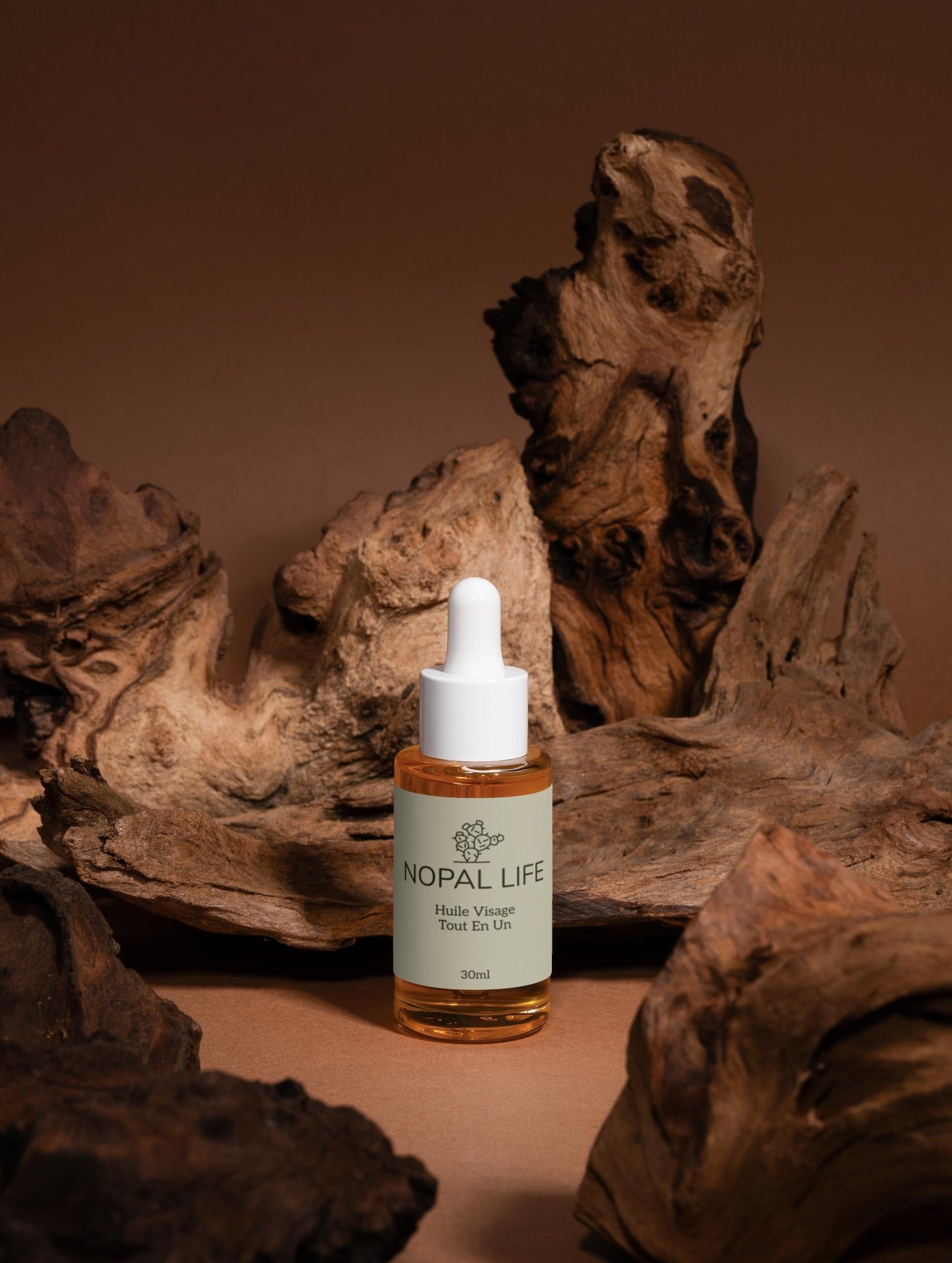
Rosehip vegetable oil is sold pure. The INCI name to look for is Rosa canina fruit oil or Rosa moschata seed oil depending on the species, and it should be the only ingredient listed on the label.
One exception: some preparations intentionally combine it with an essential oil or other vegetable oils. These are compound formulas, which have their own benefits, but they are no longer dosed in the same way.
Never confuse vegetable oil with essential oil. Rose essential oil is a highly concentrated product, subject to strict precautions; rosehip vegetable oil can be applied pure without difficulty.
Its purity is justified by its composition. Rosehip oil is used in cosmetics for its essential fatty acid content: approximately 45% omega-6 and 35% omega-3, a rare proportion among vegetable oils.
It also contains a very small amount of a plant-derived form of vitamin A, natural trans-retinoic acid. It is to this that its regenerative character on the skin barrier is attributed.
The vitamin E it contains partially protects it from oxidation. Diluting rosehip oil would dilute all these compounds at once, with no benefit.
A word about the plant. Rosehip is not a garden rose: it is the Chilean wild rose, Rosa rubiginosa or Rosa moschata depending on the producer. The oil comes from the seeds of the fruit, not the petals.
This distinction has a practical consequence. An oil labeled Rosa rubiginosa and an oil labeled Rosa moschata are dosed in the same way; their properties are similar, and the debate about the superiority of one has no bearing for the user.
Wrinkles and skin texture: 2 to 3 drops of rosehip oil
Two to three drops are enough for the entire face. Warm them between your palms, apply by pressing, and let them absorb before going to bed.
Only at night: rosehip oil oxidizes quickly in light, and its orange tint stains makeup. These two reasons are sufficient.
Its regenerative properties and richness in essential fatty acids act on skin texture in six to eight weeks of daily use. For established wrinkles, improvement remains modest and requires several months.
For the eye contour, half a drop patted with the ring finger. The skin there is thin, and the product migrates easily.
Scars: 1 to 2 drops, twice a day
For scars, quantity matters less than frequency and duration. One to two drops massaged twice a day, for at least three months.
Healing must be complete before starting. On an still open wound or a scab, no application: the oil has no business there and can delay the process.
Recent scars, still pinkish, respond better than old white scars. This is true for all skin care, and it is worth starting early.
Massage is as important as the oil. Two minutes in circular motions, with firm pressure but without pain.
For pigment spots, the dosage is the same as for scars. Rosehip oil has long been used in this area, with real but slow results — allow three months before judging.
A note on scarring: this word refers to a biological process that ends before the oil intervenes. Rosehip oil acts afterwards, on the skin's appearance of the scar, not on the healing process itself.
Stretch marks: 3 to 4 drops per area, once or twice a day
The affected areas are larger, so the quantity increases. Three to four drops for the abdomen, the same for each thigh.
Regular daily application works better than occasional massive application. During pregnancy, morning and evening use is common and without known problems — rosehip vegetable oil has no contraindications for this use.
Red, recent stretch marks are the ones to act on. White stretch marks are old scars and will not change much, regardless of the treatment.
A natural and pure vegetable oil is preferable here to a commercial anti-stretch mark cream, often laden with fragrance. Rosehip oil has long been used for this purpose, and massage is as important as the product.
On the abdomen late in pregnancy, apply without pressing. The movement should remain gentle: the goal is to spread the oil, not to work the skin.
Hair and body: the logic of volume
For medium-length hair, use a teaspoon for an oil bath before shampooing. This is no longer a drop-by-drop dosage.
For the body, rosehip oil is expensive for full-body application. Reserving it for areas that warrant it — scars, stretch marks, hands — and using a more economical oil elsewhere is common sense advice.
Counted in drops, rosehip oil is expensive; counted as targeted cosmetic care, it remains reasonable. For hands and nails, two drops in the evening are sufficient, and its regenerating effect is particularly visible there.
For chapped lips, one drop. For elbows, two. These are the areas where a vegetable oil rich in essential fatty acids gives the most for the least.
The rule that applies to all uses of rosehip
Apply to slightly damp skin. This determines the result more than the exact number of drops.
Oil does not provide water: it retains what is there. Applying to perfectly dry skin is like closing an empty room, and this is the most common mistake in using vegetable oils.
Second rule: regularity. Daily use for three months yields results that intensive use for three weeks will never provide.
Third rule, often forgotten: do not judge by wrinkles. The regenerating character of rosehip oil is first seen in skin texture and skin comfort, long before it is seen in wrinkles.
Its natural properties have clear limits. A vegetable oil, regardless of its richness in vitamin A and fatty acids, does not have the power of a retinoid in this area.
What rosehip oil dosage does not change
Applying more does not speed anything up. Beyond what the skin absorbs, the excess remains on the surface, stains clothes, and is wasted.
A higher concentration does not exist: at 100%, it is already at its maximum. Products that advertise "concentrated" rosehip oil are playing with words: a pure vegetable oil is already at its maximum.
And no amount replaces sun protection. For scars or spots, exposure without sunscreen negates the benefit of three months of application.
The series "What concentration, how many drops"
The correct dose cannot be guessed: it depends on the ingredient, its form, and the skin type. This series covers each active ingredient one by one.
- Argan oil: what concentration and how many drops
- Jojoba oil: what concentration and how many drops
- Salicylic acid: what concentration and how much to apply
- Centella asiatica: what concentration and how much to apply
- AHA: what concentration and how much to apply
- Shea butter: what concentration and what quantity
Our anti-aging treatments