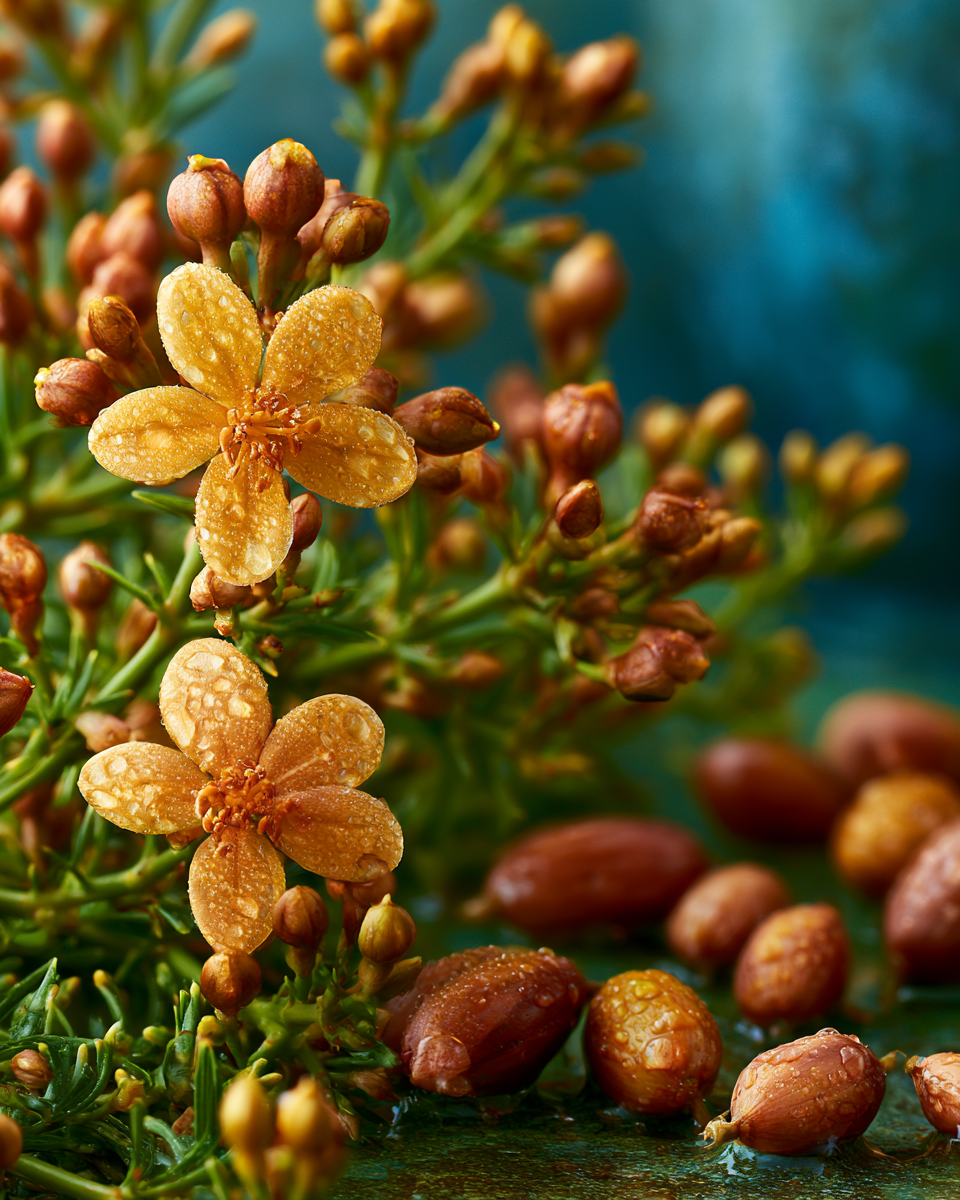
Jojoba oil: what concentration and how many drops
Pure, and the quantity depends on your skin more than the area. Jojoba oil has a unique characteristic that no other vegetable oil shares: its composition resembles that of human sebum. This explains why oily skin tolerates it, and it also dictates the dosage.
A wax, not an oil
Chemically, jojoba oil is not an oil: it is a liquid wax, composed of long-chain esters rather than triglycerides. All other vegetable oils are triglycerides.
These esters are very similar to those of human sebum. The skin recognizes it, absorbs it quickly, and does not react as it would to a foreign fatty substance.
This composition also explains its remarkable stability. Without fragile unsaturated fatty acids, jojoba oil can be stored for two years without going rancid.
On the label, only one name: Simmondsia chinensis seed oil. It must be alone on a bottle of pure jojoba oil.
Oily or acne-prone skin: 2 to 3 drops, in the evening
This is the most counter-intuitive and best-documented case. Applying an oil to oily skin seems absurd, and yet jojoba oil has its place there.
Two to three drops in the evening are sufficient, on slightly damp skin, instead of cream. Human sebum and jojoba mix instead of accumulating.
The idea that it regulates sebum production remains a hypothesis, not an established fact. What is observed is less tight skin, therefore less prone to overproduce—which is not the same thing.
For oily skin, start with two drops three evenings a week, and judge after one month. Too much product causes blackheads, which is a mechanical effect and not an allergic reaction.
The use of jojoba oil on oily skin requires only one precaution: apply sparingly, and on damp skin. The hydration obtained comes from the retained water, not from the oil itself.
Its regulatory properties are often highlighted. Data is lacking to confirm this; what is observed is more comfortable skin, which is enough to justify its use on this skin type.
Combination skin: 3 drops, dry areas only
For combination skin, application is targeted. Three drops distributed on the cheeks, around the mouth, and neck, avoiding the T-zone.
Uniform care on skin that is not uniform gives mediocre results everywhere. This is true for jojoba oil as for any other care product.
Morning application is still possible on dry areas, one drop, under sun protection. Its texture is light enough not to bother.
Dry skin: 4 to 5 drops, morning and evening
For dry skin, jojoba oil alone is often not enough. It is light and penetrates quickly: it provides comfort without forming the film that very dry skin requires.
Four to five drops morning and evening, or better, jojoba oil underneath and a rich cream on top. Jojoba prepares, cream seals.
It mixes very well with other vegetable oils. A mixture in equal parts with a richer oil—argan, avocado—gives a texture that dry skin accepts better.
Jojoba oil for hair and scalp
As an oil bath before shampoo, one tablespoon for medium-length hair. We no longer count in drops.
On the scalp, jojoba oil has a particular use: its kinship with sebum makes it one of the rare fatty substances usable on an oily scalp, as a massage before washing.
On dry hair after drying, one to two drops on the ends. Its rapid absorption avoids the greasy effect that other oils leave.
For curly or frizzy hair, jojoba oil nourishes without weighing down, which few oils allow. Two to three drops on the lengths after styling.
In winter, when cold and heating dry out, use can increase to two oil baths per week. The rest of the year, one is enough.
On the face as on the hair, applying to a damp base changes the result more than the quantity used.
Jojoba oil as a dilution base
This is its other major use. Jojoba oil serves as a neutral base to dilute an essential oil, thanks to its stability and skin tolerance.
The common dosage is one to two drops of essential oil per ten milliliters of jojoba oil, or about 1%, for use on the face. Double that for the body.
Do not exceed these proportions without knowing the specific precautions for each essential oil. The base is gentle, the diluted active ingredient is not necessarily.
What the dosage doesn't change
Applying to damp skin remains the rule. Jojoba oil retains existing water; it does not provide any, and application to dry skin gives disappointing results regardless of the quantity.
No higher concentration exists: at 100%, you are at the maximum. A "concentrated" jojoba oil makes no sense.
And it does not treat acne or wrinkles. It accompanies a routine, with skin tolerance being its true strong point.
Cold thickens jojoba oil, which solidifies around ten degrees Celsius. This is normal and without consequence: it becomes liquid again in the hand.
A natural product is not a product without possible reaction. A patch test on the crook of the elbow before the first application to the face remains the simplest precaution, even with such a well-tolerated oil.
The "What concentration, how many drops" series
The right dose cannot be guessed: it depends on the ingredient, its form, and the skin type. This series covers each active ingredient one by one.
- Salicylic acid: what concentration and how much to apply
- Centella asiatica: what concentration and how much to apply
- AHA: what concentration and how much to apply
- Shea butter: what concentration and what quantity
- Sea buckthorn oil: what concentration and how many drops
- Vitamin C: what concentration and how many drops


Go further than this article
Get our skincare guides by email — and start with your free skin diagnostic: 2 minutes, advice tailored to your skin. We ship to the US, UK, Canada, Australia and 27 European countries; somewhere else? Sign up and you will be the first to know when we deliver to your country.
By signing up, you agree to our privacy policy. Unsubscribe in one click.