Centella asiatica: what concentration and how much to apply
The percentage displayed on a centella asiatica skincare product tells you almost nothing. A product claiming 5% centella can contain ten times fewer active compounds than another with 2%, depending on how the extract was prepared. What matters is which of the four compounds the formula contains, and under what name it appears. This page goes through the names one by one.
The four active compounds of centella
The plant contains four molecules of interest: asiaticoside, madecassoside, asiatic acid, and madecassic acid. The first two are saponins, the other two are triterpenic acids.
When combined and purified, they are called TECA — titrated extract of Centella asiatica. This is the most studied and most concentrated form of active ingredients.
The whole plant contains these same compounds, in highly variable proportions depending on origin, harvest, and manufacturing process. This is the source of all the confusion.
Madecassoside is the one most formulations highlight for its soothing action. Asiaticoside is the most studied for skin repair.
These four molecules do not behave in the same way in formulation. Two are acids, two are saponins; their solubility differs, and an aqueous extract does not retain the same proportions as a hydroalcoholic extract.
This is why two products displaying the same percentage can deliver very different profiles. Titration indicates the total quantity, never the distribution — and it is the distribution that defines the character of the extract.
What INCI names tell you
"Centella asiatica extract" or "Centella asiatica leaf extract": a preparation from the plant, whose active content is not guaranteed. The displayed percentage refers to it, not to the compounds.
"Madecassoside", "Asiaticoside", "Madecassic acid, Asiatic acid": isolated molecules, whose concentration is real and verifiable.
A brand that names the molecules is therefore more transparent than a brand that only uses the plant's name. This is the best available comparison criterion.
Many skincare products combine the two: the plant for volume, an isolated molecule for activity. This is not a flaw; it is common practice.
Four mentions may appear: Centella asiatica extract, leaf extract, and the names of the isolated compounds. The first is the vaguest — it states neither the part used nor the titration.
Formulas that display an isolated compound allow for a more precise reading but lose the overall effect of the whole plant. Both approaches are valid; what is not valid is a label that remains silent on both.
Useful dosages
For a preparation from the plant, commercial products range from 0.1 to 5%. Beyond that, the color and vegetal odor become difficult to mask.
For isolated madecassoside, 0.1 to 0.5% is sufficient. These are the concentrations used in studies on skin soothing.
For TECA, 0.5 to 1%. This is the most expensive and most active form.
An ingredient listed after preservatives is present at less than 0.1%. For a plant whose active content is already variable, this will make no difference.
The properties attributed to this plant come from four distinct compounds, whose proportions vary according to origin and process. An extract rich in one can be poor in another, which makes the mere mention of Centella asiatica insufficient to compare two products.
In practice, concentrations encountered range from 0.1 to 5% depending on the types of formulas. Using centella asiatica beyond this brings no documented benefit and increases the risk of irritation on the most reactive skins.
Effectiveness, therefore, depends less on the number than on regularity. Integrated into a daily routine, these molecules yield results for specific needs — comfort, tolerance — after six to eight weeks. It is a fundamental natural active, not a corrective one.
How much to apply
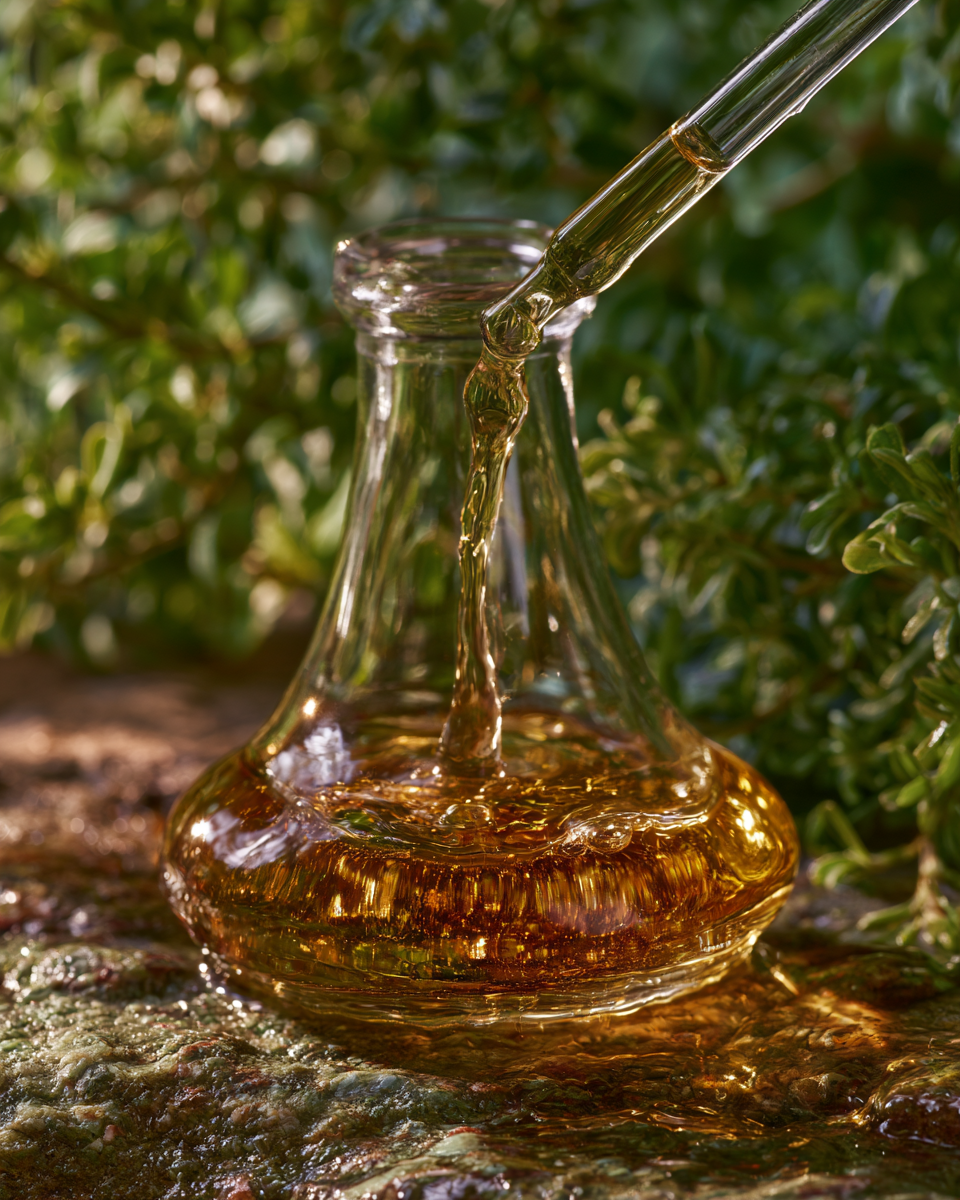
Three to four drops of serum for the face, a pea-sized amount for a cream. Centella asiatica does not present a risk of overdose.
Two applications per day are suitable for most skin types. On very reactive skin, application can go up to three without inconvenience.
Essences and lotions, common in Korean ranges, are applied first after cleansing. They primarily provide water and a low dose of active ingredients.
Application is done on damp skin, then sealed with a cream. This is the general rule, and centella is no exception.
A pea-sized amount for the entire face, morning or evening depending on the texture. Using centella in a thick layer doesn't make it better: the quantity that penetrates is limited by the surface, not by the volume applied.
In an already comprehensive daily routine, it is better to replace a product than to add one. The benefits attributed to this plant manifest over time, and an overly complex routine becomes impossible to decipher when something goes wrong.
Two daily applications are better than a single, reinforced one. The surface absorbs a finite amount each time, and distributing the dose throughout the day increases contact time without increasing volume.
This reasoning applies to most water-soluble active ingredients. It explains why a simple but regular routine consistently outperforms an ambitious and intermittent one.
What concentration doesn't compensate for
The quality of the raw material. A well-titrated ingredient at 1% performs better than any preparation at 5%, and nothing on the packaging always allows for a clear decision.
The rest of the formula. A well-dosed centella asiatica in a perfumed and alcoholic base yields mediocre results on sensitive skin.
Duration. Effects on redness require two to three weeks of regular application, regardless of concentration.
A 5% titrated extract applied to a damaged barrier provides less than a 1% extract on skin with an already healthy routine. The context dictates, and no concentration can make up for overly aggressive cleansing or unprotected exposure.
This is also true for skin types. Using centella asiatica on skin that presents no discomfort will produce nothing perceptible: the active ingredient responds to a need, it doesn't create one. Judging it under these conditions is like condemning it without having tested it.
According to your skin
Sensitive or reactive skin: this is the profile for which centella was popularized. Look for madecassoside named on the label, in a cream rather than a serum.
Blemish-prone skin: 2% is sufficient, as a complement to a treating active ingredient. Centella does not treat acne.
Normal skin: any dosage is suitable, and the interest is limited. This active ingredient provides the most benefit to skins that need it.
Using centella asiatica daily provides more than a one-off intensive application. This is true for most plant-based active ingredients, and particularly for this one, whose reported effects relate to comfort and gradually establish themselves.
Depending on the skin type, its place in the routine changes. Oily skin will receive it in a light texture, dry skin in a richer cream: it is the vehicles that adapt, not the concentration.
The plant is known as gotu kola in India, where it has been in Ayurvedic pharmacopoeia for centuries, and as tiger grass elsewhere in Asia. These three names refer to the same species and are encountered interchangeably on packaging.
What modern skincare retains from it is narrower than traditional use: support for the skin barrier and comfort for reactive skin. Allergic reactions are still possible as with any plant extract, which justifies testing on the crook of the elbow before the first application on the face.
To summarize
Read the names, not the percentages. A formula that names madecassoside or asiaticoside tells you what it contains; a formula that states "5% centella" tells you nothing verifiable.
Three to four drops, once or twice a day, on damp skin. Two to three weeks before judging. It is a patient and well-tolerated active ingredient.
Three benchmarks are enough. Verify that Centella asiatica is among the first ingredients, choose a product with a short formula, and integrate it into an already stable routine rather than changing several at once.
The properties attributed to this plant make it a versatile active ingredient, which is also its limit: versatile rarely means spectacular. Its effectiveness is judged on specific needs — comfort, tolerance — after several weeks of regular use.
One final practical benchmark. On skin that presents no discomfort, this natural active ingredient has little to prove; on reactive skin, it has its daily place. It is the need that dictates, not the trend.
The types of formulas in which it is found — essences, serums, creams — are not important in themselves. What matters is its place in the routine and regularity, two free things that concentration never replaces.
The "What concentration, how many drops" series
The right dose isn't guessed: it depends on the ingredient, its form, and the skin type. This series covers each active ingredient one by one.
The Nopal Life signature treatment


Mature skin · Dry skin

Go further than this article
Get our skincare guides by email — and start with your free skin diagnostic: 2 minutes, advice tailored to your skin. We ship to the US, UK, Canada, Australia and 27 European countries; somewhere else? Sign up and you will be the first to know when we deliver to your country.
By signing up, you agree to our privacy policy. Unsubscribe in one click.