Enzymatic Papaya: Nopal Life's Complete Guide
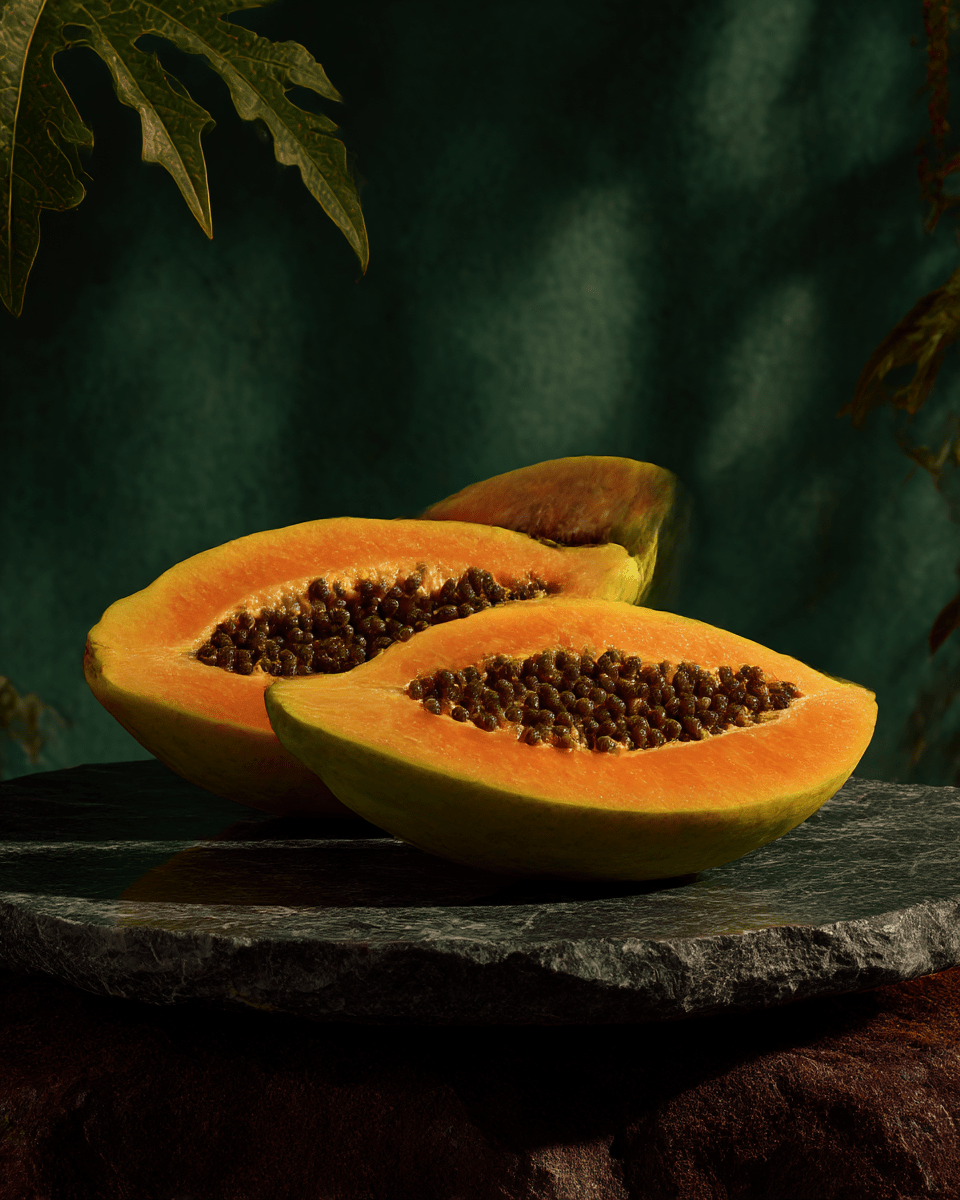
Nature is home to remarkably rich active ingredients, and enzymatic papaya is one of the most compelling examples. Its cosmetic approach is unique: it acts as a gentle plant-based exfoliant, which helps gently remove dead cells from the skin's surface to reveal a clearer complexion.
At Nopal Life, we have built our philosophy around a simple conviction: the best active ingredients are those that nature formulates itself. Our historical expertise in prickly pear oil (Opuntia ficus-indica), renowned for its exceptional concentration of linoleic acid (48.4% in our 2026 batch) and vitamin E, has led us to explore other botanical active ingredients that can meet the needs of radiance, uniformity, and texture. Enzymatic papaya has naturally become one of our strategic pillars for skin seeking to regain a bright, even, and visibly fresher complexion.
In this comprehensive guide, you will discover how this active ingredient is valued in cosmetics, learn how to incorporate it into your routine according to your skin type, explore the most popular active ingredient combinations, and avoid the most common mistakes. Whether you have mature, dehydrated, or uneven skin, this guide will give you the keys to making enzymatic papaya your daily radiance ally.
Understanding enzymatic papaya and its action on the skin
Enzymatic papaya owes its cosmetic properties to a family of natural enzymes, mainly papain, but also chymopapain and caricaïne. In cosmetics, these compounds are valued for helping to gently shed dead cells accumulated on the skin's surface, particularly in the outermost layer.
Unlike exfoliating acids (AHA, BHA) which work by dissolving, papain offers a gentle and progressive approach. It is often appreciated for its good skin tolerance, especially by sensitive or reactive skin. The exfoliation remains superficial and respectful, contributing to skin comfort.
This approach offers several visible benefits for the complexion:
- Texture evening: the removal of superficial dead cells helps visibly smooth the skin texture and reduce the dull appearance associated with their accumulation.
- Visible reduction of skin tone irregularities: by supporting the skin's natural renewal, enzymatic papaya can help progressively reduce the visible appearance of spots and age-related irregularities.
- Better enhancement of subsequent applied treatments: skin free of dead cells better reveals the benefits of serums and oils applied afterwards, which enhances the perceived effect of the entire routine.
Papaya also contains natural antioxidants — vitamins C and E, beta-carotene — renowned for helping the skin cope with daily external aggressions. Carica papaya extracts are traditionally valued in cosmetics for this richness, which leads formulators to interesting synergistic uses with other active ingredients like vitamin C.
Finally, enzymatic papaya is rich in B vitamins, potassium, and phenolic compounds which, in the context of a well-constructed cosmetic formulation, contribute to the overall nourished and comfortable feel of the skin after application. This complete profile makes it a particularly popular active ingredient for mature or dehydrated skin seeking an exfoliating result without compromising comfort.
Enzymatic papaya according to your skin type
The benefits of enzymatic papaya vary significantly depending on the skin profile. Understanding these nuances is essential for building a personalized routine and maintaining skin comfort.
Mature and dehydrated skin
It is on this profile that enzymatic papaya best expresses its potential. Mature skin naturally has slower cell turnover, and the accumulation of dead cells directly contributes to a dull, thickened, and uneven complexion. Enzymatic papaya helps to restore a smoother and fresher skin texture, while respecting skin whose comfort is often already compromised.
To learn more about this profile, our companion article on enzymatic papaya and mature skin details an application protocol adapted to this skin type, with precise usage frequencies and layering advice.
Combination or oily skin
Oily skin also accumulates excess dead cells, often associated with excess shine that traps them on the surface. Enzymatic papaya can help clear the appearance of pores and visibly refine skin texture, without the drying effect sometimes experienced with concentrated salicylic acids. Tolerance is generally good, but a progressive frequency of use is recommended.
Sensitive or reactive skin
This profile calls for caution. Although enzymatic papaya is often better tolerated than concentrated AHAs, any enzyme can cause reactions in the most reactive skin. A patch test over 24-48 hours is imperative. Standard cosmetic concentrations (between 0.5% and 2%) are generally well tolerated, but formulations combining papain with other exfoliants should be used with caution.
Our companion article dedicated to sensitive skin and enzymatic papaya explores in detail the warning signs to watch for and gentle alternatives to consider.
Gateway to a personalized diagnosis
If you are unsure of your skin type — or if your needs have evolved with the seasons, stress, or hormonal changes — the best starting point is a personalized diagnosis. The Nopal Life Skin Intelligence™ diagnosis analyzes your skin profile to guide you towards the most suitable routine, incorporating enzymatic papaya or not according to your actual needs.
Recommended routine: the Nopal Life protocol
Integrating enzymatic papaya into a coherent routine requires respecting some fundamental principles of order and frequency. Here is the protocol we recommend, designed to highlight the benefits while preserving skin comfort.
Evening: structured exfoliating session (2 to 3 times a week)
Step 1 — Cleansing: Start with a gentle, sulfate-free cleanser. Skin should be clean and slightly damp before applying any enzymatic exfoliating active ingredient.
Step 2 — Enzymatic Exfoliation: Apply the treatment containing enzymatic papaya in a thin layer to the face, avoiding the eye contour. Leave on according to product instructions (generally 5 to 10 minutes for a mask, or apply and leave on for a formulated serum). Skin should be dry to prevent dilution of the active ingredient.
Step 3 — Complementary AHA Peel (maximum once a week): For skin that tolerates it, our 10% AHA Peel with lactic acid and hyaluronic acid can complement the enzymatic action once a week. Lactic acid gently exfoliates while hyaluronic acid provides simultaneous hydrating comfort — a synergy designed not to sacrifice comfort for efficacy. Caution: never combine papain and AHAs in the same application session on the same evening.
Step 4 — Vitamin C Serum: The next morning, after a night of exfoliation, is the ideal time to apply the 2% Vitamin C Serum for radiance and spots. Skin, free of dead cells, better enhances the contribution of vitamin C, and the latter supports the radiance benefits obtained the day before. Vitamin C is valued in cosmetics for helping to unify the appearance of the complexion and reduce the visible appearance of irregularities.
Step 5 — Mandatory SPF in the morning: Any exfoliation, whether enzymatic or chemical, temporarily increases the skin's sensitivity to ultraviolet rays. Applying a minimum SPF 30 sunscreen in the morning after any exfoliating session is not optional — it is the absolute condition for your skincare efforts to yield lasting results rather than further emphasizing the appearance of existing spots.
Frequency tips by profile
- Normal to combination skin: 2-3 times a week, in the evening
- Mature or dehydrated skin: maximum 2 times a week, with enhanced hydration in the morning
- Sensitive skin: 1 time a week during the testing phase, then adapt according to tolerance
- Oily skin: 2-3 times a week, alternating with a purifying treatment
Essential natural active ingredients for radiance and uniformity
Enzymatic papaya does not act alone in a well-designed radiance protocol. It is part of an ecosystem of complementary natural active ingredients, each bringing a specific dimension to the appearance of a more uniform complexion.
Papain: the benchmark enzymatic exfoliant
Derived from the leaves and latex of the green fruit of Carica papaya, papain is a stable enzyme that retains its properties in well-buffered cosmetic formulations. Common cosmetic concentrations range from 0.1% to 2%, depending on the desired objective (maintenance or targeted care). Nopal Life selects extracts standardized for enzymatic activity to guarantee consistent quality from batch to batch.
Prickly pear oil: the Nopal Life star
Opuntia ficus-indica oil is the heart of Nopal Life's identity and an exceptional active ingredient in radiance routines. Its lipid composition is unique: approximately 60% linoleic acid (omega-6), one of the highest vitamin E (tocopherol) content in the plant kingdom (up to 900 mg/kg), and a richness in plant sterols that contribute to skin suppleness and comfort.
Linoleic acid is a valuable lipid for the skin, valued for helping to maintain a supple and comfortable appearance, in addition to the radiance action of enzymatic papaya. This synergy between the two active ingredients — one exfoliating, the other nourishing — is at the heart of Nopal Life's approach for skin seeking radiance and uniformity without harshness.
Vitamin C: the reference for evening out skin tone
Vitamin C (ascorbic acid and its stable derivatives) is recognized as one of the most valued active ingredients in cosmetology for visible radiance and evenness of complexion. It is valued for helping to unify the appearance of the complexion, protect radiance against external aggressions, and support skin that looks firmer and plumper. Our 2% formulation combines stabilized vitamin C with rich vegetable oils to maximize tolerance and comfort.
Lactic acid: the most hydrating AHA
Among alpha-hydroxy acids, lactic acid stands out for its double action: surface exfoliation and hydration (it is a natural component of the skin's Natural Moisturizing Factor). At 10% combined with hyaluronic acid, it offers a remarkable efficacy/tolerance ratio for skin that wishes to complement enzymatic action with structured chemical exfoliation.
Complementary plant antioxidants
Beta-carotene, flavonoids, polyphenols from botanical extracts — these molecules are valued for helping the skin cope with external aggressions and preserve the radiance benefits obtained through exfoliation, by supporting the skin against factors responsible for dulling the complexion. Our companion article on natural radiance active ingredients and botanical antioxidants delves deeper into this topic for those who wish to learn more.
Common mistakes to avoid with enzymatic papaya
Enthusiasm for a valued active ingredient sometimes leads to usage errors that nullify its benefits or cause undesirable reactions. Here are the five most common mistakes and how to avoid them.
Mistake 1: using enzymatic papaya too frequently
The temptation to speed up results by increasing the frequency of application is understandable, but counterproductive. Excessive exfoliation compromises skin comfort, causes discomfort, and can paradoxically accentuate the uneven appearance of the complexion. The rule: never more than 3 times a week, and always with a rest day between each session.
Mistake 2: neglecting SPF the next day
Any exfoliation temporarily makes the skin more vulnerable to UV rays. Forgetting SPF after an enzymatic papaya session means risking further emphasizing the appearance of spots — the exact opposite of the desired goal. A minimum SPF 30 is non-negotiable the morning after any exfoliation.
Mistake 3: combining papain and AHA on the same evening
Layering two different types of exfoliants in the same session puts more stress on the skin without doubling the benefits. Enzymatic papaya and AHAs are valued allies, but they should be used alternately, never simultaneously.
Mistake 4: applying to wet skin without precaution
Water can dilute or alter the enzymatic activity of papain depending on the formulation. Read the product instructions carefully: some enzymatic masks are applied to dry skin for maximum effectiveness, others require slightly damp skin. Respecting this point significantly optimizes results.
Mistake 5: not doing a patch test
Even for active ingredients presented as gentle, a preliminary patch test on the inside of the wrist or behind the ear is always advisable. Wait 24-48 hours before validating tolerance and applying to the face.
Nopal Life and enzymatic papaya: our quality commitment
At Nopal Life, every active ingredient incorporated into our formulations undergoes rigorous selection. The papain we use is sourced from certified suppliers, with enzymatic activity controls by batch to guarantee consistent quality.
Our approach is guided by three principles:
- Rigorous selection: each active concentration is chosen based on available knowledge in plant cosmetology.
- Tolerance above all: we refuse to formulate products whose efficacy would be achieved at the expense of skin comfort.
- Botanical synergy: our formulations combine active ingredients whose benefits complement rather than unnecessarily duplicate each other.
This philosophy is found throughout our range, from prickly pear oil — our foundational active ingredient — to vitamin C serums and AHA peels designed to integrate harmoniously into a structured radiance protocol.
Conclusion: enzymatic papaya, an essential natural active ingredient for radiance
Enzymatic papaya stands out as one of the most versatile and well-tolerated natural exfoliating active ingredients valued in contemporary cosmetology. Its gentle enzymatic approach, its richness in natural antioxidants, and its compatibility with synergistic active ingredients such as vitamin C or prickly pear oil make it a central piece of any rigorously constructed radiance protocol.
Whether you are looking to reduce the visible appearance of spots, regain a smooth and even skin texture, or simply maintain a vibrant and radiant complexion throughout the seasons, enzymatic papaya deserves a prominent place in your skincare ritual. It perfectly embodies the Nopal Life philosophy: exceptional natural active ingredients, formulated with high standards, for visibly beautiful skin.
To go further and discover which routine incorporating enzymatic papaya is best suited to your unique skin profile, start your personalized Nopal Life diagnosis — free, immediate, and formulated by experts in plant cosmetology.
Accreditation according to ISO/CEI 17025:2017 defines the general requirements for the competence of testing and calibration laboratories. In the plant ingredient sector, this accreditation ensures that analytical methods — gas chromatography-mass spectrometry (GC-MS), high-performance liquid chromatography (HPLC-DAD), UV-visible spectrophotometry, and ICP-MS for trace metals — meet the criteria for metrological traceability and inter-laboratory repeatability defined by national accreditation bodies (COFRAC in France, DAkkS in Germany, UKAS in the United Kingdom). The accreditation certificates issued include an exhaustive list of the analytical parameters covered and the geographical scope of international mutual recognition.
The analytical qualification of plant-based ingredients relies on several pharmacopoeial references, including the European Pharmacopoeia (Ph. Eur.) 11th edition and the United States Pharmacopeia (USP). The identification and assay monographs define the acceptance criteria for thin-layer chromatography (TLC), the HPLC profile of assayed chemical markers, heavy metal limits (lead < 5 ppm, arsenic < 3 ppm, cadmium < 1 ppm, mercury < 1 ppm), and microbiological criteria based on ISO 18416 and ISO 21150 standards. These references form the documentary basis of the cosmetic safety file compliant with the requirements of Regulation (EC) No 1223/2009.
The stability of packaged plant ingredients is evaluated according to accelerated and real-time protocols defined by ICH Q1A. Thermal stress conditions (40°C / 75% RH for 6 months) predict the behavior of the batch over its intended shelf life (generally 24 to 36 months). Monitored parameters include color index (CIELab measurement), viscosity (Brookfield viscometer), pH, active marker content (by HPLC), and initial microbiological compliance. A documented control plan with milestones T0, T3, T6, T12, T18, and T24 satisfies the requirements of the European regulatory dossier.
The management of the plant supply chain now integrates blockchain tools for batch-to-batch traceability from the agricultural plot to final packaging. Platforms such as SourceMap, Provenance, or Sourcemap Africa allow each batch to be associated with a unique identifier (QR code or RFID) that traces the entire journey: harvesting, drying, primary processing, storage, transport, formulation, and filling. These transparency tools meet the expectations of European consumers, 73% of whom declare wanting access to the precise geographical origin of the ingredients in the products they buy (Nielsen IQ, Sustainability Report 2023). Fairtrade or Fair for Life certification of supply cooperatives reinforces this approach through an independent social audit.
New-generation bio-sourced polymers represent a promising alternative to conventional plastics in packaging design. PHA (polyhydroxyalkanoate), produced by microbial fermentation of plant substrates (corn starch, sugar refinery waste), offers certified biodegradability in marine environments according to ISO 14851, unlike PLA, whose degradation requires the controlled conditions of industrial composting. FSC (Forest Stewardship Council) certified cardboard with vegetable inks is a benchmark choice for secondary packaging (boxes, cases) that meets the requirements of sustainable packaging regulations (Directive (EU) 2019/904) and facilitates sorting in municipal selective collection channels.
Frequently asked questions about enzymatic papaya
Can enzymatic papaya be used around the eyes?
No. The peri-ocular area is significantly thinner and more sensitive than the rest of the face. Exfoliating enzymes should never be applied to this area. Maintain a margin of at least 1 cm around the eyelids.
Is enzymatic papaya suitable for blemish-prone skin?
Yes, with precautions. Enzymatic exfoliation can help clear the appearance of pores and reduce the accumulation of dead skin cells that promote the appearance of blemishes. However, on skin with marked and uncomfortable blemishes, any exfoliation should be suspended until the skin returns to normal; if in doubt, consult a healthcare professional.
How long does it take to see the first results?
The first effects on radiance and texture are often noticeable within 2 to 3 weeks of regular use (twice a week). The visible reduction of spots and complexion irregularities requires a complete skin renewal cycle, i.e., 4 to 8 weeks depending on age and skin profile.
How often should enzymatic exfoliation be used?
Once or twice a week is sufficient. Gentler than a granular scrub, enzymatic exfoliation is suitable even for sensitive skin, provided it is well hydrated afterwards.
Can enzymatic papaya and exfoliating acids be combined?
Avoid combining them on the same day: instead, alternate, for example, enzymes on the weekend and a gentle acid during the week, to exfoliate without compromising skin comfort.
 Enzymatic Papaya - NOPAL LIFE" style="width:88px;height:88px;object-fit:cover;border-radius:8px;flex-shrink:0;" loading="lazy"></a>
Ingredient Reference
Enzymatic Papaya
Gentle enzymatic exfoliation, radiance & refined skin texture.
Discover the sheet →Read more
Information provided for cosmetic and educational purposes; it does not constitute medical advice.


Go further than this article
Get our skincare guides by email — and start with your free skin diagnostic: 2 minutes, advice tailored to your skin. We ship to the US, UK, Canada, Australia and 27 European countries; somewhere else? Sign up and you will be the first to know when we deliver to your country.
By signing up, you agree to our privacy policy. Unsubscribe in one click.