Combining hyaluronic acid and AHAs: the method
Two misleadingly named acids: one exfoliates, the other hydrates. An AHA sloughs off dead surface cells; hyaluronic acid replenishes the water lost in the process. It's a complementary combination, provided the order is respected.
Key points
- Order: AHA first, then hyaluronic acid.
- Wait time: ten minutes between the two.
- Frequency: AHA 2 to 3 times a week, hyaluronic acid daily.
- Essential: a cream on top.
- Morning: sun protection.
Why this order is non-negotiable
An AHA acts on the surface and needs to reach clean, dry skin. Hyaluronic acid, if applied beforehand, would form a film that would hinder its action.
Applied after the waiting period, hyaluronic acid doesn't undo anything: exfoliation has already taken place. It simply replenishes the water that the skin has just lost.
What exfoliation costs
An AHA removes accumulated dead cells, which improves radiance and refines skin texture. At the same time, it removes part of the lipidic cement that bound these cells.
The skin then loses more water in the following days. Hyaluronic acid compensates for this loss, but not for the lipid deficit — this is a nuance that determines the rest of the routine.
The detailed protocol
Cleanse, then completely dry. AHA on clean, dry skin. A full ten minutes of waiting. Then hyaluronic acid on slightly re-moistened skin, and a cream.
For dry skin, replace the cream with a richer texture, or add two drops of vegetable oil. This layer is most often missing from routines centered on hyaluronic acid.
The rhythm, week by week
Weeks 1 and 2: AHA once a week only.
Weeks 3 and 4: twice, if no dryness occurs.
Thereafter: three times maximum.
Hyaluronic acid, however, can be used daily without restriction. On evenings without exfoliant, it carries the routine.
Glycolic or lactic
Glycolic penetrates deeper and works better on texture, with less tolerance. Lactic is gentler and suitable for reactive skin.
For skin that has never been exfoliated, start with lactic. Hyaluronic acid combines equally well with either.
Using hyaluronic acid correctly
On damp skin, imperatively. A humectant applied to dry skin in dry air can exacerbate tightness instead of reducing it.
A few drops are enough, smoothed without rubbing on skin that has just been treated. A concentration between one and two percent does the job.
According to your skin type
Oily skin: AHA up to three times a week, daily hyaluronic acid with a gel-cream.
Combination skin: AHA on the T-zone, hyaluronic acid everywhere.
Dry skin: AHA once a week at most, and a rich cream systematically.
Reactive skin: lactic acid only, and hyaluronic acid every evening.
Sun protection, non-negotiable
AHAs significantly increase sensitivity to ultraviolet rays. Daily sun protection is part of the protocol, especially on the days following an application.
Hyaluronic acid, for its part, has no effect on photosensitivity.
What not to combine
An AHA and a retinoid on the same evening: alternate instead. Two different exfoliants: choose one.
Hyaluronic acid, on the other hand, combines with everything and poses no combination restrictions.
Forms of hyaluronic acid
It is found under two main names in ingredient lists: hyaluronic acid and sodium hyaluronate, its most common form. Seeing both is a good sign: it indicates multiple molecular weights.
Large chains remain on the surface and visibly smooth; shorter ones act on water content. A good formula combines both.
Why hyaluronic acid is useful after an acid
Exfoliation removes dead cells and, with them, part of what held water on the surface. The skin then dehydrates faster in the following days.
Hyaluronic acid immediately compensates for this loss. It is one of its best uses, and one that makes a regular exfoliation rhythm sustainable in the long term.
A consistent routine
Cleanse, treat, hydrate, protect. AHA occupies the 'treat' slot on certain evenings; hyaluronic acid occupies the 'hydrate' slot every day.
Knowing what each product is for prevents stacking four products that do the same thing — the most common flaw in overloaded routines.
What you need to know
This routine improves radiance, comfort, and skin texture regularity. It is cosmetic in nature and does not treat any condition: persistent irritation requires dermatological advice.
The gesture that makes exfoliation bearable
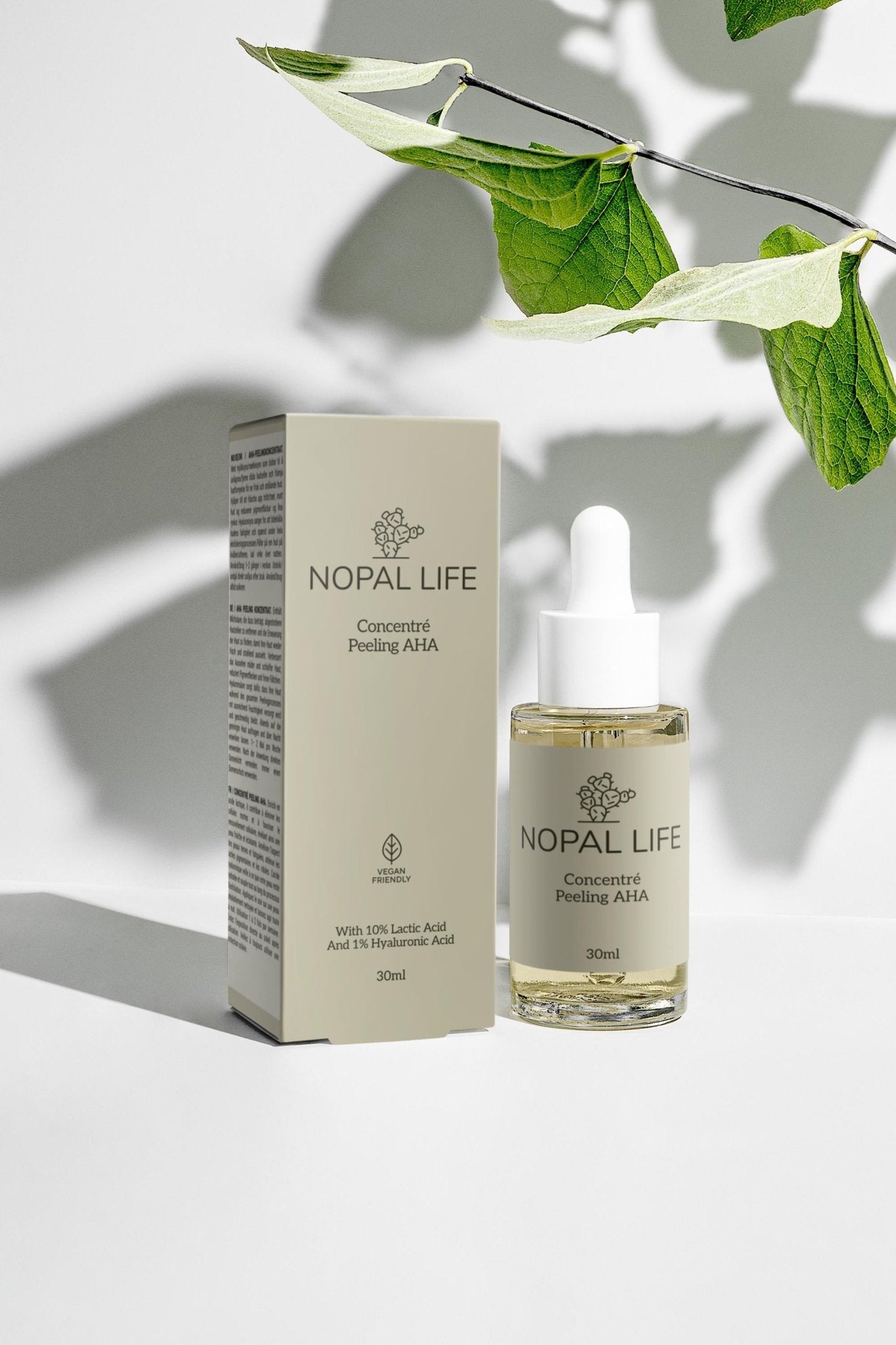
An AHA leaves the skin more permeable, and often more sensitive, in the hours that follow: this is when water evaporates most quickly. A hydrating gel with hyaluronic acid applied immediately afterwards compensates for this loss, and this is what allows for a consistent exfoliation rhythm.
Our anti-aging treatments