Prickly pear seed oil or vitamin C: which one to choose?
These two treatments are not interchangeable: they do not act in the same phase or through the same mechanism. Prickly pear seed oil is a fatty substance rich in essential fatty acids, which nourishes and limits water loss. Vitamin C is a water-soluble active ingredient, known for its brightening action and its ability to neutralize free radicals.
What distinguishes them
| Criterion | Prickly pear oil | Vitamin C |
|---|---|---|
| Nature | vegetable oil, lipid phase | water-soluble active |
| Origin | Opuntia ficus indica seeds | synthesis or stabilized derivatives |
| Role | nourishes, limits evaporation | radiance, antioxidant action |
| Place in routine | final step | serum, before fatty products |
| Stability | good, natural tocopherols | fragile to light and air |
| Skin type/concern | dry skin, mature skin | dull complexion, spots |
What prickly pear seed oil contains
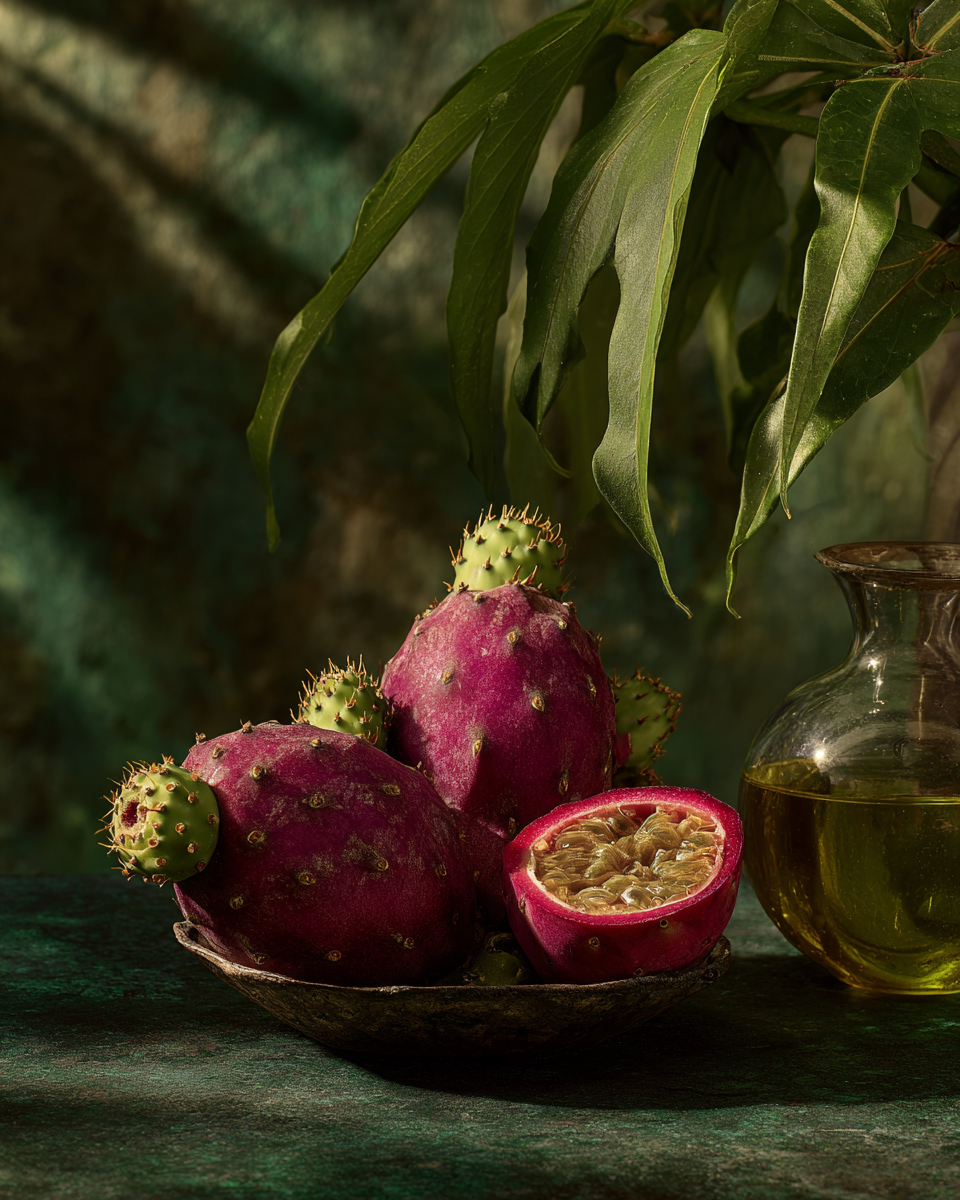
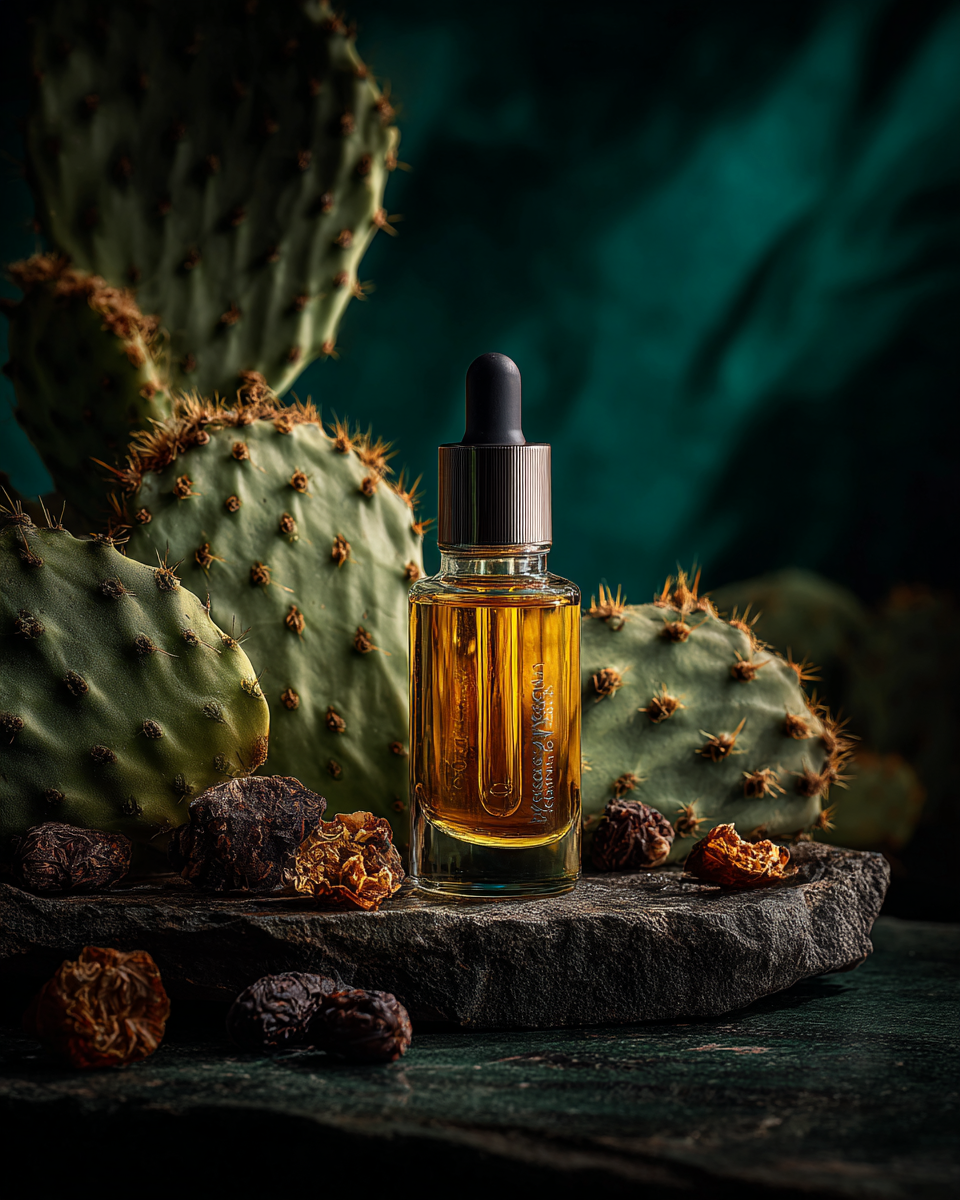
It is extracted from the seeds of the prickly pear fruit, Opuntia ficus indica. Its profile is dominated by essential fatty acids, with a very high proportion of linoleic acid — often over 60% — accompanied by oleic acid and palmitic acid.
It also contains a notable amount of tocopherols, the family of compounds of the same name. These give it its good shelf life and help limit the action of free radicals on the skin's lipid phase.
Its extraction explains its rarity. The seeds represent a tiny fraction of the fruit, and it takes nearly a ton of figs to obtain one liter of oil. It is this yield, not marketing, that determines its price.
What Vitamin C provides
It is a water-soluble antioxidant, used in cosmetics for its action on complexion radiance and the appearance of pigment spots. It also plays a role in collagen synthesis, which explains its place in anti-aging routines.
Its challenge is its stability. Pure ascorbic acid oxidizes quickly on contact with air and light: a formula that has turned orange has lost most of its benefits. Stabilized derivatives are more reliable and act more slowly.
First cold press: why it matters here
An oil obtained by first cold press retains minor compounds that refining removes — tocopherols, sterols, pigments. For an oil whose benefit partly lies precisely in these compounds, the mention is not merely decorative.
At NOPAL LIFE, the fruits come from family farms in the arid highlands of eastern Algeria and Kabylia, where prickly pear grows without irrigation. Cold pressing is the only process used there.
Which one to choose
Dry, uncomfortable, skin lacking suppleness: vegetable oil. Essential fatty acids are exactly what it lacks.
Dull complexion, spots, pigmentation irregularities: Vitamin C, which is the only one of the two to work on these concerns.
Mature skin: both have their place, at different stages of the routine.
Using them together, which is most common
They are not competitors and can be layered without difficulty, provided the order is respected.
1. Antioxidant serum on clean skin, preferably in the morning.
2. Wait a few minutes.
3. A cream, then a few drops of oil as the final layer.
A fatty product applied before the water-soluble active would form a barrier that would hinder its penetration. This is the only real mistake to avoid here.
How to apply the oil
Two to three drops are sufficient for the face. Warm them between your palms, then apply with gentle presses rather than heavy massage. For the eye contour, a single drop dabbed with the tip of your ring finger.
On slightly damp skin, penetration is better and the sensation less oily. This is also when the oil most effectively retains the water present on the surface.
What neither does
Neither the oil nor the antioxidant erases an established wrinkle. One improves suppleness and comfort, the other radiance and skin tone uniformity. These are real results, and they are not transformations.
The action whose effect on skin aging is best established remains daily sun protection. Antioxidants complement it; they never replace it.
Storing your products
Virgin vegetable oils are sensitive to heat and light: a tinted glass bottle, stored in a dark place, outside the bathroom, preserves them better. Ascorbic acid is even more demanding and benefits from being purchased in small volumes.
An oil with a rancid smell, a serum turning brown: in both cases, the product has reached the end of its shelf life.
Free radicals and skin aging
Free radicals are constantly produced by metabolism, and their production increases under the effect of radiation, pollution, and smoking. They attack the most fragile structures of the skin, including the lipids in cell membranes.
This is the common ground for both treatments, approached by two opposite paths: the water-soluble antioxidant works in the aqueous phase, the tocopherols in the oil work in the lipid phase. A routine that covers both phases is more complete than a routine that covers only one.
The oil profile, in detail
Beyond linoleic acid, Opuntia seed oil contains oleic acid and palmitic acid in more modest proportions, as well as sterols and pigments. It is these minor compounds, more than the major acids, that distinguish a virgin oil from a refined oil.
This also explains its place among so-called precious vegetable oils. The profile is not only rich: it is difficult to obtain and easy to destroy.
Using this oil on other areas
The eye contour benefits significantly from a single dabbed drop. For chapped lips, cuticles, and dry hair ends, a minimal amount is also sufficient.
Always apply to clean, slightly damp skin. On dry skin, the sensation remains oily longer and the benefit is less.
Expected benefits and product quality
The benefits that can be reasonably expected can be summarized in three words: suppleness, comfort, regularity of texture. It's not spectacular, but it's solid.
Quality, on the other hand, is judged by three signs: a first cold-press mention, a tinted glass bottle, and a frank vegetable smell. An odorless oil has probably been refined; a rancid oil has gone bad.
Limitations
These are cosmetics. Their action concerns the appearance, suppleness, and comfort of the skin, with no curative aim whatsoever. Skin that remains uncomfortable or reactive despite an adapted routine warrants a dermatological opinion.
The question of tolerance
Vitamin C at an effective concentration can tingle and is not well tolerated by reactive skin; many abandon it before seeing its benefits. An organic prickly pear seed oil poses none of these problems and can be applied in the evening, as the final layer, on skin that needs nourishment rather than correction.


Go further than this article
Get our skincare guides by email — and start with your free skin diagnostic: 2 minutes, advice tailored to your skin. We ship to the US, UK, Canada, Australia and 27 European countries; somewhere else? Sign up and you will be the first to know when we deliver to your country.
By signing up, you agree to our privacy policy. Unsubscribe in one click.