Prickly pear oil or AHA: which one to choose?
One adds, the other removes — and that's precisely why they complement each other. AHAs are exfoliating acids that loosen dead surface cells. Prickly pear oil provides essential fatty acids that the skin uses. After an AHA, it has exactly what it needs to restore.
What separates them
| Criterion | Prickly Pear Oil | AHA |
|---|---|---|
| Action | nourishes, provides lipids | exfoliates the surface |
| Solubility | fat-soluble | water-soluble |
| Frequency | daily | 2 to 3 times a week |
| Placement | last step | on clean skin, first |
| Sun | no effect | significantly increases sensitivity |
| Skin Type | dry skin, mature skin | dull complexion, uneven texture |
What are AHAs
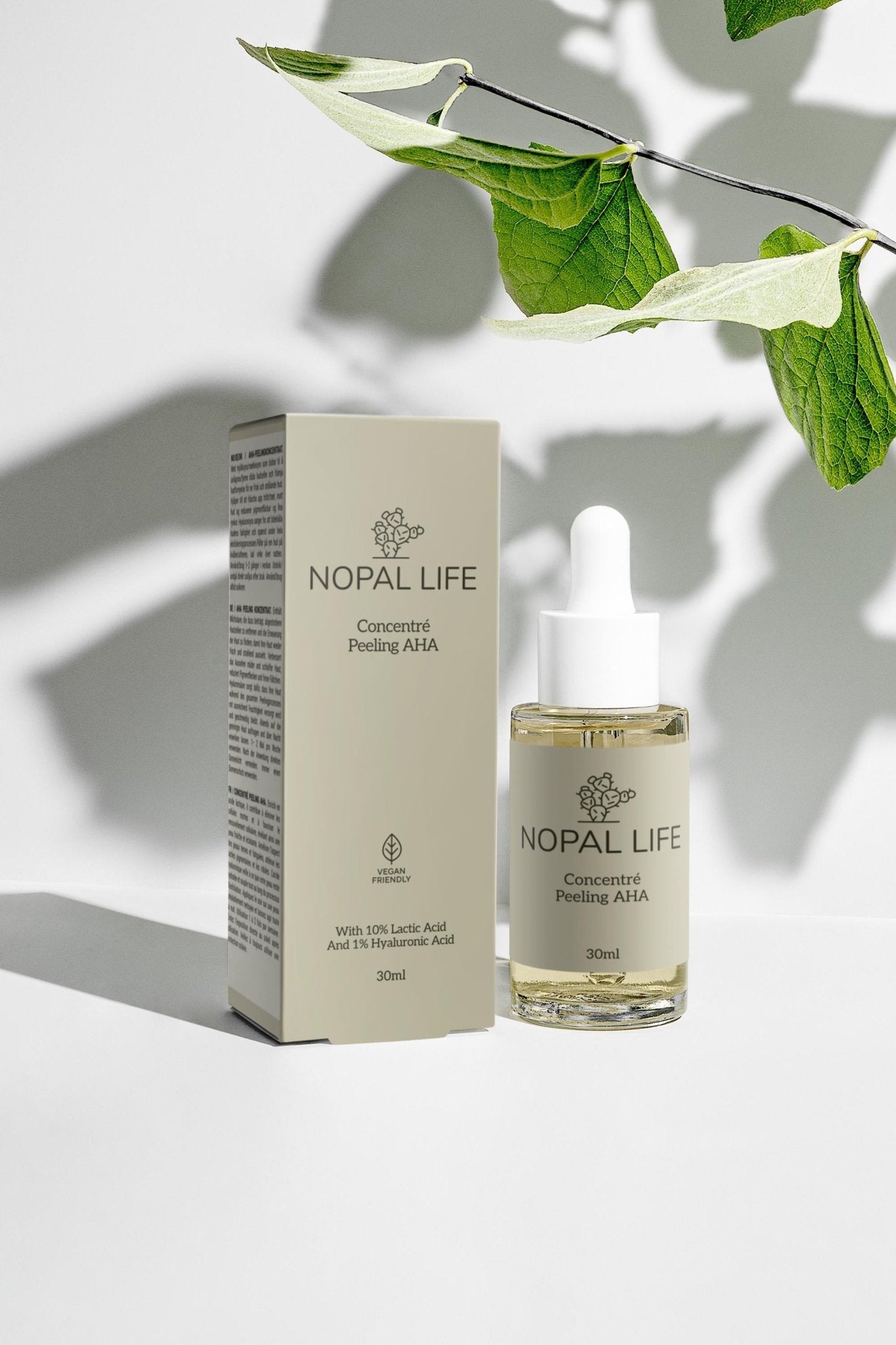
Alpha-hydroxy acids are water-soluble acids that work on the surface. The most common are glycolic acid, the most penetrating, and lactic acid, which is gentler and better tolerated.
They loosen accumulated dead cells, which improves radiance and skin texture. Unlike salicylic acid, they do not penetrate pores: their domain is the surface.
Their downside is twofold: they dry out the skin and significantly increase sensitivity to radiation. Daily sun protection is part of the protocol, without exception.
What prickly pear oil provides
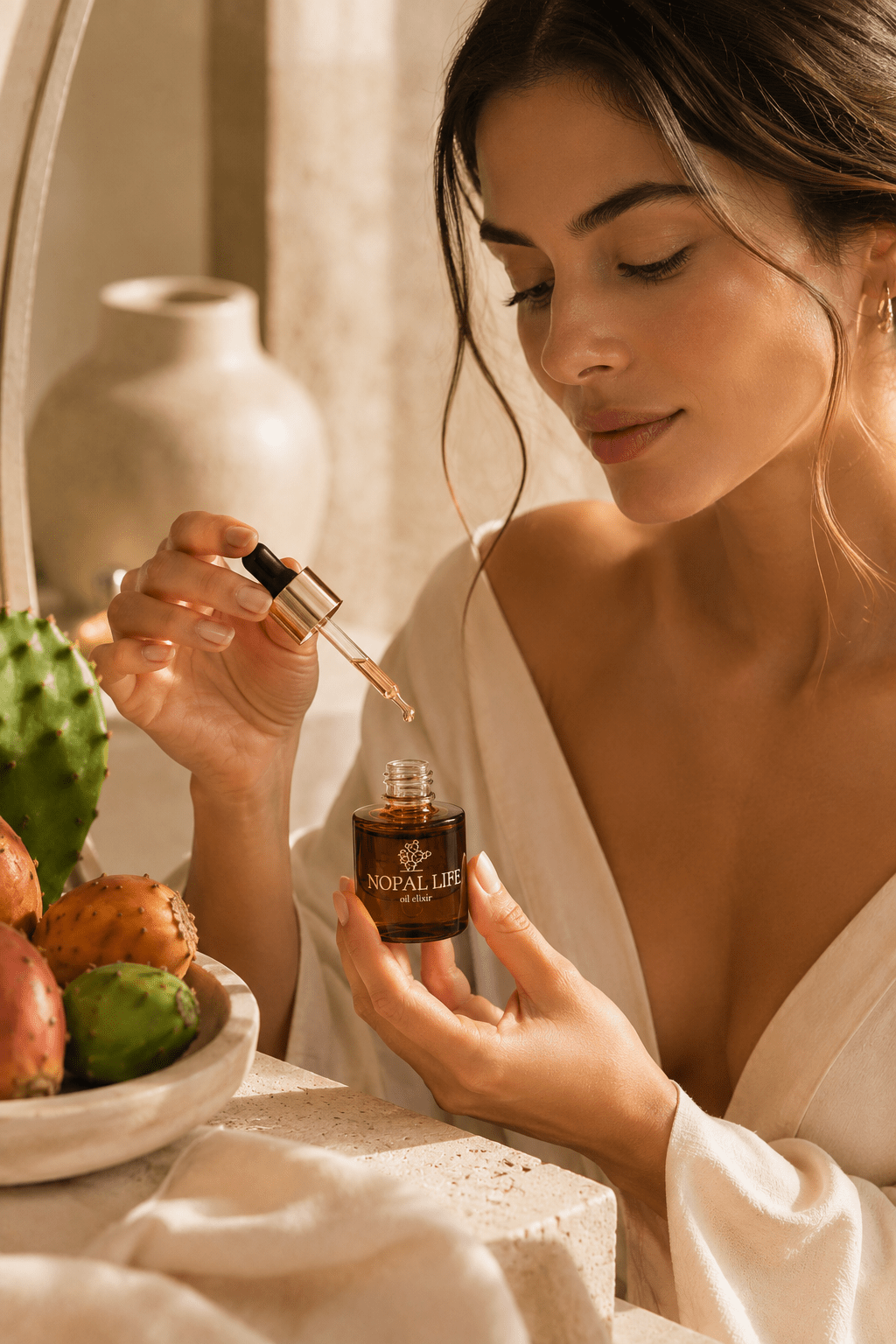
A linoleic acid content that often exceeds 60%, and significant amounts of tocopherols. The former is a component of the lipids in the skin barrier, while the latter limits oxidative damage.
Prickly pear oil is extracted from the seeds of the Opuntia ficus indica fruit. It takes nearly a ton to obtain a liter of oil, produced by first cold pressing.
Which one to choose
Dull complexion, uneven texture: an AHA, the only one of the two to act on this concern.
Dry, rough, tight skin: prickly pear oil. An AHA on already dry skin would worsen the situation.
Mature skin: both, at different times of the week.
Combine without irritation
It is possible and often desirable, provided the order and frequency are respected.
Safest method: AHA on the evenings you use it, prickly pear oil every evening without exception.
On the same evening: AHA on clean, dry skin, wait ten minutes, then apply a cream and prickly pear oil as the last layer.
Never reverse the order: a fatty substance applied first would form a film that would prevent the acid from reaching the surface.
Why oil is particularly useful here
Exfoliation removes some of the surface lipid cement, along with dead cells. The skin then loses more water in the following days.
Prickly pear oil replenishes exactly this type of material: linoleic acid, which the skin uses to rebuild this cement. It is one of its best uses.
Progression, week by week
Weeks 1 and 2: AHA once a week.
Weeks 3 and 4: twice, if no dryness occurs.
After that: three times maximum.
Skin that is constantly peeling is not skin that is improving: it is an overwhelmed barrier. Prickly pear oil, on the other hand, can be used daily without restriction.
Sun protection, non-negotiable
AHAs significantly increase sensitivity to ultraviolet rays, more so than salicylic acid. Daily sun protection is essential for the results, especially on the days following an application.
Without it, you damage on one side what you gain on the other. Prickly pear oil, for its part, has no effect on photosensitivity.
Using prickly pear oil after exfoliation
This is one of its best uses. Two drops on the evening of an AHA application, applied after a cream, restore the matter that exfoliation has removed.
Apply gently, without rubbing, to skin that has just been treated. Prickly pear oil penetrates quickly despite its richness, which limits discomfort the next day.
For what skin types
Dry skin: AHA once a week maximum, prickly pear oil daily.
Mature skin: both, AHA twice a week and prickly pear oil morning and evening.
Combination skin: AHA on the T-zone, oil on the entire face.
Reactive skin: start with lactic acid, which is gentler than glycolic, and keep prickly pear oil every evening.
Anti-aging: two different paths
An AHA improves radiance through surface renewal. Prickly pear oil improves suppleness through its essential fatty acid content and antioxidant action.
The two work in the same direction without overlapping. Neither can erase an established wrinkle, and sun protection remains the decisive action.
A rare and fragile prickly pear oil
Nearly a ton of prickly pears yields one liter of oil. The seeds represent only a tiny fraction of the Opuntia ficus indica fruit.
At NOPAL LIFE, they come from family plantations in the arid highlands of eastern Algeria and Kabylia. Prickly pear oil is obtained there by first cold pressing, the only process that preserves tocopherols.
What not to combine
An AHA and a retinoid on the same evening: this is too much for most skin types. Alternate instead.
Two different exfoliants: choose one. Prickly pear oil, on the other hand, combines with everything and poses no compatibility issues.
The benefits of prickly pear oil on exfoliated skin
The benefits of prickly pear oil are fully realized after an AHA: it restores the lipids that exfoliation has removed, which a classic cream does less effectively.
Its essential fatty acid content exceeds that of most common vegetable oils, including argan oil. This is what distinguishes it for this specific use.
Using prickly pear oil every day
Unlike an AHA, prickly pear oil has no frequency limits. Two to three drops in the evening, one in the morning, every day of the year.
Organic prickly pear oil, obtained by first cold pressing, retains its tocopherols. This is the most important criterion when buying.
On the eye contour area
Never apply an AHA there: the area is too thin and does not need exfoliation. A drop of prickly pear oil, tapped with the tip of the ring finger, is perfectly appropriate here.
Preferably in the evening, when nothing else is applied over it.
What you should know
These products are cosmetics: they act on the appearance and comfort of the skin, without treating any condition. Persistent irritation requires dermatological advice.
Our anti-aging treatments