Combining prickly pear seed oil and rosehip oil
Yes, these two oils can be layered without a problem—but alternating them is often more effective. They occupy the same place at the end of a routine and play a similar role. Layering them sometimes means doubling the amount of fatty substances without doubling the benefit.
The verdict in brief
- Layering possible: Yes, one drop of each rather than two of each.
- Alternation recommended: Rosehip oil in the evening, prickly pear oil in the morning, or alternating by season.
- If you have to choose: Prickly pear for comfort and suppleness, rosehip for working on marks and skin texture.
- Reactive skin: Start with prickly pear oil alone, as it is better tolerated.
What truly distinguishes them
Both are vegetable oils rich in unsaturated fatty acids, and both are applied at the end of a routine. The difference lies in their fine composition.
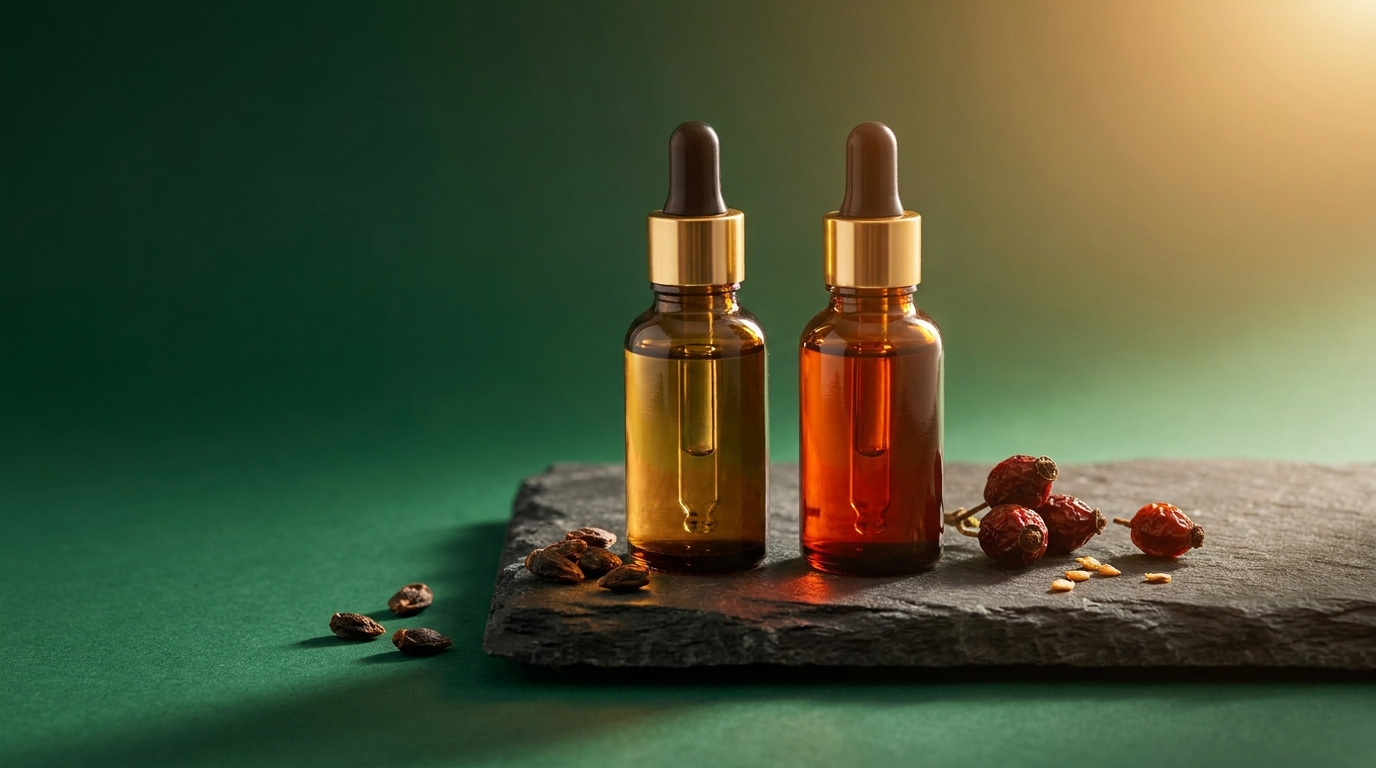
Prickly pear seed oil is particularly rich in linoleic acid and tocopherols. Its texture is light, it penetrates quickly, and leaves a supple finish. It is a comforting oil, well-accepted by reactive skin types.
Rosehip oil contains polyunsaturated fatty acids and compounds related to vitamin A. It is traditionally associated with improving skin texture and reducing marks. Its downside: it oxidizes faster and its stronger scent doesn't appeal to everyone.
Layering: how to do it
If you insist on using them together, the rule is to reduce the quantities.
1. After your serum, apply one drop of rosehip oil. It is the finer of the two, so it goes first.
2. Wait one minute.
3. Apply one drop of prickly pear seed oil, pressing it in. It seals everything.
Two drops in total, not four. Skin can only absorb a limited amount of fatty substances; beyond that, the excess remains on the surface and gives a greasy feeling without benefit.
Alternating: often better
Alternating prevents overload and allows you to observe what each oil brings to your skin.
By time of day: Prickly pear in the morning, as its light texture blends better under makeup; rosehip in the evening, where its scent and richness are less of a concern.
By season: Rosehip in winter, prickly pear the rest of the year.
By cycle: One oil for three to four weeks, then the other. This is the clearest way to determine which one suits you.
The case of combination skin
Two oils on combination skin is almost always excessive. Reserve oil for areas that feel tight—around the face, cheeks—and leave the T-zone without fatty substances, or with a simple hydrating gel.
What each oil brings to the skin
Prickly pear seed oil is obtained by cold pressing the fruit's seeds. It is rich in essential fatty acids, mainly omega-6, and tocopherols, which help protect against free radicals involved in skin aging. It nourishes without weighing down, making it suitable for both dry and combination to oily skin, provided the quantity is adjusted.
Rosehip oil is traditionally associated with skin regeneration and improving marks. Its richness in polyunsaturated fatty acids makes it more suitable for mature and dry skin. It integrates well into a homemade day cream or can be applied alone in the evening.
Prickly pear oil, derived from Opuntia ficus indica, is obtained by first cold pressing the seeds. It is a rare oil in the literal sense, which explains its price as much as its benefits for the skin.
Its active ingredients—vitamin E, sterols, unsaturated fatty acids—act on anti-aging by supporting the suppleness of the skin barrier. Using prickly pear oil in the evening, on still damp skin, remains the most effective way to achieve a visible effect.
The eye contour
Both oils can be used on the eye contour, provided you stay on the orbital bone and never approach the mobile eyelid. A single drop is enough for both eyes, dabbed with the ring finger which naturally exerts less pressure. In this area, prickly pear is often preferred for its lighter texture.
Daily skin protection
No vegetable oil protects against ultraviolet rays. They complement a routine but never replace sunscreen in the morning. Their role is to nourish and limit water loss, not to filter.
Storage
Rosehip oil oxidizes faster: keep it away from light and close it carefully. A rancid odor or darkening color indicates an oil that should no longer be used on the face.
Prickly pear oil is more stable, but the same precautions extend its shelf life.
What these oils do not do
They do not erase established wrinkles and do not replace sun protection. These are cosmetic treatments: they do not cure or treat any condition. A recent scar or an evolving lesion requires medical advice.
The origin of our prickly pear oil
Algeria, arid high plateaus and Kabylia. Bio Nopal Cactus sources from artisanal family plantations. The fig tree grows without irrigation. Cold-pressed seeds.
Frequently asked questions
Can I mix the two oils in my palm?
Yes, unlike an oil-water mixture, two oils mix perfectly. One drop of each, warmed between the palms, can be applied in a single step.
Which one should I apply first if I layer them?
Rosehip oil, being finer, then prickly pear oil to seal. The difference is modest: the essential thing is not to exceed two drops in total.
How long does it take to determine which one suits me?
Three to four weeks per oil, alternating and not layering. This is the only way to attribute a change to one rather than the other.
Can the scent of rosehip oil be masked by the other oil?
Only partially. If the scent bothers you, alternating by time of day is more effective: reserve rosehip for the evening.
The products mentioned in this article


Mature skin · Dry skin

Go further than this article
Get our skincare guides by email — and start with your free skin diagnostic: 2 minutes, advice tailored to your skin. We ship to the US, UK, Canada, Australia and 27 European countries; somewhere else? Sign up and you will be the first to know when we deliver to your country.
By signing up, you agree to our privacy policy. Unsubscribe in one click.