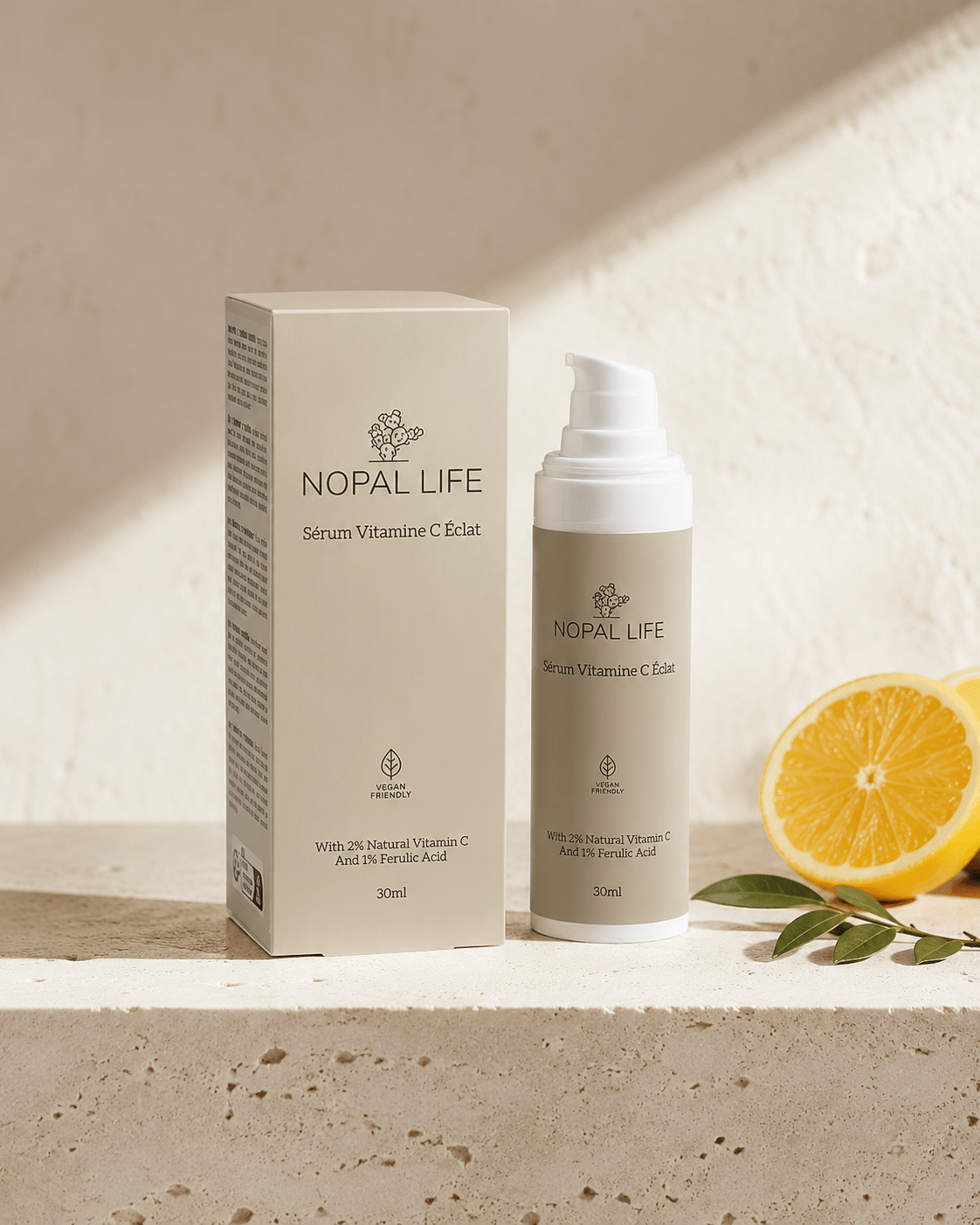
Stabilized Vitamin C: Nopal Life Complete Guide
Choosing the right active ingredients is already a way of taking care of your skin. Stabilized Vitamin C: here is the complete guide to this ingredient — cosmetic properties, application techniques, synergies — to integrate it correctly into your ritual.
What is stabilized Vitamin C? Definition and origins
Vitamin C is one of the most popular active ingredients in cosmetics, but its natural form — L-asAscorbic acid — has a major flaw: it oxidizes extremely quickly on contact with air, light, and water. In just a few hours, a formulation based on pure L-ascorbic acid can lose most of its activity, turning yellow then orangey-brown. It is precisely to circumvent this instability that cosmetics has developed derivative forms of Vitamin C, grouped under the name stabilized Vitamin C.
Among the most widely used stabilized forms today, two stand out for their widespread use in cosmetics. Ascorbyl glucoside (also noted AA2G) is a water-soluble form in which a glucose molecule is bound to ascorbic acid by a glycosidic bond. This bond protects the molecule from oxidation; once applied to the skin, it gradually releases Vitamin C. 3-O-ethyl ascorbic acid (3-OEA), on the other hand, is an ethylated form, very stable in formula, which diffuses rapidly into the superficial layers of the skin and has an excellent tolerance profile, even for reactive skin. Other derivatives exist — ascorbyl palmitate, magnesium ascorbyl phosphate, tetrahexyldecyl ascorbate — each with its own characteristics of stability, solubility, and skin affinity.
The advantage of these stabilized forms lies in their ability to maintain their chemical integrity much longer than pure L-ascorbic acid, while offering the skin a comparable or even superior cosmetic experience in some cases, particularly in terms of skin tolerance. This formulation progress has made the appreciated qualities of Vitamin C in cosmetics accessible to a much larger number of people — including those with sensitive skin who cannot tolerate acidic formulations.
Cosmetic properties of stabilized Vitamin C in skincare
Vitamin C is appreciated in cosmetics for several distinct and complementary qualities. The first and most recognized is its antioxidant nature. Ascorbic acid is known to help protect the skin from environmental stress — UV, pollution, tobacco, blue light. In this context, stabilized Vitamin C is often presented as a particularly appreciated first line of antioxidant care, which supports the skin against external aggressions and helps preserve the skin's radiant appearance.
The second often sought-after asset concerns the firm and plump appearance of the skin. Vitamin C, as an ingredient associated with skin comfort, is widely used in treatments that aim to help preserve the firm and plump appearance of the skin and reduce the visible appearance of fine lines. The third major cosmetic benefit concerns the complexion: Vitamin C is popular in treatments that help unify the appearance of the complexion and reduce the visible appearance of spots, whether linked to the sun, hormonal variations or marks left by old imperfections.
Over the years, the skin tends to appear duller and more vulnerable to external aggressions. This is what makes the cosmetic contribution of stabilized Vitamin C all the more relevant after 30 years old, to support the skin daily and help preserve the appearance of a bright and radiant complexion.
How to integrate stabilized Vitamin C into your beauty routine
The question of application time is central to making the most of stabilized Vitamin C. Morning is the ideal time: applied before your sunscreen, Vitamin C provides an additional antioxidant action to the physical or chemical UV protection of your SPF. This Vitamin C + SPF duo is recognized as one of the most popular combinations for preserving the skin's youthful and radiant appearance.
In terms of galenic form, stabilized Vitamin C is found in serums (concentration often between 5 and 20%), essences, light creams, and even masks. Water-based serums with ascorbyl glucoside or 3-OEA are ideally placed after cleanser and toner, on clean and slightly damp skin, and before more occlusive treatments such as creams or oils. Apply 3 to 5 drops to the face, neck, and possibly the décolleté, gently patting to promote absorption.
Regarding concentration, it is not necessary to go very high with stabilized forms: unlike pure L-ascorbic acid which requires concentrations of 15 to 20% to express itself at acidic pH, ascorbyl glucoside at 2-5% and 3-OEA at 3-5% offer a comparable experience with much superior tolerance. For sensitive skin, start with a low concentration and gradually increase. Consistency is key: a visibly more radiant complexion generally appears after 4 to 6 weeks of daily use, and the appearance of spots is appreciated over a longer period. To consult our complete skin guide and refine your routine according to your skin type, all advice is available online.
Mistakes to avoid with stabilized Vitamin C
The first and most common mistake is to apply stabilized Vitamin C simultaneously with exfoliating acids with low pH (AHAs like glycolic acid, BHAs like salicylic acid). Although this precaution is more valid for pure L-ascorbic acid — very sensitive to pH — it is generally advisable to avoid this combination to avoid overloading the skin and risking discomfort. If you use chemical exfoliants, reserve them for the evening, and Vitamin C for the morning.
The second mistake is to improperly store your product. Even stabilized, Vitamin C remains sensitive to light and heat in the long term. Store your serums away from direct light, ideally in a cool place (bathroom drawer away from steam, or refrigerator for very active formulas). An opaque or tinted bottle is a good indicator of formulation quality. If your product turns intense yellow or brown, its activity has been partially altered.
Third common mistake: expecting immediate results. Vitamin C is not a flash-effect active ingredient. Its action on the appearance of the complexion, the appearance of spots, and visible firmness is long-term. Many people give up too early, after two or three weeks, before the cosmetic qualities are visible. You need to maintain a regular routine for several weeks to appreciate the first results on radiance, and even longer for the appearance of spots.
Fourth mistake: underestimating the importance of the quantity applied. A few insufficient drops do not effectively cover the face and neck. Conversely, an excessive amount does not accelerate results and can cause tingling on more reactive skin. Three to five drops for the entire face are generally sufficient. Finally, remember that Vitamin C alone is not enough: unprotected sun exposure compromises the unified appearance of the complexion. Applying a minimum SPF 30 in the morning is non-negotiable.
Stabilized Vitamin C and specific skin types
Stabilized Vitamin C is one of the few truly universal cosmetic active ingredients, but its integration varies depending on skin types. For combination to oily skin, light water-based serums with ascorbyl glucoside or 3-OEA are ideal: they do not weigh down the hydrolipidic film, do not clog pores, and help mattify the appearance of shiny areas while helping to unify the appearance of an often uneven complexion and the appearance of marks left by old imperfections, common on these skin types. For dry and dehydrated skin, a formula combining stabilized Vitamin C and moisturizing agents (hyaluronic acid, glycerin) will be preferred, so as not to accentuate the feeling of tightness sometimes experienced with highly concentrated forms.
For sensitive and reactive skin, 3-OEA is often better tolerated than pure L-ascorbic acid or even ascorbyl glucoside in high quantities, due to its near-neutral pH and gentle action. Sensitive skin benefits from a gradual introduction: application every other day for the first two weeks, then daily use. Mature skin (after 45 years old) particularly appreciates antioxidant Vitamin C. Over the years, the complexion tends to appear duller and the texture more uneven. Stabilized Vitamin C, with its antioxidant action and its action on radiance, helps restore luminosity and a denser appearance to these skin types. To know your precise skin profile and identify the form of Vitamin C best suited to your skin, the Nopal Life Skin Intelligence™ diagnosis will guide you precisely.
Stabilized Vitamin C in Nopal Life formulas
At Nopal Life, the integration of stabilized Vitamin C into formulations is part of a global philosophy: each active ingredient is selected for its skin affinity, tolerance, and synergy with other ingredients in the range. Our formulas use stabilized forms carefully chosen according to the vehicle (water, oil, emulsion) and the cosmetic objective — radiance, unified appearance, antioxidant comfort, or support for the appearance of the skin barrier.
The synergy between stabilized Vitamin C and prickly pear seed oil is particularly remarkable. Prickly pear seed oil is one of the vegetable oils richest in linoleic acid and tocopherols (natural Vitamin E) — lipophilic antioxidants that blend harmoniously with hydrophilic Vitamin C. This combination covers both phases — aqueous and lipidic — of the skin film, for a complete and multi-level antioxidant action. It also helps preserve Vitamin C in the formula, tocopherol being known to help protect Vitamin C from oxidation. Our Nopal Life facial treatments fully exploit this complementarity to offer you formulas that are pleasant, well-tolerated, and long-lasting.
Serum, cream and protocol: integrating ascorbic acid into a complete routine
The experience offered by a stabilized ascorbic acid serum depends as much on its formulation as on its integration into a structured routine. A serum concentrated in ascorbyl glucoside (10–15%) is applied to a clean face, before day cream, in a thin layer. This early application in the layering allows the active ingredient to diffuse freely into the superficial layers of the skin, without competition from film-forming molecules present in thick creams.
The most often sought-after cosmetic asset is the firm and plump appearance of the skin. Vitamin C is a widely acclaimed ingredient in treatments that help preserve this appearance and skin comfort. Topical treatments support the skin daily, with a visibly denser and more toned appearance appreciated after several weeks of regular use.
Actions on radiance, wrinkles, and spots
Optically, the reduction in the visible appearance of spots and restored radiance are the most rapidly noticeable effects after introducing a good serum. The action helps to unify the appearance of the complexion, which reduces the visible appearance of existing superficial spots in a few weeks. Fine lines, meanwhile, are appreciated over a longer horizon — typically several months of regular care, the time it takes for the firm and plump appearance to reveal itself.
The combination of an ascorbic acid serum in the morning and a rich ceramide cream in the evening creates a recognized synergy: the night cream helps restore the appearance of a comfortable skin barrier after daytime exposure, while the morning serum supports the radiance of the complexion and helps preserve its unified appearance. This dual routine, maintained over the long term, is one of the most appreciated approaches to support the youthful and radiant appearance of the skin.
Frequently Asked Questions
Q: What is the difference between ascorbyl glucoside and 3-O-ethyl ascorbic acid?
A: Ascorbyl glucoside is a water-soluble form that gradually releases Vitamin C, ideal for a prolonged effect. 3-O-ethyl ascorbic acid diffuses more quickly into the superficial layers of the skin, is very stable in formula, and has an excellent tolerance profile. Both are appreciated; the choice depends on your skin type and sensitivity.
Q: Can stabilized Vitamin C be used every day?
A: Yes, it is even recommended. The cosmetic qualities of Vitamin C rely on regular and daily use. An application every morning, before SPF, offers continuous antioxidant action and progressive and lasting results on the radiance and unified appearance of the complexion.
Q: Can stabilized Vitamin C cause irritation?
A: Stabilized forms are significantly less irritating than pure L-ascorbic acid, as they do not require a very acidic pH to work. Some people with very reactive skin may experience slight initial tingling, but this generally disappears after a few applications. If in doubt, start by using it every other day.
Q: Is stabilized Vitamin C compatible with niacinamide?
A: Absolutely. Contrary to a persistent misconception, the combination of stabilized Vitamin C and niacinamide is perfectly compatible and even synergistic. Niacinamide supports the appearance of the complexion in a way that complements Vitamin C, making their combination particularly appreciated for helping to reduce the visible appearance of spots and uneven skin tone.
Q: How long does it take to see results on spots?
A: The first effects on overall radiance are often visible after 3 to 4 weeks of daily use. The appearance of spots (linked to sun, hormonal variations, marks from old imperfections) is generally appreciated over a longer period. Consistency is absolutely essential, accompanied by daily sun protection.
Q: Is stabilized Vitamin C useful for marks left by old imperfections?
A: Yes, this is one of its most valuable uses. Marks left by old imperfections give an uneven appearance to the complexion. Vitamin C, by helping to unify the appearance of the complexion, gradually reduces the visible appearance of these marks. It combines well with other active ingredients such as niacinamide or azelaic acid for an optimal routine.
Q: Can stabilized Vitamin C be applied under the eyes?
A: With gentle stabilized forms (ascorbyl glucoside or 3-OEA at low concentration), periocular application is possible and appreciated for helping to revive the appearance of the eyes and reduce the visible appearance of pigmented dark circles. As the skin around the eyes is very thin, apply with extreme lightness, by patting, without stretching the skin.
Q: Should stabilized Vitamin C be rinsed off after application?
A: No, serums and treatments based on stabilized Vitamin C are leave-on treatments. They are applied to clean skin, absorbed, and form the antioxidant base of your morning routine, before moisturizer and SPF. Do not rinse them off, at the risk of eliminating the active ingredient before it has been absorbed.

Ingredient Reference
Stabilized Vitamin C
Radiance, unified appearance & visibly firm look — antioxidant sun protection.
Discover the sheet →Read more
Information provided for cosmetic and educational purposes; it does not constitute medical advice.
Our anti-aging treatments