Prickly pear polyphenols, betalains, isorhamnetin: exceptional ORAC and dehydrated sensitive skin
In the world of natural cosmetic active ingredients, few ingredients boast a phenolic profile as dense as that of prickly pear (Opuntia ficus-indica). While prickly pear oil is already prized for its richness in vitamin E and unsaturated fatty acids, it is its polyphenolic fraction—betalains, betaxanthins, isorhamnetin, kaempferol, quercetin, and protocatechuic acid—that draws attention in cosmetics. For dehydrated and sensitive skin with a weakened skin barrier, understanding these molecules means understanding why prickly pear is establishing itself as one of the botanical active ingredients of choice to support skin comfort, radiance, and well-being daily.
Betalains and Betaxanthins: Nitrogen-containing pigments with a singular profile
Betalains constitute the most characteristic class of pigments in Opuntia ficus-indica. Unlike anthocyanins—flavonoid pigments found in other plants—betalains are nitrogen-containing pigments, resulting from the condensation of betalamic acid with amino acids or amines. They are divided into two subgroups: betacyanins (red-violet pigments) and betaxanthins (yellow-orange pigments).
Betaxanthins, particularly vulgaxanthin and indicaxanthin, are among the most studied compounds in prickly pear. These molecules are often associated with the concept of plant-based antioxidants, a central theme in cosmetics: when the skin barrier is depleted of lipids (ceramides, free fatty acids), the skin can appear more sensitive and uncomfortable. Prickly pear is traditionally valued for helping to maintain the appearance of healthy, rested skin, supporting its comfort and natural radiance.
On the skin, this interest translates concretely into a quest for comfort and freshness: helping the skin better cope with daily external aggressions, preserving its supple and smooth appearance, and supporting skin comfort linked to good hydration.
Isorhamnetin, Kaempferol, and Quercetin: The comforting flavonoid trio
Beyond betalains, prickly pear contains three flavonoids of great cosmetic interest: isorhamnetin, kaempferol, and quercetin. These three molecules belong to the flavonol family and share a C6-C3-C6 chemical backbone but differ in their functional groups, which modulates their characteristics in formulation.
Isorhamnetin (3'-methoxy-quercetin) is related to quercetin. It is traditionally associated with comforting ingredients in sensitive skin care. For sensitive skin prone to feelings of discomfort—appearance of redness, tightness, reactivity to temperature changes—this type of botanical active ingredient is valued for helping to maintain a soothed and comfortable skin appearance.
Kaempferol is a flavonoid frequently cited among plant compounds of cosmetic interest. It is one of the botanical active ingredients found in skincare products designed to support the radiance and comfort of the superficial layer of the skin, where the sensation of hydration occurs.
Quercetin, the most studied of the three, is a flavonoid widely present in the plant kingdom. It is valued in cosmetics for helping to maintain a comfortable skin appearance. The cohesion of the superficial layer plays an important role in the sensation of supple and well-hydrated skin: skincare products rich in botanical active ingredients aim to support this aspect of comfort and softness of the skin barrier.
Protocatechuic Acid: The phenolic acid that completes the profile
Less publicized than quercetin, protocatechuic acid (PCA) is a simple phenolic acid—derived from hydroxybenzoic acid—present in significant quantities in Opuntia ficus-indica cladode extracts. Its role is doubly interesting in cosmetic formulation.
First, it is one of the phenolic compounds valued for their antioxidant profile in cosmetics. Second, protocatechuic acid pairs well with flavonoids: combined with quercetin and isorhamnetin, it contributes to the richness of the total extract and the balance of the phenolic profile in the superficial layers of the skin.
This complementarity is precisely what distinguishes a total prickly pear extract from an isolated active ingredient: phenolic complexity creates a rich and harmonious profile, often perceived as more interesting than the sum of its components taken separately.
How to integrate polyphenols into a routine for dehydrated sensitive skin
Knowing the ingredients is one thing; knowing how to integrate them into a daily routine is another. For dehydrated skin with a weakened barrier, the order of application and the texture of the products matter to best benefit from polyphenols.
Morning: after gentle cleansing (sulfate-free), apply an aqueous serum containing prickly pear extracts to deposit hydrophilic polyphenols (quercetin, PCA) in a thin layer on damp epidermis. Immediately seal with regenerating prickly pear cream: its formula combines prickly pear oil (fat-soluble, carrier of carotenoids and tocopherols) with film-forming active ingredients that help retain moisture on the surface. Prickly pear oil, a true star of the range, provides a welcome nourishing touch while supporting the comfort of the skin film.
Evening: night is an ideal time to apply a more generous layer of regenerating cream. During rest, the skin benefits from a favorable environment, free from external aggressions such as atmospheric pollution: polyphenol-rich skincare then supports the comfort and rested appearance of the skin upon waking. Isorhamnetin and kaempferol are part of this evening routine designed to maintain supple and comfortable skin.
To compose this routine, consult our antioxidant and radiance care collection and perform your personalized skin diagnostic to precisely identify your skin barrier type.
Mistakes to avoid with polyphenolic active ingredients
Making the most of polyphenols is conditional: certain common practices can limit their benefits and make dehydrated, sensitive skin uncomfortable.
Mistake #1 — Combining with strong oxidants: polyphenols are antioxidants; applying them at the same time as high-concentration vitamin C (ascorbic acid > 15%) or peroxides can alter both types of active ingredients. It is better to apply polyphenol-rich products at a temporal distance from highly acidic formulas.
Mistake #2 — Neglecting pH: flavonoids exhibit optimal stability between pH 4.5 and 6.5. An overly alkaline toner applied just before can alter their structure and reduce their surface benefits.
Mistake #3 — Skipping the occlusive step: applying hydrophilic polyphenols without a lipid film over them is like letting them evaporate with surface water. The prickly pear regenerating cream plays this role of a light occlusive, useful for helping the skin retain its hydration.
Mistake #4 — Overestimating heat resistance: betaxanthins are thermolabile. Avoid storing products containing aqueous prickly pear extracts in places exposed to heat (very hot bathroom, near a sunny window) to preserve their qualities.
Mistake #5 — Ignoring the polyphenolic profile of the extract: not all Opuntia extracts are equivalent. A lyophilized cladode (paddle) extract retains betaxanthins better than a fermented fruit extract. Check the standardization of the extract mentioned on the product's technical sheet.
Prickly Pear Oil and Polyphenol Synergy: The winning formulation
Prickly pear oil is the star active ingredient in the Nopal Life range, and for good reason: with 55 to 65% linoleic acid (omega-6), it is particularly appreciated by dehydrated skin seeking nourishment and comfort. But its true uniqueness lies in its unsaponifiable fraction, one of the richest in the plant kingdom: up to 1,500 mg/kg of tocopherols and sterols (β-sitosterol, campesterol) that harmoniously complement the polyphenols.
When prickly pear oil is combined with polyphenols in a bi-phasic or emulsified formula, the whole forms a rich and balanced profile: tocopherols complement betalains and flavonoids, while sterols provide the texture with a pleasant affinity for the skin. The result: a lasting feeling of comfort and a supple appearance that neither oil alone nor polyphenols alone can provide as fully.
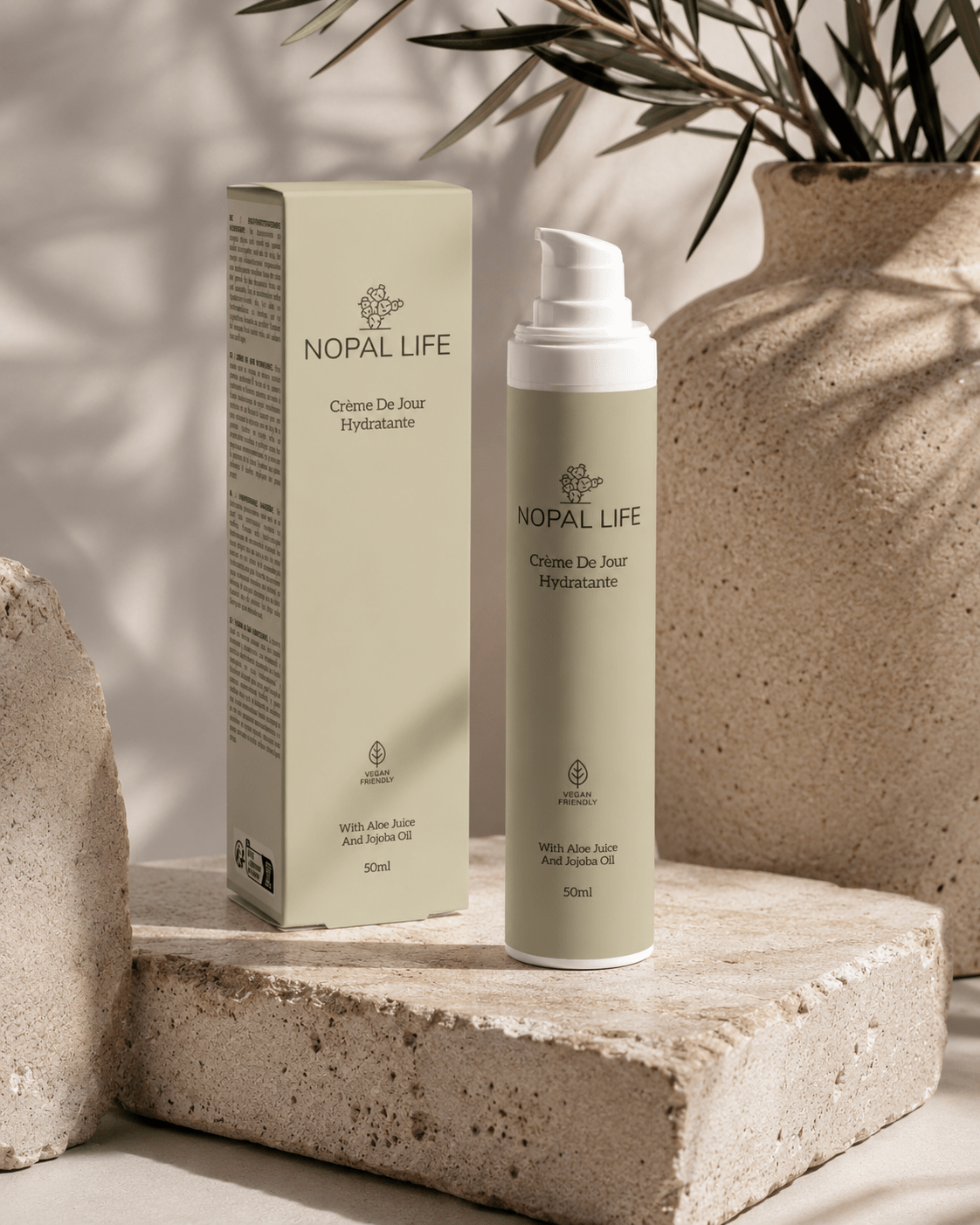
The Nopal Life Regenerating Prickly Pear Cream embodies this synergy: designed for skin with a weakened barrier, it concentrates Opuntia ficus-indica seed oil and standardized extracts to support skin comfort, radiance, and visible suppleness.
FAQ — Prickly Pear Polyphenols and Natural Skincare
Q1 — What is the difference between betalains and anthocyanins?
Betalains are nitrogen-containing pigments specific to the order Caryophyllales (which includes Opuntia), while anthocyanins are flavonoids found in most colorful flowering plants. Betalains never exist in the same plant as anthocyanins. They show better stability at neutral pH and an antioxidant profile complementary to that of flavonoids.
Q2 — Are prickly pear betaxanthins really beneficial for the skin?
In cosmetics, what matters most is the active ingredient's affinity with the skin and the sensation it provides. Opuntia polyphenols, especially indicaxanthin and isorhamnetin, are valued for their gentleness and their place in radiance care, which explains their interest in formulation beyond their sole composition.
Q3 — Are prickly pear polyphenols suitable for very sensitive or reactive skin?
Yes. Unlike some active ingredients like retinol or concentrated vitamin C, prickly pear polyphenols are known to be gentle and well-tolerated. Isorhamnetin and quercetin are among the botanical active ingredients valued for helping to maintain a soothed and comfortable skin appearance.
Q4 — How often should I use skincare products containing these polyphenols?
Daily, morning and evening. Unlike exfoliating active ingredients (AHAs, retinol) which often require an adjustment period, prickly pear polyphenols are generally well-tolerated with twice-daily application from the first day, even on the most fragile skin.
Q5 — Is prickly pear regenerating cream enough on its own, or do I need an additional serum?
For an effective minimal routine, the regenerating cream alone provides the essentials: comfort, polyphenols, and tocopherols. Adding an aqueous serum concentrated in cladode extracts increases the polyphenolic density and is recommended for skin that feels very dehydrated or is exposed to demanding environments (pollution, air conditioning, dry cold).
Q6 — Are these polyphenols beneficial for a radiance and visible firmness routine?
Yes. Isorhamnetin, kaempferol, and quercetin are flavonoids appreciated in skincare products that aim to preserve the skin's firm, plump, and radiant appearance. Together, they form a valued botanical profile, complementary to texture and comfort care, to support a fresh and rested-looking complexion.
Q7 — How can I identify a product truly rich in prickly pear polyphenols in the INCI list?
Look for Opuntia Ficus-Indica Stem Extract, Opuntia Ficus-Indica Fruit Extract, or Opuntia Ficus-Indica Seed Oil at the top of the INCI list (before emollients). The position in the INCI list indicates the relative concentration. A standardized extract mentioned in the technical sheet with a percentage of total betaxanthins is a sign of a serious formulation.
Q8 — Are prickly pear polyphenols stable in cosmetic formulations?
Betaxanthins are the least stable (thermolabile, photosensitive). Flavonoids (isorhamnetin, quercetin, kaempferol) and protocatechuic acid, however, are robust in emulsions with a pH of 4.5-6.5. Reputable brands use opaque packaging, stabilizing antioxidants (tocopherols), and encapsulated extracts to preserve the extract's qualities until its expiration date.
Why choose Nopal Life for deep and lasting hydration
Skin hydration is not limited to applying water to the skin: it is accompanied by film-forming active ingredients that help retain water on the surface of the epidermis. Nopal Life formulates each product around popular humectants (hyaluronic acid, aloe vera, prebiotics) combined with prickly pear oil, an exceptional natural emollient that helps seal in moisture and preserve the comfort of the skin's protective film.
The result: plump, supple, and comfortable-looking skin. Each formulation is dermatologically tested and adapted to your skin type. Take your free diagnostic to identify the ideal hydration routine for you.
PERSONALIZED ROUTINE
Nopal Life Skin Intelligence™
Free diagnostic · 2 minutes
DISCOVER MY ROUTINE →Read more
Information provided for cosmetic and educational purposes only; it does not constitute medical advice.
Our anti-aging treatments