Foundation on dry skin: avoid visible patches
On dry skin, foundation emphasizes what preparation leaves visible: flakes, rough areas, and lack of suppleness. The best result comes less from high coverage and more from proper hydration, a supple texture, and application in thin layers. Luminous makeup cannot compensate for a flaking surface.
Prepare skin twenty minutes before makeup
Apply a cream containing humectants and emollients to clean skin. Let it absorb for ten to twenty minutes before applying makeup so that the surface becomes supple without remaining sticky. If certain areas are very dry, add a tiny amount of balm only to these patches.
Avoid harsh scrubs just before applying makeup. They can create micro-flakes that are initially invisible but become very visible under pigments. Gentle exfoliation should be planned for another day.
Choose a more flexible than ultra-matte formula
Long-wearing matte foundations often contain more absorbent powders and film-forming polymers. They can accentuate the texture of dry skin. A fluid, satiny, or hydrating formula generally follows facial movements better.
Mentions like "serum," "glow," or "hydrating" do not guarantee the result, but they do point towards often more flexible textures. Test the formula on a cheek and observe it after four hours rather than only at the time of application.
Damp sponge, fingers, or brush
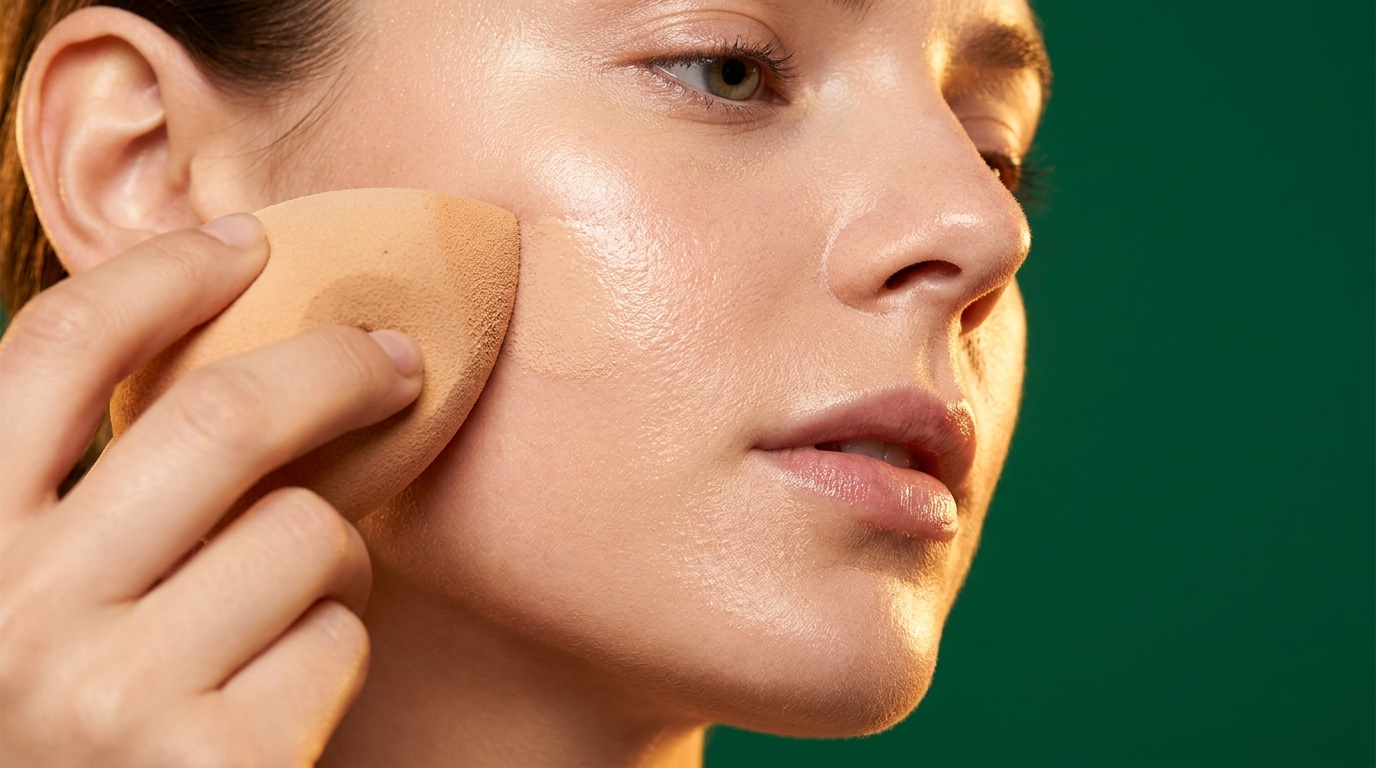
A slightly damp sponge allows you to press the product without displacing flakes. Fingers warm up the formula and are well-suited for fluid textures. A dense brush can offer more coverage, but repeated movements sometimes lift dry areas.
Start with half a pump distributed in the center of the face, then blend outwards. Add a second layer only where necessary. Thick layers almost always accentuate texture.
Powder: only where needed
Loose powder can set the area around the nose or the under-eye area, but application all over the face absorbs more lipids and light. Use a small brush and press a very small amount. Dry cheeks do not systematically need to be powdered.
During the day, prefer to dab a tiny amount of cream on an area that is cracking rather than adding more powder. The goal is to restore suppleness to the makeup film.
When foundation catches around the nose
The sides of the nose accumulate friction, cleansing, and movement. Apply less product in this area and avoid going over it multiple times with the brush. A very thin primer can be useful if it does not contain many absorbent powders.
If the area persistently peels, temporarily reduce exfoliants and simplify your routine. Makeup often reveals existing dryness rather than creating it on its own.
Choose the shade without accentuating dry areas
Test the color on the jawline rather than on a dry patch, as flakes alter how pigments reflect light. A correct shade often looks more even when the surface is well prepared. Evaluate it in daylight after a few minutes.
Highly pigmented formulas can be mixed with a small amount of cream only if the manufacturer allows it, but this method reduces coverage and changes wear. The simplest approach is to choose a texture suitable for dry skin from the outset.
Read the formula when skin is dry
Two families of ingredients change the comfort of a foundation on dry skin. Humectants—glycerin, hyaluronic acid—retain water and prevent the product from feeling tight after two hours. Vegetable oils and emollients provide glide and prevent the product from catching on rough areas.
Conversely, a significant proportion of alcohol at the top of the ingredient list, common in extreme wear formulas, accentuates the feeling of dryness throughout the day.
The terms "long-wearing" and "matte finish" generally indicate a formula that sets quickly and is less forgiving. On dry skin, buildable coverage, which can be intensified locally, gives a more natural result than an even layer applied to mask everything at once.
The "caked" effect: where it comes from
This thick, powdery finish rarely comes from the product alone. It appears when a highly covering product meets an uneven surface, or when multiple layers are applied without the first having had time to blend.
The correction comes less from a change of brand than from a change of method: less product, applied from the center of the face, and a luminous rather than matte finish on areas that tend to emphasize texture.
What a hydrating foundation does not do
A foundation does not replace a cream, even when it contains glycerin or hyaluronic acid. The quantity of skincare ingredients and contact time are not designed to correct a compromised skin barrier. Its priority remains the visual result.
Nor can it perfectly mask significant flaking without visible texture. Preparing the skin, reducing the amount of product, and choosing a flexible finish generally give a better result than increasing coverage.
A silicone-based primer can temporarily smooth some irregularities, but it does not replace hydration. On a peeling area, silicone glides over flakes without removing them. First, prepare the skin, then use the primer only if it improves the finish.Alcohol-rich setting sprays can increase the feeling of dryness in some people. A fine hydrating mist may be more comfortable, but it must be compatible with the foundation's film. Test before an important event.
Primer or not: decide based on the surface
A makeup primer can improve glide when pores and dry areas coexist. Choose a thin texture and apply it only where it provides a visible benefit. A layer of primer all over the face sometimes adds more product without improving the finish.
For peeling cheeks, a hydrating primer is generally more consistent than a very mattifying primer. Let it set for a minute before foundation. If the product pills, simplify the layers rather than adding a new one.
Touch up during the day without layering
When makeup cracks, add a trace of cream between two fingers, then gently press on the area. Wait a few seconds before reapplying a tiny amount of foundation. This technique is often cleaner than directly adding a new layer of dry pigment.
For a long day, carry a small clean sponge or cotton swab to work locally. A targeted touch-up better preserves a natural look than a second full application all over the face.
>


Go further than this article
Get our skincare guides by email — and start with your free skin diagnostic: 2 minutes, advice tailored to your skin. We ship to the US, UK, Canada, Australia and 27 European countries; somewhere else? Sign up and you will be the first to know when we deliver to your country.
By signing up, you agree to our privacy policy. Unsubscribe in one click.