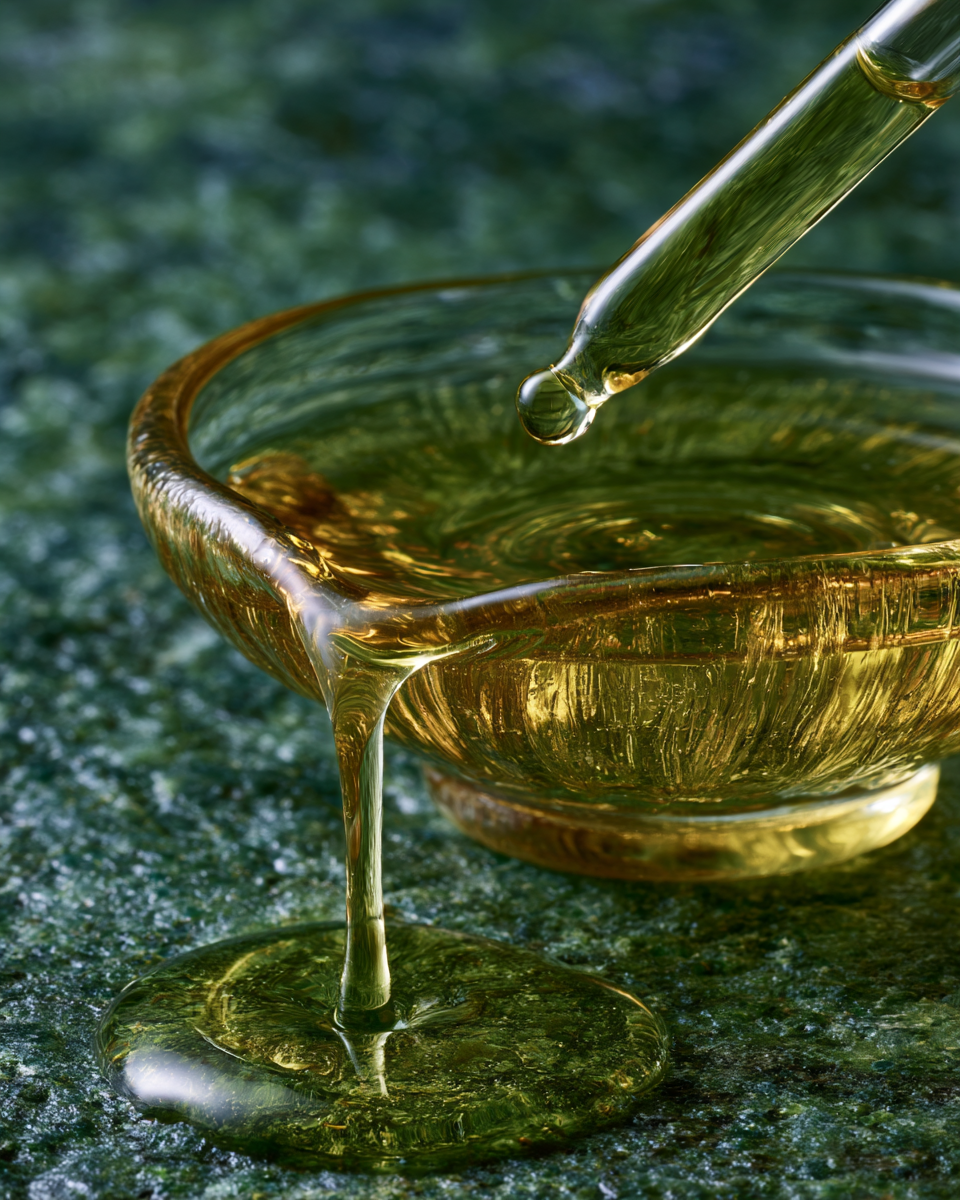
Glycerin: what concentration and how many drops
Between 3 and 10%, and never pure. The useful range for glycerin is narrow, and it is the only common ingredient for which an excess produces the opposite of the desired effect.
The 3-10% Window
Below 3%, the humectant effect is marginal. Above 10%, the texture becomes sticky and attracts dust. Serious cosmetic formulas adhere to this window, which is why glycerin so often appears in the middle of ingredient lists.
Therefore, pure vegetable glycerin purchased must always be diluted: a teaspoon in one hundred milliliters of water or hydrosol yields approximately 5%, which is the ideal concentration for most skin types.
Why Pure Glycerin Is Not Recommended
Glycerin attracts water. The question is where it comes from. In humid air, it draws water from the atmosphere and deposits it on the surface. In dry air—less than forty percent humidity—it draws it from the lower layers of the skin.
When applied pure, this effect is maximized: the skin feels tight instead of hydrated. This is the most common mistake with this inexpensive and easy-to-find ingredient, and it explains almost all the disappointments attributed to it.
How Much to Apply Once Diluted
Three to four sprays of a 5% preparation, or the equivalent of a pea-sized amount of a cream containing it. Apply to clean, still-damp skin, morning and night. For the body, quantities can be increased without particular caution.
Afterward, something must be applied over it: a cream, or two to three drops of vegetable oil. Without this layer, the attracted water evaporates, and in dry weather, the skin loses moisture. This step is a requirement, not an option.
According to Skin Type
Dry skin: 5 to 10%, morning and night, with an oil on top. Combination skin: 5%, with a light cream. Oily skin: 3 to 5% is sufficient, under a gel. Sensitive skin: no reservations, as glycerin is one of the best-tolerated ingredients on the market.
It is also one of the rare ingredients with no known contraindications at cosmetic doses, which explains its presence in a huge proportion of skincare products on the market – from the simplest to the most expensive.
Storing a Homemade Preparation
Without preservatives, a water-based preparation can be stored for one week in the refrigerator. After this period, it becomes a culture medium, even if nothing is visible to the eye. This is the main limitation of homemade products and cannot be bypassed.
Pure glycerin, on the other hand, can be stored for years: it is a stable product that does not go rancid or oxidize. Only the dilution is fragile.
What Dosage Does Not Change
No concentration affects wrinkles, spots, or pores. Glycerin provides water and comfort, nothing more — and that is often what is most lacking.
Our hydrating hyaluronic acid day cream combines the humectant and the sealing step, which avoids the question of dosage. The complete vegetable glycerin fact sheet.
Where Vegetable Glycerin Comes From
From the saponification or transesterification of vegetable oils — most often rapeseed, coconut, or palm. The molecule obtained is identical regardless of the starting plant, and identical to that of synthetic glycerin.
The mention "vegetable" therefore indicates the origin of the raw material, not the properties of the finished product. This is a point worth knowing before paying the difference.
How to Use Glycerin in a Routine
Three ways: diluted in a hydrosol as a toner, incorporated into a commercial cream at a rate of a few drops, or already present in a well-formulated product. This last option is the simplest and safest.
You can mix it with water, a hydrosol, or a plant milk for a homemade preparation. Then, you need to let it dry for a minute before applying the next layer, otherwise the two textures will mix instead of layering.
Why the Next Layer is Not Optional
Thanks to its ability to attract water, glycerin increases the water content of the superficial layers. But it doesn't retain it there: without something on top, this water evaporates and the skin returns to its initial state within an hour.
A moisturizing cream is sufficient for normal skin. For very dry skin, a fatty substance works better: two to three drops of vegetable oil, or a balm. It is this combination—humectant then occlusive—that durably enhances comfort.
On Dehydrated Skin
This is the clearest indication. Dehydrated skin lacks water, not lipids: it can be oily and dehydrated at the same time, which is often confusing. Glycerin precisely addresses this lack.
For this profile, a concentration of 5 to 10% in a light base yields better results than a rich cream, which would provide lipids that the skin does not need.
What It Provides for the Skin Barrier
A better hydrated superficial layer functions better: the enzymes that ensure natural desquamation need water to work. Dehydrated skin exfoliates poorly, which thickens the surface and makes it rough.
It is through this indirect pathway that glycerin contributes to the barrier function. It does not provide lipids and does not replace ceramides; it creates the conditions in which the skin does its work.
The "What Concentration, How Many Drops" Series
The right dosage isn't guessed: it depends on the ingredient, its form, and your skin type. This series covers each active ingredient one by one.
- Vitamin E: what concentration and how many drops
- Peptides: what concentration and how many drops
- Hyaluronic acid: what concentration and how many drops
- Prickly pear oil: what concentration and how many drops
- Rosehip oil: what concentration and how many drops
- Argan oil: what concentration and how many drops
The Nopal Life signature treatment


Mature skin · Dry skin

Go further than this article
Get our skincare guides by email — and start with your free skin diagnostic: 2 minutes, advice tailored to your skin. We ship to the US, UK, Canada, Australia and 27 European countries; somewhere else? Sign up and you will be the first to know when we deliver to your country.
By signing up, you agree to our privacy policy. Unsubscribe in one click.