Combination skin: skincare for facial contours, radiance, and texture
Tight cheeks, a shiny forehead before noon, a dull-looking oval face: this is the daily reality of combination skin. The facial contour — cheekbones, jawline, temples, eye and lip areas — is precisely the border between oily and dry areas. What works for the nose weighs down the cheeks, and the inverse is just as true.
This guide addresses this shift: how to read your face sector by sector, choose textures and active ingredients compatible with both regimes, and restore radiance without overloading the T-zone.
Key takeaways
- Two textures: a light fluid on the forehead-nose-chin triangle, a comfortable cream or 2 drops of prickly pear oil on the cheeks and jawline.
- The H+4 tissue test categorizes your profile among three types of combination skin, and should be redone twice a year.
- Dull complexion doesn't come from excess sebum but from slowed surface renewal and dehydrated cheeks.
- A 28-day dated protocol, with one variable per week, allows for objective evaluation of skincare.
Why the facial contour reacts differently on combination skin
The density of sebaceous glands is not uniform. It is higher on the forehead-nose-chin triangle — the T-zone — than on the cheeks, temples, and jawline. In normal skin, the difference goes unnoticed; in combination skin, it becomes visible: sebum production is abundant in the center of the face while the periphery still needs hydration.
The contour is precisely where these two regimes meet. Jawline, sides of the nose, lip area: transition zones whose behavior changes with the season, hormonal cycle, or a simple change in cleanser. To this is added an anatomical constraint: the skin around the eyes is very thin and virtually devoid of sebaceous glands. Even on oily skin in the center, it remains dry.
As for dull complexion, it is often attributed to excess sebum: this is a misconception. On the contrary, shine gives a luminous, albeit unevenly distributed, appearance. Dullness comes from slowed surface renewal, which leads to the accumulation of poorly reflective corneal cells, and from cheek dehydration, which makes the skin texture rougher. An irregular surface disperses light instead of reflecting it. Radiance is therefore regained through texture and hydration, not through aggressive products designed for oily skin.
Mapping: seven sectors, seven regimes
| Sector | Dominant behavior | Adapted texture | Quantity | Frequency |
|---|---|---|---|---|
| Forehead | Shine from H+3 | Watery fluid | A pea size | Twice a day |
| Nose and sides of the nose | Blackheads, enlarged pores | Salicylic acid locally | 1 drop per side of the nose | Twice a week |
| Chin | Cyclical imperfections, localized breakouts | Light fluid | 1 pump shared with the forehead | Twice a day |
| Cheekbones and cheeks | Tightness after cleansing | Rich cream or prickly pear oil | 2 drops | 1 to 2 times a day |
| Jawline | Less toned appearance, uneven complexion | Serum then cream, upward motion | The remainder on fingers | Twice a day |
| Eye contour | Dry despite nearby sebum, dark circles and puffiness | Specific gel | 1 grain of rice per eye | Twice a day |
| Lip contour | Dryness, early vertical fine lines | Nourishing balm | 1 drop, by gently dabbing | In the evening |
Out of seven sectors, only two require a light texture and a third a targeted exfoliation gesture. Skincare for combination skin is therefore not just a lighter version of skincare for oily skin: the majority of the surface needs comfort.
The H+4 tissue test: identify your profile
Cleanse in the morning, do not apply any skincare or makeup, wait four hours indoors. Then press a tissue for five seconds on the forehead, nose, one cheek, then the jawline, and read the traces in daylight.
| Skin type | Trace in the center of the face | Trace on the cheek | Tightness | Enlarged pores |
|---|---|---|---|---|
| Dry | None | None | Immediate, lasting | Almost invisible |
| Normal | Light, diffuse | None | Brief | Discrete, on the nose |
| Combination dry-leaning | Clear on the nose only | None | Pronounced on the cheeks | Sides of the nose |
| Balanced combination | Clear on forehead, nose, chin | None or very light | Slight, localized | Nose and forehead |
| Combination oily-leaning | Clear and extensive | Partial, upper cheek | Rare | Forehead, nose and chin |
| Oily | Clear | Clear | Absent | All over the face |
The consequence is immediate. Combination dry-leaning skin tolerates a plant-based lipid on the entire contour, including high cheekbones. Combination oily-leaning skin reserves it for the lower cheeks, jawline, and lip area. Same product, two ways of use. Repeat the test in February and August: cold often shifts the profile towards the dry side, heat does the opposite.
Key active ingredients
Prickly pear, an exception to the "no fatty substances" rule
What matters in a lipid ingredient is its fatty acid profile: it determines its feel. Formulas rich in oleic acid leave an occlusive film; those rich in linoleic acid have a distinctly drier feel. Opuntia ficus-indica seeds yield about 60% linoleic acid (55 to 65% depending on the batch), which places it among the lightest plant ingredients. It also contains tocopherols (vitamin E), an antioxidant valued for helping to preserve the complexion's appearance, and betaine, a hygroscopic compound that helps maintain a hydrated look.
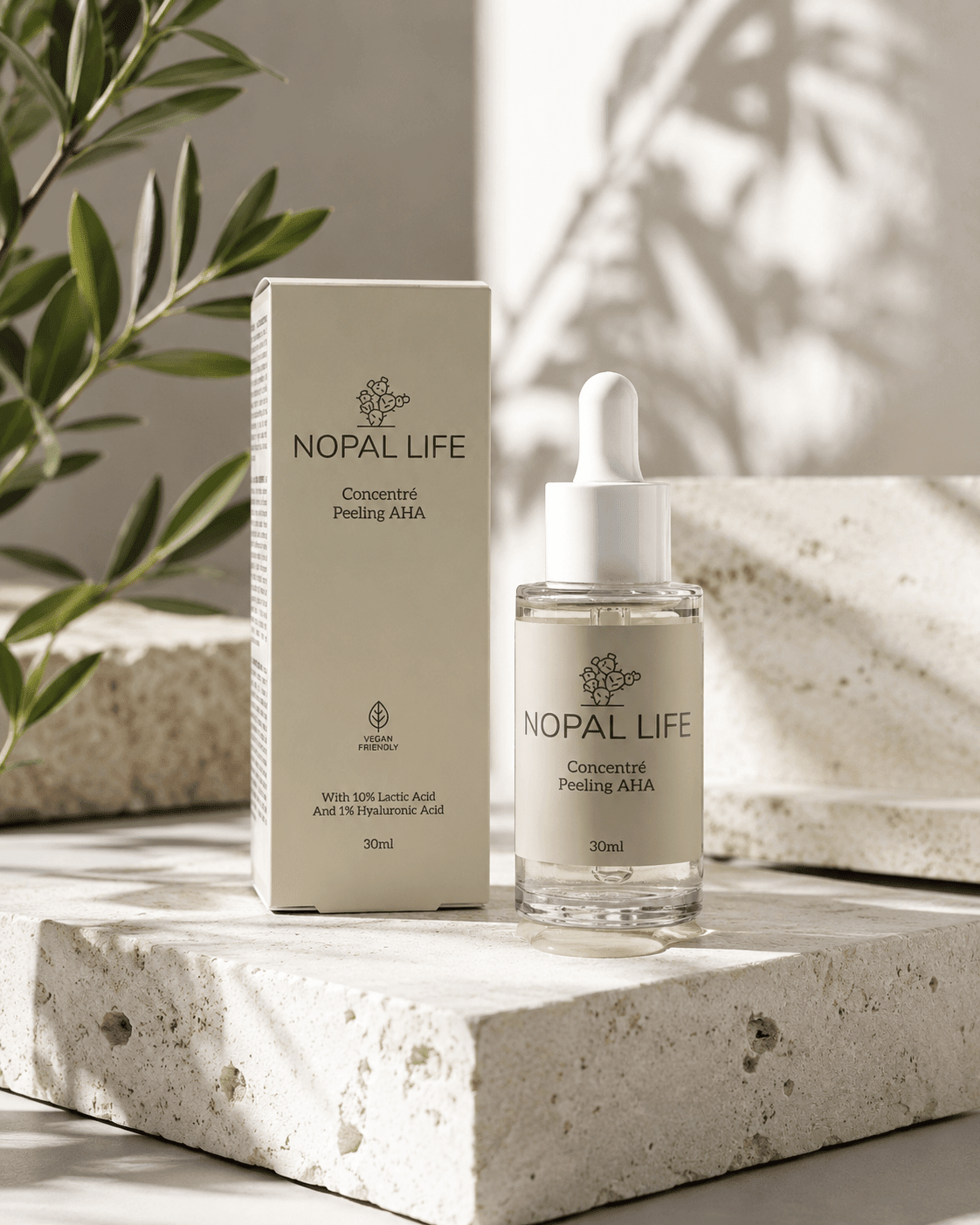
The Nopal Life gesture. Place 2 drops in the palm of your hand, warm for 5 seconds between your palms, apply to the cheeks, jawline, and lip area, moving upwards. Never move downwards towards the nose: the residue left on your fingers is enough.
Other useful ingredients
Hyaluronic acid provides water without fatty substances. Formulated with multi-molecular weights, it works on two levels: high molecular weight forms a moisturizing film on the surface, low molecular weight strengthens the cells of the stratum corneum. Apply it to still-damp skin, then seal with a moisturizing treatment.
Niacinamide is the active ingredient for radiance and skin texture: it helps unify the complexion's appearance and reduce the look of enlarged pores as well as marks left by old imperfections. Salicylic acid, being oil-soluble, helps dislodge the appearance of blackheads, applied strictly locally on the forehead, nose, and chin. Aloe vera gel moisturizes without an oily film and makes an ideal base before sunscreen; as a mask, a thick layer left for ten minutes in the evening reduces the feeling of heat after exfoliation. Caffeine remains the go-to active for the eye contour, and marine collagen peptides help preserve the dense and plump appearance of the oval face.
| Ingredient | Usual concentration | Where to apply | When | Frequency | Precaution |
|---|---|---|---|---|---|
| Prickly pear (seeds) | Pure, 2 drops | Cheeks, jawline, lips | Evening | Daily | Not in the center of the face |
| Hyaluronic acid | 0.1% to 2% | Entire face | Morning and evening | Daily | On damp skin, then seal |
| Niacinamide | 4% to 5% | Face, excluding eyes | Morning | Daily | Introduce gradually |
| Salicylic acid | 0.5% to 2% (European limit: 2%) | Forehead, nose, chin | Evening | Twice a week | Never on cheeks or eyes |
| Aloe vera | Gel, 90% and more | Center of face and cheeks | Morning | Daily | Does not replace a complete treatment |
| Caffeine | 1% | Eye contour | Morning and evening | Daily | With your ring finger, without rubbing |
| Marine collagen | Serum, 1 pump | Jawline, jaw | Morning and evening | Daily | Before cream |
The Nopal Life 28-day protocol
Four weeks: this is the minimum time to honestly assess new products. Only one variable per week, to find out what works.
Days 1 to 7 — reset the base. No new ingredients. Gentle cleansing morning and evening, 30 seconds, with lukewarm water. Then a simple moisturizing treatment, and 2 drops of prickly pear oil in the evening on the cheeks and jaw. Suspend all exfoliation, both mechanical and acid scrubs: many so-called oily skins are actually weakened by excessive cleansing. Take a photo of yourself on day 1, in daylight, without makeup.
Days 8 to 14 — establish radiance. Niacinamide in the morning over the entire face, excluding the eye contour, 60 seconds of absorption before the next step. Add the caffeine gel morning and evening, a grain of rice per eye, from the inner corner to the outer corner.
Days 15 to 21 — work on the texture of the T-zone. Salicylic acid on the nose, forehead, and chin, two evenings a week, without spreading onto the cheeks. On these two evenings, replace the fatty substance with a moisturizing treatment. Add the collagen serum to the jawline, with an upward gesture from the chin to the temples.
Days 22 to 28 — stabilize and assess. No additions. On day 28, repeat the tissue test and take another photograph under the same conditions. Three criteria are decisive: the time it takes for shine to appear (if it goes from three to five hours, you've won), the disappearance of tightness in the cheeks, and the evenness of the complexion on the jawline. If nothing has changed, the most likely hypothesis is still too harsh a cleansing: correct this point before any additional purchases.
The daily routine, step by step
Morning. Gentle cleansing 30 seconds → caffeine gel on the eye contour → niacinamide, 60 seconds → serum on the jawline → modulated hydration: aqueous texture on the forehead and nose, comfortable cream on the cheeks → minimum SPF 30 sunscreen on the jawline, ears and neck, in a non-comedogenic fluid formula. Useful regulatory clarification: no plant ingredient constitutes sun protection and no index can be attributed to it.
Evening. Double cleansing if wearing makeup → salicylic acid targeted on the T-zone, two evenings a week (after the reset phase) → eye contour gel → serum on the jawline → 2 drops of prickly pear oil on the cheeks, jaw and around the lips → night cream on the cheeks only. On skin that is oily in the center, this last step can be omitted.
Five errors that perpetuate imbalance
- Treating the entire face as oily skin. Cheeks dry out, the forehead does not improve long-term. Two textures are better than one.
- Over-cleansing. Three or four times a day undermines the comfort of the skin barrier and extends the feeling of dryness. Two are enough.
- Neglecting sun protection. UV rays accentuate uneven skin tone; protection also applies to the ears and neck, even in cloudy weather.
- Pressing on the eye contour. Use your ring finger, light tapping, never stretching the eyelid or rubbing when removing makeup.
- Changing products every ten days. A cosmetic active ingredient takes several weeks to deliver a visible result — hence the four-week protocol above.
What happens outside the bathroom
Well-constructed skincare cannot compensate for everything. Sleep comes first: it is during the night that the body works the most, and a week of shortened nights is immediately visible on the eyes. Tobacco and alcohol, on the other hand, maintain chronic oxidative stress that no bottle can permanently reverse.
Diet also matters. Vitamin C — citrus fruits, kiwi, red bell pepper, fresh parsley — is associated with skin radiance. Essential fatty acids omega-3 and omega-6 are appreciated for skin comfort, in a balanced ratio between the two families. Zinc, found in pumpkin seeds and legumes, supports clear skin texture. Polyphenols from green tea, berries, cocoa and extra virgin organic olive oil help preserve appearance against external aggressions. Useful clarification: drinking more is necessary but does not alone correct surface dehydration, which occurs at the level of the corneocytes.
Three material habits make a measurable difference, and they cost nothing. Changing your pillowcase twice a week instead of once. Avoiding resting fingers on your chin during long meetings. Finally, consider heating in winter and air conditioning in summer: in both cases the ambient air dries out, and a bowl of water placed near a radiator limits evening discomfort. These adjustments may seem anecdotal; they often explain why two people following the same protocol do not obtain the same result after a month.
Our range for the face contour
The 1% Caffeine Gel Booster Anti-Dark Circles is our eye care product: with a non-greasy texture, it helps reduce the appearance of dark circles and puffiness and is suitable for even the most reactive skin. The Collagen Serum for Skin Bounce Hydration applies to the jawline without weighing it down. Pure prickly pear oil remains the pillar for the cheeks and jaw, with two drops in the evening.
Frequently Asked Questions
What treatments should I choose for combination skin around the face?
Not a single product, but a method: an aqueous texture on the forehead-nose-chin triangle, a comfortable cream or 2 drops of prickly pear oil on the cheeks, jaw, and around the lips. Add niacinamide in the morning and a caffeine gel to the eye contour.
Can a vegetable oil be applied to combination skin?
Yes, provided you choose an ingredient rich in linoleic acid, with a dry feel, and reserve it for the cheeks and jaw. Prickly pear seed, with around 60% linoleic acid, falls into this category; oils very rich in oleic acid are more suitable for dry skin.
How to reduce the appearance of enlarged pores on the nose?
Two levers: local salicylic acid, two evenings a week, and 4-5% niacinamide in the morning. Neither modifies the actual size of the pores, which is constitutional — it is the appearance that improves, and that is visually sufficient.
Is a mask useful for combination skin?
Yes, provided it is applied in sections: clay on the forehead and nose, a hydrating mask on the cheeks, ten minutes, once a week. This is the only format where both regimens can be covered simultaneously without compromise on texture.
Can I use my face cream on the eye contour?
In principle, no: the skin there is much thinner and more reactive. A light moisturizing cream may be suitable, but rich formulas or those strongly dosed with exfoliants have no place there. A specific gel is preferable.
Can my skin type change?
Yes. Skin types evolve with the seasons, age, hormonal cycle, and even changing cleansers. Hence the importance of repeating the tissue test twice a year and adjusting your skincare rather than keeping it identical for years.
Sources — Ramadan M. F., Mörsel J.-T., « Oil cactus pear (Opuntia ficus-indica L.) », Food Chemistry, vol. 82, n° 3, 2003, p. 339-345 (fatty acid composition of the seed). Maximum concentration of salicylic acid: Regulation (EC) No 1223/2009 on cosmetic products, Annex III.
Read more
Information provided for cosmetic and educational purposes; it does not constitute medical advice.


Go further than this article
Get our skincare guides by email — and start with your free skin diagnostic: 2 minutes, advice tailored to your skin. We ship to the US, UK, Canada, Australia and 27 European countries; somewhere else? Sign up and you will be the first to know when we deliver to your country.
By signing up, you agree to our privacy policy. Unsubscribe in one click.