Panthenol and Aloe Vera: The Comfort Duo, User Guide
Panthenol and aloe vera belong to the discreet family of comfort active ingredients: they are found everywhere, without always knowing what they do together, in what order to apply them, or at what dosage they become useful. This guide answers all three questions, with supporting figures.
Key takeaways
- Three INCI names for the same ingredient: Panthenol, D-Panthenol, Dexpanthenol. Dexpanthenol is the active form.
- It is the precursor of pantothenic acid, vitamin B5.
- Usual dosage for the face: 0.5% to 5%. Beyond 5%, you gain stickiness, not comfort.
- Order: aloe, serum, then a fatty substance to seal – 90 seconds.
- Neither provides lipids: for dry skin, the routine ends with oil.
Provitamin B5: decoding the label
The molecule is the alcoholic precursor of pantothenic acid; applied to the epidermis, it gradually converts there. This pro-vitamin form is much more stable in emulsion than the vitamin itself: hence its omnipresence in moisturizing creams, serums, and hair products. It exists in two mirror forms, and only the dextrorotatory one is active: a "5% DL" is therefore only worth about 2.5% of the D form.
| INCI Label | Nature | Key takeaway |
|---|---|---|
| Panthenol | Generic, unspecified isomer | Most common |
| D-Panthenol / Dexpanthenol | Active dextrorotatory form | Most precise |
| DL-Panthenol | Mixture of both forms | ~50% active molecule |
| Panthenyl Ethyl Ether | Lipophilic derivative | Common in hair care |
Reading guide: the INCI list is ordered in decreasing concentration down to 1%. An active ingredient listed in the first third is probably well dosed; listed between fragrance and a colorant, it's more of a marketing argument. The same method applies to aloe: Aloe Barbadensis Leaf Juice at the top indicates a true plant base, while Leaf Juice Powder at the end of the list indicates a mere trace.
This label reading is the only reliable filter: it differentiates a genuinely dosed formula from a bottle whose claim is merely superficial.
What each brings – and what it doesn't
The properties of this active ingredient are threefold. As a humectant, it attracts water and helps the stratum corneum retain it: Camargo, Gaspar, and Maia Campos (Journal of Cosmetic Science, 2011) measured this increase in hydration through cutaneous bioengineering. As a softening agent, it refines the skin's texture. Finally, it helps preserve the comfort of the skin barrier – skin that doesn't feel tight after cleansing.
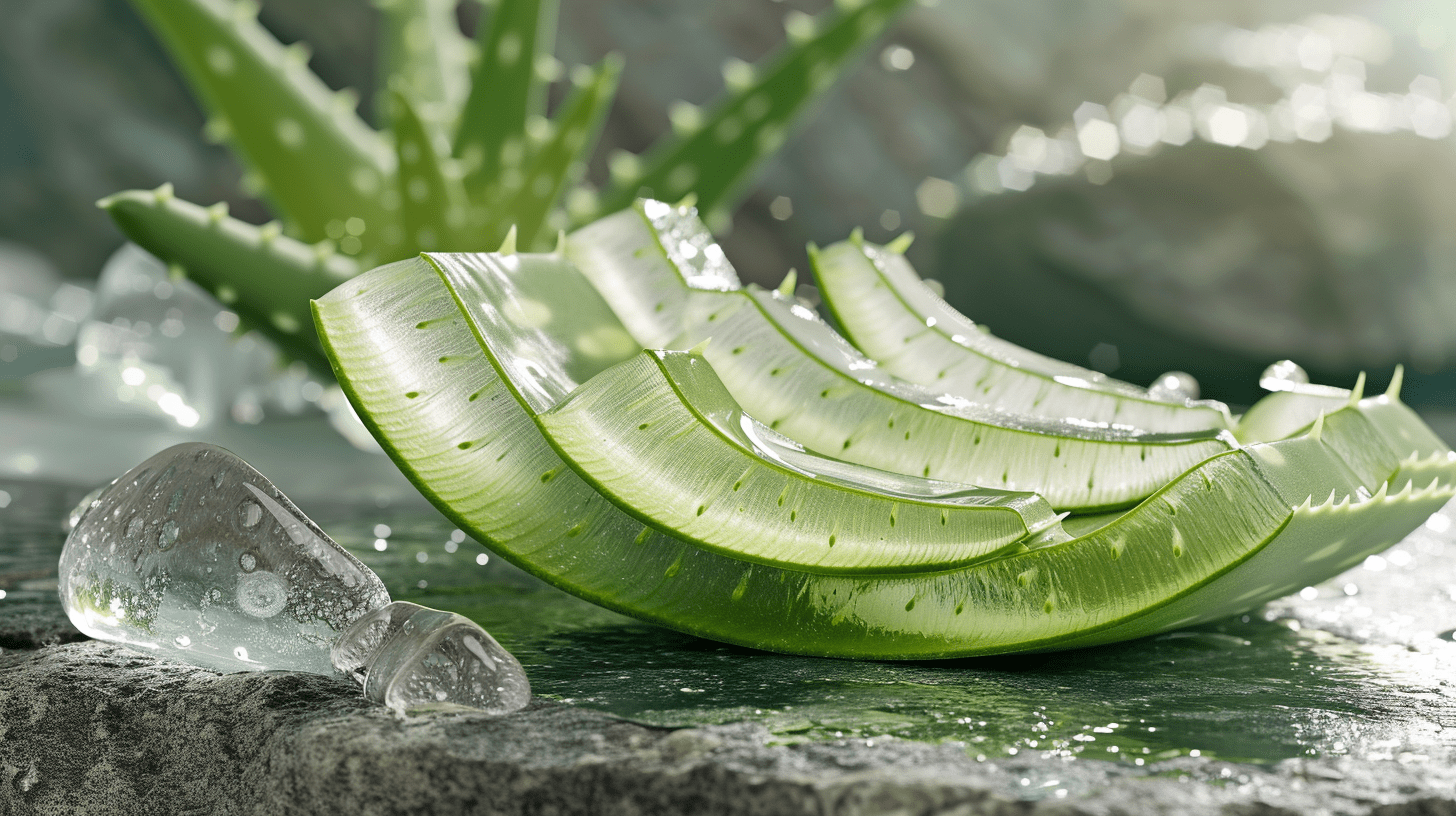
Aloe vera provides immediate freshness: composed of over 98% water structured by polysaccharides, it hydrates the surface without a greasy film. Dal'Belo, Gaspar, and Maia Campos (Skin Research and Technology, 2006) also reported an increase in surface hydration. Their limitations are symmetrical: no lipids, no exfoliation, no treatment, and no exemption from sun protection.
Panthenol, aloe, hyaluronic acid: who does what
| Criterion | Provitamin B5 | Aloe vera | Hyaluronic acid | Glycerin |
|---|---|---|---|---|
| INCI | Panthenol | Aloe Barbadensis Leaf Juice | Sodium Hyaluronate | Glycerin |
| Usual dosage | 0.5 – 5% | 1 – 20% | 0.1 – 2% | 3 – 10% |
| Role | Moisturizing, softening agent | Freshness, surface | Water retention, smoothing | Fundamental humectant |
| Perceived delay | A few minutes | Immediate | Rapid | Gradual |
| Finish | Adhesive beyond 5% | Dry, non-greasy | Supple | Sticky beyond 10% |
| Oily skin | Yes, in fluid form | Ideal | Yes | Moderate dosage |
| Lipids provided | None | None | None | None |
The conclusion is simple: none of these four provide fatty substances. Layering them without applying anything on top leaves hydration that evaporates—the most frequent error in so-called moisturizing routines.
Are they compatible?
Yes, for three reasons: both materials are aqueous and layer without demixing; they work within a similar pH range; neither is a "strong" active ingredient. Aloe provides comfort in the first minute, while B5 provides it in the sixth hour. The combination is suitable for most skin types, and especially for reactive skin.
The 90-second protocol
| Step | Action | Quantity | Time | Success indicator |
|---|---|---|---|---|
| 0 · Prepare | Cleanse, pat dry without rubbing | — | 0 – 15 s | Face remains fresh, not dripping |
| 1 · Aloe | Aqueous gel as a light veil | 1 pea-sized amount | 15 – 35 s | No sticky residue under fingers |
| 2 · B5 Serum | Gentle presses on tight areas | 3 to 4 drops | 35 – 60 s | Slightly satiny finish |
| 3 · Seal | Oil warmed between palms | 2 to 3 drops | 60 – 90 s | No tension after 10 minutes |
The logic goes from most fluid to richest. Aloe is applied to still-damp skin: a humectant applied to a dry surface in a heated room has less water to absorb. Then comes the serum, followed by cold-pressed prickly pear seed oil, rich in essential fatty acids and vitamin E: two to three drops, pressed in, never rubbed, complete the sequence. The Hydration & Comfort collection and the Face Serums collection bring together textures designed for layering.
The ten-minute test. Wait, then smile broadly. No tension: the dosage is good. Tightness on the cheeks: one more drop of oil. Sticky finish: one less drop of fluid. Shine in the T-zone and tightness elsewhere: targeted oil.
According to your skin type
| Profile | Aloe texture | Targeted B5 concentration | Sealing |
|---|---|---|---|
| Oily | Fluid gel | 1 – 2 % | 1 drop of oil, evening only |
| Combination | Aqueous lotion | 2 – 3 % | 2 drops, on cheeks only |
| Dry | Gel-cream | 3 – 5 % | 3 drops morning and evening |
| Reactive | Juice with short list | 2 – 3 %, fragrance-free | 2 drops of pure oil |
| Mature | Light emulsion | 3 – 5 % | 3 drops, plus a balm in winter |
Oily skin needs as much water as other skin types: shine comes from sebum, not from excess hydration. And for a reactive profile, the golden rule isn't product choice but rhythm—only one new product at a time. The Nutrition & Repair collection extends this approach.
On hair
On hair, B5 smooths the cuticle scales and facilitates detangling. Common dosage: 0.5 to 2% in rinse-out products, 0.2 to 1% in leave-in products. A paradox explains the conflicting opinions: as a humectant, it captures ambient humidity. Between 40 and 60% humidity, curls remain flexible; above 70%, the fiber swells and frizz increases; below 30%, it becomes rough. The same bottle can be excellent in February and disappointing in August.
Judge in 28 days, precautions
Days 1-3: tolerance test, 24 hours in the crook of the arm. Days 4-10: aloe alone, noting each evening the tension felt at 10 minutes and at bedtime, on a scale of 0 to 3. Days 11-17: add B5 serum. Days 18-28: oil in the evening, then compare with notes from the first week. One variable at a time. If the difference is zero, it's not another active ingredient you need, but a gentler cleanse.
Store aloe away from heat, and don't neglect nourishment: these active ingredients work on the surface, not the lipids. Cosmetic comfort response – in case of persistent redness, professional medical advice is essential.
Free Skin Diagnosis
Curious to know if this duo suits your profile, and at what concentration?
Take my 2-min diagnosis →
Frequently Asked Questions
Q: Can they be used together every day?
A: Yes, morning and evening. No known incompatibilities. A 24-hour tolerance test is still recommended.
Q: What about with hyaluronic acid?
A: Hyaluronic acid first, then B5, then a fatty substance—otherwise, two humectants layered in very dry air would leave a sensation of tightness.
Q: Does this replace a moisturizer?
A: No. It is a comfort active ingredient present in many formulas, not a routine in itself. After sun exposure, the duo is appreciated for its freshness—without replacing sun protection.
In conclusion
One provides freshness, the other lasting effect. Applied from thinnest to richest, in 90 seconds, then sealed with a nourishing oil, they create a light and clear routine. The step not to forget is the last one: without sealing, the added water evaporates.
RECOMMENDED PRODUCT
Cold-pressed prickly pear seed oil · Organic · Free delivery from €80 in mainland France
DISCOVER THIS PRODUCT →
PERSONALIZED ROUTINE
Nopal Life Skin Intelligence™ · 2 minutes
Start my free diagnosis →
Read more
Sources
- Camargo FB Jr, Gaspar LR, Maia Campos PMBG. "Skin moisturizing effects of panthenol-based formulations." Journal of Cosmetic Science, 2011; 62(4): 361-370.
- Dal'Belo SE, Gaspar LR, Maia Campos PMBG. "Moisturizing effect of cosmetic formulations containing Aloe vera extract in different concentrations." Skin Research and Technology, 2006; 12(4): 241-246.
- European Commission, CosIng database — INCI nomenclature.
Information provided for cosmetic and educational purposes; it does not constitute medical advice.
Our anti-aging treatments