Homemade facial care: building a useful routine without turning the kitchen into a laboratory
A homemade facial can be pleasant, economical, and simple, provided you don't confuse cooking with cosmetic formulation. The best homemade practices use few ingredients, short application times, and avoid highly acidic, abrasive, or unstable mixtures. The goal isn't to create a professional cream but to occasionally add comfort to a safe routine.
Start by defining the need
Before mixing anything, observe your skin. Does it feel tight after cleansing? Does your complexion seem dull? Are you primarily looking for a moment of relaxation? A homemade moisturizing treatment can be suitable for an occasional need for softness, but it won't replace a preserved and tested formula for daily use.
For dry skin, the reasonable goal is to soften and limit the sensation of tightness. For combination skin, it's better to keep it light and avoid large amounts of fatty substances. Sensitive skin should prioritize the shortest possible preparations.
Cleansing without aggressive DIY
Cleansing is the first step of the ritual. Use your usual cleanser rather than a mixture of baking soda, household soap, or alcohol. Massage for twenty to thirty seconds, then rinse with lukewarm water.
A clean towel is sufficient for patting dry. Coarse-grained scrubs, with sugar or coffee, are not necessary on the face: their irregular particles can be too abrasive, especially if rubbed for a long time.
This gentle preparation is more useful than a "deep cleansing" that leaves the skin feeling tight.
Very simple moisturizing mask
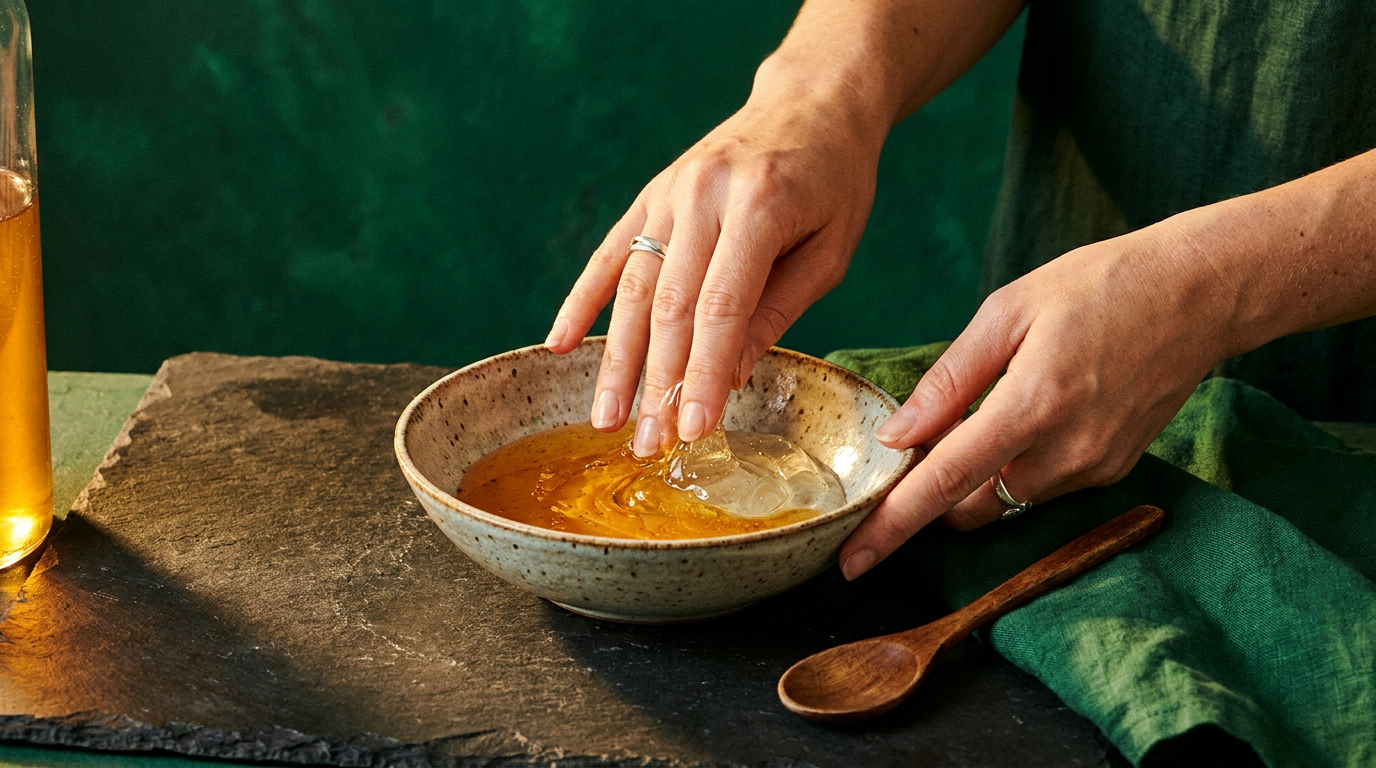
For this moisturizing preparation, combine a teaspoon of honey and the same amount of neutral cosmetic aloe gel. Use the preparation immediately and do not store any leftovers.
Apply a thin layer to your face, avoiding the eye area. Leave on for ten minutes, then rinse with lukewarm water. If your skin is sensitive, start with five minutes.
This moisturizing mask primarily aims for softness. Honey provides a humectant texture, while the gel adds an aqueous phase. There's no need to add ten ingredients to improve the result.
Variation for dry skin
If your skin feels uncomfortable, don't add a large amount of oil to the bowl. After rinsing, apply your cream, then press one to two drops of vegetable oil onto your cheeks.
This method is easier to dose and reduces the risk of transforming the mask into a very oily mixture. At this stage, a few drops of prickly pear oil provide a lipid touch consistent with a goal of suppleness.
Once a week is enough to start. A second use can be considered occasionally if the skin remains comfortable and no other exfoliating treatment is used on the same day.
Lemon and lemon juice: leave them in the kitchen
Lemon appears in many natural recipes. On the face, we advise against it. Its juice is very acidic and can cause irritation and discomfort. Some citrus fruits also contain substances that can react with light.
There is therefore no reason to take this risk in search of radiance. A cosmetic formula designed with a measured acid and controlled pH is much more predictable.
Do not mix lemon juice, baking soda, and honey with the idea of "neutralizing" acidity. An improvised reaction does not create a stable facial treatment.
Other ingredients to avoid
Essential oils are too concentrated to be haphazardly added to a mask. Pure vinegar, alcohol, strong spices, and abrasive powders do not offer benefits that justify their irritating potential.
Ground coffee is sometimes recommended as a scrub. On the body, some people appreciate its mechanical aspect; on the face, an irregular texture rubbed for several minutes is not necessary to obtain smooth skin.
Raw egg whites, dairy mixtures kept for several days, or preparations without preservatives also raise a hygiene question. Only make the quantity to be used immediately.
A twenty-minute home session
Start with two minutes of gentle cleansing. Then apply the mask for ten minutes. Enjoy this time without massaging or manipulating your face.
After rinsing, apply a serum or directly a moisturizing cream. Finish with one to two drops of oil if your cheeks are dry. In the evening, the ritual stops there.
In the morning, sun protection is the last step. A homemade ritual never changes this priority.
The limits of natural recipes
A homemade preparation does not benefit from the same controls as a finished cosmetic: stability, preservation, container compatibility, pH, and microbiological quality. This is why we reserve recipes for immediate and very simple uses.
The word "natural" does not mean risk-free. A plant substance can be fragrant, acidic, or sensitizing. The level of safety depends on the dose, preparation, and application area.
Formulated facial care remains better suited for daily use, especially for active ingredients that require precise concentration.
When not to use a homemade mask
If your skin is already irritated, very red, painful, or experiencing an ongoing reaction, avoid adding a mixture. Return to a minimal routine and seek qualified advice if the situation persists.
After significant exfoliation or an active ingredient that caused tingling, a new mask is not necessary. Let your skin recover with simple and familiar products.
Correct dosing: tablespoon and teaspoon
A homemade recipe only becomes reproducible if the quantities are written. A tablespoon corresponds to approximately fifteen milliliters, a teaspoon to approximately five. For a mask intended only for the face, the equivalent of a tablespoon of preparation is largely sufficient; beyond that, the surplus remains in the bowl.
In practice: a teaspoon of liquid honey and a teaspoon of cosmetic aloe gel provide the exact dose for one face. Mix until you obtain a homogeneous paste, apply a thin layer, leave on for ten minutes, then rinse with lukewarm water.
Writing down the measurements avoids the most common pitfall of online recipes: increasing the proportions "to make it more effective." An extended application time or a thicker layer does not improve the result and only increases the risk of discomfort.
Oily skin, blackheads, and blemishes
Homemade recipes are often sought for oily skin, blackheads, or blemishes. This is precisely the area where you need to be most careful: these issues attract the most aggressive preparations, from baking soda to toothpaste, none of which are suitable for the face.
A homemade mask does not unclog a pore and does not eliminate a blackhead. What can be aimed for is more modest: clean, supple, and non-irritated skin, which already makes irregularities less noticeable. Aloe gel alone, left for a few minutes, soothes without overloading the skin; a dab of cream applied afterwards nourishes it according to its skin type.
For oily skin, avoid adding oil to the preparation and keep the layer thin. If blemishes are numerous, persistent, or painful, the issue goes beyond a homemade ritual, and dermatological advice provides answers that no recipe can replace.
What homemade care doesn't do
It does not treat a skin condition, does not replace a consultation, and does not permanently erase wrinkles or spots. Nor does it "detoxify" the face in a biological sense.
Its best function is more modest: to create an occasional ritual, temporarily improve softness, and learn to observe the skin's reaction. A successful homemade ritual is one that remains simple, clean, short, and free of aggressive ingredients.
This sobriety aligns with the NOPAL LIFE approach: understanding the need before multiplying actions. A good routine is not measured by the number of recipes, but by the quality of decisions repeated every day.
PERSONALIZED ROUTINE
Nopal Life Skin Intelligence™
Free diagnostic · 2 minutes
DISCOVER MY ROUTINE →


Go further than this article
Get our skincare guides by email — and start with your free skin diagnostic: 2 minutes, advice tailored to your skin. We ship to the US, UK, Canada, Australia and 27 European countries; somewhere else? Sign up and you will be the first to know when we deliver to your country.
By signing up, you agree to our privacy policy. Unsubscribe in one click.