Prickly Pear Polyphenols: protecting your skin from external aggressors
UV, pollution, smoke, temperature fluctuations: the environment subjects the skin to permanent oxidative stress, which weakens its cells and accelerates aging. Prickly pear polyphenols (Opuntia ficus-indica), antioxidants born of the desert, help the skin defend itself against these external aggressions and preserve its vitality day after day.
Our skin is on the front line facing the outside world. Understanding how it copes—and how to help it resist better—is one of the keys to lasting beauty. The prickly pear, sculpted by a hostile environment, has much to teach it.
The exposome, this invisible daily stress
Researchers group under the term exposome all the exposures our skin undergoes throughout a lifetime: ultraviolet radiation, atmospheric pollution, tobacco smoke, climatic variations, blue light.
What do these aggressions have in common? They all generate free radicals, these unstable molecules that trigger oxidative stress. In the long run, this stress:
— oxidizes the lipids and proteins of the skin, including collagen, which ensures its firmness;
— weakens skin cells and can damage their constituents;
— results, year after year, in a dull complexion, loss of density, and the appearance of signs of aging.
Faced with a daily assault, the best strategy is preventive: strengthen the skin's defenses before the aggression takes its toll.
The term dates from 2005 and comes from epidemiology, not cosmetics. It refers to the sum of exposures experienced over a lifetime—air, light, diet, sleep, tobacco—as opposed to the genome, which does not change. The value of the concept lies in bringing together under one word factors that were previously studied separately.
Its contribution is estimated to be much greater than heredity in the visible aspect of skin aging. This is good news: we don't choose our genes, whereas we retain real control over our exposure. Comparing the face and the inner arm of the same sixty-year-old person is enough to be convinced—same heritage, two exposure histories.
A desert plant, expert in protection
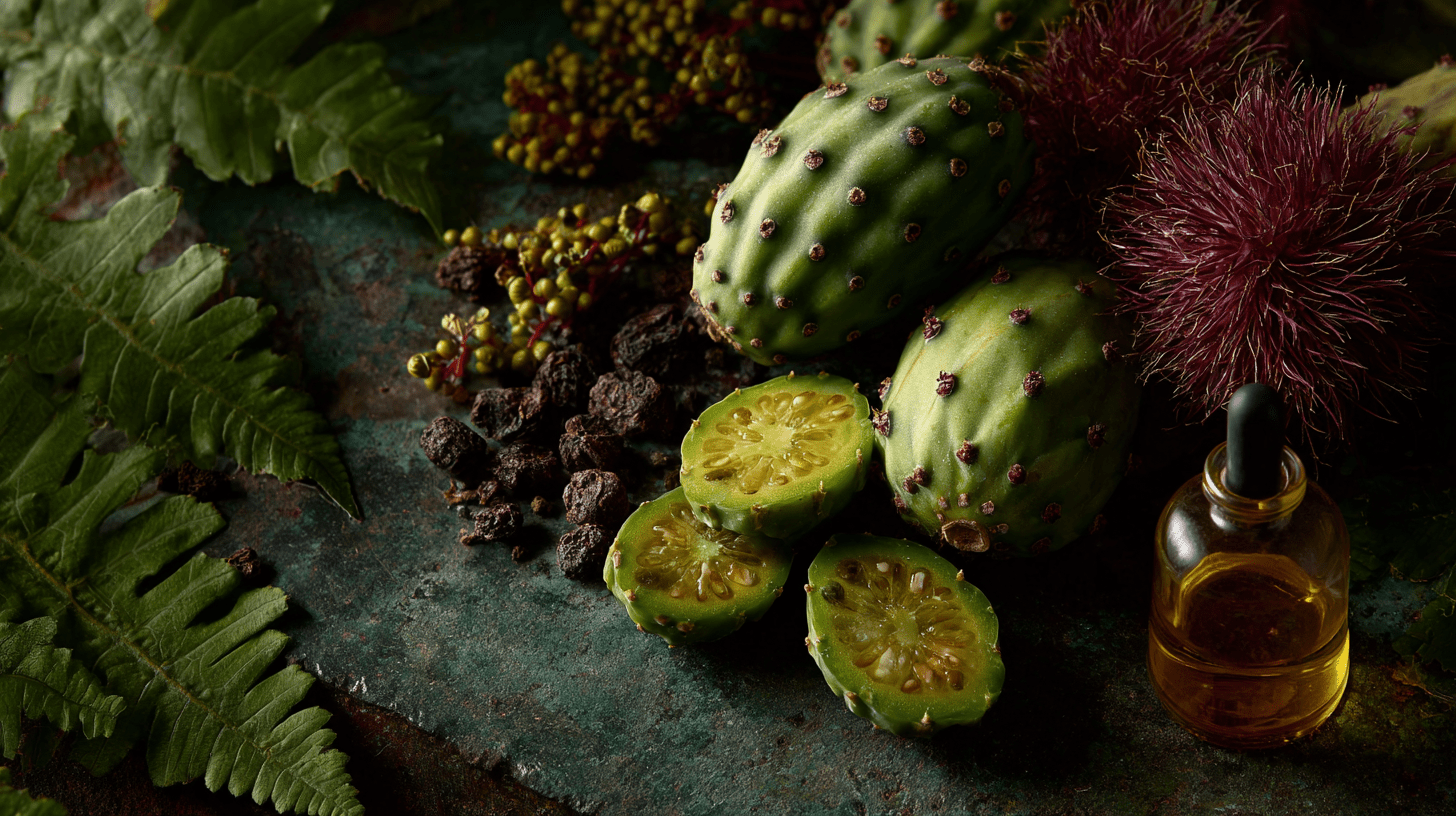
The prickly pear is a model of resistance. To survive extreme sunlight and drought, it has developed an exceptional antioxidant arsenal, which it stores in its fruit and cladodes:
— flavonoids, its major phytochemical class;
— phenolic acids, notably eucomic and piscidic acids;
— betalain pigments (betanin, indicaxanthin).
Applied to the skin, these molecules reinforce its own defense systems against the exposome.
The prickly pear, Opuntia ficus indica by its botanical name, is native to the Mexican plateau. It reached North Africa in the 16th century and today grows there without irrigation, on soils that almost no other crop accepts. This cactus bears fruit where summer temperatures exceed forty degrees and where it doesn't rain for three months.
This hardiness is not anecdotal. A plant that lives in these conditions must produce what it needs to survive: it is the environmental constraint that explains the richness of its composition, and not a recent varietal selection. The properties attributed to the prickly pear come from there, from the desert and nothing else.
What the studies show
Two laboratory studies particularly illustrate this protective effect.
— An upstream shield. Petruk and collaborators (Bioorganic & Medicinal Chemistry Letters, 2017) pre-treated human keratinocytes with an extract of Opuntia ficus-indica cladodes before exposing them to UVA. The cells thus protected produced fewer free radicals, underwent less lipid peroxidation, better preserved their glutathione, and resisted cell death. The whole point lies in this "pre-treatment": the antioxidant acts as a shield placed before the aggression.;
— A brake on photoaging. A study published in Oxidative Medicine and Cellular Longevity (2020) showed that opuntiol, a molecule isolated from prickly pear, prevented inflammation and collagen degradation induced by UVA.
These results, obtained in vitro and on animal models, clarify the mechanism of action without constituting a therapeutic promise.
How to protect your skin daily
An effective "anti-aggression" routine relies on a few simple steps:
— apply an antioxidant in the morning, to arm the skin before the day's exposure;
— never skip sun protection: the antioxidant complements it, but does not replace it;
— cleanse the skin in the evening to remove accumulated pollution particles;
— repeat these steps consistently, because protection is built day after day.
To find out which aggressions your skin is most sensitive to, the NOPAL skin diagnostic provides a personalized assessment in a few minutes. Prickly pear oil, rich in vitamin E, complements the antioxidant action of polyphenols while nourishing the skin barrier.
An anti-aging routine consists of three steps, not ten products. In the morning, a hydrating texture under sunscreen; in the evening, a few drops of oil on still-damp skin, to retain water rather than replace it. The rest is a matter of personal comfort, not effectiveness.
Consistency matters more than concentration. Daily application for three months yields visible benefits where two weeks of a highly concentrated product yields none, simply because epidermal renewal takes that long. It is biological constraint that dictates the timeline, never the promise written on the bottle.
Which prickly pear to choose daily?
To support the skin against aggressions, the prickly pear combines two complementary assets. Prickly pear seed oil, cold-pressed from the seeds and ideally organic, is among the vegetable oils richest in vitamin E, an antioxidant that helps protect facial lipids. Polyphenols, concentrated in the fruit of Opuntia ficus-indica, reinforce this protection through their action on free radicals.
On a daily basis, a simple routine is sufficient: a prickly pear seed oil in the evening to nourish and repair, an antioxidant treatment in the morning to arm the skin before exposure. Urban skins, exposed to pollution, find a real benefit. As for results, expect a few weeks of regular use for more resistant and radiant skin; consistency of care remains key.
To go further:
- Prickly Pear Polyphenols: Antioxidant Shield and Radiance
- Prickly Pear Polyphenols: Preventing Signs of Aging
- The Skin Intelligence Diagnostic
- Discover Pure Prickly Pear Oil
Everything depends on the seeds. It takes almost a ton of fruit to obtain a liter of oil, because each seed contains very little, and it can only be extracted by cold pressing. It is this rarity, not a passing trend, that determines the price of the bottle.
The composition rewards the effort: over 60% linoleic acid, one of the two essential fatty acids the body cannot produce, supplemented by oleic acid and sterols. Essential fatty acids are precisely what dry, tight skin lacks, and what the body can only obtain by receiving them from external sources.
Check three mentions on the label: first cold pressed, unrefined, and the full Latin name. A refined oil loses some of what justified buying it.
Frequently asked questions
Do prickly pear polyphenols protect from the sun?
No, they do not filter UV rays and do not replace sunscreen. However, by neutralizing some of the free radicals generated by exposure, they usefully complement sun protection within a routine.
What is the exposome?
It is the set of external factors to which the skin is exposed throughout life: UV, pollution, tobacco, climate, blue light. All promote oxidative stress, the main driver of skin aging.
Why is "pre-treatment" mentioned in the studies?
Because the cells were protected by the extract before UVA aggression. This shows the benefit of using an antioxidant preventively, daily, rather than waiting for damage to appear.
Is this active ingredient suitable for an urban routine?
Particularly, yes. Skin exposed to urban pollution and blue light benefits significantly from an antioxidant step morning and evening, combined with good cleansing.
Information provided for cosmetic and educational purposes; it does not constitute medical advice.
Should skincare be changed seasonally? The texture, yes; the principle, no. Winter calls for richer formulas because dry air and heating accelerate water loss. Summer primarily requires consistent sun protection, which remains the most well-established effective measure.
How long before judging a product? Three months. Below that, one observes the immediate effect of a texture, not the result of a deep action. This is also the duration to respect before changing products, otherwise one risks endlessly starting over without ever giving anything enough time to show results.
Can multiple products be layered? Yes, from thinnest to thickest, leaving a minute between two layers. Beyond three, you primarily add the risk of irritation and cost, without measurable benefit.
This ingredient in our range


Mature skin · Dry skin

Go further than this article
Get our skincare guides by email — and start with your free skin diagnostic: 2 minutes, advice tailored to your skin. We ship to the US, UK, Canada, Australia and 27 European countries; somewhere else? Sign up and you will be the first to know when we deliver to your country.
By signing up, you agree to our privacy policy. Unsubscribe in one click.