Prickly pear polyphenols: preventing the signs of aging
Prickly pear (Opuntia ficus-indica) polyphenols—flavonoids, phenolic acids, and betalain pigments like indicaxanthin—are powerful plant-based antioxidants that help neutralize free radicals responsible for "inflammaging," the silent skin aging driven by chronic micro-inflammation. By supporting the skin's natural defenses, they help preserve its firmness and radiance over the years.
Inflammaging is now one of the most studied areas to understand why skin eventually shows signs of time. Good news: the prickly pear, the emblem of NOPAL LIFE cosmetics, is among the most promising plant shields against this phenomenon.
Inflammaging: The Aging That Isn't (Immediately) Visible
The term "inflammaging"—a contraction of inflammation and aging—refers to a very low-intensity inflammation, invisible to the naked eye, but constantly sustained by our environment: UV rays, pollution, tobacco, stress, lack of sleep, what researchers call the exposome.
Day after day, this silent micro-inflammation:
— promotes the production of free radicals, unstable molecules that oxidize cells;
— sustains the degradation of collagen and elastin, the fibers that ensure firmness and bounce;
— eventually results, years later, in a dull complexion, loss of density, and the appearance of the first wrinkles.
Because it acts behind the scenes, inflammaging often goes unnoticed for a long time: by the time signs become visible, the process is already well underway. This is why it calls for a primarily preventive strategy—and plant-based antioxidants play a crucial role in it.
The word comes from geriatrics and dates back to the 2000s. It describes a low-intensity, underlying state that develops over decades and is not signaled at the time it begins. It is precisely this silent nature that made it so long for researchers to recognize it.
Applied to the skin, the concept explains a common discrepancy: marks that appear suddenly even though the process has been underway for years. What is seen at forty-five has begun much earlier, without symptoms, and this is what justifies focusing on prevention rather than correction.
Why Prickly Pear Polyphenols?
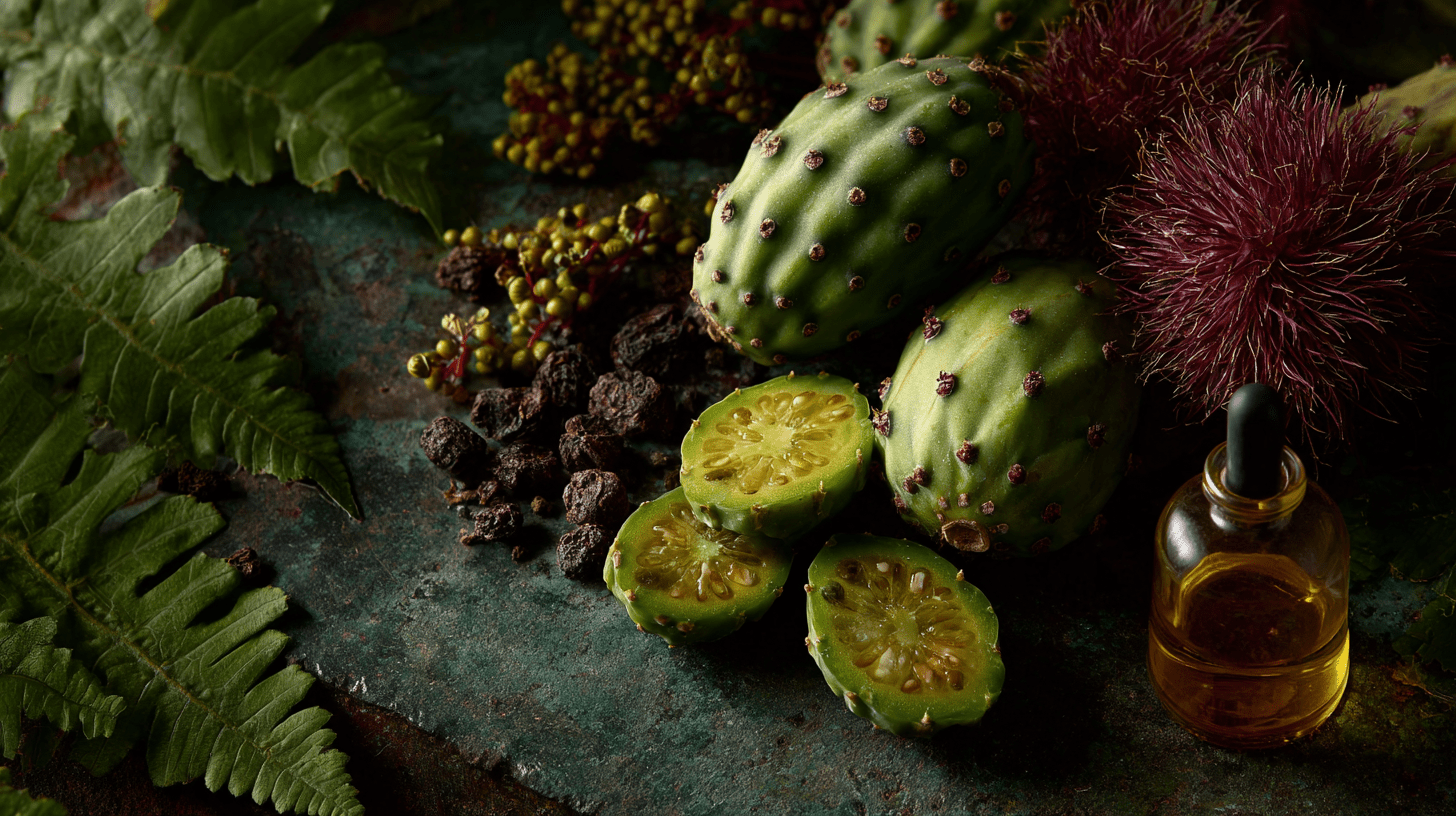
The prickly pear is a desert plant, shaped by nature to survive extreme oxidative stress: intense sun, drought, wide temperature fluctuations. To protect itself, it concentrates a remarkable cocktail of antioxidants:
— flavonoids, the major phytochemical class of the plant;
— phenolic acids, especially eucomic and piscidic acids;
— betalains, these pigments responsible for its color, including betanin (red) and indicaxanthin (yellow-orange).
These are the molecules that the skin borrows from the plant to strengthen its own defenses against daily aggressions.
"Electron Donor" Pigments
The antioxidant mechanism is based on simple chemistry. A free radical is a molecule lacking an electron, which makes it unstable and aggressive towards neighboring cells. An effective antioxidant knows how to easily donate an electron to neutralize it, without becoming aggressive itself.
A study published in the Journal of Agricultural and Food Chemistry (2002) measured the redox potential of betanin and indicaxanthin from Sicilian prickly pear: both pigments proved capable of readily donating their electrons, confirming their role as active antioxidants.
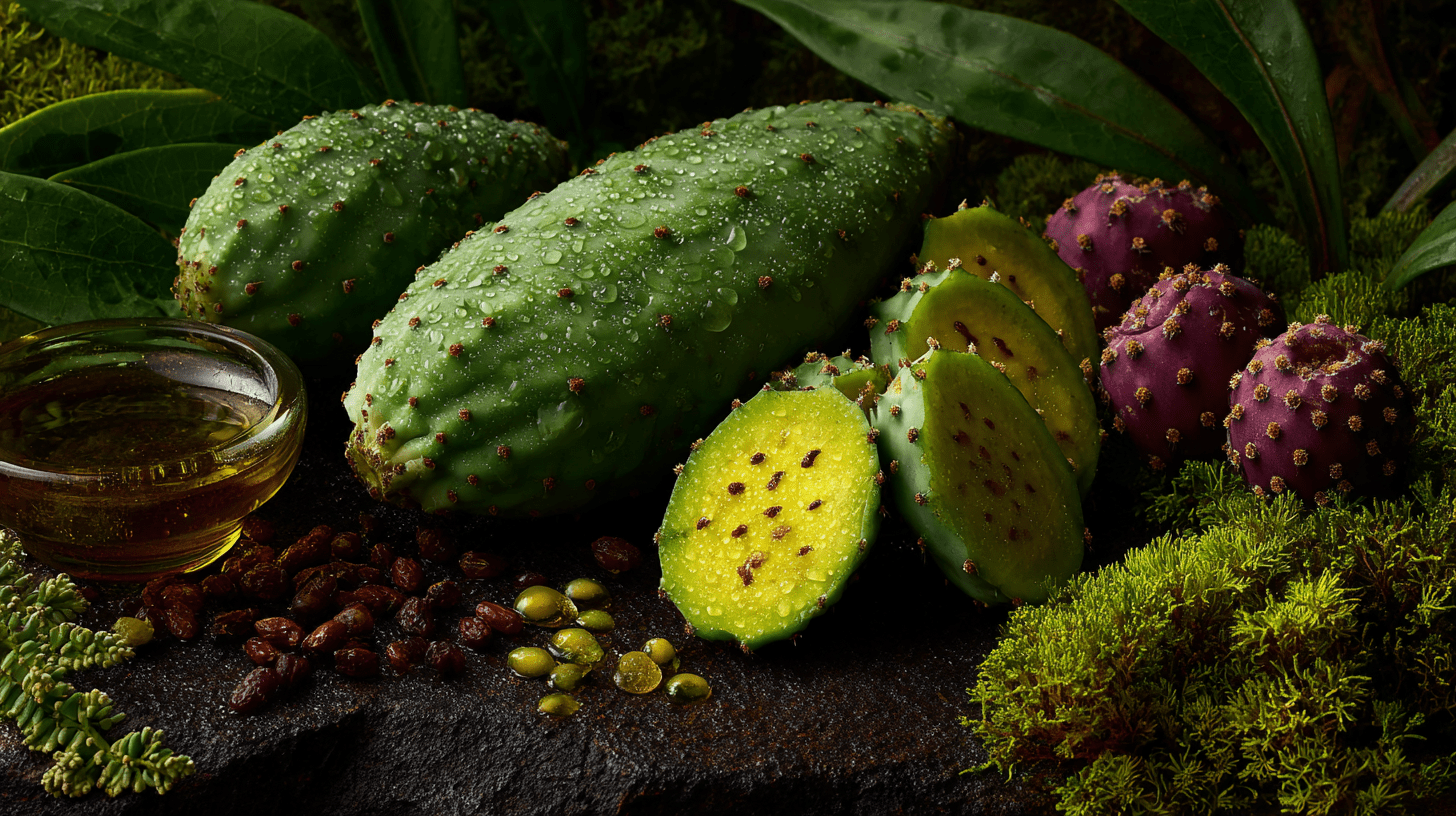
Not all prickly pears are alike. The fruit exists in green, orange-yellow, and purple-red, and this color is not merely decorative: it signals the presence of different pigments, in proportions that vary from one variety to another. A producer who cultivates three varieties harvests three compositions.
The prickly pear, originally from the Mexican plateau, has diversified over the centuries depending on the regions where it was planted. Algerian, Moroccan, Sicilian, and Mexican cultivars do not yield the same profile, and the cactus itself does not look the same from one terroir to another. Speaking of the plant in the singular is a linguistic convenience.
What Scientific Studies Show
Beyond chemistry, several laboratory studies highlight the interest of prickly pear in combating skin aging.
— Preservation of supporting fibers. A study published in Food & Function (2023) tested extracts of Opuntia ficus-indica (fruit peel and pads) on a skin aging model. The extracts inhibited collagenase and elastase, the two enzymes that degrade collagen and elastin; applied in a 5% cream, they helped restore a nearly normal collagen structure.
— Brake on photoaging inflammation. Research published in Oxidative Medicine and Cellular Longevity (2020) showed that opuntiol, a molecule isolated from prickly pear, blocked inflammatory responses and prevented UVA-induced collagen degradation.
Taken together, these results outline a consistent dual action in the fight against inflammaging: on one hand, neutralizing free radicals, and on the other, limiting the enzymatic degradation of the fibers that support the skin.
Note: These are in vitro and animal model studies. They clarify mechanisms of action and guide cosmetic formulation, without constituting a therapeutic promise.
A word of caution is needed when reading this type of literature. Most studies focus on concentrated extracts, applied to cultured cells, at doses that have no equivalent in a finished product. They describe a possible mechanism; they do not measure an expected effect on a face.
The composition of the fruit also lends itself poorly to direct comparisons. From one publication to another, the variety studied, the maturity at harvest, and the extraction method change, and the figures with them. Comparing two studies without verifying these three points is like comparing two different materials under the same name.
This does not negate anything that is described. It only requires treating these results as a solid orientation rather than as a directly applicable measurement.
How to Benefit from Prickly Pear Polyphenols
To integrate this active ingredient into an anti-inflammaging routine:
— in the morning preferably, because an antioxidant is the ideal complement to the skin's defenses against the day's exposome;
— in serum or oil form, which concentrate active ingredients and facilitate their penetration;
— in synergy with good hydration and sun protection, to act preventatively rather than correctively;
— over time, because regularity—not quantity—makes the difference with an antioxidant.
To determine if inflammaging is a priority for your skin, the NOPAL skin diagnosis analyzes signs of premature aging in a few minutes and directs you to the most relevant active ingredients. Prickly pear oil is the ideal nourishing complement, rich in vitamin E.
To go further:
- Quercetin: Preventing Signs of Aging
- Postbiotics: Strengthening the Skin Barrier
- The Skin Intelligence Skin Diagnosis
- Discover Pure Prickly Pear Oil
An analysis report covers a batch, never a species. The composition of the same plot varies from year to year depending on rainfall, sunlight, and harvest date—the measured differences between two successive campaigns sometimes exceed those observed between two regions.
This is why an isolated figure, cited without year or origin, does not prove much. The properties attributed to the plant remain constant in their nature; their intensity, however, is negotiated each season with the climate. A serious supplier provides the report for the batch delivered, not one from an analysis done once and for all five years ago.
The essential fatty acids contained in the seeds follow the same logic: their proportion changes, their presence does not. It is this fundamental stability that allows an anti-aging routine to be built upon it.
Frequently Asked Questions
Are prickly pear polyphenols suitable for all skin types?
Yes, they are generally well-tolerated plant antioxidants, even by sensitive skin. As with any new active ingredient, introduce it gradually and perform a patch test in the crook of your elbow if in doubt.
How long does it take to see an effect?
Antioxidant action is primarily preventive: it works daily, behind the scenes. For comfort and radiance, improvement is often observed within a few weeks of regular use; for firmness, consistency over several months is key.
What is the difference between polyphenols and prickly pear oil?
The oil, extracted from the seeds, is mainly rich in vitamin E and fatty acids that nourish and restructure. Polyphenols, from the fruit and pads, provide the antioxidant aspect. Both active ingredients are complementary within the same routine.
Can polyphenols be combined with other antioxidants?
Absolutely. Antioxidants often reinforce each other: combining prickly pear polyphenols with the natural vitamin E in the oil, for example, broadens the spectrum of protection against free radicals.
Information provided for cosmetic and educational purposes; it does not constitute medical advice.
Why is this plant so prevalent in North Africa? It was initially planted there for agricultural reasons, not cosmetic ones: it holds sloping soils, serves as a natural fence, and feeds livestock when nothing else grows. Its use in formulations came much later.
Does this change anything for the buyer? Yes, regarding availability. A material from orchards planted for fruit does not follow the same volumes as a material harvested from hedges. Supply shortages are most often explained by this, and rarely by a sudden commercial success.
Should one prioritize a specific origin? No single origin has been demonstrably superior to others. It is better to look at the batch's traceability and production date than the country name printed on the label.
This ingredient in our range


Mature skin · Dry skin

Go further than this article
Get our skincare guides by email — and start with your free skin diagnostic: 2 minutes, advice tailored to your skin. We ship to the US, UK, Canada, Australia and 27 European countries; somewhere else? Sign up and you will be the first to know when we deliver to your country.
By signing up, you agree to our privacy policy. Unsubscribe in one click.