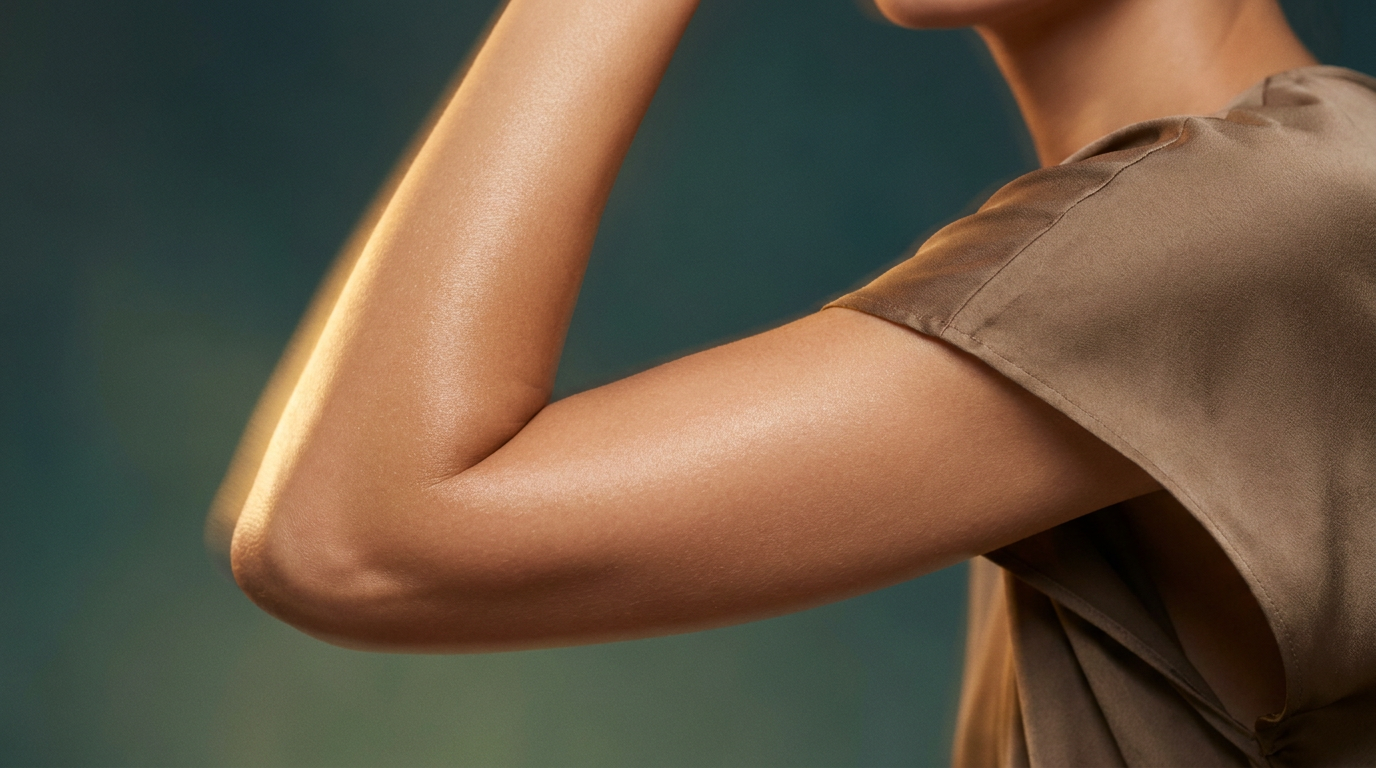
Dry elbows: causes and body care routine
Dry elbows often result from a combination of low local lipid production, friction, and dead cell accumulation. This area thickens to withstand pressure, explaining its rough and sometimes grayish feel. An effective protocol combines lukewarm showers, a gentle keratolytic active, and a rich moisturizing cream.
Why elbows become drier than forearms
Elbows contain few sebaceous glands. They undergo repeated flexion and pressure on surfaces. The stratum corneum thickens to protect the area.
The hydrolipidic film is therefore less comfortable there. Cold and dry air increase water loss. Dry elbows are common without necessarily being concerning.
Useful monitoring relies on consistent conditions rather than a randomly taken impression. Photograph the area once a week, at the same time and under the same light, then note the amount applied, the frequency, and the comfort level. This simple method avoids attributing a seasonal, makeup, washing, or lighting-related change to this localized dryness.
Change only one parameter for seven to fourteen days. Keep the cleanser, cream, and sunscreen identical, then observe tightness, radiance, suppleness, and redness. A three-line journal is enough to decide if the action makes a real difference or unnecessarily complicates the routine.
Hot showers, soaps, and aggravating clothing
Long, hot showers remove more lipids. Alkaline soaps can accentuate tightness. A mild cleansing gel with a physiological pH is more suitable.
Rough fabrics repeat friction with each movement. Wear soft clothing when the area is irritated. Pat dry rather than rubbing.
Urea, lactic acid, or salicylic acid: choosing the right level
5% urea mainly hydrates, while 10% further softens thickened areas. Lactic acid combines humectation and gentle exfoliation. Salicylic acid is suitable for very rough patches but requires more caution.
Do not apply these active ingredients to an open crack. Start every other evening. The urea in cosmetics page details the percentages.
Evening protocol in three minutes
After a lukewarm shower of less than ten minutes, pat your elbows dry. Apply a dab of 5% or 10% urea cream to each elbow. Massage for twenty seconds without insisting on a painful area.
Add a thin layer of balm if the skin remains very dry. Repeat every evening for two weeks. Then switch to three applications per week for maintenance.
Mechanical exfoliation: why friction should be limited
A pumice stone or a rough glove quickly removes superficial cells. The action can also cause micro-fissures and increase sensitivity. Prefer a soft towel after showering.
A chemical exfoliant is more consistent when properly dosed. Never remove the entire thickness in one session. Thickened skin returns if the causes persist.
Rich natural cream to maintain comfort
Shea butter provides fatty acids and an occlusive effect. Squalane improves suppleness without being too sticky. Glycerin attracts water and complements the fatty substances.
A fragrance-free formula limits the risk of irritation on a cracked area. Apply the cream within three minutes after showering. The shea butter guide helps to understand its place in the INCI list.
Why elbow skin retains water poorly
Three anatomical particularities explain why this area dries out while the adjacent forearm remains supple.
The first is the almost complete absence of sebaceous glands. Without sebum, there is no hydrolipidic film, and therefore nothing to slow down evaporation. Elbow skin continuously loses its water, and nothing retains it.
The second is mechanical: the skin must bend and straighten thousands of times a day. It is therefore naturally thicker and wrinkled, and this thickened stratum corneum exfoliates poorly. Dead cells accumulate, the surface becomes rough and gray.
The third is constant friction against tables, armrests, and sleeves. This maintains the thickening — it's a defense reaction, not a lack of care.
The ability of the skin to retain moisture is therefore structurally low, and no skincare product will make it comparable to facial skin. What is possible, however, is to compensate by regularly providing what is missing: water, a humectant to fix it, and a fatty substance to keep it in.
Hence the order that makes the difference: apply to skin that is still damp, right after showering, without having completely dried. This detail changes the result more than the choice of cream, and it's the one most often skipped.
One last useful benchmark: elbow dryness improves in two to three weeks of daily care. If nothing changes after a consistently followed month, it's no longer a matter of cream.
When dryness warrants professional advice
A deep crack, bleeding, or persistent pain should be evaluated. A very red patch that spreads or itches intensely also requires an opinion. A dermatologist can distinguish simple dryness from another cause.
Do not increase acids on an area that is worsening. Stop the new product in case of burning. Take a weekly photo to monitor its evolution.
What the dry elbow skin protocol cannot do
The dry elbow skin protocol cannot erase a persistent cause related to pressure or clothing. A cream improves suppleness as long as it is used regularly. It should not be applied to an open lesion without advice.
Elbows naturally remain thicker than the forearm. Seeking a totally identical surface is not realistic. The goal is comfort, less roughness, and fewer cracks. The dry skin page places this protocol within a broader body routine.
- Take a lukewarm shower for less than 10 minutes.
- Pat your elbows dry.
- Apply a dab of urea cream.
- Add a rich balm if necessary.
- Limit pressure and rough fabrics.
| Indicator | Recommended choice | Caution point |
|---|---|---|
| Mild dryness | Glycerin cream 1 to 2 times/day | Avoid very hot water |
| Significant roughness | Urea 10% in the evening | Do not apply to cracks |
| Very thick area | Progressive lactic acid | Monitor tolerance |
| Painful crack | Professional advice | Avoid acids |
Before acids, the evening oil layer
The table above categorizes acids by level, but none should be applied to cracked skin: the area must first be made supple. A cold-pressed prickly pear seed oil in the evening, under a long garment, fulfills this preliminary role — and is often sufficient for slight roughness.


Go further than this article
Get our skincare guides by email — and start with your free skin diagnostic: 2 minutes, advice tailored to your skin. We ship to the US, UK, Canada, Australia and 27 European countries; somewhere else? Sign up and you will be the first to know when we deliver to your country.
By signing up, you agree to our privacy policy. Unsubscribe in one click.