Niacinamide or AHA: which one for your skin?
One strengthens, the other removes—and for the complexion, both claim the same result through opposing pathways. Niacinamide improves skin function over several weeks. AHAs detach dead surface cells with a faster, more demanding effect.
Two opposing strategies
| Criterion | Niacinamide | AHA |
|---|---|---|
| Approach | strengthens function | removes surface |
| Frequency | daily | 2 to 3 times a week |
| Timeframe | 6 to 8 weeks | 2 to 3 weeks |
| Tolerance | good | variable, can dry |
| Sun | no effect | significantly increases sensitivity |
| Area of Action | shine, complexion, barrier | dull complexion, uneven texture |
What niacinamide does
Niacinamide strengthens the skin barrier, acts on sebum production—which helps limit shine—and improves skin tone uniformity. It is a versatile and widely documented active ingredient.
Its slowness is its main drawback. Allow six to eight weeks of daily use before judging, and a concentration of two to five percent.
Its advantage over an AHA: niacinamide does not dry out, does not cause photosensitivity, and can be used daily without limitation.
What AHAs do
Alpha-hydroxy acids are water-soluble and act on the surface. Glycolic acid is the most penetrating, lactic acid the gentlest.
They detach accumulated dead cells, which improves radiance and texture regularity in two to three weeks. This is significantly faster than niacinamide.
Their drawback is twofold: they dry out the skin, and they significantly increase sensitivity to radiation. Daily sun protection is part of the protocol, without exception.
Alpha-hydroxy acids work by dissolving the bonds that hold dead cells together. They are water-soluble and remain on the surface—which distinguishes them from salicylic acid, an oil-soluble BHA that penetrates the pore.
This difference guides their use. For dilated pores and excess sebum, the latter is more relevant; for uneven skin texture and a dull complexion, the former. The cell renewal they support is visible in three to four weeks.
Which to choose
Shiny skin, prominent pores: niacinamide, which acts on the cause rather than the surface.
Dull complexion, quick results desired: an AHA.
Reactive skin or weakened barrier: niacinamide alone; an AHA would worsen the situation.
Thick skin, established uneven complexion: both, at different times of the week.
One criterion is more decisive than the others: the state of the barrier. If it is intact, exfoliation provides a visible improvement in the appearance of pores and complexion. If it is compromised, it worsens the situation, and the soothing ingredient should be used first for three to four weeks.
Sensitive skin follows the same logic with double the timeframes. This is the only adjustment needed: the response doesn't change, only the schedule lengthens.
Niacinamide, known as vitamin B3, is found in a wide variety of formulations and at concentrations ranging from 2 to 10%. AHAs, on the other hand, are measured by percentage and pH: two products showing the same number can act very differently.
For redness, the former helps reduce the sensation of discomfort; the latter can worsen it if used too often. This is the quickest criterion to differentiate when skin reacts.
In the anti-aging field, the data is more extensive on the side of acids, which visibly smooth the surface. However, a powerful active used twice a week is still more effective than a powerful active abandoned after a month.
Combining them without aggressing
Safest method: AHA on evenings you use it, niacinamide every other day and every morning.
On the same evening: AHA on clean, dry skin, wait ten minutes, then niacinamide and a cream.
Never reverse the order: a serum applied beforehand would form a film that would hinder the action of the acid on the surface.
The most robust combination alternates rather than superimposes. One evening out of two for the acid, the other evening for the soothing ingredient; in the morning, skin hydration and sun protection.
This alternation yields better results than accumulation, because it allows the surface time to recover between applications. This also makes the rhythm sustainable over several months — and without duration, these ingredients do nothing.
In the anti-aging field, the contribution remains that of a better-maintained surface. It's modest, it's real, and it's what can be stated without going beyond the data.
Why niacinamide helps maintain an exfoliation rhythm
This is the most useful argument on this page. An AHA stresses the skin barrier; niacinamide strengthens it.
In practice, skin that receives niacinamide tolerates regular exfoliation better. This allows for two to three applications per week without paying the usual price in dryness.
The difficulty with chemical exfoliation is not starting but maintaining it. After the first month, the surface becomes more reactive, and many give up—the problem is comfort, not efficacy.
This is where the soothing ingredient helps. Applied on evenings without acid, it helps maintain skin hydration and reduces accumulated sensitivity, allowing you to continue instead of stopping.
This logic applies to all such combinations: what limits the result is almost never the potency of the active ingredient, but the number of weeks it is actually applied.
Progression, week by week
Weeks 1 and 2: niacinamide alone, every day. Give it time to strengthen the barrier before adding a constraint.
Week 3: add AHA once a week.
Week 5: twice, if no dryness occurs.
Thereafter: three times maximum.
This order of introduction matters: starting with AHA on a fragile barrier almost always leads to abandonment.
Weeks one and two: one evening out of three for the acid, the soothing ingredient on the other evenings. Weeks three and four: one evening out of two. Then, stabilize — most skin types never need to go beyond this.
This calendar applies to common formulations. For skin that easily reddens, double each stage: the final rhythm is the same, the path is twice as long, and this is what allows it to be achieved.
Glycolic or lactic
Glycolic penetrates deeper and works better on texture, with less tolerance. Lactic is gentler and suitable for reactive skin.
For skin never exfoliated, start with lactic. Niacinamide combines equally well with either.
Sun, non-negotiable
AHAs significantly increase sensitivity to ultraviolet rays. Daily sun protection is essential for the result, especially on the days following an application.
Niacinamide, on the other hand, has no effect on photosensitivity and can be used without restriction in this regard.
How to use niacinamide
A few drops on clean, slightly damp skin, morning and evening, followed by a cream. Two to five percent concentration is sufficient.
Introduce it every other evening for the first week, then daily. A slight initial warming sensation is possible and disappears within a few days.
For oily skin
Niacinamide acts on sebum production, which helps limit shine and refines the appearance of skin texture. An AHA works on the surface, without addressing the root cause.
In this context, niacinamide is therefore the fundamental choice and AHA a complement—not the other way around, contrary to what many routines assume.
For sensitive skin
Niacinamide alone, without exfoliant, for at least one month. A fragile barrier cannot tolerate an AHA, regardless of its advertised gentleness.
If tolerance improves after this period, lactic acid once a week can be attempted. Otherwise, stick to niacinamide alone: it is sufficient for many skin types.
A routine that lasts
Cleanse, apply niacinamide, seal, protect. AHA is incorporated on certain evenings, without displacing anything else.
What produces results is not the number of products but consistency. Two months of daily niacinamide do more than three weeks of an ambitious routine.
What to know
These products are cosmetics: they act on the appearance and comfort of the skin, without treating any condition. Persistent irritation requires dermatological advice.
Gradual or immediate
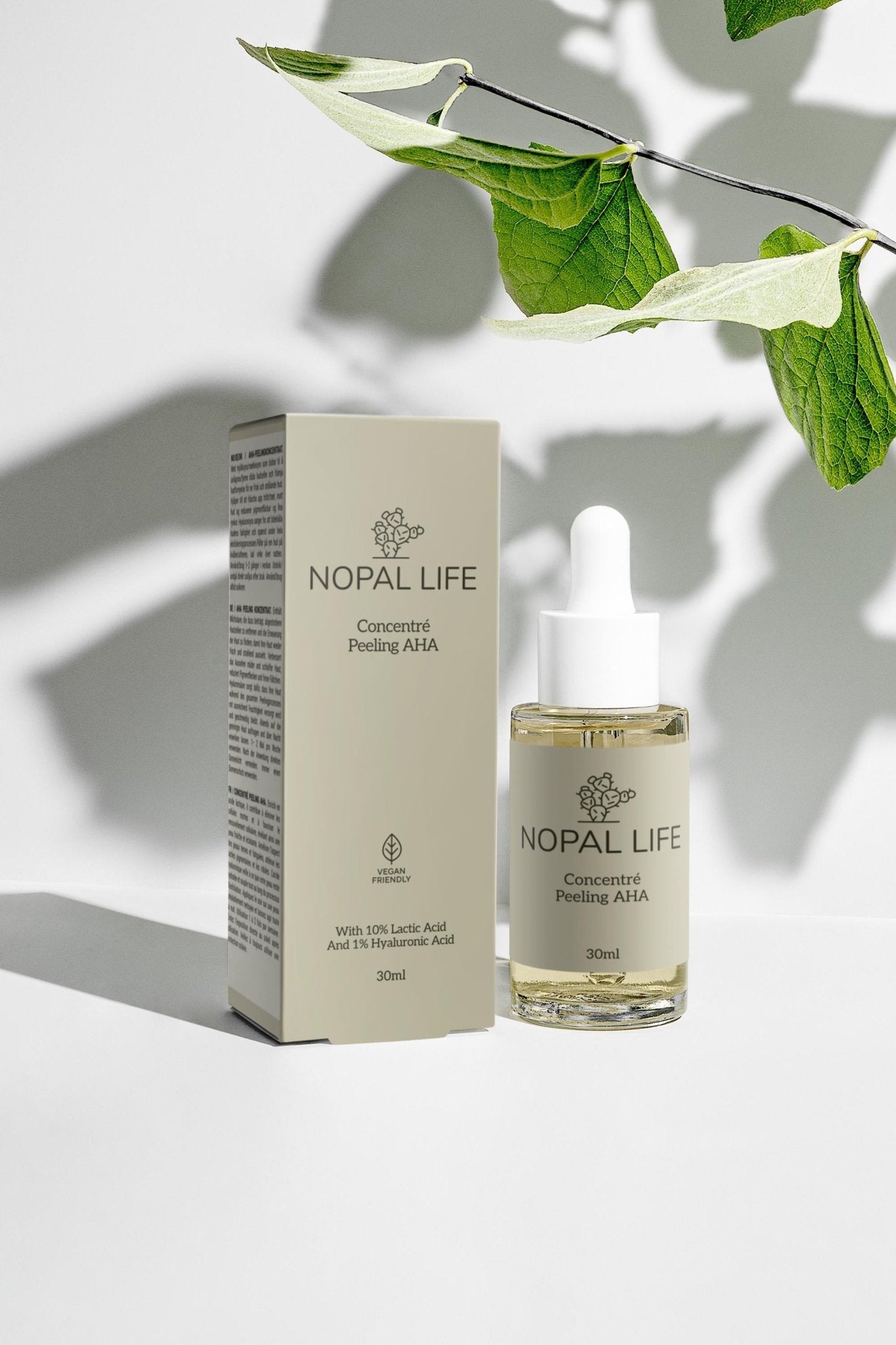
Niacinamide acts gently and can be tolerated daily; an AHA acts quickly and is reserved for once or twice a week. For irregular skin texture, an AHA peel with lactic acid gives faster results, with niacinamide remaining the core of the routine.
Our anti-aging treatments