



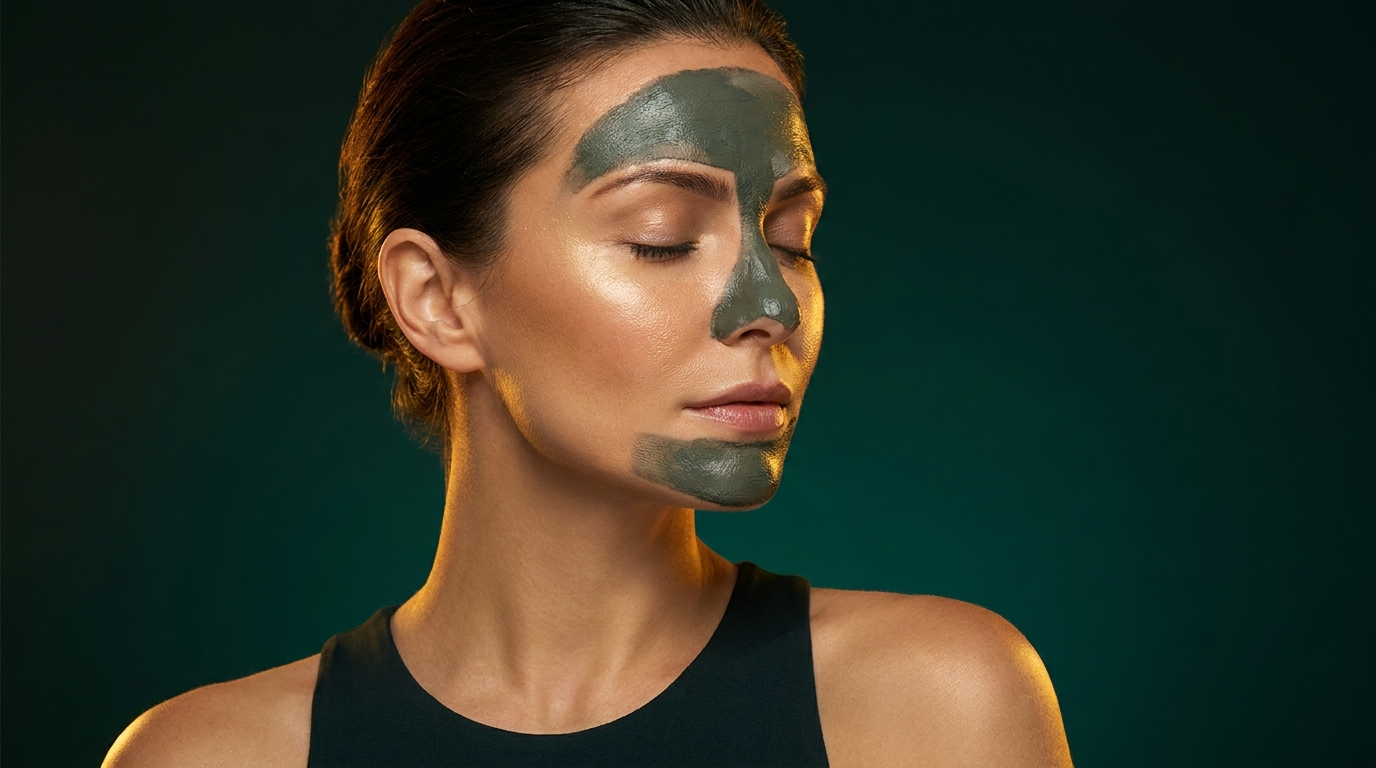
Deep-cleansing face mask: pores and gentle method
A clarifying mask absorbs surface sebum and softens the contents of the pores: it does not empty them one by one. This is a decisive nuance because it separates what can be expected—clearer skin, less visible pores—from what is pure fantasy. Methods that promise complete extraction are also those that leave marks.
What is actually found in a pore
What is called a pore is the opening of a pilosebaceous canal: a follicle that houses a hair, often invisible on the face, and the sebaceous gland that opens into it.
This canal constantly contains sebum, shed horny cells, and normal microbial flora. It is never empty, and it doesn't have to be.
Two situations make it visible. The blackhead, or open comedone: a compact plug whose surface oxidizes on contact with air and darkens. And sebaceous filaments, normal structures present in each follicle, which form fine gray dots regularly distributed on the nose.
The confusion between the two explains most disappointments. A blackhead can be reduced; a sebaceous filament reforms in a few days no matter what, because that is its normal state.
Prepare the area without scalding steam
Boiling steam over a pot is a common and counterproductive gesture: it dilates blood vessels, heats the skin, and weakens reactive skin, for a benefit that gentle heat also provides.
The correct method involves three steps. Cleanse for twenty to thirty seconds with a gentle gel to remove surface sebum and residues. Rinse with lukewarm water, never hot. Place a warm cloth on the T-zone for one minute, which is enough to soften the contents of the pores.
Then dry completely before applying the mask. Clay applied to damp skin dilutes, dries poorly, and loses its absorbent power.
One point to absolutely respect: do not squeeze any plugs before the mask. Already irritated skin reacts poorly to clay, and the inflammation created is what leaves a lasting mark.
Recipe with kaolin and glycerin
Kaolin—white clay—absorbs less than green clay but dries out much less. Combined with a humectant, it deeply cleanses without leaving the skin tight.
One tablespoon of kaolin, superfine powder.
Half a teaspoon of vegetable glycerin, which retains water and prevents the paste from cracking.
Witch hazel floral water, added gradually until a smooth paste is obtained, neither liquid nor compact.
Mix in a glass or ceramic bowl with a non-metallic spatula—prolonged contact with metal alters the properties of the clay. Spread on the nose, forehead, and chin only, in a thick layer. Leave on for eight to ten minutes, then rinse with lukewarm water before drying completely.
Once a week is sufficient. On oily and thick skin, green clay can replace kaolin.
Why you shouldn't let it dry
This is the most common mistake, and it reverses the desired effect.
As long as the clay remains moist, it absorbs sebum. As soon as it dries, it has nothing left to absorb and begins to draw water from the skin by capillarity. The sensation of tightness that accompanies cracked clay is not a sign that it is working: it is a sign that it is dehydrating.
Two consequences follow. The skin barrier weakens, making the skin more reactive. And dehydration triggers a sebum overproduction in reaction, exactly the opposite of the objective.
The good practice: mist lightly during application if the paste starts to matte, and rinse at the first signs of drying. Clay that remains supple for ten minutes works better than clay that hardens in five.
Rinsing, an underestimated step
Rubbing to remove the clay cancels out some of the benefits and irritates the thinnest part of the nose.
The method: moisten generously with lukewarm water, let the clay rehydrate for thirty seconds, then gently slide it off with your fingertips without pressing. Finish by gently dabbing with a soft cloth.
Then apply a light, non-comedogenic moisturizer within minutes. This step prevents sebaceous rebound, and it's the one most often skipped, thinking that oily skin doesn't need hydration.
Strips and extraction: what they really do
Adhesive nose strips pull out what protrudes from the opening. What they remove mainly consists of sebaceous filaments—normal structures—and not blackheads. The result is spectacular on the strip and has no effect on the cause: everything reforms in a few days.
Repeated pulling weakens the pore opening, which then appears larger. This is the opposite of the desired result.
Extraction with fingernails poses a more serious problem. Pressing a comedone pushes some of the content into the dermis instead of extracting it. The subsequent inflammation leaves a brown mark—post-inflammatory hyperpigmentation—that lasts for months, much longer than the original blackhead. See our guide to brown spots.
Extraction performed by a professional, after softening and with an appropriate instrument, is another matter. It's not the same action.
Alternate with an active ingredient
The mask works from the outside, by absorbing. An active ingredient works from inside the pore, by dissolving. The two complement each other, provided they are not used on the same evening.
Salicylic acid is the logical partner: being fat-soluble, it penetrates into the canal where clay remains on the surface. Use two evenings a week, alternating with the mask.
Niacinamide can be used daily without conflict and improves the overall appearance of oily skin.
What not to do: clay mask and mechanical exfoliation on the same day, or acid and mask one after the other. Only one exfoliating action at a time.
According to skin type
Oily skin. Green clay, once or twice a week, on the entire face if shine is generalized. See our oily skin page.
Combination skin. Clay on the T-zone only, hydrating mask on the cheeks on the same evening. This is the most common and most poorly treated case.
Sensitive skin. Kaolin only, five minutes, never more than once a week. See our sensitive skin page.
Dry skin with visible pores. Clay is rarely indicated. A hydrating mask often improves the appearance of pores more, because plumped skin makes them less noticeable.
What a clarifying mask does not do
It does not tighten pores. Their diameter depends on genetics and sebum production. An unclogged pore appears smaller—the appearance changes, the anatomy does not.
It does not make sebaceous filaments disappear, which are normal structures of the follicle and systematically reform.
It does not act on closed comedones or deep inflammatory lesions, which require a different approach.
And it does not replace evening makeup removal. Insufficient cleansing leaves enough in the pore to reform a plug faster than the mask breaks it down. See our double cleansing guide.
PERSONALIZED ROUTINE
Nopal Life Skin Intelligence™
Free diagnostic · 2 minutes
DISCOVER MY ROUTINE →


Go further than this article
Get our skincare guides by email — and start with your free skin diagnostic: 2 minutes, advice tailored to your skin. We ship to the US, UK, Canada, Australia and 27 European countries; somewhere else? Sign up and you will be the first to know when we deliver to your country.
By signing up, you agree to our privacy policy. Unsubscribe in one click.

