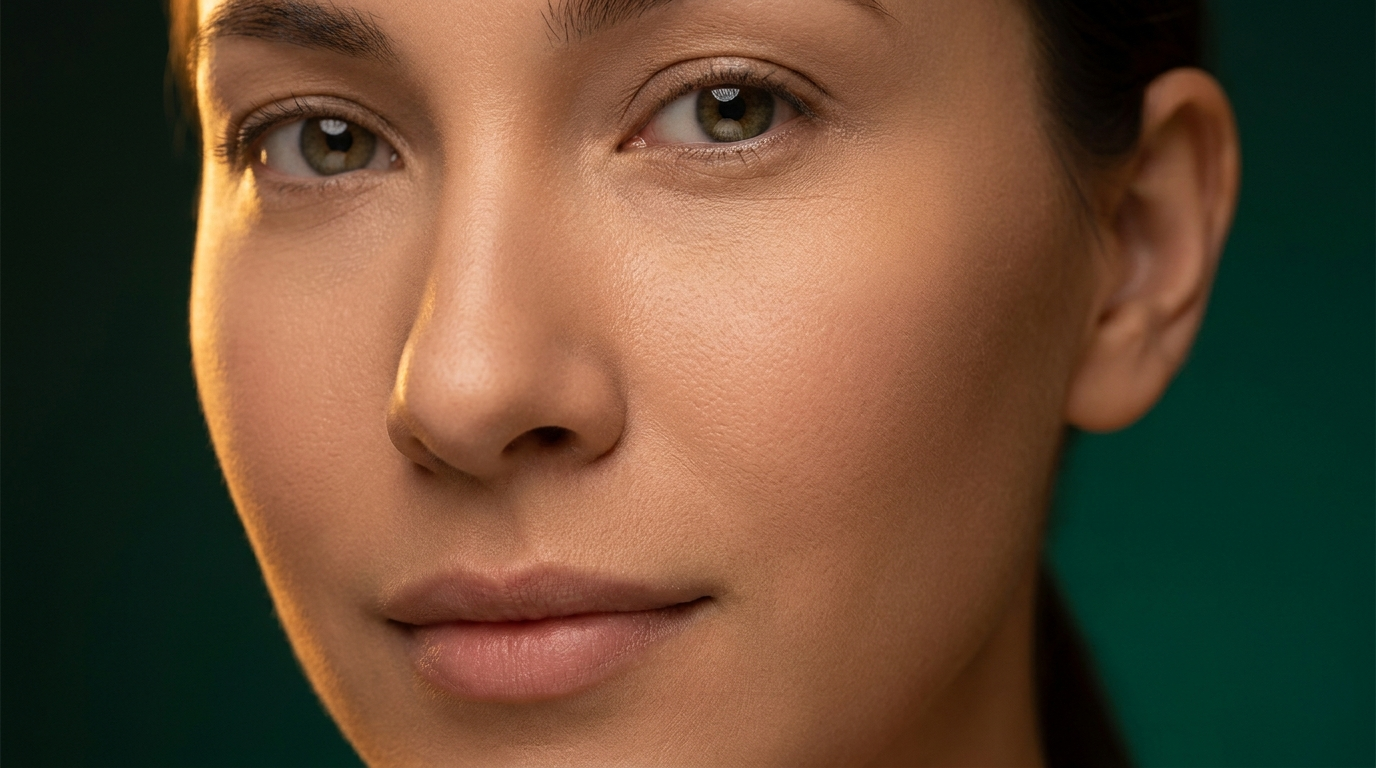
Excess sebum on the nose: pores, blackheads and routine
Excess sebum on the nose mainly comes from the high density of sebaceous glands in the T-zone, but visible shine does not always mean you need to cleanse more. Sebum, dead cells, and oxidation make sebaceous filaments and blackheads more visible. An effective routine combines a gentle cleanser, progressive salicylic acid, light hydration, and no aggressive extraction.
Why the nose produces more sebum than the cheeks
The nose has a high concentration of sebaceous glands connected to follicles. Their activity depends on hormones, genetics, temperature, and age. This anatomy explains why combination skin can have normal or dry cheeks and a shiny nose a few hours after cleansing.
Excess sebum on the nose does not disappear by stripping the surface. A very degreasing cleanser immediately removes the lipid film but can increase discomfort and encourage repeated washing. The reasonable goal is less visible shine, not a completely matte surface all day.
Sebaceous filaments or blackheads: how to recognize them
Sebaceous filaments are small gray or beige dots, numerous and regular, especially on the sides of the nose. They naturally transport sebum to the surface and return after extraction. Blackheads are darker, more isolated, and correspond to an open obstruction whose contents oxidize upon contact with air.
Pressing with fingernails can create redness, a mark, or a small crack. A magnifying glass also exaggerates pore size. Evaluate the area from fifty centimeters in front of the mirror, under diffuse light, before deciding that extraction is necessary.
Dead cells and pore obstruction
Corneocytes normally detach during cell renewal. When they accumulate with sebum in the duct, they form a more compact plug. Very occlusive textures, makeup residues, and incomplete cleansing can increase this accumulation in some people.
Double cleansing is not mandatory every day. It becomes useful after waterproof makeup or a large amount of sunscreen. In this case, use an oil or balm, emulsify for thirty seconds, rinse, then finish with a gentle gel for twenty seconds.
Salicylic acid: concentration and frequency
Salicylic acid is lipophilic and disperses in the lipids of the duct. Over-the-counter products are often between 0.5% and 2%. Start with 1% two evenings a week, only on the nose, then increase to three evenings if no lasting sensation of warmth or flaking appears.
Apply two drops to dry skin, wait one minute, then add a gel-cream with glycerin or panthenol. Do not use a grainy scrub, another AHA, or a very absorbent clay mask on the same evening. The salicylic acid sheet details its use.
Morning and evening routine for four weeks
| Time | Step | Quantity | Frequency |
| Morning | Gentle cleanser | 1 pea-sized amount | Every day |
| Morning | Gel-cream | 1 pea-sized amount | Every day |
| Morning | SPF | 2 fingers | Every day |
| Evening | Salicylic 1% | 2 drops | 2 to 3 times/week |
| Evening | Light cream | 1 pea-sized amount | Every day |
For four weeks, do not simultaneously change your cleanser, cream, and serum. Photograph your nose once a week at the same time. The oily skin routine helps place these steps in the context of the entire face.
Clay, patches, and extraction: what is temporary
A kaolin mask can absorb some of the surface sebum. Mix one tablespoon of kaolin with two teaspoons of water and half a teaspoon of glycerin, apply to the nose for five minutes, then rinse before it completely dries. Once a week is sufficient.
Adhesive patches mainly remove superficial materials and fine hairs. Their effect is immediate but brief. Excess sebum on the nose is not permanently corrected by repeated strips or a metallic extractor used without control.
Adopting a routine adapted to your skin type
Excess sebum localized on the nose should not be treated like overall oily skin, and this is the most common mistake: applying to the entire face what only the T-zone requires.
For combination skin — shiny nose and forehead, normal or dry cheeks — the routine is built zone by zone. A decongestant active on the nose, a richer cream on the cheeks, on the same evening. Treating uniformly will inevitably strip half the face or overload the other.
For uniformly oily skin, the routine can be uniform, but moderation remains the rule: gentle twice-daily cleansing, an active ingredient two to three times a week, light daily hydration.
For acne-prone skin, where excess sebum is accompanied by inflammatory lesions, the cosmetic routine quickly reaches its limits. Widespread or painful forms require dermatological advice rather than a third product.
Two principles apply to all three situations. The first: hydrate despite the shine. Dehydrated oily skin compensates by producing more sebum — thus, eliminating cream worsens what you are trying to correct. The second: change only one parameter at a time, and judge over twenty-eight days, the duration of a renewal cycle.
Finally, a routine adapted to your skin type is not measured by its number of steps. Three well-chosen products, used for three months, do more than eight products abandoned after three weeks.
Factors that modify daily shine
Heat thins sebum and makes it more visible. Stress, certain hormonal cycles, prolonged mask-wearing, and hair products on the sides of the nose can also affect the area. Note days of high shine before adding a new active ingredient.
A cream that is too rich can be reserved for the cheeks, while a gel-cream is suitable for the nose. This two-zone approach respects combination skin without drying out less oily areas. The dilated pores file explains the visibility of the ducts. Excess sebum on the nose should be monitored over several weeks rather than after a single cleansing.
Blotting paper removes the visible film without adding powder. Press a sheet on your nose for five seconds, without rubbing, once in the middle of the day. This occasional solution does not affect production but avoids multiple washes.
Niacinamide between 2 and 5% can be used in the morning in a light formula. Introduce it every other day and observe tolerance for two weeks. It complements the routine without replacing salicylic acid for plugs.
Blotting paper removes the visible lipid film without adding powder. Press a sheet on the sides of the nose for five seconds, then discard it. This occasional gesture avoids a third wash and does not interfere with cream or sunscreen already applied.
Niacinamide between 2 and 5% can complement the morning routine. Introduce two drops every other day for fourteen days, then observe shine and tolerance. A 10% concentration is not necessary to start and can be less comfortable.
Very occlusive makeup powders can accumulate around the sides of the nose. Clean brushes once a week with mild soap and let them dry completely. Replace damp sponges that retain an odor or persistent discoloration.
Glasses rest on a warm area where sebum, sweat, and sunscreen mix. Clean the nose pads and frame every evening, then dab the nose without alcohol. This mechanical detail can reduce localized accumulation without adding a new active ingredient.
A very rich sunscreen can accentuate shine without increasing gland production. Test a fluid or gel-cream texture for a week, maintaining the same protective amount. The lighter sensation comes from the vehicle, not from sebum suppression.
Morning cleansing can be reduced to a rinse if the skin feels tight despite a shiny nose. Evening remains the primary time to remove filters, pollution, and makeup. This distribution better respects the cheeks while keeping the T-zone clean.
Pores become more visible when sebum reflects light. A frontal photo with flash therefore exaggerates their diameter. Compare instead under diffuse natural light and at a constant distance, once a week, before concluding that the routine is failing.
Zinc PCA appears in some formulas for combination skin. It can complement a light texture but does not replace cleansing or progressive exfoliation. Start with a single serum to avoid confusing tolerance and efficacy.
The menstrual cycle and certain periods of stress can modify shine without permanently changing skin type. Note the date, sleep, and temperature for a month. This observation avoids attributing every variation to a product and modifying the routine too quickly.
What controls sebum production
Understanding the origin of excess sebum explains why no topical treatment can permanently reduce it.
Sebum production is controlled by androgens. Testosterone is converted into dihydrotestosterone within the sebaceous gland itself, and it is this that stimulates its secretion. This conversion depends on an enzyme whose activity is largely genetic — hence considerable differences from person to person with comparable hormones.
The nose has the highest density of glands on the face: up to several hundred per square centimeter, compared to a few dozen on the cheeks. This is not a dysfunction; it is anatomy.
Three periods of life see this production intensify: puberty, variations in the menstrual cycle — shine typically increases in the days leading up to menstruation — and certain hormonal treatments.
Heat also contributes measurably: secretion increases by approximately ten percent per degree of skin temperature. This explains shine in summer and after exertion, without any product being responsible.
Diet remains debated. The most solid data concerns high glycemic index foods and, to a lesser extent, skimmed dairy products — with modest and variable effects depending on the individual.
What this physiology implies: you can remove surface sebum, prevent the accumulation of sebum and dead cells in the pores, and limit shine for a few hours. You cannot modify the flow rate of the gland with a cosmetic. The only treatments that achieve this are medical and should be discussed with a dermatologist.
What the routine cannot eliminate
Excess sebum on the nose cannot be permanently eliminated without altering the normal functioning of the sebaceous glands. Pores do not close like doors, and sebaceous filaments reform. The realistic goal is to limit accumulation and improve the appearance of the area.
Painful, numerous, or persistent pimples require professional advice. A cosmetic routine can support comfort and surface regularity, but it does not replace an individual evaluation.
Filaments are not emptied, they are managed
A sebaceous filament is not a blackhead: it returns because it is physiological, and wanting to eliminate it leads to stripping. Daily cleansing simply limits accumulation — an aloe vera clarifying gel morning and evening, without friction, takes care of that part.


Go further than this article
Get our skincare guides by email — and start with your free skin diagnostic: 2 minutes, advice tailored to your skin. We ship to the US, UK, Canada, Australia and 27 European countries; somewhere else? Sign up and you will be the first to know when we deliver to your country.
By signing up, you agree to our privacy policy. Unsubscribe in one click.