Deep hydration for dull mature skin: firmness and radiance
What is often mistaken for a tired complexion is more often than not a water deficit that has been present in the epidermis for months. It alters the appearance of facial contours, accentuates the appearance of wrinkles, and dulls the complexion. However, most hydrating products on the market only act on the surface film. Here's where true hydration occurs, with data, a timed protocol, and three self-tests you can do at home.
Key takeaways
- A cosmetic product does not replenish the dermis: it recharges the epidermis with water and limits transepidermal water loss.
- Molecular weight dictates everything: above 1,000 kDa, surface film; between 10 and 50 kDa, diffusion into the upper layers.
- The 60-second rule: applying to damp skin is better than changing formulas.
- Three 3-minute self-tests tell you if your skin lacks water, lipids, or both.
- Comfort in 14 days, radiance in 4 weeks, apparent firmness in 8–12 weeks. Nothing should be judged before then.
Dehydration, dryness, age: three different things
The epidermis retains water thanks to the Natural Moisturizing Factor and intercellular lipids. Hydrating products deposit humectants that attract water, and occlusives that slow down its evaporation — transepidermal water loss, or TEWL. Beneath this layer, the dermis houses collagen, elastin, and native hyaluronic acid, capable of binding up to 1,000 times its weight in water. With skin aging, the production of collagen, elastin, and hyaluronic acid slows down: the skin thins, the appearance of wrinkles sets in, and the complexion becomes dull.
No product applied to the face replenishes the dermis with water — Regulation (EC) No 1223/2009 actually defines cosmetics by their action on the superficial parts of the body. What a good routine does, however, is visible: it recharges the entire thickness of the epidermis, slows down evaporation, helps preserve the skin barrier, and limits the impact of external aggressions. The most costly mistake is to address a lack of water with a fatty substance, or vice versa.
| Condition | What's missing | Sign | Solution |
|---|---|---|---|
| Dehydrated | Water | Tightness, fine lines in glancing light, dull complexion | Humectants: multi-fraction hyaluronic acid, glycerin |
| Dry | Lipids | Roughness, flaky appearance, constant discomfort | Prickly pear oil, ceramides, squalane |
| Mature | Apparent density | Resting wrinkles, less defined oval, pigmentation spots | Both, plus antioxidants and SPF |
| Common case | Water and lipids | After 45: both rough and marked with fine lines | Serum, then oil, then cream — in that order |
A dull mature skin almost always falls into the last category: oil alone doesn't provide water, serum alone evaporates.
What changes in the skin, decade after decade
Skin aging is not a sudden shift but a slow decline, with cosmetic levers changing with age. This guide serves to identify your current priority rather than to accumulate randomly purchased anti-aging products.
| Period | What changes | Visible sign on the face | Skincare priority |
|---|---|---|---|
| 25–35 years | Native hyaluronic acid content declines; epidermal renewal slows down | Dehydration fine lines, less radiant complexion upon waking | Daily hydration and photoprotection: the age of prevention |
| 35–45 years | Collagen and elastin production slows down; hydrolipidic film depletes | First visible resting wrinkles, more pronounced eye contour | Low molecular weight hyaluronic acid, antioxidants, evening oil |
| 45–55 years | Epidermis thins, transepidermal water loss increases | Dull skin, irregular texture, first pigmentation spots, less defined oval | Complete water and lipid hydrating care, glycolic acid, SPF without exception |
| 55 years and older | Structural dryness, more reactive skin barrier | Daily discomfort, skin "drinks" products, cold sensitivity | Rich cream, fragrance-free formulas, fewer active ingredients simultaneously |
After 45, most disappointments come from excess, not lack: layering everything on a weakened barrier yields the opposite of the desired effect.
Hyaluronic acid: molecular weight dictates everything
It is not a single ingredient but a family of molecules. A study by confocal Raman spectroscopy by Essendoubi et al. (Skin Research and Technology, 2016) compared their penetration: low molecular weight fractions diffuse into the upper layers of the epidermis, while high molecular weight ones remain on the skin's surface.
| Fraction | Weight | Where it settles | Benefit | Delay | INCI Name |
|---|---|---|---|---|---|
| High | > 1,000 kDa | Surface film | Immediate comfort, optical smoothing effect | Minutes | Sodium Hyaluronate |
| Medium | 50–1,000 kDa | Stratum corneum | More regular texture, apparent density | 2–4 weeks | Hyaluronic Acid |
| Low | 10–50 kDa | Epidermal thickness | Suppleness, appearance of dehydration wrinkles | 4–8 weeks | Hydrolyzed Hyaluronic Acid |
| Oligomers | < 10 kDa | Lower layers | Plumped appearance — avoid if skin is reactive | 4–8 weeks | Sodium Acetylated Hyaluronate |
Three reflexes when shopping: look for two different INCI denominations (only one = only one level of action); check their position in the list (after fragrance means it's a trace); ensure an occlusive follows in the routine, otherwise the captured water evaporates. The displayed concentration is not a criterion: above 2% high molecular weight, you gain stickiness, not hydration.
Active ingredients that complement hydration
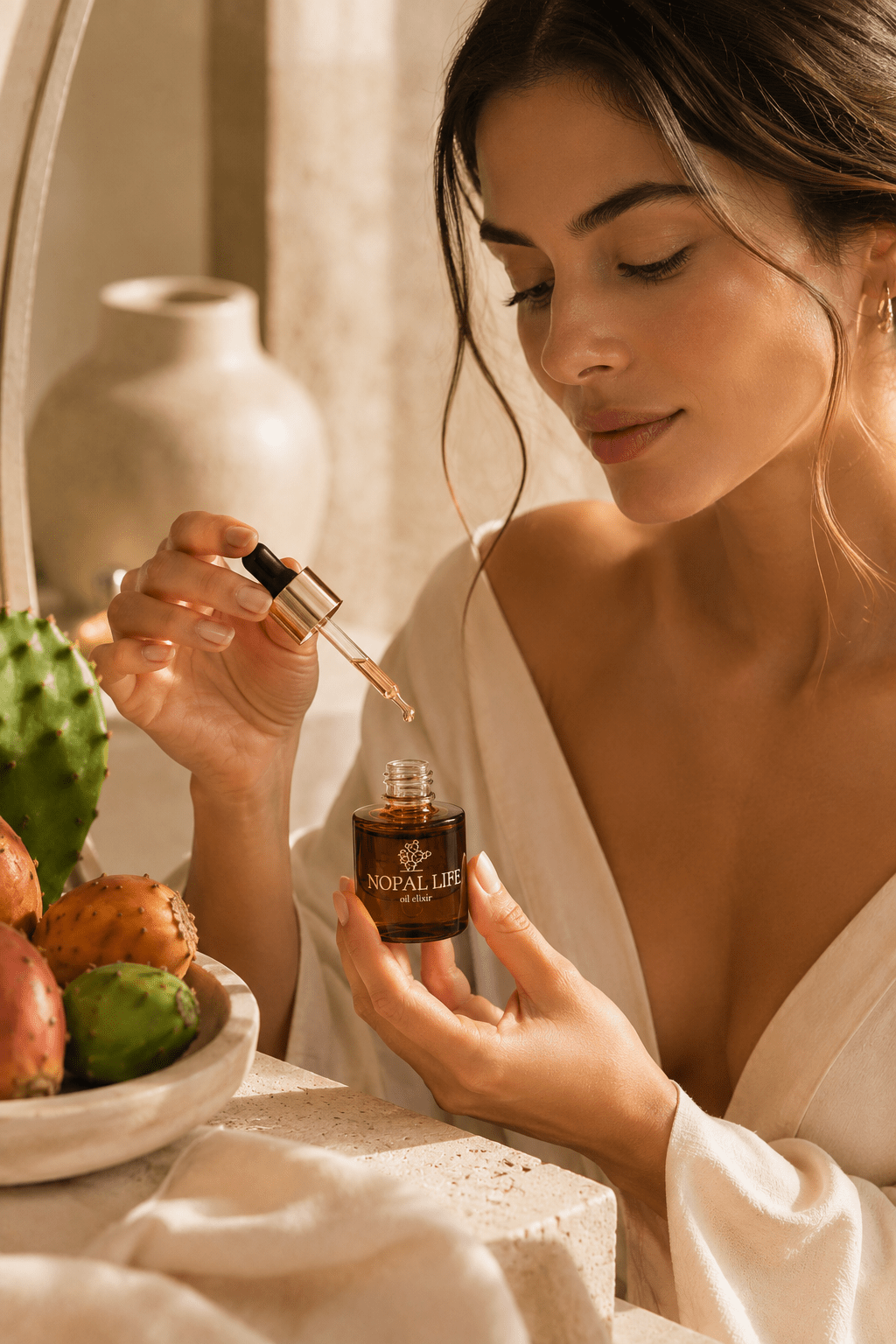
Prickly pear oil (Opuntia ficus-indica) is the foundation of Nopal Life routines. Analysis published by Ramadan and Mörsel (Food Chemistry, 2003) shows a linoleic acid content close to 60% of total fatty acids and an unsaponifiable fraction rich in tocopherols and plant sterols. Linoleic acid is one of the structural lipids of the intercellular cement: this oil helps strengthen the hydrolipidic film and limit transepidermal water loss, while tocopherols help protect the skin from oxidative stress. Its dry texture makes it suitable even for those who fear rich products on the face.
Around it, four active ingredients are sufficient. Niacinamide (vitamin B3) helps support the skin barrier and comfort; at 4–5%, it helps unify the appearance of the complexion and reduce the appearance of pigmentation spots common on mature skin. Oat beta-glucan, whose molecular weight is reduced by hydrolysis, is a valuable film-forming humectant for skin sensitized by years of repeated exposures. Biomimetic peptides (palmitoyl tripeptide-1, palmitoyl hexapeptide-12) help preserve the firm and plump appearance of the skin, in a maintenance logic: their effectiveness is judged at 12 weeks, not 15 days. Finally, vegetable squalane thins rich textures without significant comedogenic properties.
| Active ingredient | Role | Usual dose | Timing | Precaution |
|---|---|---|---|---|
| Multi-fraction hyaluronic acid | Multi-level water replenishment | 0.2–2% | Morning and evening | On damp skin, always sealed |
| Prickly pear oil | Strengthens hydrolipidic film, antioxidant | 2 to 3 drops | Evening | After an aqueous phase |
| Niacinamide | Skin barrier, unified complexion appearance | 4–5% | Morning | Gradual if skin is reactive |
| Oat beta-glucan | Film-forming humectant, tolerance | 0.5–2% | Morning and evening | None |
| Biomimetic peptides | Help preserve firm appearance | 2–5% | Evening | Judge at 12 weeks |
| Glycolic acid | Refines skin texture, revives radiance | 5–8% | 1 to 2 evenings/week | SPF the next day; never with retinol |
| Stable Vitamin C | Antioxidant, radiance against oxidative stress | 5–15% | Morning | Opaque bottle, 3 months after opening |
Three 3-minute self-tests
To be done on the same day, on a cleansed face that has been free of makeup for four hours.
- The pinch test. Form a fold on your cheek, hold for 2 seconds, release, and time how long it takes to return to flat. Immediate return: good apparent elasticity. Return in 1 to 3 seconds: decreasing suppleness. Beyond 3 seconds: established lack of water.
- The glancing light test. Face at a 45° angle to a window, magnifying mirror, cheekbones and eye contour. Dehydration fine lines only appear in this lighting; established wrinkles are visible in all lights. Count them: this is your benchmark at 4 weeks.
- The blotting paper test. Place a mattifying paper on the side of your nose for 10 seconds, and a second one on your cheekbone. This test measures not water, but surface lipids. Two dry blotting papers indicate a lipid deficiency; a translucent nasal blotting paper and a dry cheekbone indicate combination skin, not dry skin.
| Combined Result | Interpretation | Purchase Priority |
|---|---|---|
| Slow fold + fine lines + noticeable blotting papers | Dominant dehydration: lipids are present, water is lacking | A multi-fraction serum, before everything else |
| Rapid fold + rough texture | Lack of lipids | An oil rich in linoleic acid, a cream with ceramides |
| Slow fold + fine lines + dry blotting papers | Mixed profile, common on dull mature skin | The complete protocol below, without skipping a step |
| Slow fold + translucent nasal blotting paper | Combination skin dehydrated by a harsh cleanser | Change cleanser, then add a light serum |
Record your results with the date: you will redo them on D30 and D90. The daily mirror never shows slow changes.
The Nopal Life 90-day protocol
Phase 1 — D1 to D14: Rest the barrier. No acids, no retinol, no new products.
- Morning — rinse with lukewarm water only. A second daily cleansing depletes the hydrolipidic film. Pat dry, leave damp.
- Morning — serum, 3 to 4 drops, within 60 seconds; moisturizer, a small dab; then SPF 30 in the city, SPF 50+ for prolonged exposure, using two fingers for face and neck.
- Evening — gentle cleansing at pH 4.5–5.5, lukewarm water. Serum, 3 to 4 drops, within 60 seconds.
- Evening — 2 to 3 drops of oil warmed between palms, pressed onto still damp skin. Rich cream only if skin still feels tight after 10 minutes.
If tightness persists on D14, extend for another week. Adding active ingredients to an uncomfortable barrier is the primary cause of anti-aging routine failures.
Phase 2 — D15 to D45: one new active ingredient every ten days. D15, morning antioxidant. D25, glycolic acid one evening a week, in place of the serum that evening. D35, eye contour: one drop for both eyes, applied with the ring finger, on the orbital bone, never on the mobile eyelid. D45, optional retinol, 1 to 2 evenings a week on dry skin, followed by a cream.
Phase 3 — D46 to D90: consolidate. Occlusive mask 2 to 3 evenings a week, 15 minutes, dabbed without rinsing. One week break from active ingredients every two months. Self-tests redone on D90.
| Criterion, rated from 0 to 3 | D0 | D14 | D30 | D90 |
|---|---|---|---|---|
| Tightness within an hour after cleansing | ___ | ___ | ___ | ___ |
| Fine lines visible in glancing light | ___ | ___ | ___ | ___ |
| Dull complexion upon waking | ___ | ___ | ___ | ___ |
| Skin fold return, in seconds | ___ | ___ | ___ | ___ |
| Roughness to the touch on the cheekbone | ___ | ___ | ___ | ___ |
The 60-second rule
After rinsing, the surface retains a film of residual water that evaporates in less than two minutes in a heated room. A humectant applied at this stage captures this water. The same humectant on already dry skin will draw water from elsewhere — and if the ambient air is too dry, it draws it from the skin itself. The same formula, applied with a 90-second difference, will not yield the same result. Therefore, never completely dry your face; if your air is very dry, spray with thermal water rather than increasing the dosage.
Adapting the routine to the environment
Skin comfort is between 40 and 60% relative humidity. A heated home often drops below 30%.
| Situation | Relative Humidity | Effect | Adjustment |
|---|---|---|---|
| Heated indoors, winter | 20–30% | Accelerated evaporation, tightness in the evening | Oil also in the morning, under cream; humidifier |
| Air-conditioned office, summer | 30–40% | Dull complexion midday | Mist around 3 PM, then cream pressed onto cheekbones |
| Airplane cabin | 10–20% | Visible dehydration after 2 hours of flight | Thick layer before boarding, renewed every 3 hours |
| Mountains, wind, cold | Variable | Compromised barrier, redness due to discomfort | Occlusive texture before going out, SPF 50+ even on cloudy days |
| City, pollution | Variable | Increased oxidative stress, grayish complexion | Antioxidant in the morning, double cleansing on makeup days |
Dull complexion, spots and oxidative stress
Four mechanisms combine. A thickened stratum corneum diffuses light instead of reflecting it: this is where glycolic acid helps. A hydration deficit makes the surface optically less smooth, and this is reversible in a few weeks. Oxidative stress — UV, pollution, tobacco — alters the skin's appearance over the years, which antioxidants help to mitigate. Finally, pigment spots, a cumulative consequence of sun exposure: no skincare product can erase them, niacinamide helps reduce their appearance and SPF prevents new ones. Any spot that changes shape, color, or size requires medical advice, never just a cream.
Regarding lifestyle, EFSA (2010 opinion on reference values for water) recommends adequate total fluid intake of 2.0 L per day for women and 2.5 L for men, including both beverages and food. Drinking more than one needs does not improve facial appearance; a chronic deficit, however, is noticeable. Regular sleep works faster than any serum, and it's free.
Six common mistakes that sabotage everything
- Applying a watery serum to perfectly dry skin: below 30% humidity, the effect can reverse.
- Using too many exfoliants: once a week is enough, twice at most.
- Skipping SPF on cloudy days: UVA rays penetrate clouds and windows, with no sunburn to warn you.
- Choosing a product with denatured alcohol at the top of the INCI list: immediate freshness, followed by dryness.
- Stopping at the serum: without an occlusive, the captured water evaporates within an hour.
- Changing routines every three weeks: a product judged after 15 days is a product never truly evaluated.
What timeline to expect
| Timeline | What Changes | How to Verify |
|---|---|---|
| 7 to 14 days | No more tightness, softer touch, makeup lasts longer | Sensation within an hour after evening cleansing |
| 4 weeks | Less dull complexion, radiance, reduced dehydration fine lines | Glancing light test, compared to D0 |
| 8 to 12 weeks | Apparent density, apparent firmness on the oval, temples, neck | Pinch test, frontal photo at the same time and place |
| 6 months | Maintained appearance, less reactivity to seasons | Consistency of comfort from one month to the next |
Prevention takes precedence over correction: skin whose hydration reserves are maintained resists external aggressions better and exhibits signs of aging more gradually. Undecided about the order of your products? The Skin Intelligence diagnosis analyzes your profile in 11 questions and guides you to the appropriate sequence.
Frequently asked questions
Serum or moisturizer: which one to choose?
Both, in order. Serum is light and concentrated in small molecules: it diffuses. Cream is rich in occlusive lipids: it seals. Serum within 60 seconds of cleansing, cream 2 minutes later. One without the other is half the effectiveness.
Does hyaluronic acid applied to the face replace injections?
No, these are two different approaches. Fractions of 10 to 50 kDa diffuse into the epidermis and improve the appearance of dehydration wrinkles and suppleness: this is daily, preventive, non-invasive maintenance. Injection is a medical procedure intended to fill volume, outside the scope of cosmetics.
Why does my skin remain dull despite good hydration?
Check in this order: thickened stratum corneum (gentle exfoliation one evening a week), uncompensated oxidative stress, irregular SPF, sleep, and smoking. If the glancing light test improves but the complexion remains gray, the cause is no longer hydration-related.
At what age should I start anti-aging moisturizing care?
The content of native hyaluronic acid declines as early as 25–30 years old, long before it becomes visible. A multi-fraction serum and daily photoprotection are then part of maintenance. After 45 years, the same logic applies: regularity trumps intensive treatments.
Can prickly pear oil replace cream?
No: a fatty substance does not provide water, it retains what is already there. Apply it after an aqueous treatment, on still-damp skin, 2 to 3 drops warmed between the palms and pressed on. On dry skin alone, it smooths the touch without correcting the lack of water.
Retinol and hyaluronic acid in the same routine?
Yes, it's consistent. Retinol promotes natural skin renewal but initially dries; hyaluronic acid compensates and improves tolerance. In practice: retinol on dry skin, 1 to 2 evenings a week, never on the same evening as glycolic acid, followed by a cream.
Do you need a dedicated eye contour cream?
Not necessarily: a gentle, fragrance-free cream is often suitable. The difference lies in the application — only one drop for both eyes, with the ring finger, on the orbital bone, never on the mobile eyelid. Too much product can cause puffiness upon waking.
My skin is shiny yet dull and marked: is that possible?
Yes. Sebum and epidermal water content are independent: you can be shiny in the T-zone and lack water everywhere. This profile is common after 40, often maintained by a harsh cleanser. Solution: a gentle cleanser with a pH of 4.5–5.5, a light aqueous serum, and a non-comedogenic fluid cream.
How long before seeing an effect on apparent firmness?
Allow 7 to 14 days for comfort, 4 weeks for radiance and the appearance of dehydration wrinkles, 8 to 12 weeks for apparent firmness and apparent skin density. Daily regularity takes precedence over intensity: a simple routine applied every day yields more than an intensive course followed by a month of neglect.
Are fragrance-free products preferable for mature skin?
Often, yes. Mature skin frequently has a thinner skin barrier and increased reactivity. The most common fragrance compounds — limonene, linalool, geraniol — are among the substances subject to mandatory labeling in the European Union, precisely because they are frequently implicated in contact intolerances. On reactive skin, repeated discomfort never helps the appearance of the face.
Sources
- Ramadan M.F., Mörsel J.-T., "Oil cactus pear (Opuntia ficus-indica L.)", Food Chemistry, 2003.
- Essendoubi M. et coll., "Human skin penetration of hyaluronic acid of different molecular weights as probed by Raman spectroscopy", Skin Research and Technology, 2016.
- EFSA, scientific opinion on nutrient reference values for water, 2010.
- Regulation (EC) No 1223/2009 on cosmetic products.
RECOMMENDED CARE
Pure Prickly Pear Seed Oil
100% plant-based · rich in linoleic acid
DISCOVER THIS PRODUCT →PERSONALIZED ROUTINE
Nopal Life Skin Intelligence™
Free diagnostic · 2 minutes
START MY FREE DIAGNOSTIC →Information provided for cosmetic and educational purposes; it does not constitute medical advice and does not replace consultation with a healthcare professional.
Our anti-aging treatments