Anti-Aging Hydration for Mature Skin: 90-Day Protocol
Key takeaways
- After 40, the useful answer isn't "a richer cream," but a three-step architecture: water, lipids, sun protection.
- A moisturizer provides or retains water; a nourishing product provides lipids. Both are useful, in that order, 60 seconds apart.
- Our 90-day three-level protocol (D1–D14, D15–D45, D46–D90) and the 60-second pinch test allow you to monitor progress yourself, without equipment.
- The neck and décolletage receive the exact same routine, including sunscreen.
Why does mature skin lose water so quickly?
This isn't temporary dehydration but a slow evolution of skin structure: the hydrolipidic film thins, the proportion of ceramides decreases, and dermal hyaluronic acid becomes scarcer. In the mirror, this translates to a dull complexion, fine lines appearing by the end of the day, and a loss of firmness in the jawline.
The mechanism is well-documented. As early as 1995, Ghadially, Elias, and their colleagues showed in the Journal of Clinical Investigation that the skin barrier of an elderly subject recovers more slowly after disruption, with a reduced overall intercorneocyte lipid content. In 2012, Papakonstantinou, Roth, and Karakiulakis reiterated in Dermato-Endocrinology that hyaluronic acid, capable of retaining a quantity of water far exceeding its mass, sees its presence change with age. Added to this are external aggressions—UV radiation, pollution, smoking, heating—which accelerate what is known as extrinsic skin aging.
What changes, decade by decade
| Period | Most frequently reported signal | Priority #1 | Essential step |
|---|---|---|---|
| 30–39 years | Less radiant complexion upon waking, fine lines around eyes in the evening | Daily sun protection | SPF 30 every day, including in the office |
| 40–49 years | Tightness after cleansing, uneven skin texture | Combine water and lipids | Hyaluronic acid serum on damp skin |
| 50–59 years | Less defined jawline, marked neck and décolletage | Richer textures, extended areas | Vegetable oil as evening sealant, including neck |
| 60 years and over | Thinner epidermis, increased reactivity to perfumes | Simplify: fewer, better-chosen steps | Fragrance-free formulas, non-stripping cleansing |
Moisturizing or nourishing: the distinction that changes everything
A moisturizing product provides water or helps retain it; a nourishing product provides lipids and limits water loss. Three families share the work: humectants (hyaluronic acid, glycerin, beta-glucan, panthenol) that bind water; emollients (squalane, vegetable esters) that make the skin supple; occlusives (rich fats, butters, waxes) that slow evaporation.
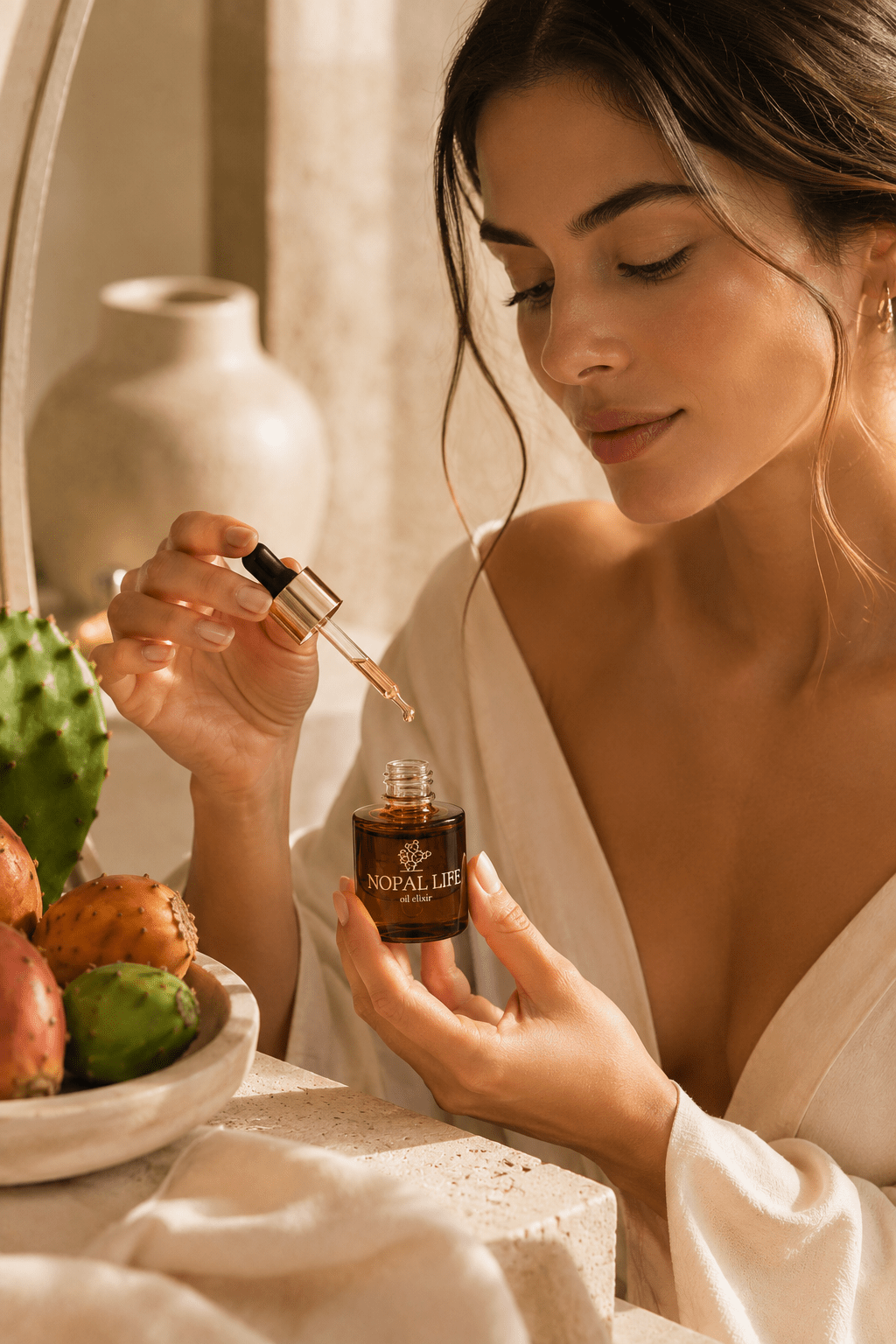
Prickly pear seed oil, a cornerstone of the Nopal Life range, belongs to the latter two families: fluid on application, yet it leaves a semi-occlusive film. The rule is without exception: hydrate first, then nourish. Applying a fatty substance to perfectly dry skin is like sealing... nothing.
Nopal Life Method
The 60-second pinch test
Lack of water, lack of lipids, or both? Here's the observation guide we use at Nopal Life, reproducible at home in the morning, before any treatment.
- On a bare, clean face for 20 minutes, pinch your cheekbone between your thumb and forefinger, hold for 3 seconds, then release.
- Time how long it takes for the fold to disappear. Less than 2 seconds: satisfactory retention. 2 to 5 seconds: lack of water, prioritize humectants. More than 5 seconds: the skin barrier is also an issue; combine water and lipids.
- Run the back of your index finger over your cheek: if it feels "sticky," there's a lack of lipids, regardless of the previous answer.
- Repeat the test on D1, D30, and D90, at the same time and in the same room. It's the comparison that provides information, not the absolute value.
Layering: building the barrier effect
Layering involves applying textures in increasing order of thickness, with each layer preparing the next. The detail that causes most routines to fail is applying layers too quickly: allow 60 seconds between each layer and occupy yourself elsewhere during this time. Our Fragrance-Free Soothing Moisturizer is applied as layer 2, Nopal Life prickly pear seed oil as layer 3, pressed rather than rubbed.
| Layer | Texture | Reference quantity | Wait time | Role |
|---|---|---|---|---|
| 1 · Water-based serum | Fluid | 3 to 4 drops | 60 seconds | Provides water |
| 2 · Moisturizing cream | Emulsion | A pea-sized amount | 60 seconds | Fixes and completes |
| 3 · Vegetable oil | Oily | 1 to 2 drops in the morning, 3 to 5 in the evening | 2 minutes | Seals the whole |
| 4 · Sunscreen (morning) | Cream or fluid | 1/4 teaspoon, face + neck | 10 to 15 min before going out | Protects from UV |
The Soothing & Barrier Routine
It addresses a specific need: to help preserve the integrity of the skin barrier while providing comfort to skin that has become reactive. At bedtime, the oil applied as the last layer serves as a vehicle for a 5-minute massage—upward movements from chin to temples, light pressure under the arches, gentle pinching on areas of sagging. This is, incidentally, the only step that no one gives up after three weeks.
In the morning: build protection
- Minimal cleansing. On a face that has spent the night on a clean pillow, a rinse with lukewarm water is often sufficient. If you prefer a cleansing product, choose one without harsh sulfates: the skin should never feel tight afterward. This tightness is a warning sign, not proof of cleanliness.
- Soothing lotion. Floral water, thermal water, or aloe vera: it immediately rehydrates and prepares the next layer.
- Antioxidant serum. This is the time for vitamin C, which helps protect against external aggressions and revive the complexion's radiance.
- Fragrance-Free Soothing Moisturizer, the central product of the routine, with no fragrance allergens.
- Prickly pear seed oil, one to two drops, gently pressed onto dry areas.
- Sunscreen SPF 30 minimum, in a generous and even layer: face, neck, décolletage, and back of hands.
In the evening: nourish and restore comfort
- Double cleansing on makeup or sunscreen days: a cleansing oil first, then a gentle cleanser. Water-resistant sun formulas are not properly removed with just a gel.
- Soothing lotion, as in the morning.
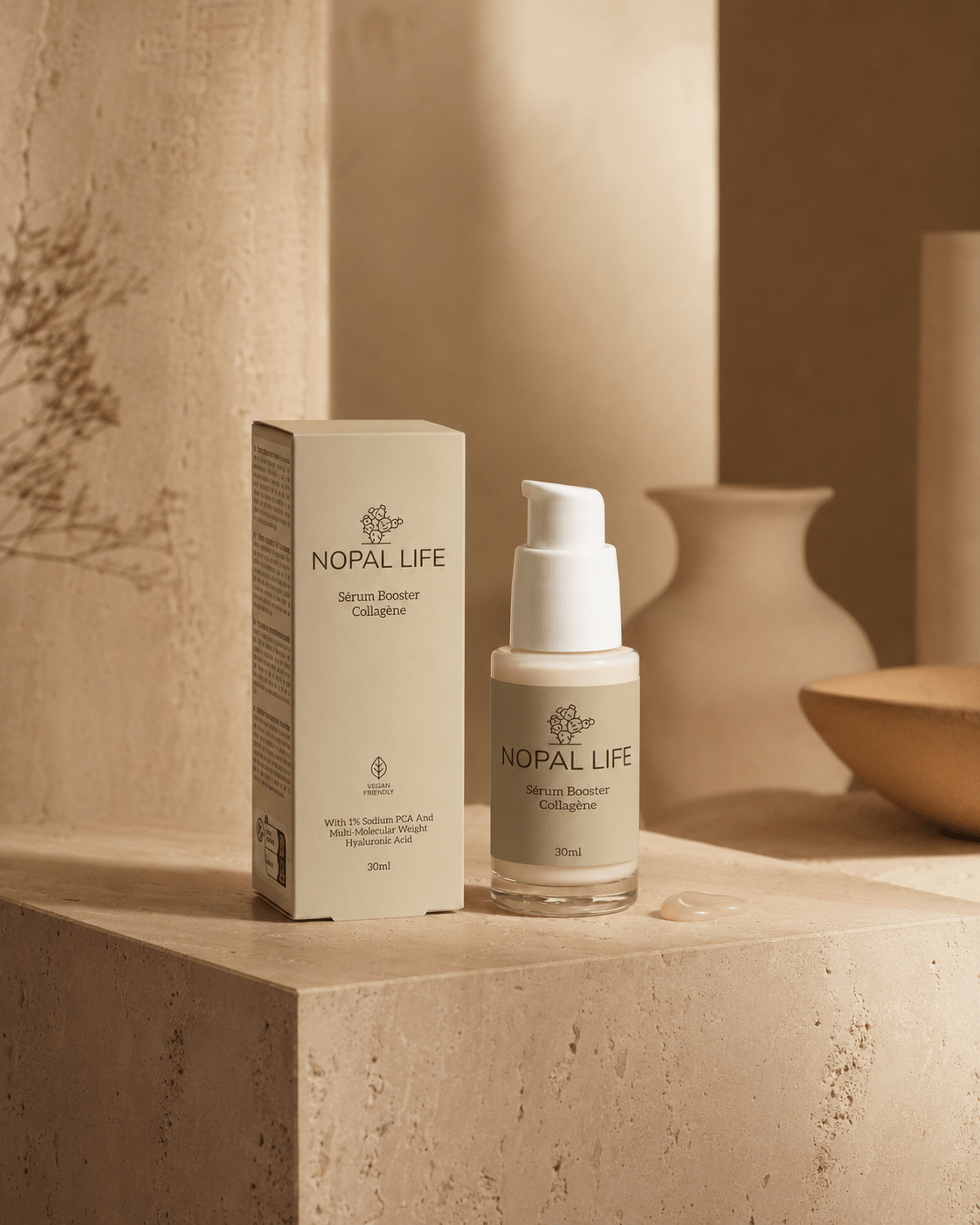
- Targeted serum depending on the day of the week: retinol, peptides, or hyaluronic acid alone on rest nights.
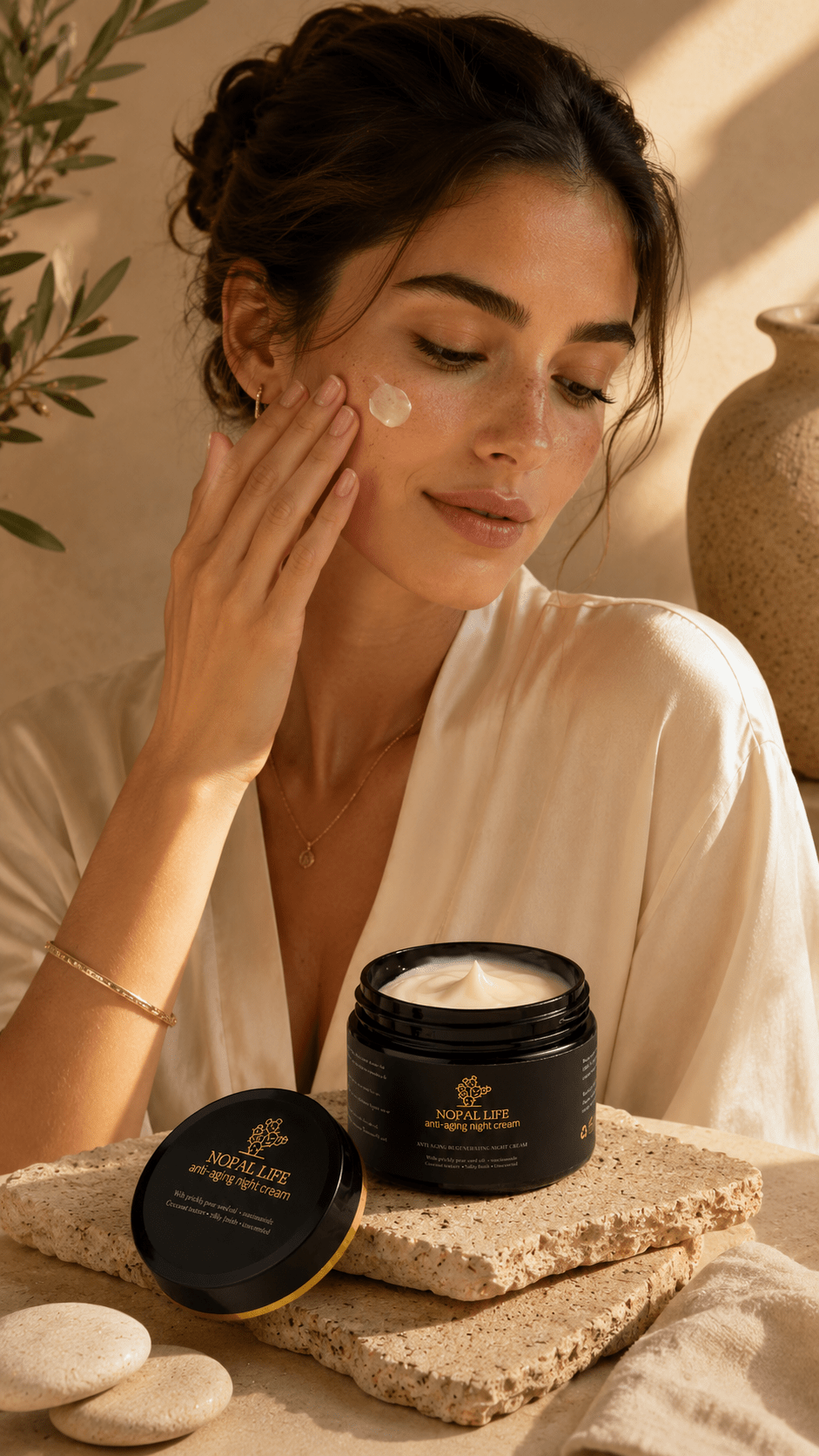
- Fragrance-Free Soothing Moisturizer, in a slightly more generous layer than in the morning.
- Prickly pear seed oil, three to five drops, as the last step, to help seal the barrier overnight.
- 5-minute massage with the oil from the previous step, without adding more.
| Step | Morning | Evening | Duration |
|---|---|---|---|
| Cleansing | Lukewarm water or very gentle gel | Double cleanse if wearing makeup or sunscreen | 30 s / 2 min |
| Soothing lotion | Yes | Yes | 15 s |
| Serum | Vitamin C | Retinol, peptides or hyaluronic acid | 30 s + 60 s wait |
| Fragrance-free moisturizer | Thin layer | Generous layer | 30 s + 60 s wait |
| Prickly pear seed oil | 1 to 2 drops, dry areas | 3 to 5 drops + massage | 30 s / 5 min |
| Sunscreen | SPF 30 minimum, every day | — | 45 s |
If you're unsure of your profile, the Nopal Life Skin Intelligence™ diagnostic determines your skin type and adjusts each step.
The Nopal 90-day protocol: three levels
Most routines fail because they change everything at once. Thin, reactive skin tolerates three new products simultaneously poorly: at the first stinging, you don't know which one is causing it, you stop everything, and conclude that "nothing works." This protocol introduces elements one by one, with a dated checkpoint.
- D1 to D14 — Restore comfort. Hydration and sun protection, nothing else. Zero exfoliation. Goal: no more tightness after cleansing. If this is not achieved by D14, extend for two weeks rather than moving on.
- D15 to D45 — Introduce one active ingredient, and only one. Two evenings a week first, never consecutive; three evenings from D22; every other evening from D32. Sandwich technique: cream, active, cream. The first noticeable benefit is skin radiance.
- D46 to D90 — Consolidate and extend. Second active on the opposite slot, gentle exfoliation once a week maximum, extension of the entire routine to the neck and décolletage. Final check: pinch test and photo, same light and time as on D1.
| Level | Days | What you add | Active frequency | Transition criteria |
|---|---|---|---|---|
| 1 · Comfort | D1 – D14 | Hydration + sun protection only | 0 / week | No more tightness |
| 2 · Introduction | D15 – D45 | A single active, in a sandwich | 2 evenings → 3 evenings → every other evening | No redness after 24 hours |
| 3 · Consolidation | D46 – D90 | Second active, exfoliation 1×/week, neck and décolletage | Every other evening per active, opposing slots | Photo and pinch test vs D1 |
Ninety days may seem like a long time, but it is a realistic timeframe, with visible effects on the appearance of fine lines being reported after 8 to 12 weeks of regular use. Any quicker promises relate to hydration and radiance – which are real, but of a different nature.
Active Ingredients and Their Usage Ranges
The table shows the usual ranges found in formulations: these are not personalized recommendations, but rather benchmarks for reading an INCI list. One point worth noting: since Regulation (EU) 2024/996, retinol is regulated at a maximum of 0.3% in leave-on facial products and 0.05% in body lotions. A European brand that claims more is outside the scope.
| INCI Name | Benefits | Typical Range | Time of Day | Visible Results | Avoid on the Same Evening |
|---|---|---|---|---|---|
| Retinol | Helps reduce the appearance of wrinkles and smooth the skin surface | 0.1 – 0.3% (EU cap) | Evening | 8 to 12 weeks | AHA/BHA, pure ascorbic acid |
| Ascorbic Acid (Vitamin C) | Antioxidant, brightens skin, evens out skin tone | 5 – 20% | Morning | 4 to 8 weeks | Retinol |
| Niacinamide | Refines skin texture, helps maintain barrier comfort | 2 – 5% | Morning or evening | 4 to 8 weeks | Almost all compatible |
| Sodium Hyaluronate | Binds water, smooths surface | 0.1 – 2% | On damp skin | Immediate to 2 weeks | No incompatibilities |
| Glycerin | Benchmark humectant, immediate comfort | 3 – 10% | Morning and evening | Immediate | None |
| Panthenol | Soothes discomfort, improves suppleness | 1 – 5% | Morning and evening | 1 to 2 weeks | None |
| Palmitoyl Tripeptide-1 (peptides) | Helps maintain a firm and plump appearance | 1 – 5% of solution | Evening | 8 to 12 weeks | Low pH acids |
| Squalane | Very well-tolerated emollient, silky feel | 2 – 15% | Morning and evening | Immediate | None |
| Tocopherol (Vitamin E) | Antioxidant, helps protect against external aggressions | 0.2 – 1% | Morning and evening | Not measurable alone | None |
| Opuntia Ficus-Indica Seed Oil | Emollient rich in linoleic acid and tocopherols, seals in moisture | Pure, 3 to 5 drops | Evening mainly | Suppleness in 3 weeks | Apply after, never before, aqueous products |
Three combinations to avoid. Retinol and exfoliating acids on the same evening: two cumulative renewal mechanisms can lead to peeling – alternate them. High-dose ascorbic acid and niacinamide: well tolerated by many, but can cause transient redness on reactive skin; the simplest approach is to use one in the morning and the other in the evening. Finally, introducing three new products in one week is not a chemical incompatibility but a methodological one; you'll never know what worked.
Hyaluronic Acid: One Molecule, Multiple Sizes
| Type | Common Name | Where it Acts | Perceived Effect |
|---|---|---|---|
| High molecular weight | Sodium Hyaluronate | Stays on the surface | Smoothing film, light and immediate tightening effect |
| Low molecular weight | Hydrolyzed Hyaluronic Acid | Upper layers | Longer-lasting comfort, plumped appearance |
| Cross-linked form | Sodium Hyaluronate Crosspolymer | Surface, prolonged release | Benefits spread throughout the day |
The trap. A humectant attracts water—and if the ambient air is very dry, it can draw water from where it is available, i.e., the superficial layers of the skin. This explains the feeling of tightness after applying a serum to dry skin, in winter, in a heated room. Two simple rules are enough: apply to damp skin, and always seal it with another product.
For mature skin, effective anti-aging skincare falls into three categories: those that retain water, those that provide lipids, and those that support cellular renewal. The rest pertains to user comfort.
Collagen applied to the surface does not penetrate the dermis—its molecule is too large. What is observed is due to its film-forming effect, which is real but superficial. Elasticity, however, is primarily maintained through protection: signs of aging appear faster on unprotected skin exposed to the sun than on protected skin.
Adopting a sustainable routine is more important than the length of the product list. Caring for mature skin means repeating a few steps consistently over time.
Daily Sun Protection: The True Foundation of Anti-Aging Prevention
If there was only one step to remember, this would be it. In 2013, Flament and his team compared the visible clinical signs of facial aging based on cumulative sun exposure in Clinical, Cosmetic and Investigational Dermatology: at the same age, exposure appears to be the most significant external factor associated with wrinkles, loss of firmness, and uneven skin tone.
- SPF 30 minimum daily, 50+ when exposed, at high altitudes, by the sea, or after introducing retinol.
- The circled UVA logo is more important than the stated SPF: European recommendation 2006/647/CE stipulates that a product bearing this logo must provide UVA protection of at least one-third of the SPF. An SPF 50 without this logo protects against sunburn, but not necessarily against photoaging.
- Quantity takes precedence over SPF. The SPF value is measured at 2 mg/cm², which is approximately a quarter teaspoon (nearly 1.2 g) for the face and neck. Applied at half the recommended dose, an SPF 50 will not provide the advertised protection. This is the most common mistake.
- Reapply every 2 hours during prolonged exposure, after swimming or toweling off. Indoors, one morning application is usually sufficient.
- The back of the hands receives a lot of UV rays while driving and almost always receives less care.
| Profile | Preferred Texture | Daily SPF | Caution Point |
|---|---|---|---|
| Mature and dry | Rich, moisturizing base | SPF 30 to 50 | Avoid alcohol-based fluids |
| Mature and reactive | Mineral filters, fragrance-free | SPF 50+ | White cast: choose a tinted option |
| Mature and combination | Fluid or gel-cream | SPF 30 to 50 | Do not skip the moisturizer underneath |
| Mature with spots | Tinted, broad-spectrum | SPF 50+ all year round | Pigment adds a barrier against visible light |
Neck and Decolletage: The Areas Routines Forget
These two areas age as quickly as the face, sometimes even faster: thinner epidermis, fewer sebaceous glands, constant mechanical stress — and twenty years of creams that stop abruptly at the jawline. Four points suffice: the same products, just a little more quantity; upward motion, from the base of the neck towards the chin and from the sternum towards the shoulders; included sun protection, as a V-neckline receives sun exposure all year round; more cautious active ingredients, retinol used every other time compared to the face.
Prickly Pear Seed Oil: What Its Composition Says
The only objective criterion for a vegetable oil is its fatty acid profile. In 2003, Ramadan and Mörsel published in Food Chemistry a characterization of Opuntia ficus-indica seed oil that remains a reference: predominantly composed of linoleic acid, accompanied by oleic and palmitic acids, with a high content of tocopherols and plant sterols.
| Constituent | Order of Magnitude | Cosmetic Benefit |
|---|---|---|
| Linoleic acid (omega-6) | Major, approximately 60 to 70% | Affinity with surface lipids, non-greasy feel |
| Oleic acid (omega-9) | Secondary | Suppleness, melting texture upon application |
| Tocopherols | High for this type of pressing | Antioxidant, oil stability |
| Plant sterols | Present | Comfort, helps protect against external aggressions |
This profile explains its behavior: rapid penetration, absence of a greasy film, hence its usefulness as the last step of the day for skin that rejects heavy textures. However, it needs to be stored away from light and heat, in its closed amber bottle — far from the bathroom window. A point of honesty: no matter how well-composed it is, an oil does not hydrate, due to lack of water. It nourishes, softens, and seals. Its entire value depends on what has been applied underneath.
Adapt According to Profile and Season
| Profile | Morning Serum | Cream | Evening Oil | Exfoliation |
|---|---|---|---|---|
| Mature and dry | Hyaluronate + gentle Vitamin C | Rich, morning and evening | 5 drops | 1×/week, enzymatic |
| Mature and combination | Niacinamide | Light in the morning, rich in the evening | 2 to 3 drops | 1 to 2×/week |
| Mature and reactive | Panthenol, fragrance-free | Fragrance-free, morning and evening | 3 drops | Every 10 days maximum |
| Mature with imperfections | Niacinamide + hyaluronate | Gel-cream | 2 drops, dry areas | 1×/week, BHA |
| Season | Dominant constraint | Adjustment | Index |
|---|---|---|---|
| Winter | Cold outside, dry heating inside | More generous use of fatty substances, humidifier in the bedroom | SPF 30 |
| Spring | Return of sunshine | Gradually reintroduce active ingredients that were paused | SPF 30 to 50 |
| Summer | High UV, perspiration, air conditioning | Lighten textures, never remove moisturizer | SPF 50+, renewed every 2 hours |
| Autumn | Marks left by summer | Ideal window to start the 90-day protocol | SPF 30 |
One last lever, outside the bathroom: maintaining the bedroom between 40 and 60% relative humidity significantly reduces nocturnal water loss. This is probably the best effort-to-benefit ratio on this page.
Seven mistakes that sabotage your routine
- Over-exfoliating. Daily exfoliation weakens the skin barrier and perpetuates discomfort instead of resolving it. Once or twice a week is enough.
- Forgetting the neck and décolletage. See above: same gestures, no exceptions.
- Using formulas designed for oily and young skin. They are often very mattifying, underdosed in lipids and comfort agents.
- Changing routines every month. Giving up in the sixth week means experiencing discomfort without ever reaping the benefits.
- Underdosing sunscreen. A pea-sized amount for the entire face is half the recommended amount.
- Applying oil to dry skin. It contains no water; alone, it nourishes without moisturizing.
- Judging yourself in the mirror every morning. A photo every 30 days, with the same device and same light, is the only reliable way to track progress without special equipment.
Frequently Asked Questions
How often should I apply an anti-aging moisturizer?
Twice a day: in the morning under sunscreen, in the evening after serum. Consistency is far more important than quantity.
Can my cream replace serum?
No. One provides comfort and barrier support in an emollient base; the other concentrates active ingredients on a specific concern — appearance of wrinkles, radiance, firmness. They are complementary, not interchangeable.
How long does it take to see results?
Hydration and radiance improve in 2 to 3 weeks. Noticeable changes in the appearance of firmness and fine lines take 8 to 12 weeks, which is exactly the duration of the three-stage protocol.
Does micellar water moisturize?
No, it's a makeup remover. It cleanses, provides no hydration, and can leave a feeling of discomfort if not rinsed off.
Dehydrated or dry: what's the difference?
Dry is a skin type, linked to a chronic lack of lipids. Dehydrated is a temporary condition, linked to a lack of water, affecting all skin types — including oily. After 50, both often coexist.
Can retinol and hyaluronate be combined?
Yes, and it's even a good combination: hyaluronate on damp skin, then retinol, then cream on top. This layering improves tolerance without reducing the active ingredient's benefits.
How much sunscreen for the face?
Approximately a quarter teaspoon, or about 1.2 g for the face and neck, which corresponds to the 2 mg/cm² dose used to measure the displayed SPF.
Is an oil sufficient as a sole treatment?
No. It seals but does not provide water. It makes full sense as the last layer, 3 to 5 drops, after a water-based product.
Why Nopal Life
Our prickly pear seed oil is cold-pressed. Combined with the Fragrance-Free Soothing Moisturizer, it forms the backbone of the Soothing & Barrier routine: a simple, sustainable architecture designed for those who can no longer tolerate product accumulation.
Don't know where to start? The three-stage protocol answers the question itself: start at stage 1, and only advance once its passing criterion is met — no more tightness after cleansing. The rest follows.
RECOMMENDED TREATMENT
Soothing & barrier routine
Fragrance-free moisturizer + prickly pear seed oil
DISCOVER THIS TREATMENT →Sources
- Ghadially R, Feingold KR, Elias PM et coll., Journal of Clinical Investigation, 1995;95(5):2281-2290 — epidermal barrier and age.
- Papakonstantinou E, Roth M, Karakiulakis G., Dermato-Endocrinology, 2012;4(3):253-258 — hyaluronic acid and age.
- Flament F, Bazin R, Piot B et coll., Clinical, Cosmetic and Investigational Dermatology, 2013;6:221-232 — sun exposure and visible signs.
- Ramadan MF, Mörsel JT., Food Chemistry, 2003;82(3):339-345 — composition of prickly pear seed oil.
- Regulation (EU) 2024/996 amending Regulation (EC) No 1223/2009 — retinol regulation.
- Commission Recommendation 2006/647/EC — sun protection and UVA logo.
Information provided for cosmetic and educational purposes; it does not constitute medical advice and does not replace consultation with a healthcare professional.
Our anti-aging treatments