Dull facial skin: the 7-minute radiance routine
A dull complexion is rarely a superficial problem: light is poorly reflected by the stratum corneum and poorly bounced back by the deep volumes that structure the facial contours. This is why a dull skin does not regain its radiance with a simple scrub.
Three aspects are covered here: the anatomy of fat compartments (SOOF, ROOF, Bichat's fat pad), a timed micro-massage protocol, and a comparative analysis of radiance-boosting active ingredients — including prickly pear seed oil.
Key takeaways
- Five causes, five actions: the introductory table associates each visible sign with the appropriate action and its timeframe.
- Three compartments govern the light and shadow of the face: SOOF (under the eye), ROOF (under the eyebrow), Bichat's fat pad (cheek).
- The detailed micro-massage protocol described here lasts 7 minutes, in 5 timed sequences, after applying the moisturizing fluid.
- The comparison of the 7 active ingredients provides the usual concentration, application time, and duration: 10 to 15 days for glycolic acid, 2 to 3 months for the contour.
- The week-by-week calendar tells you what to introduce and when — this is where most routines fail.
What dulls a complexion: five mechanisms, not just one
What the eye perceives as natural radiance is how light is reflected: partly directly, partly diffused. When the skin's surface loses its regularity — stacked corneocytes, depleted hydrolipidic film — the rays scatter in disorder, and the complexion appears greyish. Added to this is the geometry of the face: if the volumes that support the cheekbone sag, what once caught the light no longer does.
| Cause | Visible sign in mirror | Corresponding action | Appearance timeframe |
|---|---|---|---|
| Accumulated dead cells | Uneven texture, makeup clinging, uniform grey appearance | Exfoliation with glycolic acid, 1 to 2 times a week | 10 to 15 days |
| Dehydration of the stratum corneum | Tightness, dehydration lines, flat texture | Hyaluronic acid on damp skin, morning and evening | 3 to 7 days |
| Compromised skin barrier | Diffuse redness, reactivity to products, discomfort after cleansing | Fatty substances rich in linoleic acid, pause exfoliants | Approximately one month |
| Uneven pigmentation | Uneven complexion, pronounced spots on cheekbones and forehead | Vitamin C in the morning + daily SPF 30 sun protection | 8 to 12 weeks |
| Redistributed deep volumes | Shadows under the eyes, lower cheekbones, blurred jawline | Targeted daily micro-massage (protocol below) | 8 to 12 weeks |
Cellular renewal, the complexion's clock
Cells produced deep within migrate to the surface, flatten, then detach. This cellular renewal cycle lasts approximately four weeks in a young adult and lengthens with decades. Exfoliation does not accelerate biology: it helps detach what no longer sheds on its own.
The skin barrier, a prerequisite
The skin barrier combines corneocytes and lipid cement — ceramides, cholesterol, free fatty acids. It retains water and helps protect the skin from external aggressions. When depleted, it allows water to escape and the skin's texture becomes disorganized: hence the paradox of combination skin types, shiny on the forehead and greyish on the cheeks. Taking care of the skin barrier is the prerequisite, never the final step.
Anatomy of fat compartments: SOOF, ROOF and Bichat's fat pad
The face is not a homogeneous mass of fat: it is organized into distinct compartments, separated by fibrous partitions called septa. Three of these determine the contour and how the facial features capture light.
The SOOF (Sub-Orbicularis Oculi Fat) is a fat pad located under the orbicularis oculi muscle. It supports the cheekbone; its evolution contributes to the deepening of dark circles and determines whether the area under the eye reflects light or absorbs it into a bluish shadow.
The ROOF (Retro-Orbicularis Oculi Fat) is located behind the same muscle, at the eyebrow level, and maintains the projection of the forehead. Its evolution flattens the eye frame: the gaze appears hollowed, the overall impression more tired.
Bichat's fat pad (buccal fat pad) is the most voluminous. Its volume slightly increases at the beginning of aging before descending due to gravity: hence the rounded lower cheek that blurs the mandibular line.
Redistribution begins around age 35 in the medial region and extends to the periphery after age 45: light no longer settles where it did at age 25.
| Compartment | Location | Optical effect when it descends | Decade of shift | Protocol step |
|---|---|---|---|---|
| ROOF | Behind the orbicularis muscle, under the eyebrow | Less prominent arch, tired-looking eyes | From 35-40 years old | Sequence 2 — 1 min 30 |
| SOOF | Under the orbicularis muscle, suborbital region | Hollowed shadow under the eye, cheekbone losing height | From 35 years old (medial compartments) | Sequence 3 — 2 min |
| Bichat's fat pad | Buccal fat pad, the most voluminous | Rounded lower cheek, blurred jawline | After 45 years old (lateral compartments) | Sequence 4 — 2 min |
Compartment mobility and firm appearance
These volumes do not age passively: their mobility depends on the collagen that makes up the septa. When this changes — around age 25 — the partitions lose flexibility and the contour changes. The action remains useful at any age: calibrated, repeated pressure supports tissue comfort and helps preserve their firm and plump appearance, while refining the skin texture through the smoothing it produces.
The micro-massage protocol in 5 sequences, 7 minutes
Morning or evening, on clean skin, after moisturizing fluid. Regularity takes precedence over intensity.
Sequence 1 — Activation (1 min). Palms flat, heat generated: about ten static presses for 3 seconds on the forehead, cheeks, and chin. Presses, never frictions.
Sequence 2 — ROOF (1 min 30). Using the pulp of the index and middle fingers, small clockwise rotations at the eyebrow level, moving up towards the forehead: 15 rotations per side, then three strokes towards the temple. Moderate pressure.
Sequence 3 — SOOF (2 min). Gently pinch the cheekbone between thumb and index finger, pull upwards and outwards, hold for 5 seconds, release. Eight times on each side. The most visually rewarding sequence.
Sequence 4 — Mandibular (2 min). Hands flat under the chin, firmly move upwards along the jawline towards the ears: 12 passes per side, sustained pressure on the bony path.
Sequence 5 — Drainage (30 s). Light and rhythmic presses in the pre-auricular area, descending submaxillary, then three supraclavicular presses.
| Sequence | Duration | Repetitions | Pressure | Area |
|---|---|---|---|---|
| 1. Activation | 1 min | 10 presses of 3 s | Light | Entire face |
| 2. ROOF | 1 min 30 | 15 rotations / side | Moderate | Eyebrow, lower forehead |
| 3. SOOF | 2 min | 8 pinches of 5 s / side | Gentle then progressive | Cheekbone, suborbital |
| 4. Mandibular | 2 min | 12 passes / side | Sustained | Chin towards ears |
| 5. Drainage | 30 s | 3 supraclavicular presses | Very light | Pre-auricular, neck |
Compared active ingredients: what each really does
Many routines stack redundant ingredients and forget others that nothing can replace.
| Active ingredient | Family | Usual concentration | Time | What is observed | Combination skin profile |
|---|---|---|---|---|---|
| Glycolic acid | AHA, 76 g/mol | 4% max in face leave-on (EU), pH ≥ 3.5 | Evening, 1 to 2 times / week | Smoother texture, brighter appearance in 10-15 days | Good, T-zone first |
| Lactic | AHA, 90 g/mol | 5 to 10% | Evening, 1 time / week | Softer smoothing, fewer tingling sensations | Very good, including dry cheeks |
| Mandelic | AHA, 152 g/mol | 5 to 10% | Evening, 1 to 2 times / week | Slow penetration, high tolerance, more uniform appearance | Excellent, reactive profiles |
| Hyaluronic acid | Humectant | 0.1 to 2% depending on molecular weight | Morning and evening, on damp skin | Immediate plumping effect, reduced fine lines in 3-7 days | Excellent, non-greasy texture |
| Vitamin C | Antioxidant | 5 to 15% in opaque bottle | Morning, before sunscreen | Even skin tone, reduced appearance of dark spots in 2 to 3 months | Good, prefer stabilized derivatives |
| Niacinamide (B3) | Water-soluble vitamin | 2 to 5% | Morning or evening | Refined pore appearance, reduced T-zone shine | Ideal |
| Prickly pear | Vegetable oil, rich in linoleic acid | 2 to 3 pure drops, or integrated into a formula | Evening, or before micro-massage | Comfort, suppleness, preserved firm appearance | Good, non-comedogenic |
Glycolic acid, the smallest AHA
With 76 g/mol compared to 90 for lactic and 152 for mandelic, it penetrates the stratum corneum more easily and acts faster. In Europe, its use is regulated: maximum 4% in leave-on facial products for the general public, pH of at least 3.5. At these doses, exfoliation remains gentle and cumulative. In practice: one evening per week, T-zone only for two weeks, then extend to the cheeks.
Key points about hyaluronic acid: this humectant captures water and retains it on the surface, but it must be applied to damp skin and then sealed with a fatty substance — otherwise the effect reverses.
Prickly pear oil: the lipid pillar
Extracted from Opuntia ficus-indica seeds, it is dominated by linoleic acid — around 60 to 65% according to analyses published in food science — and rich in tocopherols, the natural form of vitamin E. This fatty substance is a major component of corneal ceramides: hence its affinity with the skin film and its dry, non-occlusive texture. It is also the only item on the list that is both a treatment and a tool.
Where Collagen Rebound comes in
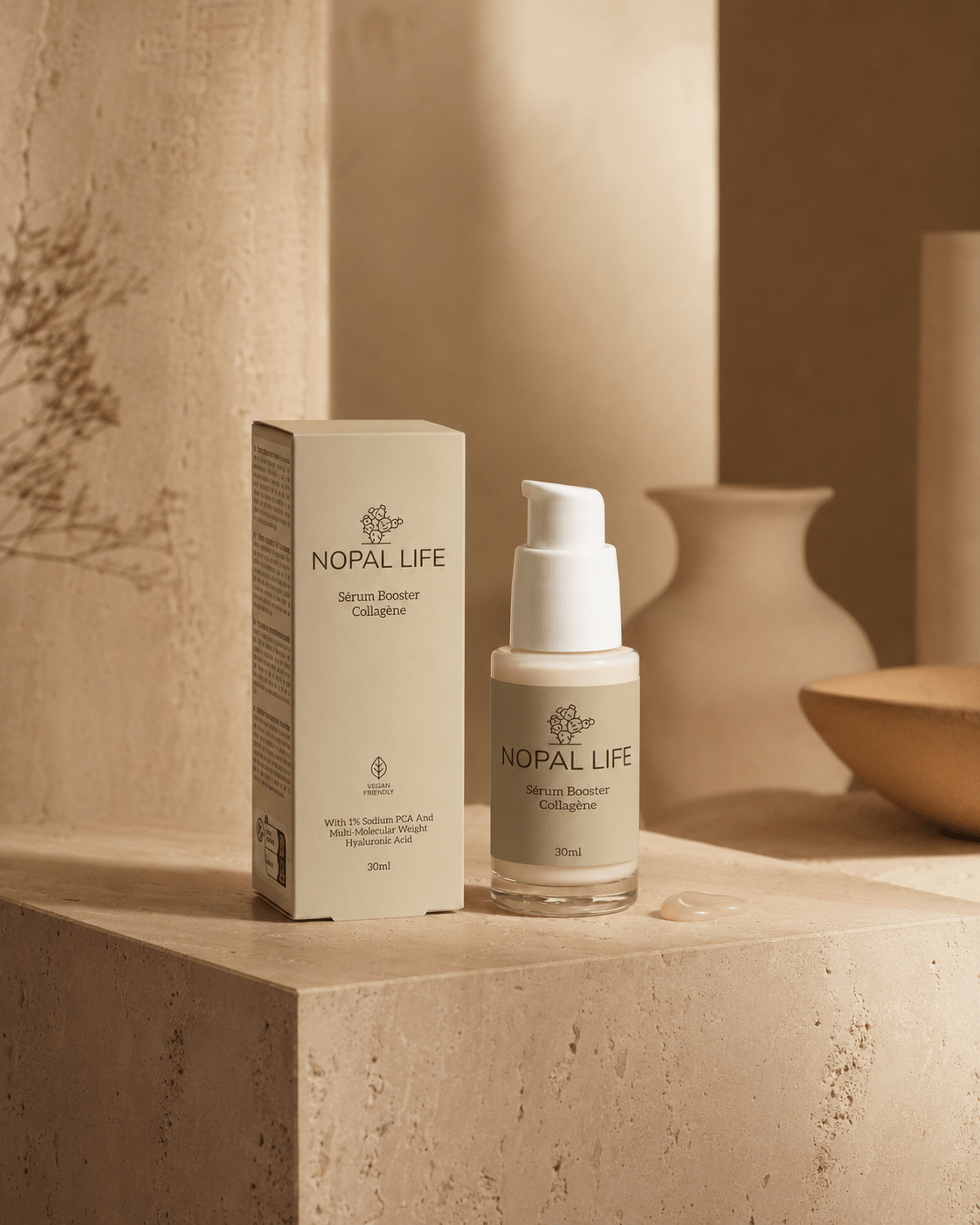
The Collagen Hydration Rebound Skin Serum has been formulated to prepare tissues for mechanical manipulation: without a gliding support, micro-massage turns into friction. Its formula places Opuntia ficus-indica seed oil as a central ingredient, valued for its tocopherol content and nourishing properties.
Its non-comedogenic texture does not overload the T-zone while nourishing the cheeks. Count 3 to 4 drops before each session, warmed between the palms — this is the quantity that allows for the full seven minutes without reapplying mid-session.
The only question left is which version of the protocol corresponds to your skin type: this is the subject of the adaptation grid at the end of the guide.
A tailored skincare routine, morning and evening
An effective skincare routine consists of a few steps, in a precise order: from the lightest to the richest.
| Step | Morning | Evening | Quantity |
|---|---|---|---|
| 1. Cleansing | Warm water only or very gentle gel | Double cleanse: oil then gentle gel | A pea-sized amount |
| 2. Targeted active | Vitamin C | AHA 1-2 evenings, niacinamide the others | 3 to 4 drops |
| 3. Hydration | Hyaluronic on damp skin | Collagen Rebound Serum | 3 to 4 drops |
| 4. Micro-massage | Optional, short version 3 min | Full protocol 7 min | — |
| 5. Fatty substance | Light cream | Night cream for radiance and firmness, or 2-3 drops of oil | 1 pea / 2 to 3 drops |
| 6. SPF | SPF 30 to 50, every day | — | 2 finger-lengths of product |
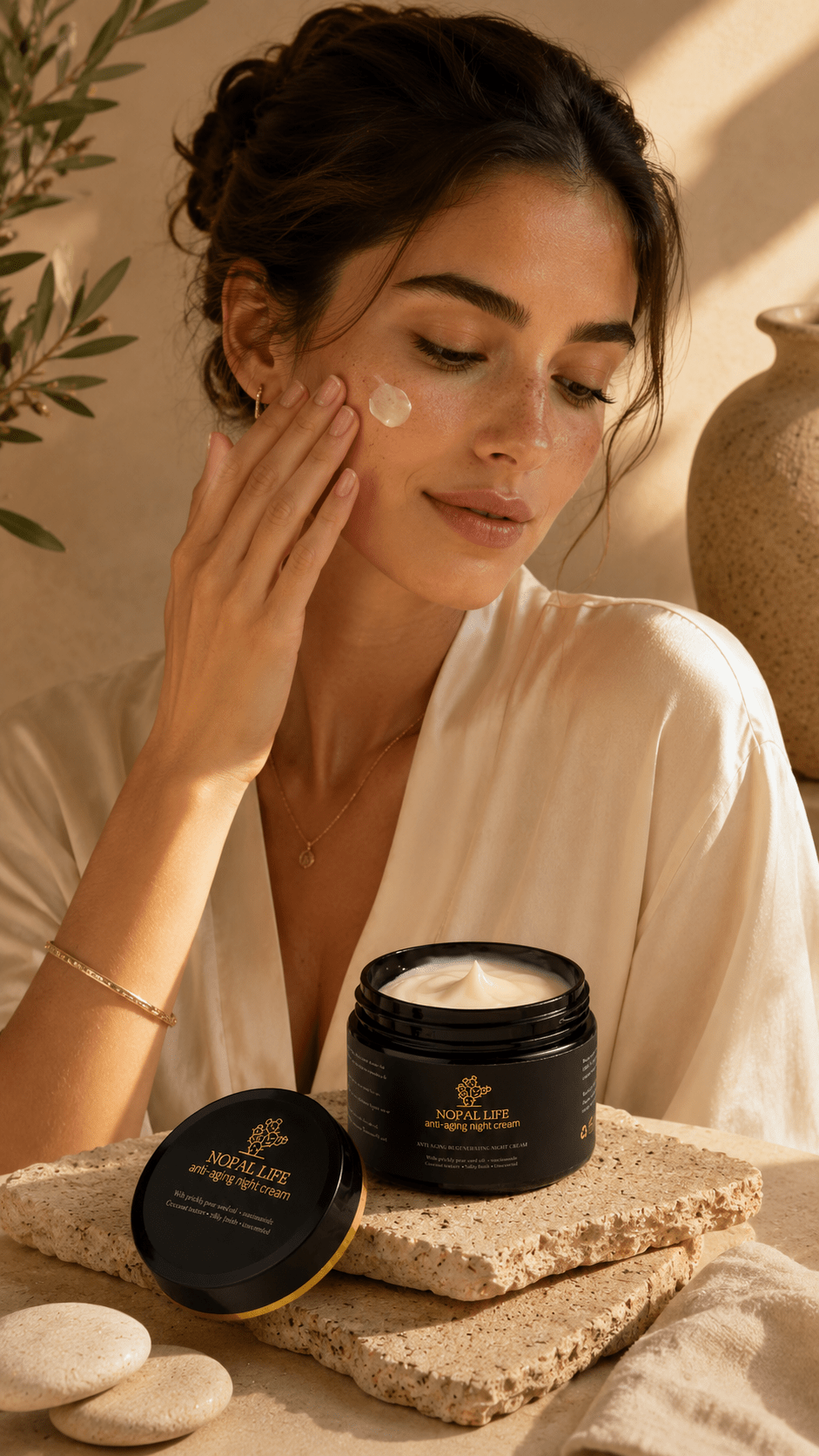
The night cream works on occlusion: no UV or makeup, but higher water loss than during the day. For combination skin, adjust quantities according to zones.
What about masks? A weekly clay or gentle acid mask complements this framework; it does not replace any of its steps. Two details weigh more heavily: apply vitamin C to perfectly dry skin, and cleanse in the evening even on make-up-free days — fine particles linked to pollution also settle on clear days. This regularity maintains a radiant complexion over time, rather than a superficial "glow" effect that fades in a few hours.
Sun protection, a non-negotiable condition
Ultraviolet rays remain the primary external factor for loss of uniformity and the appearance of dark spots. An SPF 30 filters approximately 96.7% of UVB, an SPF 50 approximately 98%: the transmitted fraction decreases from 3.3% to 2%, i.e. one third less dose for the same applied quantity. However, three rules outweigh the choice of product.
- The quantity. Tests use 2 mg/cm², which is two finger-lengths of product for the face and neck; we usually apply two to three times less.
- The regularity. Every day, even on cloudy days: UVA penetrates clouds and windows.
- Reapplication. Every two hours during prolonged exposure.
With AHAs, it's not an option: they increase sun sensitivity, and exfoliating without protection leads to a more uneven result than before.
Lifestyle: levers outside the bathroom
Adopting a consistent lifestyle weighs as much as the contents of the bathroom shelf — and can also be measured with numerical benchmarks.
| Lever | Numerical Benchmark | Observable Effect |
|---|---|---|
| Total fluid intake | 2.0 L/day (women), 2.5 L/day (men), including beverages and food — EFSA reference values | Increased comfort, facial volumes appear less hollowed |
| Sleep | 7 to 9 hours per night for adults | Less noticeable dark circles, eyes appear more rested |
| Smoking | Complete cessation; no beneficial threshold | Greyish complexion is one of the visible markers of chronic smoking |
| Diet | 5 portions of fruits and vegetables per day | Contributes to overall appearance of vitality |
These beauty tips are not decorative: they are the only levers that address all five causes in the opening table simultaneously, whereas each product targets only one.
The eight-week calendar
Introducing everything at once guarantees discomfort without knowing which product is to blame.
| Week | What to introduce | What to observe |
|---|---|---|
| W1 | Gentle cleansing + hyaluronic morning and evening + SPF. Nothing else. | End of tightness, less visible dehydration lines |
| W2 | Evening fatty substance: 2 to 3 drops of oil or rich balm | More comfortable awakening, smoother skin to the touch |
| W3 | First exfoliation, 1 evening, T-zone only | Mild tingling acceptable for the first 2 minutes; otherwise, reduce |
| W4 | Extended exfoliation if W3 went well + 3 min micro-massage in the evening | First clear gain: cheekbones catch light better |
| W5 | Introduction of vitamin C in the morning, before SPF | Nothing visible yet: it works over 2 to 3 months |
| W6 | Micro-massage extended to 7 min, full protocol | Perceived tonicity after session, brighter awakening |
| W7 | Increase to 2 weekly exfoliations if tolerance allows | Visibly more even skin texture, make-up lasts longer |
| W8 | Control photos, same conditions as W1 | Objective comparison: contour, clarity, uniformity |
Overarching rule: never two new things at the same time. In case of discomfort, remove the last one and try again later at a reduced frequency.
Measuring your results: the three-light method
"Does it work?" cannot be decided by guesswork: the eye gets used to it, and bathroom lighting distorts everything. The method below, used internally at Nopal Life, only requires a phone.
- Light 1 — facing a window, in the morning. No makeup, no products for two hours. Reveals general luminosity and uniformity.
- Light 2 — three-quarters, side source. Head at 45°, light source from one side only: the only position that makes shadows legible.
- Light 3 — overhead lighting. Under a ceiling light. The most unforgiving for surface texture.
Three shots in W1, three in W8, same time and same place. Rate from 1 to 5: intensity of shadow under the eye, regularity of skin texture, general homogeneity. A gain of one point on two indicators is a solid result.
Mistakes to avoid
Mistake 1 — Pulling downwards. Downward movements accompany the sagging of volumes: work with upward movements.
Mistake 2 — Massaging dry skin. Micro-friction weakens the superficial layer; a gliding medium is essential.
Mistake 3 — Pressing too hard under the eye. The SOOF is delicate: start with a feather-light touch, then increase according to comfort.
Mistake 4 — Exfoliating to compensate for hydration deficit. If it feels tight and makeup settles into fine lines, the problem is dehydration: excessive exfoliation weakens the skin's protective barrier and accentuates dullness.
Mistake 5 — Waiting for visible signs. Start as early as 28-30, when volumes are still well positioned, to sustainably maintain their apparent firmness.
Mistake 6 — Changing course too soon. Three of the five causes require two to three months to produce a signal; what is abandoned after three weeks has not been evaluated, only tried.
Adapt according to your skin type
| Profile | Exfoliation | Evening fatty substance | Micro-massage |
|---|---|---|---|
| Combination to shiny-prone | Gentle AHA, 2 evenings, T-zone prioritized | 2 drops of oil on cheeks only | Full protocol, 7 min |
| Dry and lacking radiance | Lactic, 1 evening | Night cream + 3 drops of oil as a seal | Full protocol, slower pressures |
| Sensitive and reactive | Mandelic, 1 evening maximum | Oil only, no added active ingredients | Sequences 1, 3 and 5 only, 4 min |
| Mature | Gentle AHA, 2 evenings | Collagen Bounce Serum + rich balm | Full protocol, morning and evening |
If in doubt — the line between dehydrated combination skin and dry skin is thin — the Skin Intelligence diagnosis will decide in two minutes.
Conclusion
Everything plays out on two levels: a surface that has lost its regularity, a deep architecture whose volumes have shifted. What makes the difference is not the number of bottles, but consistency: seven minutes a day, one introduction at a time, an honest evaluation after two months.
Frequently Asked Questions
Q: How long does it take to revive a dull complexion?
A: Depending on the cause: 3 to 7 days for dehydration, 10 to 15 days for skin texture, 2 to 3 months for uniformity and contour.
Q: At what age do fat compartments shift?
A: Redistribution begins around 35 years old in the medial compartments and extends to the lateral compartments after 45 years old. Genetics play a role, but also smoking, oxidative stress, and sleep.
Q: Does micro-massage really reposition these volumes?
A: No. It contributes to comfort and a toned appearance at the septa level, which helps maintain their look. The action is progressive and cumulative, noticeable after about two months of daily practice for 7 minutes.
Q: Can glycolic acid and hyaluronic acid be combined?
A: Yes. The humectant morning and evening, AHA one to two evenings a week — in this case, exfoliant first, complete drying, then moisturizer and emollient.
Q: Is collagen serum suitable for a combination skin type?
A: Yes: a fluid texture hydrates without occlusion, and the Opuntia ficus-indica seed oil it contains is non-comedogenic. Use 3 to 4 drops per application.
Q: Can prickly pear seed oil be used alone?
A: Yes, 2 to 3 drops are enough as a massage support, with primarily antioxidant and nourishing action.
Q: Is it compatible with retinol or AHAs?
A: Yes, with caution: wait 20 to 30 minutes after their application before massaging, on a completely dry surface. Never combine retinol and glycolic on the same evening.
Why choose Nopal Life
Nopal Life prickly pear seed oil, rich in omega-6 and omega-9, tocopherols, and plant sterols, contributes to the suppleness and comfort of the skin barrier and helps reduce the appearance of dehydration lines. It is also, in this guide, the gliding support for the protocol: the same bottle serves as both an evening treatment and a massage tool.
RECOMMENDED TREATMENT
Collagen Bounce Serum — radiance & firm appearance
Prickly pear seed oil · Non-comedogenic serum texture
DISCOVER THIS TREATMENT →PERSONALIZED ROUTINE
Start my free diagnosis
Nopal Life Skin Intelligence™ · 2 minutes
DISCOVER MY ROUTINE →Sources: EFSA Panel on Dietetic Products, Nutrition and Allergies, "Scientific Opinion on Dietary Reference Values for water", EFSA Journal, 2010, 8(3):1459 — Ramadan M. F. & Mörsel J.-T., "Oil cactus pear (Opuntia ficus-indica L.)", Food Chemistry, 2003, 82(3), p. 339-345 — Regulation (EC) No 1223/2009 on cosmetic products, Annex III, as amended in 2024 for glycolic acid (4% maximum and pH ≥ 3.5 in leave-on consumer face products).
This content is for informational and educational purposes only; it does not replace medical advice, diagnosis, or a dermatological consultation. If in doubt or for persistent skin problems, consult a qualified health professional.
Our anti-aging treatments