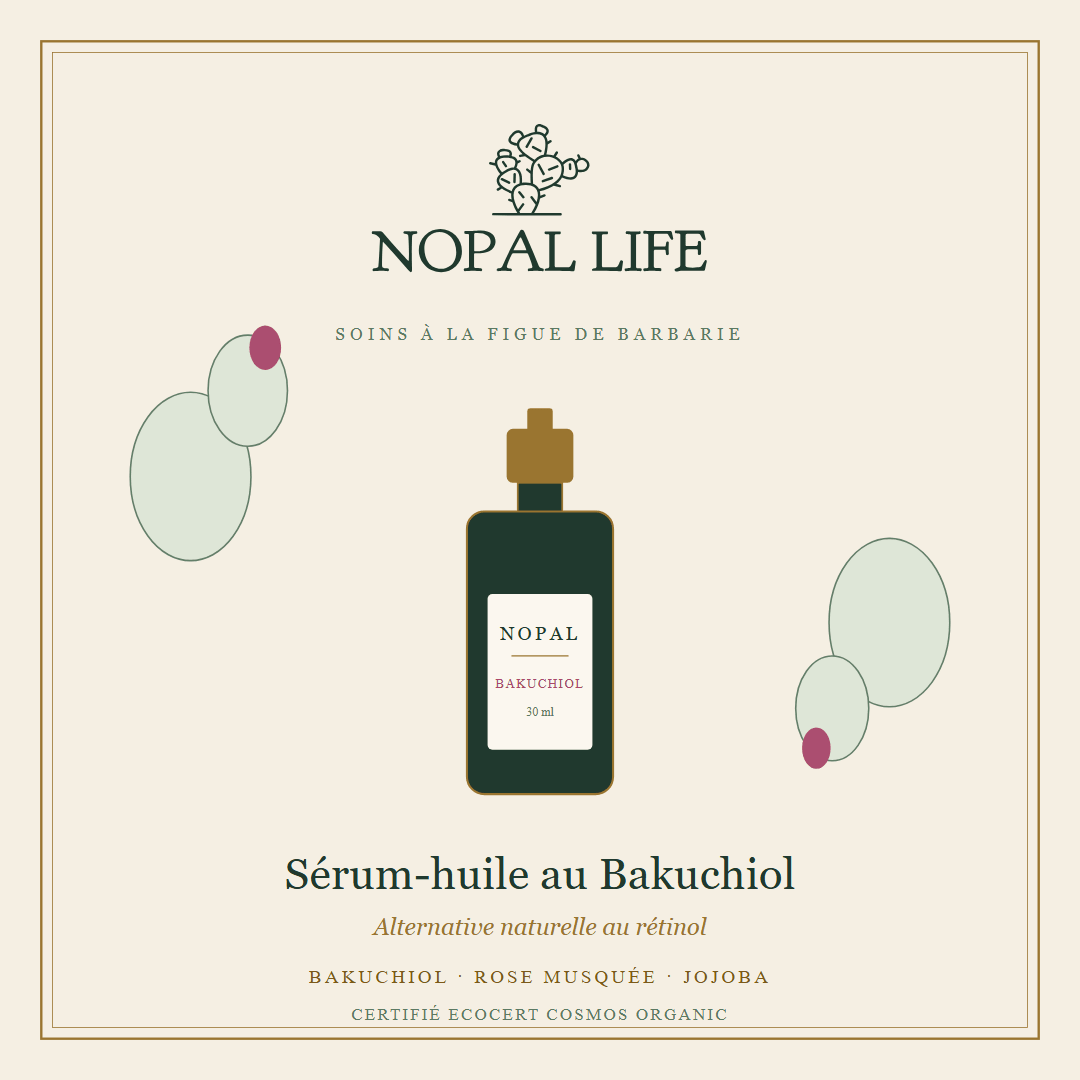
Bakuchiol storage: shelf life and signs of oxidation
Twelve months after opening, and often longer. Bakuchiol keeps better than retinol, for which it is presented as an alternative—which contradicts a persistent misconception: a naturally derived active ingredient would not be less stable than a synthetic molecule. On this specific point, it's the opposite.
The misconception: natural, therefore fragile
Many active ingredients of plant origin are indeed unstable. Oils rich in unsaturated fatty acids go rancid, plant extracts lose their color, and natural vitamin C oxidizes in a few weeks.
Bakuchiol is an exception to this rule. It is a phenolic meroterpene extracted from the seeds of Psoralea corylifolia, and its structure makes it significantly more stable than retinol.
It resists light, air, and temperature variations that retinol would not tolerate. This is even one of the arguments explaining its rapid adoption by formulators.
In other words: bakuchiol is a naturally derived active ingredient that behaves like a stable molecule. Its origin says nothing about its stability.
Compared to retinol, the difference is clear
A retinol serum degrades in light and loses part of its activity in a few months. That's why it is sold in opaque bottles, often airless, with strict storage recommendations.
A bakuchiol serum tolerates an ordinary tinted glass bottle and storage at room temperature. The product remains active until the end.
This difference has a practical consequence: you can buy bakuchiol in a classic format without fearing that it will expire before it's finished, which is not true for retinol.
For sensitive skin that uses products sparingly and slowly, this is a real advantage.
What can still damage it
First, the other ingredients in the formula. A serum that combines bakuchiol and vitamin C will keep as long as the vitamin C does: it's always the most fragile component that dictates the shelf life.
Next, the carrier oils. Many bakuchiol serums are formulated in an oil base, and if this vegetable oil goes rancid, the product becomes irritating even if the active ingredient is intact.
Strong and prolonged heat. Bakuchiol tolerates ordinary variations, but no cosmetic product survives several weeks in a car in summer.
Finally, contamination, as with any product where you dip your fingers.
Signs that it should be discarded
An off odor, which is the most common sign. It almost always comes from the carrier oil, not the active ingredient itself.
A marked change in color. Bakuchiol gives serums ranging from colorless to straw yellow depending on the extract; a frank browning indicates degradation.
A texture that becomes sticky or separates into phases. The formula has broken down.
These signs are rare for this type of product. In practice, a bottle of bakuchiol is usually finished before any issues arise.
Where to store it
A dry place, at a stable temperature, away from direct sunlight. These are standard conditions, with no additional requirements.
The bathroom is still not recommended, not for the active ingredient but for the other components: temperature variations and humidity tire out preservatives and oils.
The refrigerator offers no benefit. It does not extend an already comfortable shelf life and complicates application.
Note the opening date and follow the open jar symbol on the packaging, usually 12M.
What to check when buying
The INCI name is bakuchiol, sometimes accompanied by psoralea corylifolia seed extract. A crude extract of psoralea corylifolia without mention of bakuchiol is not the same thing: the plant also contains psoralens, which are photosensitizing.
Modern cosmetic extracts are purified of these. This is a point that deserves attention for products sold outside European circuits.
A concentration of 0.5 to 2% corresponds to what studies use. Beyond that, there is no indication of additional benefit.
A thirty-milliliter bottle used daily will be finished in two to three months—well before its expiration date.
Bakuchiol skincare products come in serums, creams, and sometimes face oils. Creams are better suited for dry skin, serums for combination skin.
Also check the other ingredients in the formula. A bakuchiol combined with ceramides or niacinamide is a good choice; combined with an exfoliating acid, it loses its main advantage, which is not to cause irritation.
It is recommended to start with one application per day, in the evening. Bakuchiol is well tolerated, but any new product deserves to be introduced alone.
What its stability does not change
Bakuchiol remains an active ingredient to be used in the evening, like retinol, even if it is not sensitive to light. This is not a matter of preservation but of routine: the skin renews itself more at night.
Nor does it eliminate the need for sun protection. Unlike retinol, it does not make the skin more sensitive to the sun, but an active ingredient for wrinkles without sunscreen is a wasted effort.
And its stability says nothing about its effectiveness. Bakuchiol is better tolerated than retinol, especially on sensitive skin; its effects are more modest and take more time.
A stable, gentle, and slow-acting active: this is a consistent profile, provided you know what you are buying.
Apply bakuchiol to the face after cleansing, on dry skin, before cream. It's the same routine as for retinol, without the adaptation period.
Its antioxidant activity, often highlighted, remains modest. This is not why it is used: its interest lies in its tolerance on sensitive skin.
Using a stable active ingredient does not mean you don't need to replace it. A bottle opened two years ago may contain intact bakuchiol, but its preservatives and carrier oil have aged.
The "Preserving Your Skincare" Series
Each ingredient degrades in its own way. These guides provide the actual duration and the sign that betrays it.
- Rosewater Preservation: Duration and Signs of Alteration
- Shea Butter Preservation: Duration and Signs of Alteration
- Ceramide Preservation: Duration and Signs of Alteration
- Panthenol Preservation: Duration and Signs of Alteration
- Retinol Preservation: Duration and Signs of Oxidation
- Jojoba Oil Preservation: Duration and Signs of Oxidation
Our anti-aging treatments