Collagen for skin: which type to choose and at what dose
Dry, mature skin combines two distinct realities: a lipid barrier that retains water less effectively, and a dermis whose supportive architecture thins with age. Collagen is central to the second. It is also the most used—and misused—word in the beauty aisle. This guide clarifies hydrolysates, daltons, and label promises, with verifiable figures, a comparison of sources, and a truly applicable twelve-week protocol.
Key takeaways from this page
- For this profile, the useful duo is type I + type III: the first provides apparent firmness, the second suppleness. Other forms address other needs—type II targets joint comfort.
- The only reliable indicator to differentiate two products is the stated value in daltons: the good threshold is less than 3,000 Da, and a product without a stated figure cannot be compared.
- Documented doses in published trials range from 1 g to 10 g per day for 8 to 12 weeks. Below eight weeks, no conclusions can be drawn.
- Vitamin C is the only cofactor whose role is recognized by European claims regulations in this regard. Zinc, copper, and manganese are primarily managed through diet.
- An oil rich in linoleic acid like prickly pear seed oil does not replace this internal chemistry: it improves the comfort and nourished appearance of the surface, on a completely different timeline.
What this protein actually does in mature dermis
Collagen is the most abundant structural protein in the human body. In the dermis, it accounts for most of the dry mass: it is the framework on which elasticity, apparent density, and rebound depend. Water circulates around it, retained notably by hyaluronic acid, a molecule capable of holding several hundred times its weight in water. The two work together: a framework without water appears dull, and water without a framework does not hold its shape.
This architecture is maintained by fibroblasts, dermal cells that assemble the fibers and the matrix surrounding them. With age, their activity slows down, and renewal intervals lengthen. The most commonly cited estimates suggest a decline of about 1% per year from the age of twenty, with an acceleration in the first few years after menopause. This is an order of magnitude, not a strict rule: sun exposure, smoking, and sleep quality weigh at least as much as age.
In this scenario, a second phenomenon overlaps: the production of surface lipids decreases, the barrier loses water, and the complexion appears all the more marked. Hence this observation, which structures the rest of this article—dehydration lines fade in a few days with a well-chosen fatty substance, while the issue of density plays out over several months. Two time scales, two different levers.
Vocabulary to know before reading a label
- Amino acids: the building blocks. The signature is recognizable—about one-third glycine, supplemented by proline and hydroxyproline, almost specific to this family.
- Hydrolysate: a protein broken down by enzymes into short fragments. This is the form used in almost all serious food supplements.
- Collagen peptides: these short fragments themselves, notably di- and tripeptides prolyl-hydroxyproline.
- Dalton (Da): the unit of molecular weight. 1,000 Da = 1 kilodalton. A native molecule weighs approximately 300,000 Da; a well-hydrolyzed peptide, less than 3,000 Da.
The different types of collagen, and which ones concern your face
In humans, there are over twenty-five types of collagen. Only five are mentioned in the discourse of skincare brands and food supplements. Here's what they cover, and which product each corresponds to on the shelves.
| Form | Where it's found | What it's associated with | Corresponding department | Useful here? |
|---|---|---|---|---|
| Type I | About 80% of adult dermis, bones, and tendons | Apparent firmness, density, fiber strength | Marine powders, bovine "beauty" ranges | Yes, main target |
| Type III | About 15% of adult dermis, dominant in infants | Suppleness, fine network, apparent elasticity | Bovine sources, rich in I + III | Yes, supporting type I |
| Type II | Cartilage | Joint comfort, mobility | Chicken cartilage, undenatured forms (40 mg/day) | No, different need |
| IV | Basement membrane, dermal-epidermal junction | Cohesion between layers | High-end communication argument | Not actionable |
| XVII | Dermo-epidermal junction (BP180) | Epidermal anchoring, recent research topic | No dedicated offering | Not actionable |
To summarize: for the face, we talk about type I collagen, possibly associated with type III; for joints, type II. A range that promises "skin, hair, and joints" with a single powder mixes two different logics. Let's add that hair and nails are made of keratin: "for hair" claims are based on indirect reasoning, and a sufficiently rich diet contributes more.
Molecular weight: the only figure that differentiates two products
The native form is a triple helix of about 300,000 daltons. In this form, it crosses nothing: neither the skin surface when applied, nor the intestinal wall. The entire strategy of food supplements is therefore to fragment it, and the size of the fragments determines assimilation.
| Stated molecular weight | Common name | What this concretely means | Label verdict |
|---|---|---|---|
| ≈ 300,000 Da | Native, unhydrolyzed form | Entire molecule, unfragmented | To be disregarded for this use |
| 10,000 – 50,000 Da | Gelatin | Partial hydrolysis, gels when cold | Food, not a targeted active ingredient |
| 3,000 – 10,000 Da | Standard hydrolysate | Soluble in cold water, no longer gels | Acceptable, nothing more |
| < 3,000 Da | Peptides | Form used in most published trials | The right benchmark |
| < 1,000 Da | Very low molecular weight | Di- and tripeptides, more neutral taste | High-end, price accordingly |
Marine, bovine, porcine, or chicken: a comparison of sources
The origin determines the dominant type, allergen profile, and compatibility with your dietary habits. Here are the ranges actually observed on products in the French market.
| Origin | Raw material | Dominant forms | Common molecular weight | Stated daily dose | Dietary profile |
|---|---|---|---|---|---|
| Marine | Fish skins and scales | I, highly dominant | 1,000 – 3,000 Da | 2.5 – 10 g | Fish allergen; no pork or beef |
| Bovine | Skin and bones | I and III | 2,000 – 5,000 Da | 5 – 10 g | Certification required for halal and kosher |
| Porcine | Pork rind and bones | I and III | 2,000 – 5,000 Da | 5 – 10 g | Excluded from halal and kosher diets |
| Chicken | Sternal cartilage | II | Undenatured, or 1,000 – 2,000 Da | 40 mg to 2 g | Oriented towards joint comfort |
| "Plant-based" | Plant extracts, yeasts | None | Not applicable | Variable | Misleading name, read composition |
Here, low molecular weight hydrolyzed marine collagen is the default choice: the richest in type I, the best represented in publications. Bovine collagen remains relevant for the natural association of I + III, or if fish allergies concern you.
What published trials show
Three studies consistently appear in manufacturers' scientific dossiers. Here they are with their doses and durations, the most actionable information for you.
- Randomized, double-blind, placebo-controlled trial, 69 women aged 35 to 55, comparing 2.5 g and 5 g of peptides per day for 8 weeks: measured improvement in skin elasticity by cutometry in both groups (Proksch E. et al., Skin Pharmacology and Physiology, 2014).
- Second trial at 10 g per day for 8 weeks: increase in hydration measured by corneometry and modification of dermal network density assessed by ultrasound (Asserin J. et al., Journal of Cosmetic Dermatology, 2015).
- Third trial on very low molecular weight peptides, 1,000 mg per day for 12 weeks in 64 subjects: changes in hydration, elasticity, and appearance of fine lines (Kim D.-U. et al., Nutrients, 2018).
What to infer from this without over-interpreting: the sample sizes are modest, funding is often industrial, and measurements focus on biophysical parameters. None of these publications can affirm that a powder erases wrinkles. What they do establish, however, is an order of magnitude for dose and a minimum duration — below eight weeks of regular intake, there is nothing to observe. This is already much more precise than most packaging promises.
Cofactors: what really matters, and at what dose
Only one cofactor benefits from an authorized health claim at the European level on this specific point: vitamin C, which is recognized as contributing to "normal collagen formation for the normal function of skin." The others play a foundational role, primarily covered by diet. The values below are adult nutritional references published by ANSES.
| Cofactor | Adult Reference (ANSES) | Dense Food Sources | Claim Status |
|---|---|---|---|
| Vitamin C | 110 mg/day | Raw bell pepper, blackcurrant, kiwi, parsley, citrus fruits | Authorized, normal collagen formation |
| Zinc | 7.5 mg/day (women) to 11 mg/day (men) | Oysters, meat, legumes, pumpkin seeds | Maintenance of normal skin |
| Copper | 1.5 to 1.9 mg/day | Liver, nuts, cocoa, shellfish | Maintenance of normal connective tissues |
| Manganese | ≈ 3 mg/day (adequate intake) | Whole grains, tea, nuts | Normal formation of connective tissues |
| Silicon | No official reference | Mineral waters, oats, bamboo, horsetail | No authorized claim |
Practical consequence: no need to stack supplements. Covering the vitamin C reference — half a raw red bell pepper or two kiwis — and eating a varied diet largely takes care of the matter. The budget is better spent on the quality of the hydrolysate and on consistency.
Decoding three marketing formulas
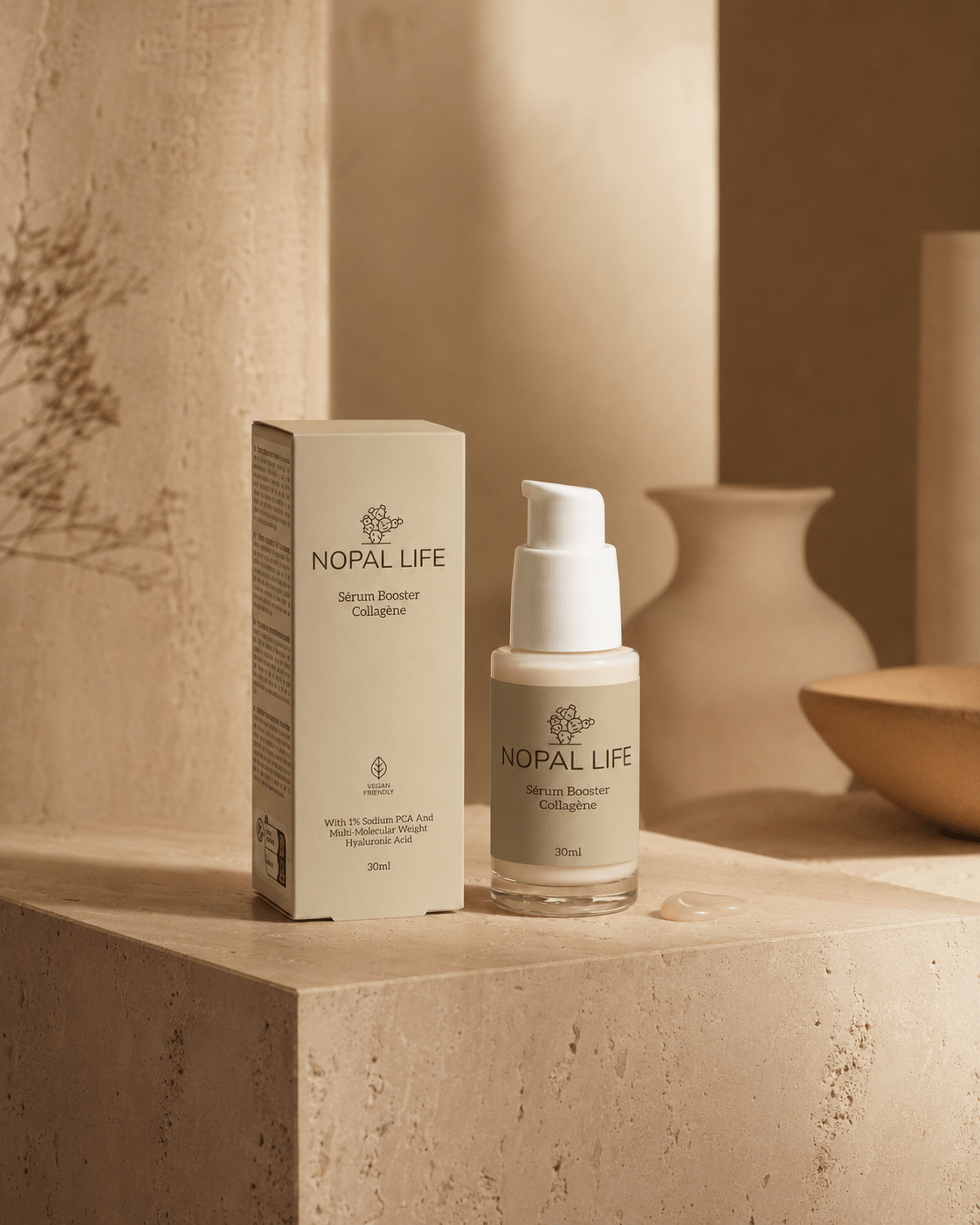
"Collagen Booster." This phrase has no regulatory definition. It refers equally to a supply of vitamin C, a silica-rich bamboo extract, or a cream with biomimetic peptides. When you read "booster" on a bottle, look for the specific ingredient that carries the promise, and its rank in the INCI list. Without this information, the formula is only as good as the slogan.
"Stimulate production." This formulation belongs to the commercial register, not to that of a cosmetic claim acceptable in Europe: a locally applied product is not supposed to modify a physiological function, otherwise it would change regulatory category. Cosmetics work on the appearance and comfort of the surface.
"Plant-based collagen." This does not exist: it is an exclusively animal protein, which no plant produces. These products contain plant proteins, vitamin C, sometimes silica — potentially useful, but of a completely different nature.
Skincare or food supplements: an honest comparison
| Criterion | Topical route (skincare) | Oral route |
|---|---|---|
| What is affected | Surface, hydrolipidic film, immediate appearance | Amino acid supply to the entire body |
| First perceptible change | 3 to 7 days (comfort, dehydration fine lines) | Minimum 8 to 12 weeks |
| Daily routine | 2 applications, approx. 2 minutes each | 1 intake, 30 seconds |
| Reversibility upon discontinuation | Rapid, a few days | Gradual, over several weeks |
| What brings the most benefit | Selected oils, vitamin C, hyaluronic acid, retinoids, SPF | Consistency and duration, rather than dose |
On the skincare side, the active ingredients that are generally agreed upon for firm and smooth skin are few: cosmetic retinoids, stabilized vitamin C, biomimetic peptides, low-concentration AHAs, hyaluronic acid — and, underneath all this, daily sun protection, the best effort-to-result ratio on the list.
The Nopal Life 12-week protocol for mature dry skin
Here is the framework we recommend for those concerned. It is intentionally short: consistency over three months makes the difference, not product stacking.
| Period | Morning | Evening | Oral intake | What to observe |
|---|---|---|---|---|
| Days 1 to 14 | Lotion on damp skin, 3 drops of prickly pear seed oil, 30 seconds of warm palm pressure, then SPF 30 | 4 drops of prickly pear seed oil on still damp skin | 2.5 g marine peptides, in the morning, at a fixed time | Comfort, reduced tightness, less visible dehydration fine lines |
| Weeks 3 to 6 | Add a vitamin C serum before oil, on well-hydrated skin. SPF 30 maintained | Same, 2 evenings a week with a richer balm on dry areas | Increase to 5 g/day | Brighter complexion, more even skin texture |
| Weeks 7 to 12 | Stabilized routine, no new additions | Renewing active ingredient 2 evenings per week, never the same evening as vitamin C | 5 g/day maintained, without interruption | The window where suppleness and rebound are best appreciated |
Photo benchmark
Three photos on day 1: front, 45° left, 45° right. Same room, same time, indirect natural light, without makeup, at 40 cm.
Two reminders
Take the same series in week 6 then in week 12. The daily mirror shows nothing: the eye adapts, the photo does not.
One variable at a time
Don't start four new things the same week, otherwise you'll never know which one made a difference.
Hesitating about the order of products or the textures suitable for your profile? Our free Skin Intelligence diagnostic builds the exact sequence, morning and evening, according to your profile and climate.
Where prickly pear seed oil stands
Let's be precise, because this is the kind of topic where brands tend to exaggerate: a vegetable oil does not produce anything inside the dermis. What it provides falls into another category, equally crucial for daily life — the quality of the surface film, the softness to the touch, the reduction of water loss, the nourished and radiant appearance.
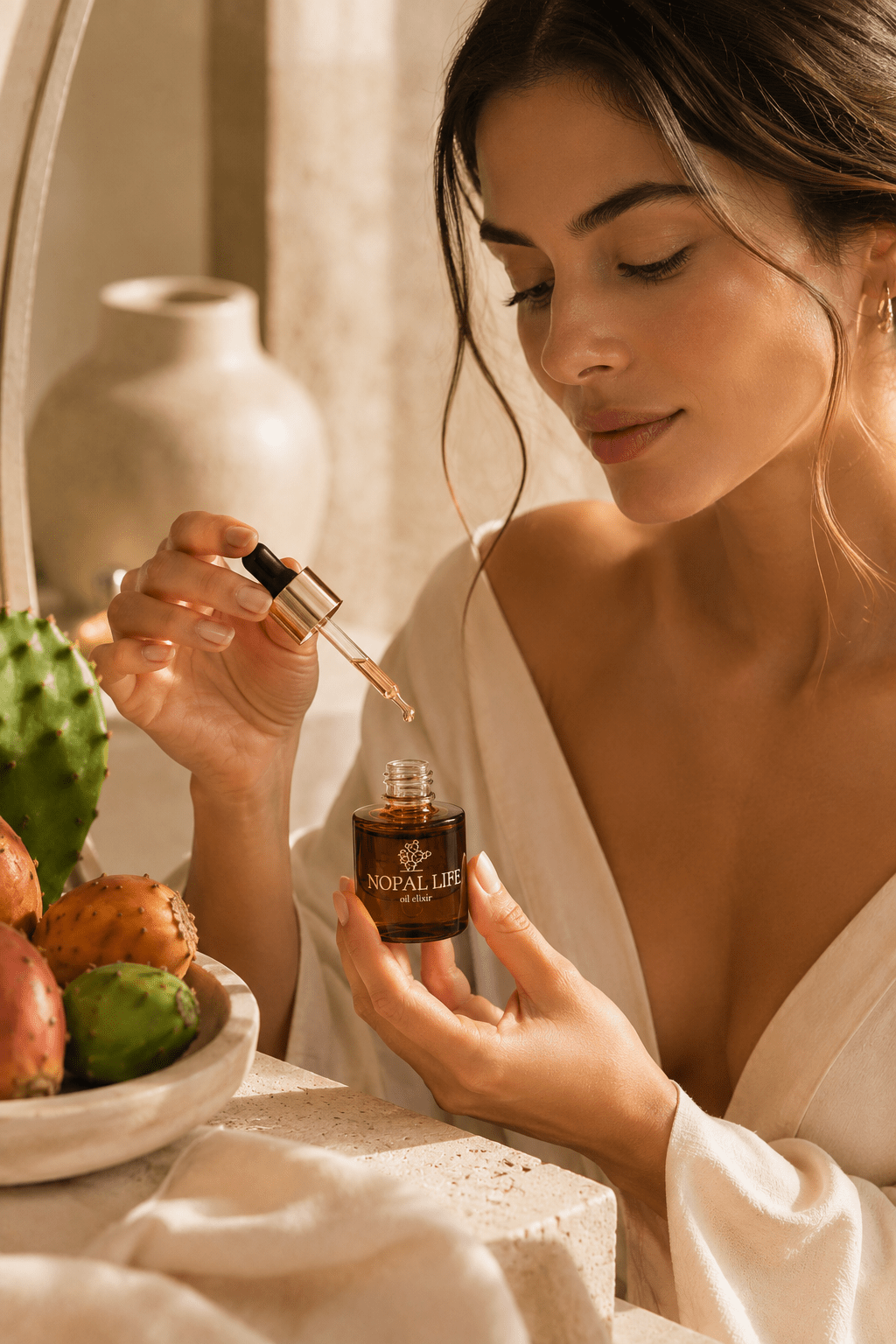
Prickly pear seed oil, in this regard, presents a documented and unusual profile: published analyses of Opuntia ficus-indica seed oil report a linoleic acid fraction close to 60% of total fatty acids, supplemented by oleic acid, and tocopherol and plant sterol contents significantly higher than those of most common cosmetic oils (Ramadan M.F. & Mörsel J.-T., Food Chemistry, 2003). Linoleic acid is precisely the fatty acid that dry skin is most often depleted of on the surface.
Yield explains the rest: it takes about one ton of fruit to obtain one liter of oil. Hence, use is by the drop — three in the morning, four in the evening are enough for the whole face — and not by the dollop.
Firmness by age: what changes at 30, 40 and 50
| Age group | What changes first | Skincare priority | Oral intake: relevance |
|---|---|---|---|
| 25 – 35 years | First expression lines, uneven complexion after a short night | Daily SPF 30, hydration, vitamin C | Low: diet is usually sufficient |
| 35 – 45 years old | Less bounce upon waking, less defined oval, established dryness | Oils rich in linoleic acid, progressive renewing active ingredients | Interesting: age group for most studies |
| 45 – 55 years old | Pronounced dryness, more defined wrinkles, skin that appears thinner | Nourishing textures, serum then oil, never harsh cleansing | Strong: twelve weeks of regularity makes perfect sense |
| 55 years and older | Comfort first: tightness, discomfort after showering, dull complexion | Balms and oils, short and gentle movements, sun protection all year round | Strong, with a sufficiently rich diet |
A rarely written point deserves to be said: after a certain age, the variable that most influences appearance is neither the brand of cream nor the origin of the powder, but the history of sun exposure. Nothing can make up for thirty years of sun without protection; however, the SPF applied this morning still counts, at all times.
Six quality criteria to check on the shelf
| Criterion | What to read on the box | Warning sign |
|---|---|---|
| Molecular weight | A numerical value in daltons, ideally < 3,000 | No value indicated |
| Dose per serving | At least 2.5 g per serving, to easily reach the 5 g/day benchmark | 400 mg per unit, meaning twelve servings to reach 5 g |
| Origin and traceability | Species or sector, country of processing, identifiable ingredient | Generic mention without any specific details |
| List of ingredients | Short: peptides, possibly vitamin C, a flavor | Fifteen active ingredients at symbolic doses |
| Price per effective gram | Price divided by the grams actually provided over 12 weeks | Comparison made to the price of the box |
| Tone of discourse | Measured formulations, realistic durations | "Wrinkles erased in 15 days" |
Realistic effects: what to expect, and what not to expect
The beauty of commercial discourse is inversely proportional to the precision of the announced results. Let's put expectations in perspective. The available work on collagen describes changes in laboratory-measured parameters — hydration, elasticity, appearance of fine lines — in a portion of the monitored individuals, after several weeks. The effects are therefore real but gradual, and efficacy varies greatly from person to person depending on the individual's characteristics, diet, and lifestyle.
What can reasonably be expected from a collagen regimen: a more lasting sensation of hydration, a more rested complexion, less tightness at the end of the day, and over three months, a more supple appearance. What no product in this family will do: erase an established wrinkle, reshape an oval, or replace sun protection. A brand that promises this is primarily telling you about its relationship with the truth — and that's an excellent selection criterion.
Five habits that matter as much as the product
No powder or treatment can compensate for an unfavorable environment. Here are the tips that, in our experience, make the biggest difference to the appearance of the complexion in the medium term.
- Get enough sleep. Night is the body's recovery window. Chronic sleep debt shows on the complexion before it shows elsewhere.
- Avoid tobacco. Smoking is one of the best-documented factors for earlier visible skin aging, all else being equal.
- Get enough protein. Without raw material, no peptide intake can compensate for a poor diet. Aim for approximately 0.8 to 1 g of protein per kilogram of body weight per day for adults.
- Move. Regular physical activity supports microcirculation and the overall quality of the body's supportive tissues.
- Protect yourself from the sun all year round. This is the only action whose effect on appearance is visible over decades. No other expense item has this return.
The seven mistakes that cause a treatment to fail
1 — Buying a non-hydrolyzed native form. A whole molecule of 300,000 Da does not do the expected job: look for "hydrolysate" or "peptides," with a numerical molecular weight.
2 — Stopping before eight weeks. The most costly mistake: it turns a reasonable investment into a completely wasted expense.
3 — Taking an articular formula for facial care. It has no reason to change its appearance.
4 — Applying a vitamin C serum to dry, unprepared skin. First dampen – with mist, lotion, or while the face is still damp after cleansing. Comfort changes completely.
5 — Neglecting sun protection. Without a minimum SPF 30 daily, the rest of the routine is working against the current.
6 — Relying on the word "booster" without checking the ingredient. A formula that claims to boost something without naming the active ingredient or its place in the INCI list is selling a slogan.
7 — Changing products every three weeks. Choose a short routine, stick to it for twelve weeks, judge by photos.
Our selection tips, in summary
Let's summarize the criteria that guide our recommendations when asked for an opinion on a commercial collagen product. First selection criterion: transparency on origin and manufacturing process. Second: consistency between the advertised promise and what scientific studies actually show — many formulas borrow research vocabulary without having the results. Third: simplicity, two or three well-dosed active ingredients are better than fifteen symbolic ones. This choice does more for apparent firmness than a spectacular bottle.
In terms of firmness, let's keep things in perspective. Published data describe measurable but gradual effects on hydration and suppleness; efficacy varies among individuals, and no results are immediate. Formulas that claim to stimulate fiber production, erase wrinkles, or rebuild tissues in fifteen days belong to advertising rhetoric, not scientific studies. In beauty as elsewhere, the quality of vocabulary does not replace the quality of results.
Finally, keep in mind that collagens do not form a homogeneous family: depending on the raw material and the tissue from which they come — dermis, cartilage, bone — they do not meet the same uses. One range designed for joints, another for nails, a third for firmness: three distinct selections, three budgets, three result timelines. It is by keeping these plans separate that useful choices are made, and that one stops paying for effects that will not be obtained.
FAQ
Q: When applied to the skin, does collagen penetrate?
A: Not in its whole form: 300,000 daltons do not cross the stratum corneum. Very low molecular weight peptides present in some creams also remain on the surface, where they form a moisturizing film appreciated for comfort and immediate smoothing. This is a real benefit, but of a cosmetic nature.
Q: What dose per day, and for how long?
A: Published trials cover a wide range, from 1 g/day for very low molecular weight peptides to 10 g/day for standard hydrolysates. The most consensual benchmark here is 5 g/day, maintained for 12 weeks without interruption — with, if you wish, an introduction at 2.5 g/day for the first two weeks, as detailed in the protocol above. Regularity matters more than the exact dose.
Q: On an empty stomach, in the morning or evening?
A: No solid data differentiates the best time to take it. Choose the time you won't forget. Peptides are soluble in cold or hot liquids, in lukewarm coffee, a glass of water, or yogurt.
Q: Marine or bovine for the face?
A: Marine collagen is richer in type I, which predominates in the dermis and is best represented in publications: it's the default choice. Bovine collagen provides the natural combination of types I and III and is suitable if you have a fish allergy. In both cases, the decisive criterion remains the announced molecular weight.
Q: Does the same powder also work for hair and joints?
A: Three distinct subjects. Hair is made of keratin; "for hair" claims are based on indirect reasoning. Joint comfort relies on another raw material, cartilage. A formula that promises all three at once communicates more than it targets.
Q: Does menopause change anything?
A: The hormonal changes of this period are often accompanied by skin that appears less dense and drier, especially in the early years. This is when a regular routine, combining surface comfort and consistent nutritional intake, makes the most sense. For any questions related to this period, a healthcare professional remains the relevant contact.
Q: Does prickly pear seed oil replace taking peptides?
A: No, and the reverse is also true. The oil works on the surface film, suppleness, and nourished appearance, with noticeable effects in a few days; the oral route works over three months and on a different level. Combining them covers two timescales.
Q: Powder or capsules?
A: It's a question of dosage. Many capsules provide 400 to 500 mg per unit: reaching 5 g daily would then mean swallowing ten or twelve, which isn't sustainable in the long run. Powder is almost always more rational for this need; capsules retain their interest for concentrated, low-dose forms, such as those aimed at joint comfort.
Q: What about brittle nails?
A: Nails, like hair, are made of keratin. "Beauty" products that combine the two rely on a supply of sulfur and zinc. This is plausible but indirect, and published results on this point are significantly thinner than on the skin. If fragility is marked and persistent, a health professional remains the right contact.
Our approach can be summarized in one sentence: few products, each justified. Pure prickly pear seed oil as a base for comfort and suppleness, a vitamin C serum for skin radiance, and non-negotiable daily sun protection. The rest — including the question of food supplements — depends on your diet and your choice, with the reading guidelines given above.
Sources: Proksch E. et al., Skin Pharmacology and Physiology, 2014; Asserin J. et al., Journal of Cosmetic Dermatology, 2015; Kim D.-U. et al., Nutrients, 2018; Ramadan M.F. & Mörsel J.-T., Food Chemistry, 2003; ANSES, nutritional reference values for the adult population; Regulation (EU) No 432/2012 on authorized health claims.
This content is for informational and educational purposes only; it does not replace medical advice, diagnosis, or dermatological consultation. In case of doubt or persistent skin problems, consult a qualified healthcare professional.
RECOMMENDED TREATMENT
Vitamin C 2% radiance & dark spots serum
In the morning, on damp skin · before oil
DISCOVER THIS TREATMENT →PERSONALIZED ROUTINE
Nopal Life Skin Intelligence™
Start my free diagnosis · 2 minutes
START MY DIAGNOSIS →Our anti-aging treatments