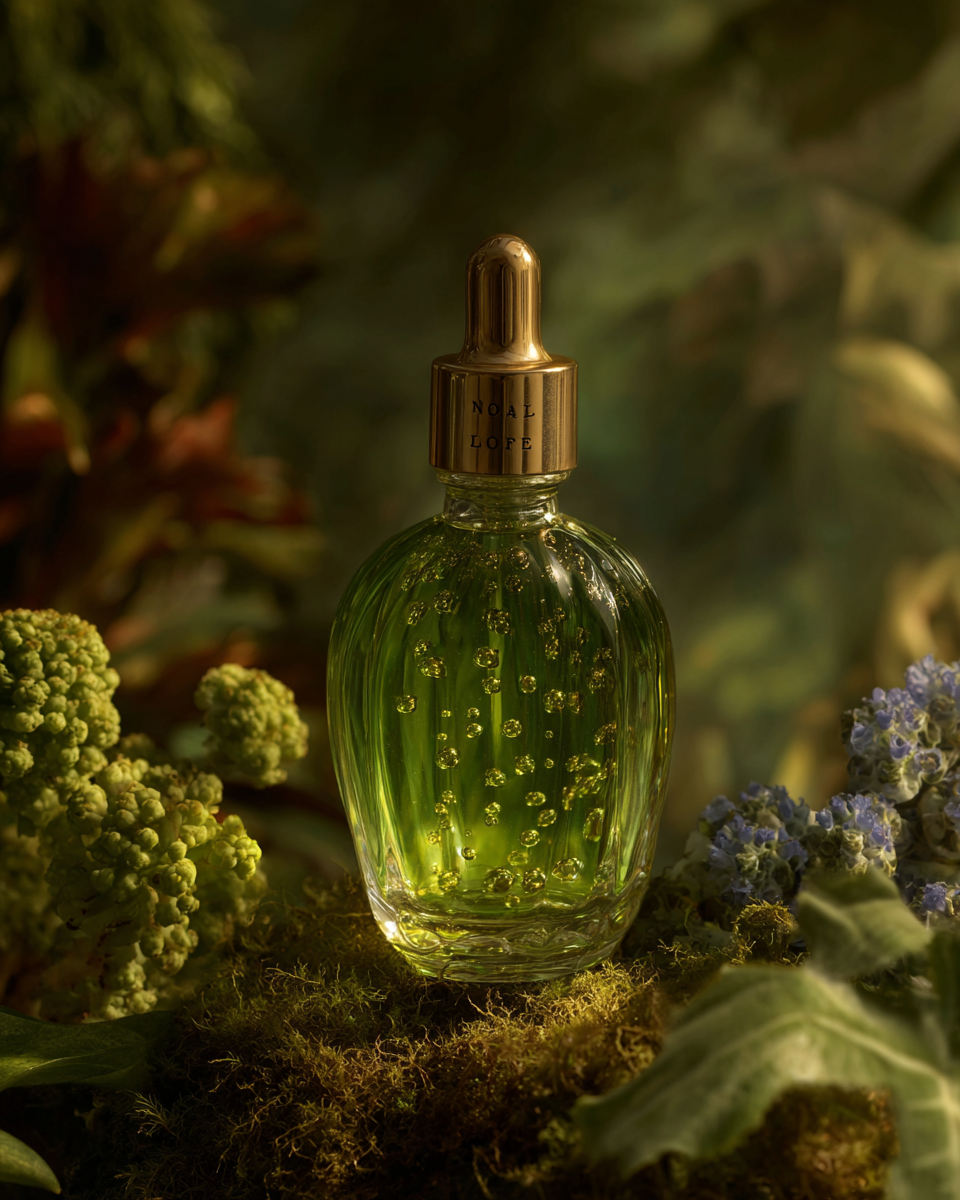
Vitamin C: what concentration and how many drops
Here, form dictates more than quantity. Two serums with the same percentage of vitamin C can act very differently, and knowing which one to choose comes before the question of drops.
The different forms, and what they change
Ascorbic acid is the pure and best-documented form. It is also the most unstable: it oxidizes in light, air, and heat. A serum that turns dark yellow then orange has lost most of its effectiveness, regardless of the number on the bottle.
Derivatives — ascorbyl glucoside, sodium or magnesium ascorbyl phosphate, ascorbyl tetraisopalmitate — are more stable and less potent. They require conversion by the skin. This is the first trade-off to make, and it is more important than the concentration.
The right concentration according to tolerance
10 to 15% ascorbic acid for accustomed skin. 5 to 8% for beginner skin. A neutral pH derivative for sensitive skin, where ascorbic acid stings. Above 20%, data shows no additional benefits and tolerance decreases.
An essential point rarely stated: ascorbic acid is only active below pH 3.5. This acidity explains the tingling of the most effective serums. A product that indicates neither its form nor its pH leaves both important questions unanswered.
How many drops, in practice
Three to four drops for the entire face, in the morning, on clean, dry skin. The rest goes on the back of the hands and the décolleté, two areas that get as much sun as the face and are systematically forgotten.
Applying more does not make it better: the skin only absorbs a limited amount, and the excess remains on the surface. This is true for all active ingredients, and particularly for an acidic active ingredient, where excess only causes discomfort.
What to combine, and in what order
Vitamin C first on clean skin, one minute wait, then hyaluronic acid, then a cream, then sunscreen. The order goes from thinnest to thickest and is not debatable.
The incompatibility sometimes read with niacinamide comes from a reaction observed when hot in the laboratory, with no equivalent on the skin at ordinary temperatures. Spacing them by one minute is more than enough.
Storing a fragile product
Opaque bottle, airless pump preferably, in a cool place, closed immediately. Three months after opening for an ascorbic acid, longer for a derivative. Color is the best indicator: beyond straw yellow, discard.
This is why a small, finished bottle is better than a large, half-oxidized one. The oxidative stress that vitamin C is supposed to limit eventually affects it itself.
What the dosage does not change
The indications remain the same at all concentrations: complexion radiance, evenness, and appearance of spots, over eight to twelve weeks. No dose affects established wrinkles.
Our radiance serum concentrated with vitamin C is formulated with this logic, and the vitamin C page details the available forms.
How vitamin C really works on the skin
Its antioxidant action consists of donating an electron to unstable molecules — free radicals — before they reach the surface lipids. This is what makes it useful in the morning, when exposure begins.
It also acts as a cofactor in collagen synthesis, a long-established biochemical fact. What this produces through a cream is more modest than what advertising makes of it, and distinguishing this avoids disappointed expectations.
The different forms of vitamin C, compared
Ascorbic acid is the most effective and the most difficult to work with: active only below pH 3.5, it stings and oxidizes in air and light. This is the reference on which all serious studies have been conducted.
Ascorbyl glucoside is stable, gentle, and requires conversion by the skin. Sodium or magnesium ascorbyl phosphate works at neutral pH and is suitable for reactive skin. Ascorbyl tetraisopalmitate is fat-soluble, thus compatible with oily textures. These forms are not discount vitamin C: they are different compromises between effectiveness and tolerance.
Should the concentration be increased over time?
Not necessarily. Skin that tolerates 10% and gets results has no reason to switch to 20%. The optimal concentration is one that produces an effect without discomfort, and it varies from person to person more than it depends on a rule.
If you want to increase, do so in three-month increments and never at the same time as another routine change. Otherwise, in case of a reaction, nothing is identifiable.
The price, and what it pays for
A vitamin C serum is expensive for three reasons: stable raw material is costly, packaging must protect from air and light, and low pH formulation requires know-how. A very cheap product has cut corners on one of the three.
This is no reason to pay any price. Beyond a certain threshold, you are paying for the brand: the ingredients that make a difference are all listed on the label and can be compared.
Tips for a consistent routine
In the morning, after cleansing, before moisturizing and sunscreen. Every day rather than in courses: the effects set in over eight to twelve weeks and disappear if you stop. Photographing your face every four weeks, at the same time and in the same place, provides an answer that the daily mirror never gives.
The "What concentration, how many drops" series
The right dose is not a guess: it depends on the ingredient, its form, and the skin type. This series covers each active ingredient one by one.


Go further than this article
Get our skincare guides by email — and start with your free skin diagnostic: 2 minutes, advice tailored to your skin. We ship to the US, UK, Canada, Australia and 27 European countries; somewhere else? Sign up and you will be the first to know when we deliver to your country.
By signing up, you agree to our privacy policy. Unsubscribe in one click.