



Sea buckthorn oil: what concentration and how many drops
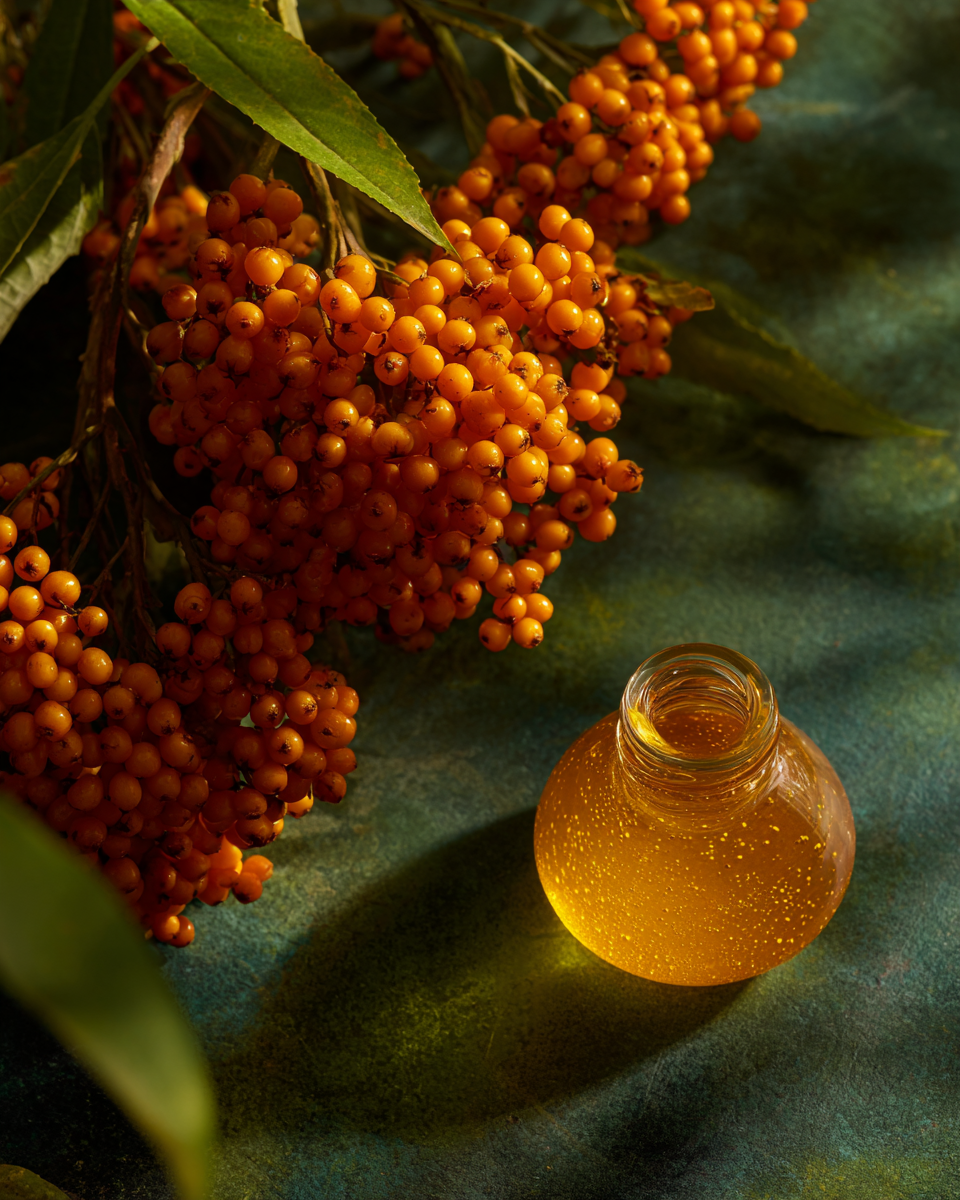
Pure on the body, diluted to one-fifth on the face. Sea buckthorn oil is one of the few vegetable oils that cannot be reasoned in drops: its intense orange color visibly stains the skin and textiles. The question of dosage therefore becomes a question of ratio, and that's what follows.
Two oils under one name
Sea buckthorn berries yield two very different oils, and confusion is constant. Pulp oil, dark orange, concentrates carotenoids and omega-7. Seed oil, lighter, is rich in omega-3 and omega-6.
On the label: Hippophae rhamnoides fruit oil for the pulp, Hippophae rhamnoides seed oil for the seeds. These are not the same products and are not dosed the same way.
Pulp oil is the most concentrated in pigments, thus the most restrictive to use. It is also the one whose skin benefits are most often highlighted.
Seed oil is dosed like an ordinary vegetable oil, in drops, without coloring problems. If the color puts you off, this is the one to look for.
Both oils come from the same berry and share similar properties. Both are rich in unsaturated fatty acids, and both contain naturally occurring vitamin E, which protects them from oxidation.
Sea buckthorn oil is used in cosmetics for these natural compounds as much as for its richness in omega-7, rare in the plant kingdom. Its contribution to hydration remains indirect: like any oil, it retains water rather than providing it.
Sea buckthorn on the face: 1 drop for 4
One drop of sea buckthorn oil for four drops of a neutral oil — jojoba, sweet almond, squalane. This is a 20% dilution, which no longer visibly colors.
This proportion retains the essential interest of the product. A highly concentrated carotenoid oil does not need to be applied pure to be effective.
On fair skin, reduce to one drop for six if an orange tint persists. On olive or dark skin, this is not an issue and you can increase to one for three.
Only in the evening. Carotenoids degrade in light, and the colored deposit does not hold well under makeup.
Sea buckthorn on the body: pure, without counting
The color is much less of a problem on covered areas. Pure sea buckthorn oil can be applied to elbows, knees, heels, and hands.
Be careful with light sheets and clothes: the stain is stubborn. Apply in the evening, allowing it to penetrate before bed, or in the morning before dressing.
Over a large area, dilution becomes interesting again for reasons of cost as well as color. This oil is expensive and its targeted use is more reasonable.
In a commercial cream: the question no longer arises
A cream enriched with sea buckthorn generally contains less than 5% oil. It does not color, and it is dosed like any cream.
This is the simplest solution for those who want the benefits of this plant without the constraint. The benefit is less than with a pure oil diluted by oneself, but the convenience is greater.
Check the ingredient's position in the list. Sea buckthorn placed after preservatives is present at a concentration that will not make a difference.
What the concentration of sea buckthorn actually provides
Sea buckthorn oil owes its interest to three things. Its richness in omega-7, a rare fatty acid that few vegetable oils contain. Its carotenoid content, which gives it its color. And its vitamin E, which protects it from oxidation.
These compounds are present in sufficient quantities for a 20% dilution to remain active. Doubling the dose does not double the effect.
The berries themselves are also very rich in vitamin C, but this vitamin remains in the juice: the oil does not contain any. This is a common and harmless confusion.
French and European production of sea buckthorn oil has developed with the cultivation of the shrub in France, Germany, and the Baltic countries. Oil from these cultures is generally fresher than imported oil.
The fatty acids and natural compounds it contains remain the same regardless of origin. What changes is the pressing date — and for an oil so rich in carotenoids, this freshness matters.
The fruit and the oil, two subjects
Sea buckthorn fruits are consumed as juice, jam, or supplement. This consumption is nutritional and has no relation to the topical use of the oil.
Use on mucous membranes, sometimes mentioned for this plant, falls outside the cosmetic domain and requires medical advice. This page only deals with application to the skin.
The cultivation of sea buckthorn, a hardy shrub from coastal and mountainous areas, explains the increasing availability of the oil. European production has developed in recent years.
What dosage doesn't change
Applying to damp skin remains the rule. Oil retains existing water; it does not provide any, regardless of dilution.
No concentration protects from the sun, despite the carotenoid content. No vegetable oil filters UV rays.
And oxidized sea buckthorn oil is no longer useful, diluted or not. Six to twelve months after opening, kept cool and away from light.
The "What concentration, how many drops" series
The right dose isn't guessed: it depends on the ingredient, its form, and skin type. This series covers each active ingredient one by one.


Go further than this article
Get our skincare guides by email — and start with your free skin diagnostic: 2 minutes, advice tailored to your skin. We ship to the US, UK, Canada, Australia and 27 European countries; somewhere else? Sign up and you will be the first to know when we deliver to your country.
By signing up, you agree to our privacy policy. Unsubscribe in one click.

