Combining argan oil and shea butter: the method
These two fats complement each other in texture, not composition. Argan oil penetrates quickly and is suitable for the face; shea butter stays on the surface and works best on truly dry areas. Layering them makes sense on the body in winter, but rarely elsewhere.
Key points
- Order: argan oil first, then shea butter.
- Where: body and rough areas.
- When: on damp skin, within three minutes after showering.
- Quantity: a pea-sized amount of butter per area.
- Season: mainly in winter.
What each brings
Argan oil is extracted from the kernels of the argan tree, native to southwestern Morocco. Rich in oleic and linoleic acid, with a fraction of vitamin E, it nourishes without leaving a film and is suitable for both face and body.
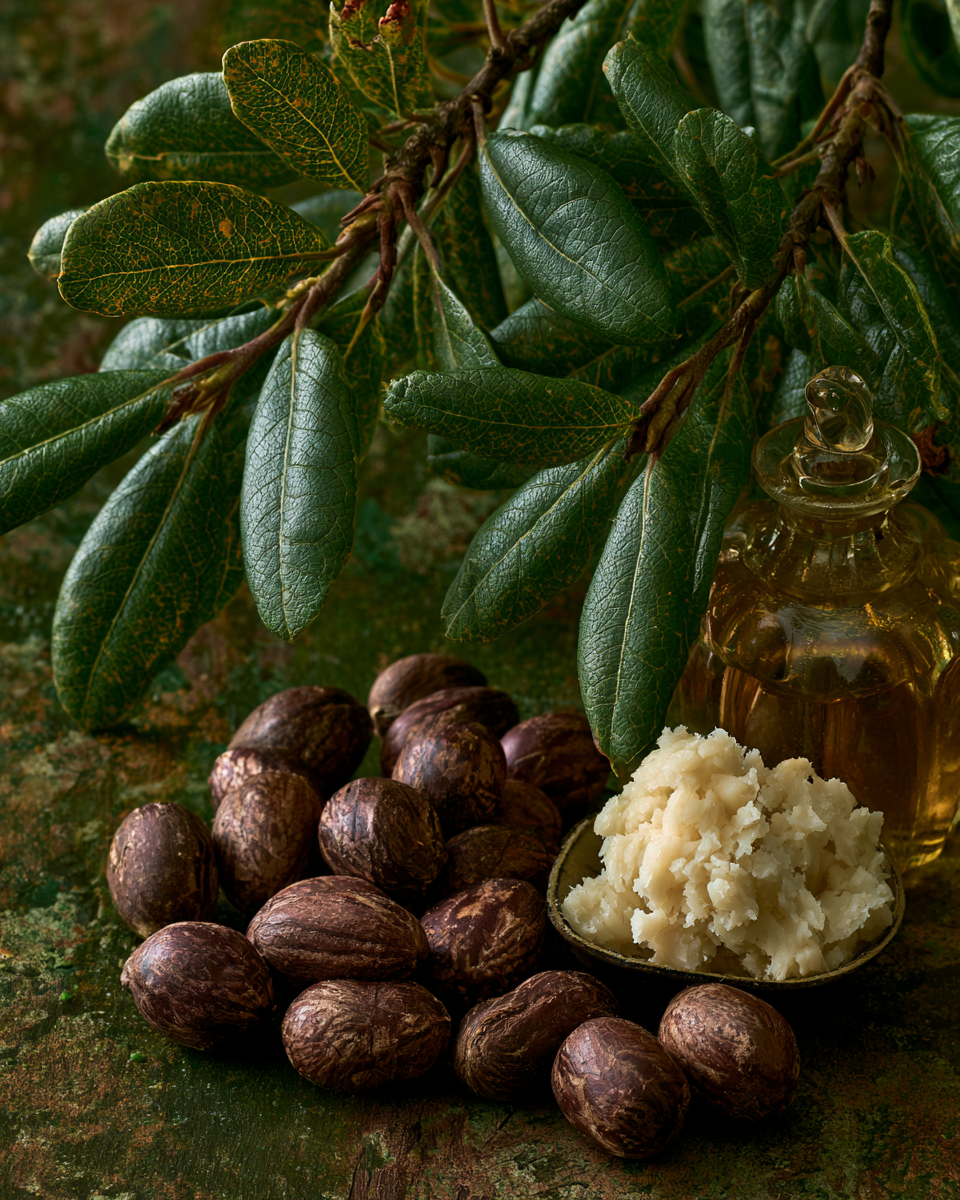
Shea butter comes from the nuts of Vitellaria paradoxa, a tree from West Africa. Solid at room temperature, it melts on contact with the skin. Its composition of oleic and stearic acid, with a fraction of unsaponifiables, makes it a nourishing and frankly occlusive treatment.
Using both therefore means applying a product that penetrates, then a product that seals. This is the only logic that justifies layering them, and it's not universally applicable.
Argan oil penetrates, shea butter covers. This is the whole logic of the combination: one nourishes at a relative depth, the other forms a film that limits evaporation.
Raw, unrefined shea butter retains its unsaponifiables; organic shea butter retains as many without additives. On sensitive skin, this raw version is better tolerated than scented versions, and its protective effect against external aggressions is most noticeable in winter.
The order and application
The thinnest first, always. Argan oil penetrates in a few minutes; shea butter, applied over it, forms the layer that limits evaporation.
Reversing the order would create an occlusive barrier that the oil would have to overcome. It wouldn't succeed, and the first application would be wasted.
Apply to damp skin: these fats retain the skin's water, they don't provide it. On the body, the useful window is narrow—the three minutes following a shower. After this time, there's not much left to retain, and the treatment becomes a simple greasy film.
Oil first, then butter: from thinnest to richest, as always. Warm the shea butter between your palms until it becomes translucent before applying it.
On the face, dab; on the body, spread widely. This gesture changes the result more than the choice of brands, and this is true even for sensitive skin where there is a tendency to press too hard.
Where this combination works, and where to avoid it
It works on the body in winter, on chapped hands, elbows, and heels. A moisturizing treatment beforehand, argan oil, then a pea-sized amount of shea butter on the roughest areas.
On the face, it is limited to dry areas and very small quantities. Mixed or oily skin will not tolerate it well: shea butter is too heavy, and argan oil alone is largely sufficient.
Under makeup or sunscreen, also avoid it. The texture won't combine well and the result will be uncomfortable—save the butter for the evening.
It works on the body, hands, and dry areas of the face. It should be avoided on the T-zone, where it shines: shea butter is too occlusive there, regardless of the quantity.
For sensitive skin, test each product separately first. Unscented organic shea butter almost always works; it is argan oil, more rarely, that can cause a reaction in people sensitive to tree nuts.
Quantities, and the most common mistake
Two to three drops of argan oil for the face, more for the body. A pea-sized amount of shea butter per area: one knee, two hands, one elbow.
Shea butter melts and spreads a lot. Excess remains sticky for an hour and ends up on clothes—this is the most common mistake with this product, and it often discourages people from using it again.
The right amount is that which has disappeared after two to three minutes. Beyond that, you've applied too much, regardless of your skin type.
Two drops of argan oil, a pea-sized amount of shea butter for the face. The most common mistake is to reverse the proportions: excess shea butter remains on the surface and stains the pillow.
On the body, the logic is reversed and shea butter dominates. This combination of argan oil and shea butter should therefore be adjusted by area, never by a single recipe applied everywhere.
Choosing the right products
For argan oil: first cold press, unrefined, dark bottle. Only one name on the label, Argania spinosa kernel oil. Cosmetic pressing is done on raw kernels; a toasted hazelnut scent indicates a cooking oil.
For shea butter: unrefined preferably, ivory color, slightly smoky smell. Perfectly white and odorless butter has been refined, which removes some of its unsaponifiables. Look for Butyrospermum parkii butter.
Pre-made blends exist and are easier to apply. In this case, check the proportions in the ingredient list, where the order is decreasing.
For argan: cold-pressed, virgin, unrefined. For shea: raw or organic, with its characteristic nutty smell—a neutral smell indicates a treatment that has removed some of the useful compounds.
Raw shea butter sometimes crystallizes into small grains. This is not a defect but a sign of authenticity: they melt between the fingers and disappear quickly upon application.
Storage
Argan oil lasts twelve to eighteen months after opening, away from light. Shea butter lasts one to two years, away from heat.
A grainy butter has not gone bad: it's recrystallization due to temperature variations, which disappears when warmed between the hands. A rancid or pungent odor, however, indicates a product to be discarded.
Limitations of this routine
It nourishes and protects, without acting on wrinkles, spots, or deep texture. These are comfort treatments, and that is their entire role.
It does not protect against radiation, despite what is written about the natural indices of shea butter. Daily sun protection remains essential.
Neither provides water. On dehydrated skin, this combination applied alone seals a deficiency instead of compensating for it—an aqueous serum underneath is not optional.
And neither protects from the sun. This is the most important limitation, and the one most easily forgotten due to the rich texture.
When to consult
These products are cosmetics and improve skin comfort without treating conditions. Deep chapping, fissures, or dryness that resists suitable care warrant medical advice.
PERSONALIZED ROUTINE
Nopal Life Skin Intelligence™
Free diagnostic · 2 minutes
DISCOVER MY ROUTINE →


Go further than this article
Get our skincare guides by email — and start with your free skin diagnostic: 2 minutes, advice tailored to your skin. We ship to the US, UK, Canada, Australia and 27 European countries; somewhere else? Sign up and you will be the first to know when we deliver to your country.
By signing up, you agree to our privacy policy. Unsubscribe in one click.