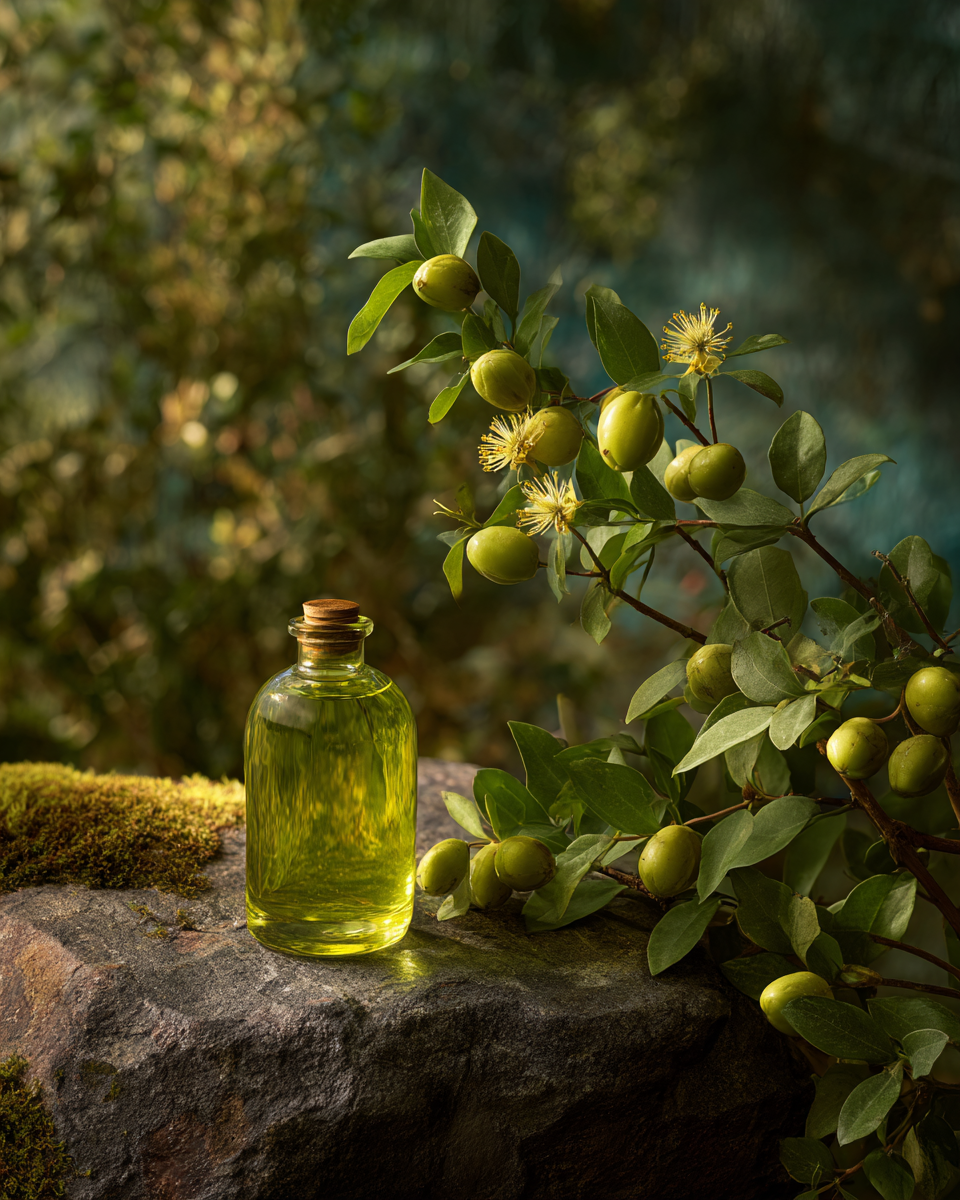
Jojoba Oil or Ceramides: Which One for Your Skin?
Jojoba oil mimics sebum, while ceramides are part of the skin. This is a difference of nature, not degree: jojoba oil sits on the surface, ceramides fill a deficit in the very structure of the outer layer.
Comparison
| Criteria | Jojoba Oil | Ceramides |
|---|---|---|
| Nature | liquid wax, esters | structural lipids |
| Role | seals, softens | cohesion, repair |
| Effect | immediate | a few days |
| Uses | face, body, hair | face, body |
| Shelf life | very long | 6 to 12 months |
What Jojoba Oil Is
Jojoba oil is extracted from the seeds of Simmondsia chinensis, a shrub from the arid regions of North America, also cultivated in Argentina and Israel. It is not composed of triglycerides like other vegetable oils, but of wax esters.
This chemical characteristic makes it similar to human sebum, which explains its remarkable tolerance and lightness. Jojoba oil penetrates well, leaves a barely waxy feel, and practically does not go rancid—a bottle can be kept for years.
It provides a fraction of vitamin E and is suitable for the face, body, and hair. It is one of the most versatile vegetable oils, and one of the rare ones that oily skin tolerates without difficulty.
What jojoba oil does not do is also worth mentioning: it provides practically no essential fatty acids, unlike argan oil or rosehip oil. Its esters belong to a different chemical family.
Jojoba oil also stands out for its stability. Where most vegetable oils go rancid in twelve to eighteen months, a bottle of jojoba oil can be kept for years without its quality deteriorating. This is a real practical advantage: the product purchased is the product used until the end.
Its price remains moderate relative to this duration. Two to three drops of oil per day make thirty milliliters last several months, and use on hair or body requires little more.
Jojoba grows in the deserts of the American Southwest and northern Mexico, where it withstands considerable temperature fluctuations. Its cultivation has spread to Argentina, Peru, and Israel, on land unsuitable for other crops.
The seeds contain nearly half their weight in oil. Extraction is done by cold pressing, without solvent in serious cosmetic channels, and the high yield explains a contained price despite time-consuming cultivation.What Ceramides Are
Ceramides are lipids naturally present in the outermost layer of the skin, where they ensure cohesion between cells and retain water. They constitute the essence of what is called the skin's protective function.
Their quantity decreases with age, exposure to cold, aggressive cleansers, and the accumulation of exfoliating active ingredients. Skin that feels tight, reddens easily, or tolerates its usual products less and less often lacks them.
A product that provides them fills this deficit, and the effect is noticeable in a few days. This is what distinguishes them from jojoba oil: they repair, where jojoba oil simply covers.
The mentions you will read on labels refer to specific families. Ceramide NP is the most common in cosmetics, ceramide AP is involved in cohesion, and ceramide EOP in the impermeability of the outer layer. A formula that combines several covers more functions than a formula that contains only one.
Studies on skin describe a ratio of approximately three parts ceramides to one part cholesterol and one part fatty acids. The best-designed products approach this, and this explains why a complete cream performs better than an isolated supply.
This detail has a practical consequence: a product that advertises ceramides without cholesterol or fatty acids remains useful, but it works with one brick out of three.
Which one to choose
Oily or combination skin: jojoba oil, whose kinship with sebum is well tolerated.
Skin that feels tight, reddens, reacts to everything: ceramides, which treat the cause.
A single versatile product: jojoba oil, usable even on hair.
Skin damaged by winter or overly aggressive care: ceramides, without hesitation.
Tight budget: both remain accessible; jojoba oil lasts longer.
Using Them Together
This is the best option, and it costs nothing more. Ceramides cream first, jojoba oil as the last layer.
The order follows the textures: an oil applied beforehand would form a film that the cream would have to penetrate, and the ceramide input would be partially lost. A minute's wait between the two is sufficient.
Many creams already contain both. Then check that ceramides appear before preservatives in the ingredient list.
On oily skin, this combination has a particular advantage. The ceramide gel-cream repairs without weighing down, and jojoba oil seals without giving the film sensation that other vegetable oils leave. Few routines are as suitable for this skin type.
On dry skin, a richer cream and more oil will be needed. The principle does not change, only the thickness of each layer varies.
Hydration, two distinct mechanisms
A humectant attracts water to the surface, fats prevent it from leaving. Neither jojoba oil nor ceramides fall into the first category: they retain, they do not provide.
A hyaluronic acid serum applied to damp skin, before either, changes the hydration obtained completely. It is the most useful addition in a routine focused on oily care, and most often overlooked.
Failing that, simply apply to still soft skin after cleansing. The principle is the same and it costs nothing.
Skin hydration relies on the moisture it retains. Ceramides contribute to this retention by reconstituting the outer layer; jojoba oil contributes by covering it. The two mechanisms complement each other without being confused.
On dry skin, daily application of both gives better results than intensive application once a week. Regularity is key, here as elsewhere.
On Hair
Jojoba oil has a well-established use here, and its kinship with sebum makes it less heavy at the root than other vegetable oils. A few drops on the lengths and ends after washing, while hair is still damp.
On the scalp, it is one of the few oils that is well accepted. For a pre-shampoo oil treatment, leave on for an hour and wash thoroughly.
Ceramides are not used in this way on hair, although some hair care products claim to contain them. This is a practical advantage of jojoba oil, and it matters in the choice.
Jojoba oil is also used for makeup removal. Its kinship with sebum allows it to dissolve the fatty substances in makeup, including resistant formulas, without aggressing the skin like a foaming cleanser would.
A few drops of oil on dry skin, a one-minute massage, then a warm damp cloth. This method is suitable even for oily skin, which often reacts poorly to classic makeup removers.
On dry hair, jojoba oil is used in very small quantities on the ends. For curly or frizzy hair, which are more demanding, a more generous application on the lengths is justified, while hair is still damp.
The scalp accepts jojoba oil better than other vegetable oils, even when it produces a lot of sebum. A scalp massage with jojoba oil before shampooing, left on for an hour, is suitable for both oily and dry hair.
The properties that make jojoba oil useful for the skin are therefore also valid for hair: lightness, stability, affinity with sebum. Few oils cover these three uses.
How to Choose Your Products Well
For jojoba oil: Simmondsia chinensis seed oil, first cold pressing, dark bottle. Added essential oils do not provide anything useful and increase the risk of reaction.
For ceramides: ceramide NP, ceramide AP, ceramide EOP. A formula that combines several, with cholesterol and fatty acids, approaches the actual composition of the skin—this is the best sign of quality for this type of product.
Their Limitations
Neither acts on established wrinkles or spots. These are comfort and repair treatments, which is already a lot, but they do not transform the skin.
Neither protects against radiation. Daily sun protection remains essential, regardless of the care in your routine.
When to Consult
These products are cosmetics and act on the appearance of the skin without treating any condition. Skin that remains painful or inflamed despite appropriate care requires dermatological advice.
The Finish or the Mortar
Jojoba is a liquid wax very similar to sebum: it regulates the surface finish, which is sufficient for many combination skin types. A ceramide cream aims for something else, the cement between the cells—this is what is needed when the skin remains uncomfortable despite a well-tolerated oil.


Go further than this article
Get our skincare guides by email — and start with your free skin diagnostic: 2 minutes, advice tailored to your skin. We ship to the US, UK, Canada, Australia and 27 European countries; somewhere else? Sign up and you will be the first to know when we deliver to your country.
By signing up, you agree to our privacy policy. Unsubscribe in one click.