Hyaluronic acid or vitamin E: which one for your skin?
They work in two opposing phases, which is what makes them complementary. Hyaluronic acid is water-soluble: it retains water, up to several hundred times its weight. Vitamin E is fat-soluble: it protects the skin's lipids against free radicals. One hydrates, the other protects.
What separates them
| Criterion | Hyaluronic acid | Vitamin E |
|---|---|---|
| Solubility | water-soluble | fat-soluble |
| Role | retains water on the surface | antioxidant, protects lipids |
| Place in routine | serum, beginning | oils and creams, end |
| Perceived effect | fast, plumping effect | progressive, comfort |
| Condition | dehydration, fine lines | exposed skin, dryness |
What hyaluronic acid does
It retains water in the upper layers, which produces a visible plumping effect in a few days and reduces dehydration fine lines. Its action is superficial, reversible, and effective.
It must be sealed: applied alone in dry air, it can accentuate tightness instead of reducing it. A cream or vegetable oil on top solves the problem.
What vitamin E does
It is a fat-soluble antioxidant, naturally present in most vegetable oils. It protects skin lipids from oxidation caused by free radicals—those generated by exposure and pollution.
It also plays a role in the formula itself: added to an oil, it slows down rancidity. A prickly pear seed oil naturally contains a notable amount of it, in the form of tocopherols.
On the skin, its perceived effect is increased comfort and better tolerance to aggressions. Nothing spectacular in the short term, and real benefit over time.
Which one to choose
Dehydrated, tight-feeling skin, fine lines at the end of the day: hyaluronic acid.
Exposed, dry skin, prone to external aggressions: vitamin E, through a vegetable oil that naturally contains it.
When in doubt: both. They do not overlap in any way.
Combining them, which is the most common
The rule is that of all layering: aqueous before oily.
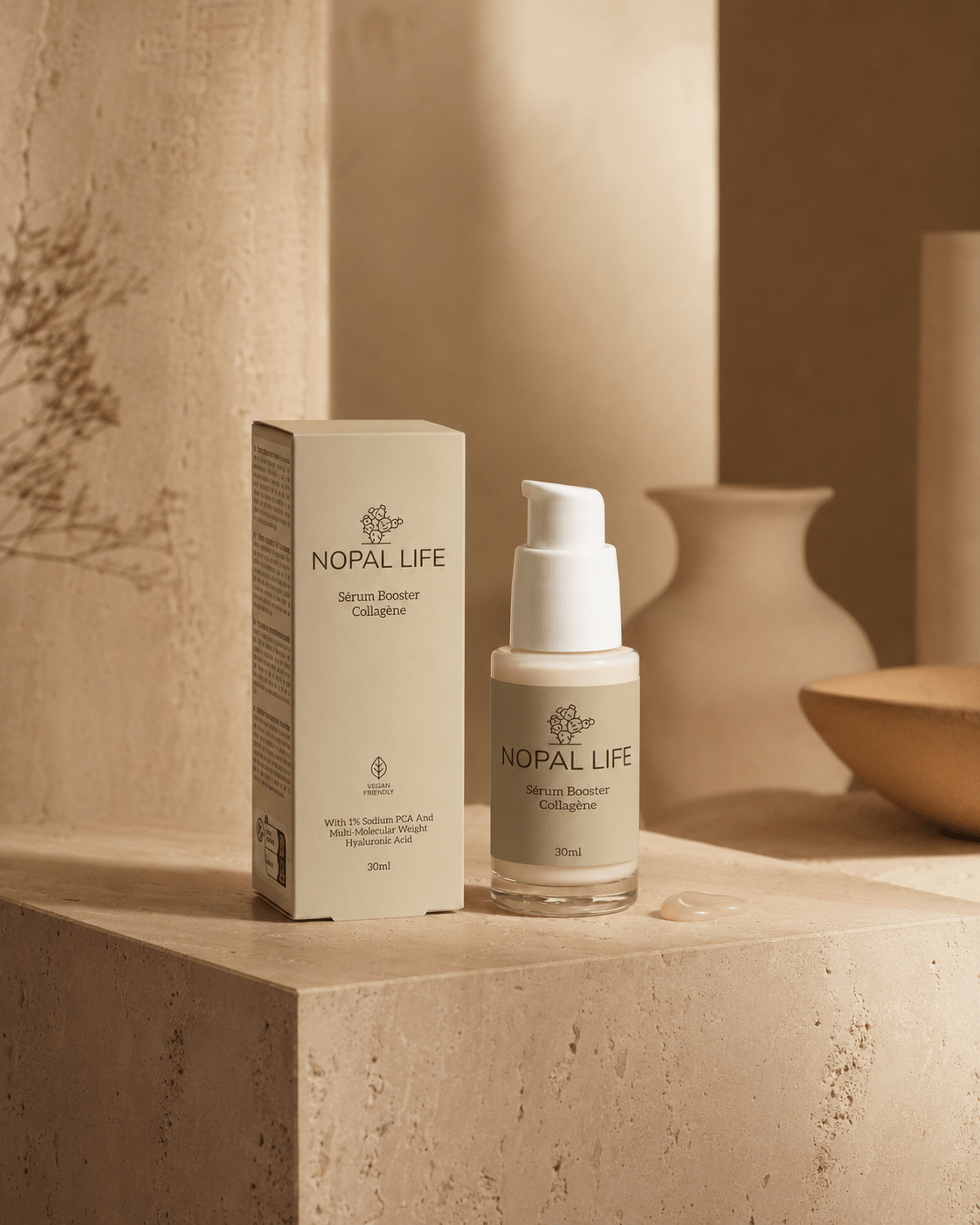
1. Hyaluronic acid serum on slightly damp skin.
2. Wait one minute.
3. A vegetable oil rich in vitamin E, or a cream that contains it.
The fatty substance then performs two functions at once: it seals the humectant and provides the antioxidant. This is the basis of a simple and effective anti-aging routine.
In what form to find vitamin E
Rarely alone. It is found in almost all vegetable oils, in varying quantities, and in many creams under the name tocopherol.
A cold-pressed oil retains more of it than a refined oil, as refining removes some of the minor compounds. This is one of the reasons why a virgin oil costs more—and is worth more.
On wrinkles and long-term effectiveness
Neither one erases established wrinkles. Hyaluronic acid reduces reversible fine lines; vitamin E supports the skin's defense against oxidative aggressions.
The most effective action against signs of aging remains daily sun care. Antioxidants are complementary; they never replace it.
What each does for the skin
The humectant can retain up to a thousand times its weight in water depending on its molecular weight, which explains the immediate plumping effect on fine lines. The antioxidant, on the other hand, retains nothing: it positions itself in the oily phase and neutralizes reactive species there before they damage cell membranes.
This difference in action has a practical consequence. The first improves the appearance of dehydration wrinkles in a few days; the second works in the background, with no immediate visible effect, and its benefit is judged over time.
Elasticity, density, and suppleness of the face
Skin elasticity depends on a network of fibers that oxidation gradually degrades. Well-hydrated skin appears more supple, but it is the fight against oxidative stress that preserves the underlying structure.
The two therefore complement each other over time: one for daily comfort, the other for what the skin will retain in ten years. This is also why there is no point in opposing them.
Concentrations and properties of formulas
A humectant-enriched serum is generally between 0.5 and 2%. Beyond that, the texture becomes sticky with no demonstrated gain. Tocopherol, on the other hand, is used at much lower concentrations, often below 1%, where it plays both an active role and a preservative role for the oily phase.
A high concentration is therefore not a criterion of quality. It is recommended to look at the consistency of the formula as a whole, and how the bottle protects it from light and air.
How to combine the two daily
The basis of a good routine is simple: cleanse without stripping, apply the humectant to still damp skin, then a fatty substance that provides the antioxidant. Both are easily applied morning and evening, and tolerate each other very well.
If your skin produces a lot of sebum, a tocopherol-enriched gel texture can advantageously replace oil without changing the logic. It's not the texture that matters, it's the order.
What one cannot do in place of the other
An antioxidant does not hydrate, and a humectant does not defend against oxidation. Confusing them leads to unbalanced routines: many aqueous serums on skin lacking lipids, or a lot of oil on skin lacking water.
The right approach is to identify what is missing before adding. Skin that feels tight after cleansing often lacks both at once.
What skin hydration changes for collagen production
Properly hydrated skin does not have more collagen than dry skin, but it retains what it has better. Oxidation and low-grade inflammation accelerate fiber degradation; limiting both slows down this loss.
This is where the anti-aging effect of the two ingredients converges, without either directly affecting synthesis. One maintains water balance, the other limits oxidative damage: natural production decreases anyway with age, so it's best not to add to it.
What results according to skin type
Skin type does not change the choice of active ingredients; it changes the texture that carries them. Dry skin regains comfort in a few days with a hyaluronic acid base sealed by an oil. Combination skin will achieve the same results with a gel-cream.
Also, the most exposed skin types—outdoors, high altitude, outdoor work—benefit most from the antioxidant component. The difference is not visible in the first month; it is seen over several years.
Two essential molecules, two roles not to be confused
It is important to keep the distinction in mind when purchasing. A serum enriched with hyaluronic acid and a product rich in tocopherols do not replace each other, even when both promise "radiance" and "skin beauty."
A routine that combines them covers the two essential daily needs of the skin: water and defense. The rest—targeted active ingredients, exfoliants, masks—comes on top, never in place of.
Limitations
These are cosmetics: their action affects the appearance and comfort of the skin, without curative intent. Skin that remains uncomfortable despite an adapted routine warrants dermatological advice.
Recognizing what's missing
Skin that feels tight upon waking lacks water; skin that feels rough to the touch lacks oil. For the former, a hyaluronic acid gel acts where the need is, and vitamin E would not change anything.
Our anti-aging treatments