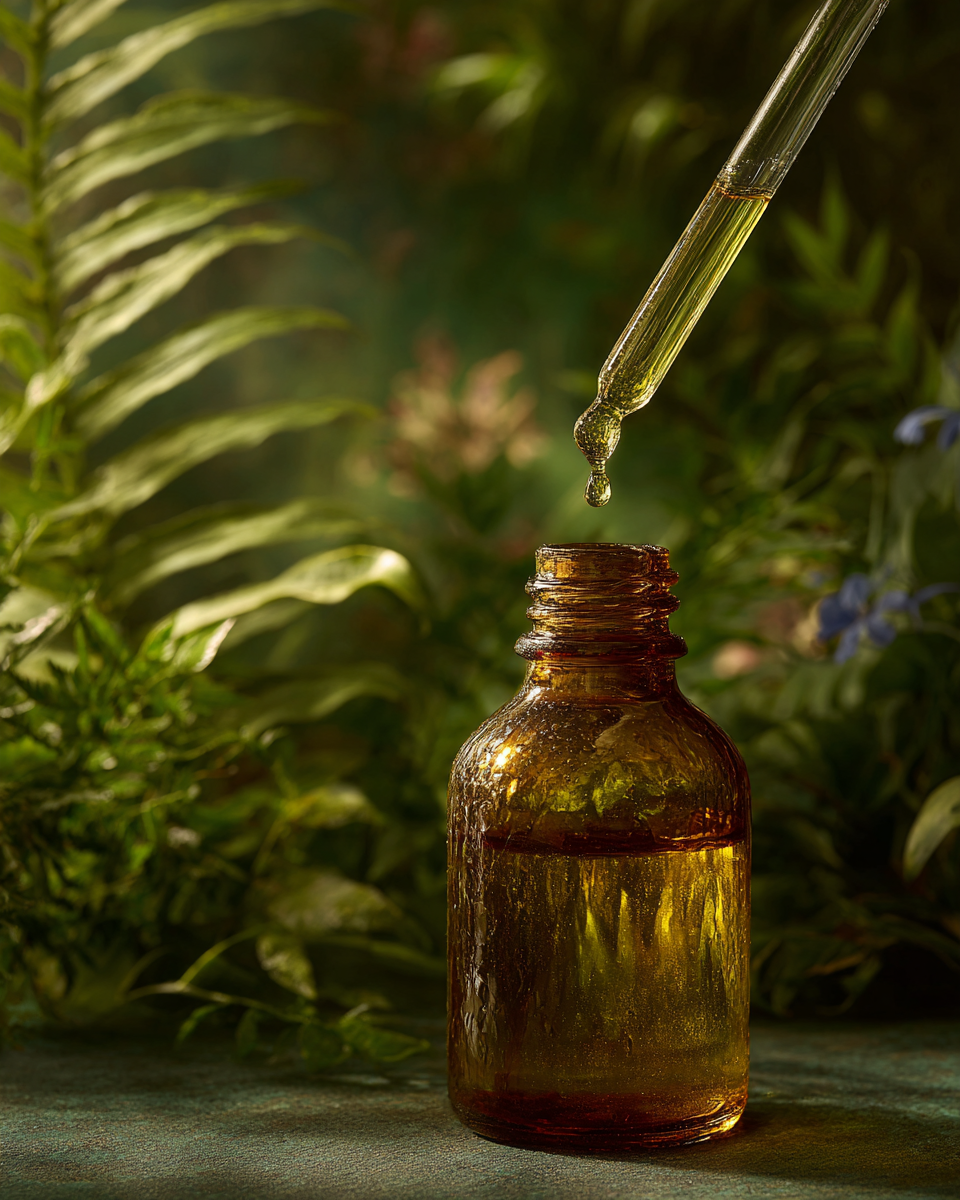
Combining Niacinamide and Shea Butter: The Method
The combination is simple because the two never intersect. Niacinamide works in the aqueous phase, at the very beginning of the routine; shea butter comes at the end. No interaction, no special precautions—just an order to follow.
The essentials
- Order: niacinamide serum first, then shea butter.
- Wait: one minute.
- Quantities: a few drops of serum, a small dab of butter.
- Use: daily, adjusting the last layer.
- Compatibility: complete.
Why this order
Shea butter is the most occlusive body in an ordinary routine. Placed underneath, it would prevent the serum from reaching the skin; placed on top, it seals everything that came before.
The rule applies everywhere: from the thinnest to the thickest, aqueous before oily. This is the only point of this protocol that tolerates no exceptions.
What niacinamide provides
It strengthens the skin barrier, which limits water loss and makes the skin less reactive. It also has a soothing effect, valuable for redness and damaged areas.
Finally, it acts on sebum production and on the uniformity of the complexion, with a slow effect: six to eight weeks of daily use before judging.
What shea butter provides
Surface protection, and soothing qualities derived from its unsaponifiable fraction. Rich in oleic and stearic acid, it effectively slows down evaporation.
It also soothes areas damaged by cold or friction, making it a benchmark natural ingredient in winter.
Both therefore have a soothing action, by different routes: one on function, the other on immediate comfort. This partial overlap is an advantage for irritated skin.
The protocol
1. Gentle cleansing, without completely drying the face.
2. The niacinamide serum, applied in a few spots then spread from the center outwards.
3. Wait one minute for it to penetrate.
4. A small amount of shea butter, warmed between the fingers until fluid, in a thin layer.
Butter applied cold remains in clumps. This prior warming changes the entire comfort of use.
According to your skin type
Sensitive skin: this is the clearest indication. Both soothe, and neither aggresses.
Dry skin: the complete combination, morning and evening.
Combination skin: serum everywhere, butter only on areas that feel tight.
Oily skin: keep the serum and replace the butter with a gel cream. The last step remains useful, only its texture changes.
Adjust to the season
This is the main advantage of two separate products. In winter, a more generous layer of shea butter; in summer, a simple light cream over the same serum.
Niacinamide, for its part, does not move. It is the constant basis of the routine, and it is what allows its long-term effectiveness to be judged without parasitic variables.
Morning and evening: two dosages
In the morning, reduce the butter to a minimal amount if you wear makeup, and finish with sun protection.
In the evening, nothing goes over it and the skin remains in contact with the treatments for a long time: you can be more generous.
On the body and difficult areas
The protocol is transposed as is. After showering, on still damp skin, serum on the areas that need it, then butter on top.
On elbows, heels and hands, apply in the evening and leave on overnight. Shea butter is difficult to compete with, at this price level.
On what timeframe to judge
Comfort returns from the first few days, thanks to the butter. The effect of niacinamide on skin texture, redness and complexion takes six to eight weeks.
Only change one parameter at a time during this period, otherwise the result will be unassignable.
The benefits of this daily combination
The benefits are mainly seen with use: more comfortable skin upon waking, less tightness after cleansing, and a slowly refining texture. These are fundamental ingredients, not products with a spectacular effect.
Shea butter, being a very simple natural fat, is suitable for almost all skin types on the body. On the face, its richness requires more discernment.
Strengthening skin rather than correcting it
The logic of this routine is to strengthen rather than correct. Daily niacinamide allows the skin to function better; a suitable fatty substance prevents it from losing what it retains.
This approach gives slower results than an aggressive active ingredient, and it never causes the setbacks that make you lose months. Over two years, it wins hands down.
What ingredients to avoid alongside
Nothing is really incompatible here, but two habits spoil the benefit. Piling on three different creams, which leaves a film without improving anything. And exfoliating too often, which undoes what the serum builds.
Regular and sober use is better than accumulation. This is true of this combination as of most routines.
A routine adapted to every stage of life
On young skin, the serum is often sufficient alone, with a fatty substance reserved for winter. On mature skin, where natural lipid production decreases, butter takes on a daily role.
The composition of the routine does not change; it is the dosage of the last layer that evolves. This continuity is what allows long-term effectiveness to be judged.
Limitations
This routine improves the comfort, suppleness and appearance of the skin. It is cosmetic and does not treat any condition. A persistent irritation justifies dermatological advice.
The Nopal Life signature treatment


Mature skin · Dry skin

Go further than this article
Get our skincare guides by email — and start with your free skin diagnostic: 2 minutes, advice tailored to your skin. We ship to the US, UK, Canada, Australia and 27 European countries; somewhere else? Sign up and you will be the first to know when we deliver to your country.
By signing up, you agree to our privacy policy. Unsubscribe in one click.